The new era of education and the future of work relies heavily on our ability to think in new ways (Creativity), do things in new ways (Innovation) and generate new value and opportunity (Entrepreneurship)
12 October 2017 – At 18 months-old, Sophia cannot walk, but she can understand speech and, at United Nations Headquarters in New York, participate in panel discussion and respond to questions using her artificial intelligence (AI).
Sophia is a robot. A ‘social’ robot, according to her creator, the CEO of Hanson Robotics, David Hanson, which means that she was designed to form relationships.
“Robots like Sophia will come into people’s lives more through high-end applications, so she can be used for education. She could help in factories. She could help in search and rescue […] she can go in to comfort someone who is hurt,” Mr. Hanson told UN News in an interview on Wednesday after both were panellists at a UN meeting on ‘the future of everything,’technological change and development.
12 October 2017 – At 18 months-old, Sophia cannot walk, but she can understand speech and, at United Nations Headquarters in New York, participate in panel discussion and respond to questions using her artificial intelligence (AI). Sophia is a robot. A ‘social’ robot, according to her creator, the CEO of Hanson Robotics, David Hanson, which means that she was designed to form relationships. “Robots like Sophia will come into people’s lives more through high-end applications, so she can be used for education. She could help in factories. She could help in search and rescue […] she can go in to comfort someone who is hurt,” Mr. Hanson told UN News in an interview on Wednesday after both were panellists at a UN meeting on ‘the future of everything,’technological change and development.
Automation is real. It is here to stay. Jobs will be lost. Careers will disappear. People are fearful, if not for their own occupation, for someone close to him or her. Interestingly, only 7% feel that their own job will be effected. In addition, Pollyanna analysts say that automation will actually increase the number of good, well-paid, full-time jobs – tell that to the tens of thousands of auto workers who all decided to take early retirement (or maybe they were simply redundant) 30 – 40 years ago when robots were introduced to the assembly lines.
We are told, and recent experience bears this out, that a large segment of incoming university students will be working at a job that hasn’t been invented yet. We can all assure our graduates that they will be saved by the information age. Except that the information age didn’t work out quite as planned – everyone (developed and developing countries alike) has a degree, and in the networked world we live in, information age jobs go to the lowest bidder, regardless of where he or she lives.
What can we do to ensure that we don’t become redundant in tomorrow’s world?
Automation is real. It is here to stay. Jobs will be lost. Careers will disappear. People are fearful, if not for their own occupation, for someone close to him or her. Interestingly, only 7% feel that their own job will be effected. In addition, Pollyanna analysts say that automation will actually increase the number of good, well-paid, full-time jobs – tell that to the tens of thousands of auto workers who all decided to take early retirement (or maybe they were simply redundant) 30 – 40 years ago when robots were introduced to the assembly lines. We are told, and recent experience bears this out, that a large segment of incoming university students will be working at a job that hasn’t been invented yet. We can all assure our graduates that they will be saved by the information age. Except that the information age didn’t work out quite as planned – everyone (developed and developing countries alike) has a degree, and in the networked world we live in, information age jobs go to the lowest bidder, regardless of where he or she lives. What can we do to ensure that we don’t become redundant in tomorrow’s world?
Creativity has always been a part of a successful classroom, however recent advances in technology are making it possible to increase the ability for students to use their creativity in academia. With the ability to take and store thousands of pictures and videos, and listen to music in the palms of our hands, our students have the ability to be more and more creative in their projects, assignments, as well as group and individual tasks. As universities are encouraging the expansion and use of technology in the classroom, many professors are also encouraging the development of their students’ creative minds.
As universities are encouraging the expansion and use of technology in the classroom, many professors are also encouraging the development of their students’ creative minds.
Learning Creative Learning is an online course and community, starting October 18, 2017. To learn more and sign up: http://lcl.media.mit.edu
The course is organized by the MIT Media Lab's Lifelong Kindergarten group, led by Mitchel Resnick. Join a community of educators, designers, and tinkerers exploring how to support creative learning through projects, passion, peers, and play.
Learning Creative Learning (LCL) is a free online course that explores the what, why, and how of creative learning: What is creative learning? Why is it more important now than ever before? How can we engage children in creative learning experiences?
The course runs for six weeks, starting on October 18, 2017.
All materials in the course will be freely available.
The ultimate goal of LCL is to cultivate an ongoing learning community, where people from around the world can meet one another and share ideas, strategies, and practical tips on how to support creative learning.
There are a few certainties in this world: death, taxes, and that our jobs will eventually be taken by robots. However, some professions are under greater threat than others. Accountants and couriers should probably worry. But doctors and teachers will be fine, surely? Even the most sophisticated algorithm can’t capture the nuanced set of skills these professions require – compassion, common sense and emotional intelligence?
According to Sir Anthony Seldon, former headmaster of public school Wellington College and current vice-chancellor of Buckingham University, teachers might have reason to be concerned after all. Last month he said he believed “extraordinarily inspirational” robots would begin taking on the work of teachers over the next ten years.
“It will open up the possibility of an Eton or Wellington-style education for all,” he said. “Everyone can have the very best teacher and it's completely personalised; the software you're working with will be with you throughout your education journey.”
According to Sir Anthony Seldon, former headmaster of public school Wellington College and current vice-chancellor of Buckingham University, teachers might have reason to be concerned after all. Last month he said he believed “extraordinarily inspirational” robots would begin taking on the work of teachers over the next ten years.
The John Curtin Leadership Academy (JCLA) is the premier leadership program at Curtin University. Students partner with not-for-profit groups for a unique real-world learning experience. Hear from Curtin students how the program has changed their lives for the better and created exceptional opportunities to make real and positive change in the community.
The John Curtin Leadership Academy (JCLA) is the premier leadership program at Curtin University. Students partner with not-for-profit groups for a unique real-world learning experience.
Student publishing is a topic Erin Murphy and I explore in-depth in Hack 10 of our upcoming book, Hacking Project Based Learning! (Update – The book is now available here!)
Currently in my district we’ve had some preliminary talks regarding if/how digital portfolios could be implemented on a wide-scale. Of course, while the focus shouldn’t necessarily be on the technology, one of the first questions asked by everyone (both in and out of district) always involves what type of platform we have in mind.
While these portfolio talks are only in their infancy, and we currently have no certain idea what will actually happen (in regards to what technology is chosen and with the portfolios in general)…I do strongly feel that, if possible, we should always be looking to use an authentic tool (e.g., self-hosted WordPress or WordPress.com) as opposed to one that has been made for school (e.g., Kidblog or Seesaw).
While these portfolio talks are only in their infancy, and we currently have no certain idea what will actually happen (in regards to what technology is chosen and with the portfolios in general)…I do strongly feel that, if possible, we should always be looking to use an authentic tool (e.g., self-hosted WordPress or WordPress.com) as opposed to one that has been made for school (e.g., Kidblog or Seesaw).
A short course designed to tackle the issue of managing and presenting data in the ever-growing digital universe was the winning idea at this year’s Curtin University Marketing Hackathon.
This year’s Hackathon focused on developing new courses to equip students with the skills and capabilities required for the jobs, careers and industries of the future.
The Hackathon teams were made up of University staff, Curtin students, alumni and external agency partners, with participants tasked with using start-up business model techniques to rapidly generate ideas, and develop a course pitch.
Curtin’s Chief Marketing Officer Ty Hayes said it was critical for universities to use techniques such as Hackathons to be able to tap into the ideas that exists within their broad networks and be able to test new ideas in a rapid, fail-fast manner.
I’ve been doing a lot of reflecting on what makes a good and accessible digital assignment for faculty and teachers who are not comfortable with digital tools but open to learning and experimenting. An approach I’ve often seen is what I’ve recently started calling the kitchen sink approach to “onboarding.” In this approach, a suite of tools or a single tool that can do “everything you can imagine and more” is shown or given to a faculty member to integrate into their already existing course or assignment. The hesitant but eager faculty member, initially excited to try something new, quickly becomes overwhelmed and frustrated as they attempt to make the tool live up to the promises of “doing everything and more.” Frustrated, the faculty member then abandons integrating the tool because they “tried and it didn’t really work with their style of teaching” or “there is too much stuff in the course already to add digital tools.”
Synopsis While innovation programs at secondary schools are relatively new, they seem to be metastasizing across the education system and are increasingly popular among educators, parents and students.
Traditionally, we went to school to attain knowledge. The smart kids knew that Columbus discovered America in 1492 and that the square root of 64 is eight. They studied diligently at home so that when the teacher asked a question they could shoot their hand up and be praised for their good work.
Today, however, teenagers carry far more information and computing power in their pockets than would ever fit in their heads. So the ability to retain knowledge and manipulate numbers with facility have become, to a large extent, outdated skills. Kids today need to learn how to understand systems and solve problems.
Synopsis While innovation programs at secondary schools are relatively new, they seem to be metastasizing across the education system and are increasingly popular among educators, parents and students.
It’s probably been a long time since you lay on your back in the grass, looked up and wondered, Why is the sky blue? Or since you took the time to consider a question as difficult as, Where does the universe begin, and where does it end?
In 2013, education innovator Sugata Mitra received the million-dollar TED Prize to develop an online learning platform for schoolkids, based around big questions like these (TED Talk: Build a school in the cloud). But the big secret is: It’s actually fun for adults. By tweaking Mitra’s idea, you can get in touch with your inner child — while building important skills. Here’s how to do it.
(New York, United States) To place the issue of artificial intelligence on the international agenda, experts from Governments, academia, business and civil society, will gather at UN Headquarters in New York on 11 October, to identify options to harness the potential of rapid technological change and innovation towards achieving the Sustainable Development Goals.
The joint meeting of the United Nations General Assembly Second Committee and the Economic and Social Council (ECOSOC) will have a special focus on “The Future of Everything—Sustainable Development in the Age of Rapid Technological Change.”
(New York, United States) To place the issue of artificial intelligence on the international agenda, experts from Governments, academia, business and civil society, will gather at UN Headquarters in New York on 11 October, to identify options to harness the potential of rapid technological change and innovation towards achieving the Sustainable Development Goals. The joint meeting of the United Nations General Assembly Second Committee and the Economic and Social Council (ECOSOC) will have a special focus on “The Future of Everything—Sustainable Development in the Age of Rapid Technological Change.”
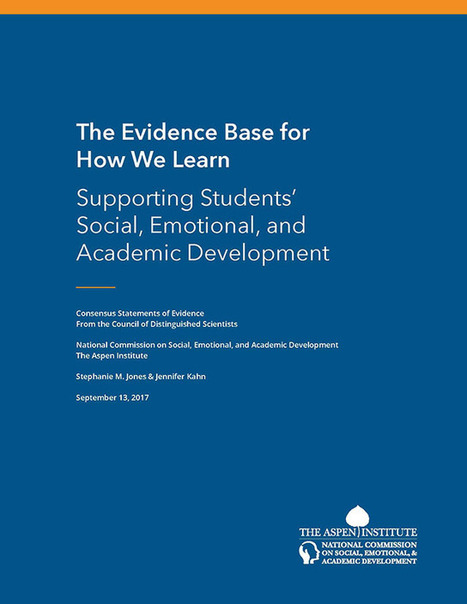
Distinguished Scientists, Scholars call for full integration of social, emotional, and academic development in K-12 education.
"The Evidence Base for How We Learn: Supporting Students’ Social, Emotional, and Academic Development articulates the scientific consensus regarding how people learn. The research brief presents a set of consensus statements—developed and unanimously signed onto by the Commission’s Council of Distinguished Scientists—that affirm the interconnectedness of social, emotional, and academic development as central to the learning process.
"The brief draws from brain science, medicine, economics, psychology, and education research to describe why it is essential to address the social, emotional, and cognitive dimensions of learning; how these dimensions together shape students’ academic and life outcomes; and how these competencies can be taught throughout childhood, adolescence, and beyond. The evidence outlined in this brief moves the nation beyond the debate as to whether schools should attend to students’ social and emotional development, to how schools can integrate social, emotional, and academic development into their daily work."
Is creativity important, and specifically is it so in teaching and learning?
My short answer, “Yes”.
I would argue that without creativity there is the danger of not challenging what we do and why we do it. Possibly to go blindly along with what we are told without question for we have no drive, no vision of how things could be different, no need even, to do anything different. Without creativity in our lives, we risk seeing the world only as a series of things we are directed to achieve in the way we are shown to achieve them. Should we forgo challenge and accept obedience? This may be fine when we want or need compliance[i] but do we want compliant learners or those who challenge us to explain or justify what it is we want them to learn?
Virtual international exchanges (VIEs) are a form of collaborative online international learning (COIL) in which an online, on-campus, or hybrid course connects virtually with a similar course in a different country.
VIEs let students connect with peers in other countries to discuss concepts and ideas learned about in shared course materials, including presentations, videos, podcasts, songs, blogs, websites, and articles.
The ideal VIE timeframe is three to eight weeks, which lets instructors bond and gives students sufficient time to interact with and learn from each other, as well as creating a new space for virtual social engagement.
Virtual international exchanges (VIEs) are a form of collaborative online international learning (COIL) in which an online, on-campus, or hybrid course connects virtually with a similar course in a different country.
For the last two years, I’ve had the privilege of working on the Learning & Teaching team at an inner-city high school in Brisbane where we’ve used agile practices to drive positive change in pedagogy, curriculum and assessment. I work with an amazing group of smart, passionate, innovative educators and have had the chance to experiment with a range of initiatives to affect whole-school change management.
We collaborated with the students and staff to generate four pedagogical principles: Critical Thinking, Connectedness, Collaboration, Creative Problem Solving. We partnered with QUT School of Design to create the Indooroopilly SHS Innovation Hub and implemented a Professional Learning Community comprising cross-faculty teams, each working on a specific ‘challenge of practice’ to trial one of the pedagogical principles in classrooms.
So, I bucked up, set some goals and took advantage of professional development and leadership opportunities, building projects in digital literacy, video games, STEAM and documentary film across state and private schools.
We spoke to current Curtin students to find out what Curtin's 50 Years of Innovation means for them, where they see Curtin heading in the future, and how they plan on contributing to Curtin's legacy.
We spoke to current Curtin students to find out what Curtin's 50 Years of Innovation means for them, where they see Curtin heading in the future, and how they plan on contributing to Curtin's legacy.
The conversation with George Couros and Jo Boaler in the IMMOOC live session has had me thinking a lot about how we use research in education and the impact (or not) on how we innovate and improve. As we talked about mindset, brain plasticity, making mistakes, the problem with homework, facing critics and so much more, much of the conversation revolved around research in each of these areas and the implications for innovation in education. Too often, however, these two are placed at odds. For example, I hear people challenge innovation in education because “it” is not proven by research or evidence-based. It often sounds like this “We can’t just experiment with kids and their future.” Or “We have to know it works first.” I certainly don’t want to do anything to harm kids but I also see how this can be used as an excuse to maintain traditions rather look at what’s best for those we serve.
“Higher education has been in lockstep for a long time with a diet of lectures, seminars and tutorials delivered in four concurrent subjects at a time across semesters.
“But we know 21st century students come with increasingly diverse preparedness, expectations, dependencies and interests. We asked how we could reimagine a first year that offered a very different experience.”
The University investigated a number of options, starting by identifying the challenges students found in transitioning from school to tertiary study.
Key among challenges reported by first-year university students was a perceived lack of support, with young or inexperienced students struggling to navigate their enrolment in courses, choice of subjects, and extra workload.
“But we know 21st century students come with increasingly diverse preparedness, expectations, dependencies and interests. We asked how we could reimagine a first year that offered a very different experience.”
Looking for a challenge? Want to work with the latest technology? Eager to be an innovator? An Innovation Internship with Innovation Central Perth (ICP) will give you the opportunity to immerse yourself in a cutting-edge project leveraging digital technologies and supervised by experts from industry and academia.
ICP’s Innovation Internships are aimed at undergraduate university students looking to extend their discipline knowledge with hands-on experience in projects involving the Internet of Things (IoT), network technologies and data science. So if you are studying at a WA University, and excited by technology and innovation, this is the internship for you!
Research areas include: smart cities, drones for industry, digital instrumentation/monitoring for agriculture and supply chain optimisation.
Interns are supervised by leading researchers from Curtin University and/or sponsoring industry organisations. Projects focus on one of the ICP development themes and involve one of more of the Centre’s industry clients.
Supervisors and sponsors benefit from the opportunity to carry out proof of concept projects designed to address specific real world industry challenges. These pages provide detailed information on the program for students, supervisors and industry sponsors.
Diversity is important in the innovation process. We welcome applications from all interested students.
Interns are supervised by leading researchers from Curtin University and/or sponsoring industry organisations. Projects focus on one of the ICP development themes and involve one of more of the Centre’s industry clients.
It has been nearly 20 years since UNESCO issued its World Declaration on Higher Education for the Twenty-First Century. Since its publication, global higher education has undergone dramatic change and global higher education enrolments have increased at a rate of about 5% per year. Today, higher education is in the midst of an academic revolution and many countries have now reached universal access status.
The World Declaration on Higher Education promotes several important principles regarding creativity in higher education:
Creativity should be used to integrate local/indigenous knowledge with advanced scientific knowledge, Curricula, teaching-learning and research should be organised in such a way as to continually foster creative thinking at every grade level, and Creative thinking and critical thinking should enhance and complement each other.
The World Declaration on Higher Education promotes several important principles regarding creativity in higher education: Creativity should be used to integrate local/indigenous knowledge with advanced scientific knowledge, Curricula, teaching-learning and research should be organised in such a way as to continually foster creative thinking at every grade level, and Creative thinking and critical thinking should enhance and complement each other.
We are living at a time of enormous uncertainty. Technology is advancing at an ever-increasing rate, transforming the nature of work and employment. Widening inequality threatens to further disrupt our systems and to leave a large part of the world behind. And as a result, our political systems are increasingly facing an isolationist backlash.
Change is happening at a disorienting pace and our institutions can barely keep up.
That’s why, in March 2017, we convened a meeting of top thought leaders in the fields of learning, innovation, and technology. We asked them: how can we rapidly accelerate progress in education—not only to help marginalized communities catch up to where the privileged are today, but also to reach a more effective, holistic, and equitable education for every child in the world?
This collection of essays represents the outcome of those discussions. It addresses some of the most urgent and important issues of our time.
What will we humans do as artificial intelligence and automation replace us in an ever-wider range of roles? In a world of rapid change, educators, policy makers and parents ask how education must change. What skills will be required for our future? Science and math? Creativity? Emotional intelligence? Empathy?
These are all useful for flourishing, but I’d like to add one capability nearly absent from most of education: how to discover, select and pursue mission and purpose. By this, I refer both to modest, near-term objectives, as well as the longer-term notion of life purpose. As technology increasingly enables us to do nearly anything, what should we do and why should we do it?
Few if any of us have been taught to identify and select missions to pursue. Most formal education is syllabus-driven: what’s expected, defined by the instructor. Later, for the sake of efficiency, “work” typically channels attention into narrow lanes — again defined by others.
"As technology change destroys traditional roles for human beings — and generates new ones — the question of “what’s next” becomes central for each of us."
To get content containing either thought or leadership enter:
To get content containing both thought and leadership enter:
To get content containing the expression thought leadership enter:
You can enter several keywords and you can refine them whenever you want. Our suggestion engine uses more signals but entering a few keywords here will rapidly give you great content to curate.


 Your new post is loading...