Your new post is loading...

|
Scooped by
michel verstrepen
January 30, 2012 12:24 AM
|
Les exploits des ordinateurs nous émerveillent au point d’oublier qu’ils sont le produit du cerveau humain. On perd de vue qu’il s’agit de phénomènes isolés, et non l’oeuvre d’une même machine. Histoire de remettre les pendules à l’heure, Chris Chatham, un doctorant en neurosciences, décrit dix différences fondamentales entre le cerveau et un ordinateur (source : Cognitive Daily). Sans nier les avantages des ordinateurs (précision d’exécution, infatigabilité, etc.), il importe de reconnaître ce qui nous distingue.
|
|
Scooped by
michel verstrepen
January 29, 2012 10:35 PM
|
By Susan Weinschenk: Do you ever feel like you are addicted to email or twitter or texting? Do you find it impossible to ignore your email if you see that there are messages in your inbox? Have you ever gone to Google to look up some information and 30 minutes later you realize that you’ve been reading and linking, and searching around for a long time, and you are now searching for something totally different than before? These are all examples of your dopamine system at work.
|
|
Rescooped by
michel verstrepen
from Big Data News
January 29, 2012 5:55 PM
|
Data needs at Amazon, Microsoft, and Google have driven the development of distributed file systems such as GFS and Dynamo.
Via Armando Reis
Web 2.0 has evolved internet as more of an interactive medium that can literally communicate with users while dissipating information to them, thus making it even more attractive for people already witness to countless benefits of internet.
Via juandoming
|
|
Rescooped by
michel verstrepen
from GooglePlus Expertise
January 29, 2012 12:57 PM
|
BLOG: Facebook Sucks: Google+ Blows Away Facebook for User Visibility So why does Google+ – in my opinion – work so much better for smaller businesses…...
Via Jaana Nyström
Initiative rare et appréciable pour tous les internautes, les bibliothèques de l’Université d’Alberta (Canada) consacrent une rubrique dédiée sur leur portail Web à la Netiquette (charte qui définit les règles de conduite et de politesse sur Internet et via des outils connectés) à propos de Facebook, Twitter, du courrier électronique, de l’utilisation des téléphones portables et des smartphones… ===> Merci beaucoup pour cette initiative louable ! <===
Via Gust MEES
RT @Qualysto: RT @vallatph: Faut-il créer un poste de Chief #Chaos Officer ?
Via Henri Lefèvre
|
|
Rescooped by
michel verstrepen
from Freewares
January 29, 2012 9:47 AM
|
Qui d'autre veut construire un business rentable et durable avec l'affiliation ? Cliquez ici pour voir... Vous faites du marketing par email, ou vous avez une newsletter sur votre blog ? Alors faites ce petit test rapide : 1.
Via Freewares&Tutos
|
|
Rescooped by
michel verstrepen
from Boîte à outils du Web
January 29, 2012 3:45 AM
|
|
|
Rescooped by
michel verstrepen
from Technologie Au Quotidien
January 29, 2012 3:42 AM
|
Si, comme moi, vous êtes présent sur plusieurs réseaux sociaux (facebook, twitter, tumblr, linkedin…), vous pouvez être amené à vous poser une question simple, mais néanmoins embêtante: où poster quoi ?
Via ETF Research & Solutions
|
|
Rescooped by
michel verstrepen
from Digital Delights
January 29, 2012 12:31 AM
|
Many scientists want to open up an age-old system of submitting private research to commercial journals that they say is hidebound, expensive and elitist. ...
Via Ana Cristina Pratas
|
|
Rescooped by
michel verstrepen
from DATAVISION
January 29, 2012 12:23 AM
|
J'ai eu le plaisir de participer aujourd'hui à la journée PraTIC sur le thème Spatialité et Temporalité du Web ... Avec carte des visualisations du web, et 2 prezis par Caroline Goulard
Via loichay
|
|
Rescooped by
michel verstrepen
from Innovation et startups
January 29, 2012 12:11 AM
|
|
|
|
Scooped by
michel verstrepen
January 30, 2012 12:23 AM
|
Have your paper reviewed BEFORE you turn it in. PaperRater.com is a free resource, developed and maintained by linguistics professionals and graduate students. PaperRater.com is used by schools and universities in over 46 countries to help students improve their writing.
PaperRater.com combines the power of natural language processing (NLP), artificial intelligence (AI), machine learning, information retrieval (IR), computational linguistics, data mining, and advanced pattern matching (APM). We offer the most powerful writing tool available on the internet today.
As part of the development process, we put together a team of computational linguists and subject matter experts to develop a core Natural Language Processing (NLP) engine using statistical and rules-based NLP to extract language features from essays and robustly translate that into statistical models. We hope to showcase some of our technology at a later date.
What makes us different?
We’ve tried out similar websites and found them to be out of touch with most writers’ needs. We found false-positive rates as high as 50% on grammar detection. As the Hippocratic Oath encourages medical doctors to “first do no harm”, we wanted to create tools that do not muddy the waters in the process of assisting with the craft of writing. These same websites acquire hefty payments for the use of their services, while our goal has always been to provide tools that are universally accessible.
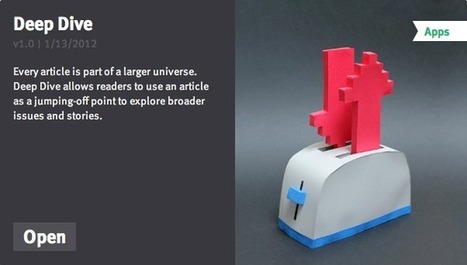
Thinking about the sheer volume of information — stories, images, videos, data — available from The New York Times can evoke a simultaneous glee and terror. It is simply impossible for readers to see them all. The task for beta620, the Times experimental projects group, launched Deep Dive that uses the Times’ massive cache of metadata from stories to go, as the name suggests, deeper into a news event by pulling together related articles. So Deep Dive would provides readers a collection of stories relating to a topic, based on whatever person, place, event or topic of their choosing. What’s interesting about Deep Dive? At least three things: 1) Deep Dive relies on the extensive tagging system the Times uses for all its stories and makes the Times Topics pages possible. As part of the editing flow tags are applied to stories by editors or producers, with suggestions provided by an internal algorithm. Deep Dive looks for connections among topics. 2) Deep Dive’ unique interfact, where the related articles flow into the same frame as the main story when selected. You need never leave the page; jumping backwards or forwards in articles all happens in the same space. That’s a departure from the pageview-driven way most news sites are designed. But Deep Dive’s UI matches its underlying thesis: that individual articles are really pieces of a larger story, told in pieces over time and across bylines and datelines. 3) More interesting, Deep Dive will also allows users to save their “dives,” which would be constantly updated with new articles. What Deep Dives promises is an alert more directly based around a specific developing story. But beyond those elements, the real promise of Deep Dive, though, is that it continues to show the Times’ flexibility in providing different ways for different kinds of readers to access its content... read full article http://j.mp/x2SoPf
visit also http://beta620.nytimes.com/projects/deep-dive/
and read here: http://beta620.nytimes.com/projects/deep-dive/exploring-stories-with-deep-dive/
Curated by Giuseppe Mauriello
Via Giuseppe Mauriello
|
|
Rescooped by
michel verstrepen
from Transhumanisme
January 29, 2012 5:54 PM
|
|
|
Rescooped by
michel verstrepen
from Science News
January 29, 2012 12:59 PM
|
Neurons are highly specialised cells that conduct and process information in animals, enabling thought, perception and control of movement. Problems with neuronal function underpin a range of neuro...
Via Sakis Koukouvis
This guest post is by Belinda of The Copy Detective. Your blog is a good read. Everyone says so. Although ... So why isn’t your blog being found by other people? The millions and millions of people hungrily consuming blog content out there in the global online space we call the Internet? The cold, hard truth is that Google hates your blog. And it’s nothing personal. You just don’t have anything that Google wants. Creating high-quality, relevant content is a must if you want your blog to be noticed by search engines but it’s only part of the picture. If you’re not sure if Google really hates your blog, or whether it’s just ambivalent, then step through these warning signs.
Via maxOz, ABroaderView
|
|
Scooped by
michel verstrepen
January 29, 2012 9:49 AM
|
Plus d’une centaine de nouvelles règles, modifications, fonctionnalités ont vu le jour depuis 2006 sur Facebook. Le rythme est soutenu, avec en perspective une introduction en bourse dans les prochains jours.
|
|
Rescooped by
michel verstrepen
from Bien communiquer
January 29, 2012 9:48 AM
|
|
|
Rescooped by
michel verstrepen
from Les visages de la réussite
January 29, 2012 8:44 AM
|
Un blog à alimenter sans relâche et des milliers de commentaires à consulter, 24 heures sur 24, sept jours sur sept ou presque. Après des années de blogging compulsif, Thierry Crouzet s'est retrouvé, une nuit, à l'hôpital.
Via Fadhila BRAHIMI
|
|
Scooped by
michel verstrepen
January 29, 2012 3:43 AM
|
Video sharing site Vimeo has rolled out its first major redesign in five years, with a super-large video window and big emphasis on quality and content . . .
|
|
Rescooped by
michel verstrepen
from Ecrire Web
January 29, 2012 3:41 AM
|
Le ton monte, SOPA et PIPA se font tout petits ... "La Maison Blanche avait fait savoir qu'elle mettrait son veto si la SOPA venait à être voté : "Nous ne supporterons pas une législation qui réduit la liberté d'expression, accroît les risques de cybersécurité ou sape la dynamique de l'innovation sur Internet" ...
Via Gilles Le Page
|
|
Scooped by
michel verstrepen
January 29, 2012 12:23 AM
|
Data Visualization, Infographics, and Statistics
|
|
Scooped by
michel verstrepen
January 29, 2012 12:23 AM
|
A community of creative people making sense of complex issues through data and design...
|