


Sky NewsTwitter's New Logo Inspires Parodies, CSS GreatnessWired NewsBy Scott Gilbertson In case you've been too busy using third-party apps to notice, Twitter recently unveiled a new logo.

 Your new post is loading...
 Scoop.it! Sky NewsTwitter's New Logo Inspires Parodies, CSS GreatnessWired NewsBy Scott Gilbertson In case you've been too busy using third-party apps to notice, Twitter recently unveiled a new logo. No comment yet.
Sign up to comment
Scoop.it!

Information graphics or “infographics” are graphic visual representations of information, data, or knowledge. Infographics help us absorb facts and figures in the most effective way possible. They come in extremely handy when you need to explain complex information, numbers or data rather quickly and effectively. One cool way to get inspired is to look at some of the best infographics out there. Infographics are an excellent way to add humor or irreverence to tell a great story in short possible way. However, infographics can be pretty hard to design since you have to gather together a lot of information and make it look good. Today we're to sharing the top places to see some great visual graphics and also find inspiration to create your own... Via Lauren Moss
Scoop.it!

Google vient de présenter les deux dernières nouveautés de son service de cartographie, qui sera doté d'un mode 3D et disponible hors connexion sur Android. Via Ardesi
Scoop.it!

A little learning is a dangerous thing; drink deep, or taste not the Pierian spring Alexander Pope How does an organization decide what to spend on knowledge? What is the value of investments in R&D or knowledge management? Via Ana Cristina Pratas
Scoop.it!

Les créateurs du site de partage de musique Napster, Sean Parker et Shawn Fanning viennent d'officialiser l'ouverture de leur nouveau site Airtime. Via Marc Escomel
Scoop.it!

With IP addresses now depleted, the Internet Society is leading the launch of IPv6 to allow the web to continue growing.
“IPv6 is the single largest upgrade in the history of the Internet. It’s not a small decision for the major content providers to turn on IPv6 and leave it on.” -John Curran, president and CEO of the American Registry for Internet Numbers Via TEDxSF
Scoop.it!

From
bundlr

From Journalism.co.uk: "The content curation website Bundlr has just announced a new version of its service which allows for embedding of content from a wide range of sources. By partnering with Embedly the site now supports over 200 sources of content, including Storify, Pinterest and Amazon, for users to add to their bundles.
Embedly is the service that the new version of Twitter uses to embed photographs and articles in your Twitter stream and is used by a host of other sites such as Reddit and Bitly and comes as a WordPress plugin. While Bundlr was originally seen as an alternative to sites like Storify, which can be used to create stories from curated links and content, Bundlr's focus is now on creating a top-level resource for curated content around a story or topic."
(Source: Journalism.co.uk)
Try it out: http://bundlr.com/ ; Via Robin Good, Martin (Marty) Smith
Scoop.it!
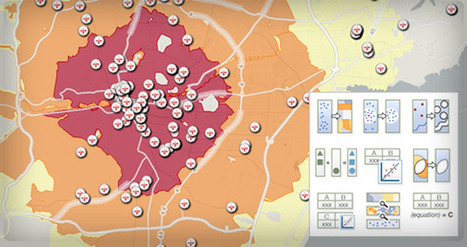
GeoCommons delivers visual analytics through maps. We make it possible to view massive amounts of data, make decisions and solve problems with no prior training or experience using traditional mapping tools. Via Natalie Sing
Scoop.it!

AnswerHub is a customizable, enterprise-class social Q&A platform that integrates into your existing infrastructure and utilizes social networking tools. ... Via Martin (Marty) Smith
Scoop.it!
Transmedia Business Models....
thanks Lina, for sharing! so timely - Transmedia Business Models are the next must- map AND Business Model Generation is the MUST book for those who don't have it yet. Via siobhan-o-flynn
Scoop.it!

Le Financial Times et le New York Times voient leurs abonnés aux éditions numériques dépasser les ventes de journaux imprimés. Via Romain Saillet
Scoop.it!

From
www
Evernote is, without a doubt, a multi-faceted tool that can help you accomplish a lot, but when you have that kind of breadth in options and input channels, there’s a chance you could get overwhelmed.See it on Scoop.it, via iPads in Education... Via WebTeachers
Scoop.it!

This piece was posted by Loren Sorenson for Hubspot, as she says "If you aren’t prepared for the visual content revolution, you may be left in the dust.
Not convinced? Let's take a look at exactly how visual content is positively contributing to marketing strategies -- it may just give you the push you need
"Learn why visual content is a critical part of your content creation strategy.
Here are some highlights:
**People remember only 20% of what they read. **83% of learning is visual. Condenses and Explains Large Amounts of Information
Selected by Jan Gordon covering "Content Curation, Social Business and Beyond"
Read full article here: [http://bit.ly/Ifujbp] Via janlgordon, Deborah Verran, MegaAulas, Ken Morrison 
janlgordon's comment,
April 11, 2012 3:21 PM
Beth Kanter
Thank you for adding me to the wiki and for your kind words, it's greatly appreciated. Yes this is the conversation of the moment so to speak. I'm sure your presentation was amazing. Would love to hear it if you have a replay. 
Beth Kanter's comment,
April 11, 2012 10:08 PM
Jan: There's a link in the wiki to the live stream of the session - and a lot of notes and resources ... I love this topic! I'm holding myself back from created another scoop.it on it ...
janlgordon's comment,
April 13, 2012 10:05 PM
Beth Kanter
Thanks for looking forward to seeing this info. Knowing you, I can imagine that you want to start another scoopit on this topic but it's not necessary because you're already doing a wonderful job covering it now. |
Scoop.it!

Journal du NetMédiamétrie revoit les règles de mesure d'audience sur InternetJournal du NetSuite à la réunion des membres du Comité Internet de Mediametrie//Netratings qui s'est déroulée le vendredi 11 mai dernier, plusieurs modifications dans la... Via Miralles Richard
Scoop.it!

6 juin 2012 - Matt Cutts a indiqué hier sur un salon américain que Google va proposer, d'ici à trois mois, un outil permettant à un webmaster d'indiquer à Google qu par Actualité Abondance... Via Wilfried Caruel
Scoop.it!

Combien de temps passez-vous sur les réseaux sociaux pour promouvoir votre activité? 3h par semaine? 1 h par jour? Gagnez du temps! Via Laurence Galambert
Scoop.it!

From
www
Les développeurs de Napster, Sean Parker et Shawn Fanning, ont lancé hier leur service de chat vidéo : Airtime. Sorte de Chatroulette design, Airtime a la particularité d’utiliser le réseau Facebook.
Scoop.it!

Jean-Michel Cornu, Chief Visionary Officer à Imagination for People nous livre (...)... Via algrappe
Scoop.it!

Startup Funding Strategies: Bootstrapping vs. Venture Funding Recently Glenn and I were speaking with a fellow entrepreneur regarding funding startups (@VendScreen Latest post from Paresh...
***** My Bootstrapping Note I prefer bootstrapping because NOs from VC and Angels can be crushing and may not even have anything to do with the merits of your idea or business plan. Often a NO means more about where they are at in their investing journey than where you are at in your company creation cycle. Via Didier Roggeri, Martin (Marty) Smith
Scoop.it!
Quantum Entanglement and Information First published Mon Aug 13, 2001; substantive revision Thu Aug 26, 2010 Quantum entanglement is a physical resource, like energy, associated with the peculiar nonclassical correlations that are possible between separated quantum systems. Entanglement can be measured, transformed, and purified. A pair of quantum systems in an entangled state can be used as a quantum information channel to perform computational and cryptographic tasks that are impossible for classical systems. The general study of the information-processing capabilities of quantum systems is the subject of quantum information theory. 1. Quantum Entanglement2. Exploiting Entanglement: Quantum Teleportation3. Quantum Information4. Quantum Cryptography5. Quantum Computation6. Interpretative RemarksBibliographyOther Internet ResourcesRelated Entries 1. Quantum Entanglement In 1935 and 1936, Schrödinger published a two-part article in the Proceedings of the Cambridge Philosophical Society in which he discussed and extended a remarkable argument by Einstein, Podolsky, and Rosen. The Einstein-Podolsky-Rosen (EPR) argument was, in many ways, the culmination of Einstein's critique of the orthodox Copenhagen interpretation of quantum mechanics, and was designed to show that the theory is incomplete. (See The Einstein-Podolsky-Rosen Argument in Quantum Theory and Copenhagen Interpretation of Quantum Mechanics.) In classical mechanics the state of a system is essentially a list of the system's properties — more precisely, it is the specification of a set of parameters from which the list of properties can be reconstructed: the positions and momenta of all the particles comprising the system (or similar parameters in the case of fields). The dynamics of the theory specifies how properties change in terms of a law of evolution for the state. Pauli characterized this mode of description of physical systems as a ‘detached observer’ idealization. See Pauli's letter to Born in The Born-Einstein Letters (Born, 1992; p. 218). On the Copenhagen interpretation, such a description is not possible for quantum systems. Instead, the quantum state of a system should be understood as a catalogue of what an observer has done to the system and what has been observed, and the import of the state then lies in the probabilities that can be inferred (in terms of the theory) for the outcomes of possible future observations on the system. Einstein rejected this view and proposed a series of arguments to show that the quantum state is simply an incomplete characterization of the system. The missing parameters are sometimes referred to as ‘hidden parameters’ or ‘hidden variables’ (although Einstein did not use this terminology, presumably because he did not want to endorse any particular ‘hidden variable’ theory). It should not be supposed that Einstein's definition of a complete theory included the requirement that it be deterministic. Rather, he required certain conditions of separability and locality for composite systems consisting of separated component systems: each component system separately should be characterized by its own properties (even if these properties manifest themselves stochastically), and it should be impossible to alter the properties of a distant system instantaneously (or the probabilities of these properties) by acting on a local system. In later analyses — notably in Bell's extension of the EPR argument — it became apparent that these conditions, suitably formulated as probability constraints, are equivalent to the requirement that statistical correlations between separated systems should be reducible to probability distributions over common causes (deterministic or stochastic) in the sense of Reichenbach. (See Bell's Theorem and Reichenbach's Common Cause Principle.) In the original EPR article, two particles are prepared from a source in a certain quantum state and then move apart. There are ‘matching’ correlations between both the positions of the two particles and their momenta: a measurement of either position or momentum on a particular particle will allow the prediction, with certainty, of the outcome of a position measurement or momentum measurement, respectively, on the other particle. These measurements are mutually exclusive: either a position measurement can be performed, or a momentum measurement, but not both simultaneously. Either correlation can be observed, but the subsequent measurement of momentum, say, after establishing a position correlation, will no longer yield any correlation in the momenta of the two particles. It is as if the position measurement disturbs the correlation between the momentum values. The puzzle is that the assumption of the completeness of the quantum state of the particle pair is inconsistent with the assignment of labels to the particles separately that could be associated with appropriately correlated values for the outcomes of position and momentum measurements. These labels would be the common causes of the correlations, and would provide an explanation of the correlations in terms of the initial correlations between the properties of the two systems at their source. EPR concluded that the quantum state was incomplete. Here is how Schrödinger put the puzzle in the first part of his two-part article (Schrödinger, 1935; p. 559): Yet since I can predict either x1 or p1 without interfering with the system No. 1 and since system No. 1, like a scholar in an examination, cannot possibly know which of the two questions I am going to ask first: it so seems that our scholar is prepared to give the right answer to the first question he is asked, anyhow. Therefore he must know both answers; which is an amazing knowledge; quite irrespective of the fact that after having given his first answer our scholar is invariably so disconcerted or tired out, that all the following answers are ‘wrong.’ What Schrödinger showed was that if two particles are prepared in a quantum state such that there is a matching correlation between two ‘canonically conjugate’ dynamical quantities — quantities like position and momentum whose values suffice to specify all the properties of a classical system — then there are infinitely many dynamical quantities of the two particles for which there exist similar matching correlations: every function of the canonically conjugate pair of the first particle matches with the same function of the canonically conjugate pair of the second particle. Thus (Schrödinger, p. 559) system No. 1 ‘does not only know these two answers but a vast number of others, and that with no mnemotechnical help whatsoever, at least with none that we know of.’ Schrödinger coined the term ‘entanglement’ to describe this peculiar connection between quantum systems (Schrödinger, 1935; p. 555): Via Jan Bergmans
Scoop.it!

The social network to find books, publish your own, create shelves and spread ideas... Via Patty Ball
Scoop.it!

Bime launches easy-to-use front-end for Google BigQueryVentureBeatBime, which just launched version 4.0 of its browser-based data mining and data visualization tool, promises to make diving into enormous databases as pleasant as taking a swim in a... Via Armando Reis
Scoop.it!

Le trafic Internet va-t-il exploser en 2016 ?Atlantico.frSelon une étude réalisée par l'équipementier américain Cisco, le trafic de l'Internet mondial sera multiplié par quatre d'ici à 2016. La situation sera-t-elle techniquement soutenable ? Via Miralles Richard
Scoop.it!
Comment s'y prendre pour ne pas être impacté par ces nouveaux filtres et algorithmes imposés par Google ? Via Arobasenet |






