


Comprendre comment utiliser Facebook pour sa visibilité quand on est un peu trop tourné vers le SEO pur et dur.
Via Ma veille

 Your new post is loading...
 Scoop.it! Comprendre comment utiliser Facebook pour sa visibilité quand on est un peu trop tourné vers le SEO pur et dur. Via Ma veille No comment yet.
Sign up to comment
Scoop.it!

Il est souvent difficile d'expliquer le processus qui conduit à la conception d'un service sur les bases des méthodologies de l'expérience utilisateur (UX).
Scoop.it!
Robin Good: This is a one-hour recording of a webinar, where Jane Hart interviews David Kelly on curation.
I am reporting about it, because Jane's has lot of visibility and a good reputation, but while there is a lot of good, basic, introductory information about curation in this interview, some of the critical information contained in it, is at best incorrect if not altogether misleading to those seeking to understand the actual differences between the different curation tools presented.
The "expert" guest is David Kelly, a workplace learning enthusiast writing his own blog and sharing interesting info on his Twitter channel. His specialty, is actually collecting and sharing relevant links emerging in the backchannels of key conferences.
While he does a good job of introducing what is curation (tapping fully into Rohit Barghava model but never acknowledging/ or referencing it), the different types of approaches that can be used, and dismantling the myth of "personal curation", he insists on a few of points that, in my humble view, are in need of review.
Specifically:
1) Know your data sources (not just one though). Mr Kelly insists that one of the top skills a curator needs to have, is the ability to manage and skillfully use your key data source (in his case Twitter). True. But in reality, any good curator needs to be able to tap and be able to find and retrieve relevant information coming from anywhere. Limiting your source to Twitter, YouTube, or Facebook may actually be very limiting if your goal is to not to curate a "technology platform output", but what people are saying on a specific topic, no matter where they say it.
b) Everybody can be a curator. By clicking the "Share" button on Facebook makes anyone a curator as much as saving a file in Photoshop makes you a digital artist. No specific competence needed. As long as the stuff is cool and interesting.
c) Tools. Mr Kelly claims that while Storify, helps you to manually curate stories by picking and selecting individual pieces of information coming from different sources, tools such as Paper.li and Scoop.it do not provide such ability, as they automatically generate a news-magazine based on criteria you have provided.
While this is mostly true for Paper.li, it is definitely not true for Scoop.it, a tool that has no automatic publishing feature (like paper.li does) and which requires manual intervention from the user to select, edit and post whichever content items are most relevant to their audience needs.
Yes, I am an avid Scoop.it user, I am not posting this to defend this platform or to try to make it look better. Storify is a great curation tool indeed, but it has no better research, filtering or aggregation or content curation support than Scoop.it does. Scoop.it technology requires as much human intervention to curate content than Storify does. May be more. Not less.
For one, and to meet Mr Kelly on his own grounds, Scoop.it provides a lot more opportunities to source and gather valuable content in its backend than Storify does, providing a richer set of filters and pre-set persistent search engines hooks than Storify does.
Therefore Mr Kelly recommendation of Storify, not only is founded on incorrect information, but it shows that Mr Kelly has clearly never used (beyond using it for news discovery) at least one of the tools he is using to make his evaluations, making his recommendations unreliable (this is how much he has used Scoop.it before evaluating it: http://i.imgur.com/AoaOU.jpg) N.B.: I watched this whole video, from beginning to end, twice, to make sure I had not missed anything important.
For Jane: I would love you to exercise more pro-active curation of your interviewees, as asking questions to someone who may be passionate, but who has a limited experience in a specific area, can instantaneously dent into YOUR credibility and trust by those who know and appreciate you most, even when, most of the information being shared is of value.
I would question how someone who transparently admits not to include any opinion in his curation work can be considered a curator to whom to go and ask for advice. Maybe I would frame this differently, as for example having an open conversation with someone starting to explore this field (given the amount of time he has spent and researched this area by his own admission), and everything said in here could become suddenly fully acceptable. But if you serve this as an "expert" voice to listen to, I have all the right to ask proof for this "experience".
I may be a demanding perfections but I think that interviews must maintain a level of critical judgement whereby the answer you receive are not just opportunities to compliment your guests, but also vital spots to ask difficult questions, demand examples and some kind of proof of what is being claimed.
For David: I actually think you did a great job, as you introduced and well explained some of the basic concepts of curation clearly.
Tools and their use is an area where there is a lot more to explore and I look forward to a more precise re-evaluation of the tools you have selected.
I really have nothing against you, but I feel it is my role to use this space also to be constructively critical of anything that I see could be improved. I probably make more mistakes than you do, and you are welcome anytime to highlight them.
P.S.: For readers: The overall length of the webinar is one-hour but there are only a few slides to see. You are not going to miss much if you just listen to it.
Some good things tainted by some incorrect information. Opportunity to reflect on those curating curators. (A little bug can rot a great apple.) 5/10
Video: http://www.youtube.com/watch?v=Vv9NZL5LfQ4&feature=colike Via Robin Good 
Robin Good's comment,
June 25, 2012 8:27 AM
Thank you Terry for reporting this: "the video is now private"
What do you make of it? Do you think it would have been better for the authors to provide a feedback or a comment to these issues rather than closing down the video for everyone? In a situation like this, what is more appropriate to do, in your view? Take down the material that may have some disputable parts, or discuss openly the issues with everyone while fully acknowledging possible overlooks and mistakes? 
Terry Elliott's comment,
June 25, 2012 8:45 AM
Robin, I actually went to Jane Hart's Social Learning Centre site (http://sociallearningcentre.co.uk/) and registered thinking that I had to be a member-still private. Then I joined the group that was based upon the webinar (http://sociallearningcentre.co.uk/groups/in-conversation-with-david-kelly-webinar/). No joy--still private. I left a comment on the video asking for help, but it has only been a short while.
I suppose what anyone makes of it depends upon how much slack is deserved. Jane Hart has been a serious asset in my search for answers to social media questions especially lately with her work at Internet Time Alliance, but... 1. Perhaps they realized that the webinar was a bit off the cuff. Half-baked might be less charitable, but I don't know because it's PRIVATE. I cannot make my own judgment and that is not good. 2. It might be painful, but sunlight is always best in public conversation. I would not take down the disputed parts but rather view them as starting points for another webinar 3. Don't you think they are missing a wonderful opportunity to drive traffic to their site? I do. It isn't too late. I would love to follow that, perhaps a Hangout on Air? I am working with a study group on P2PU that will open a discussion of curation for the National Writing Project's Digital Is network that is considering some of what you have already spoken to (https://p2pu.org/en/groups/curating-our-digital-lives/). Our goal is teacher-centered curation and I know my teaching fellows would value this conversation. Hell, we might just have it ourselves. I don't think you are wrong in your critique but without a public conversation we will never really know for certain, will we. Perhaps it would be a dialectic and a grander truth than yours or Kelly's would evolve from it.
Robin Good's comment,
June 25, 2012 9:03 AM
Terry, I couldn't agree more with your excellent comments and thoughts.
I second them all and you have all of my support in promoting them. Thank you.
Scoop.it!

Just answer some short questions and you'll learn exactly when a particular work will fall (or has fallen) into the public domain! The Genie can also collect additional information on the work and produce a PDF copy for your records or further vetting with a copyright specialist
Scoop.it!

From
oedb

There are a lot of variations between e-Book platforms. So much so that it often seems like comparing apples to oranges. These posts will attempt to clear up much of the confusion and set you on a path to confidently evaluate and compare the different offerings..... Via aikker
Scoop.it!

A nice array of tools that help you get your point across with both web sites and documents.
Scoop.it!

Source : Florence Meichel VEILLE OUTILS
Lier le document à Yahoo! Pipes pour mettre en place l'outil de veille Via FrancoisMagnan, @AnneDiscart
Scoop.it!

Robin Good: Epiblogger is a new service which allows you to auto-aggregate on a web page all content published on the Internet relating to a specific event: photos, video clips, tweets, comments on Facebook, blog posts and more. A kind of publicly-shared social memory of any specific event that happened or is about to come.
To make Epilogger work you provide as much information as possible about the event, by providing reference links, keywords and search terms that can be utilized to collect and aggregate all of the relevant stuff.
Already created event pages: http://epilogger.com/browse/past ;
Try it out now: http://epilogger.com/ ; Via Robin Good
Scoop.it!

Advice from Common Sense Media editors. Everything you need to know about pictures, settings, COPPA, and more.
Scoop.it!

Ikujiro Nonaka and Hirotaka Takeuchi propose a model of the knowledge creating process to understand the dynamic nature of knowledge creation, and to manage such a process effectively: the SECI model.
Scoop.it!

According to statistics from a DMA survey of 1,020 adults, 1 in 3 consumers now regard their personal information as a tradable commodity. These consumers are prepared to share their details for marketing purposes, as long as they trust the brand in question, while others would ‘sell’ their data for a discount. The following infographic from DMA shows the 3 types of consumers and in what circumstances and reasons will they share their personal information to brands. The Three Types of Consumers: 1. Data Pragmatists (53%) 2. Unconcerned (31%) 3. Data Fundamentalists (16%)
Full graphic here: http://ijustdid.org/2012/06/consumer-data-privacy
Scoop.it!

By Andy Goodman.
Scoop.it!

By collating data from sensors such as cameras and microphones, and cross-referencing it with results from social networks such as Twitter, users will be able to receive detailed responses to questions such as ‘What part of the city hosts live music events that my friends have been to recently?' and ‘How busy is the city centre?'
[...]
"SMART builds upon the existing concept of ‘smart cities', physical spaces which are covered in an array of intelligent sensors which communicate with each other and can be searched for information," said Dr Iadh Ounis, of the University of Glasgow's School of Computing Science.
"The search results sourced from these smart cities can be reused across multiple applications, making the system more effective."
The team from Glasgow University hopes the SMART project will be ready for testing in a real city by 2014.
Via ddrrnt |
Scoop.it!

Navigocorpus est une base de données historiques sur le transport maritime en méditerranée au XVIIe siècle. Elle a été réalisée dans le cadre du programme «Corpus et outils de la recherche en sciences humaines et sociales» de l’Agence nationale de la recherche (ANR). Elle contient les sources des archives portuaires et douanières dans leurs intégralités, sous la forme de fiches informant sur le type de navire, de cargaison, le nom du navire, celui de son capitaine, les étapes de l’itinéraire du navire et bien d’autres renseignements, le tout dans une base de données relationnelle. Elle est innovante car elle permet de dépasser les approches classiques des chercheurs dans le monde de l’échange maritime. L’objectif de notre recherche a été de créer un outil permettant la visualisation des informations contenues dans cette base. Via Emilie Kochert, Laurent Blanquer
Scoop.it!

Nos voisins d'Outre-Rhin ne sont plus contraints de passer par Facebook pour créer un compte Spotify. Via Freewares&Tutos
Scoop.it!

Vous voulez copier dans vos documents des extraits de pages Web, mais pas les nombreuses photos, tableaux et logos qui encombrent ces pages.
Scoop.it!

Cet outil mesure toutes les statistiques de partage d'une page sur les réseaux sociaux.
Il permet ainsi de visualiser la performance de vos contenus, au regard de ceux de la concurrence... Via @AnneDiscart
Scoop.it!

Découvrez dans ce tutoriel vidéo Comment ajouter Twitter, Facebook et tout le bazar dans Gmail... Via Freewares&Tutos
Scoop.it!
Ce PDF de l'ERYICA propose des modes d'actions sur l'accompagnement des jeunes et de l'Internet : maîtrise de l'information, risques et communautés du web. Un dossier très complet pour nos usages de médiation documentaire. Via David Vergnon, Benoit Vallauri
Scoop.it!

Un article repris du magazine de juin d’Outils Réseaux (L'écriture collaborative: De l’écriture individuelle à la production collective : les enjeux et modalités de l’é...)...
Scoop.it!

According to Hitwise, Google+ has grown by 37% in the past couple of weeks. The introduction of Google+ Local could have something to do with the increased activity. This community is steadily growing and will continue to do so as long as Google keeps adding new features to it. It will be interesting to see where Google+ ends up a year from now. -- Google+ may not be as big as Facebook yet. But it is growing fast.
Via Mark Boudreau, Martin (Marty) Smith
Scoop.it!

Keemix est un outil de curation actuellement en Beta et accessible sur invitation.
Petite démo: http://vimeo.com/42615704
... à tester ! Via @AnneDiscart
Scoop.it!

Le réseau social espère développer le micropaiement en adoptant les devises locales. Il lance aussi la vente d'abonnements dans les applications. Via Ghislain Vacherot, Alexandre Kuhn
Scoop.it!
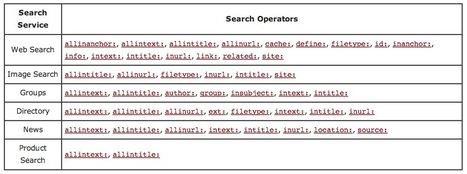
Robin Good: Curation is often about searching, exploring and digging through tons of materials to find a perfect match, a complementary resource, a citation or quote that can help add more value and meaning to your "collection" or to your curated content.
Yet, many curators have not yet explored and mastered the tools available to them to make their search efforts even more effective.
Not that you can't find these on Google's own help pages (http://support.google.com/websearch/bin/answer.py?hl=en&answer=136861 ), but there is more information in this guide that can be quite useful including the syntax, the capabilities, and an example for each operator.
Very useful. 9/10
Full guide: http://www.googleguide.com/advanced_operators.html ; Via Robin Good
Scoop.it!
"Pour le moment, nous nous concentrons sur le produit. Nous ne monétisons pas Del.icio.us. Mais la monétisation pourra prendre plusieurs formes. Je pense que le modèle de Del.icio.us peut évoluer vers celui de la recherche, avec de la publicité ciblée selon vos centres d'intérêt et vos recherches. Les marques peuvent aussi être intéressées par des services professionnels." |






