As we live closer together and push global boundaries, experts believe we need to be more prepared for the next infection that may spread into a pandemic.
We are living exciting times. Our civilization is evolving quickly as new technologies emerge at a giant’s pace, and there is an unprecedented opportunity for cities to leverage these new technolog…
How can 600 million people be left in the dark in an area with an estimated 1,100 GW of untapped energy potential? This week the World Energy Council will be meeting at the 9th Annual African Energy Indaba to find a solution to this question. Presently, the continent harbors plentiful resources that have the potential to develop powerful solar, hydro, geothermal, wind, and bio-energy. So, why is Africa struggling to deliver electricity? The short answer to the question lies in Africa’s lack of necessary components to channel the energy opportunity in the region. The population does not have the level of technical support required to jumpstart the continent’s renewable energy sector. There is also an absence of support from African government and institutional agencies. Without their support it is difficult to get projects out of the planning stages and into action. Africa’s biggest obstacle for the renewable energy sector is funding. The funds necessary are by no means small fees. Africa will require billion dollar investments to launch clean energy projects. One estimate has been calculated for 3,200 low-carbon energy projects that would come with a price tag of about $157 billion. This may seem like an insurmountable cost, but the benefits are just as large. Low-carbon energy projects, like these, have the ability to eliminate 740 million tons of carbon dioxide from the atmosphere in one year. In addition to creating clean energy, these projects would be changing the lives of millions of African residents who, at the moment, have little to no access to power sources. Bringing power to these members of the population could lead the continent’s economic, social, and political landscape in a positive, new direction. Even with all of these substantial benefits, the question still remains, how can clean energy projects be funded in Africa? To kick-start progress, the World Bank has provided extensive support for projects included in the Africa Climate Business Plan. Their financial support has resulted in a pledge of $3.6 billion. While this is a substantial contribution, $3.6 billion is a small amount in relation to the estimated total cost of $19.3 billion necessary to complete the project. Politicians, engineers, and energy experts will meet this week to address this funding issue along with several other issues hindering projects for the African energy sector. Of course, funding is a central concern for the attendees, but progress is also a major agenda item. The World Energy Council wants to ensure that the $3.6 billion pledged to date are used efficiently and effectively. In order to do so, attendees of the conference will be discussing ways in which clean energy projects can be kept on schedule to ensure that progress is continuous. This progress will be crucial for the continent to be able to maintain their commitment to the international community to assist in the reversal of global warming and its detrimental effects. Clean energy is not just a beneficial opportunity for growth, but rather, a necessity for the progress and development of the African continent. With their vast reserves of viable renewable resources the region will be able to accommodate the needs of their increasing population and subsequent increases in energy needs. This meeting is a step in the right direction for the development of new clean energy projects, financial solutions, and political support that will shape the future of the African continent.
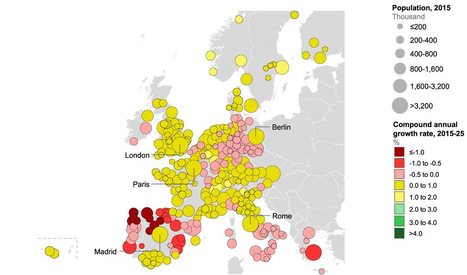
"The world is experiencing rapid urbanisation, but not every city is growing. Population is likely to decline in 17% of large cities in developed regions and 8% of cities across the world from 2015 to 2025, according to a McKinsey report."
In this article the maps below are a good tool for Regional Geography classes. These maps show how the world is experiencing rapid urbanization, but not all cities are growing. Population is likely to decline in 17% in developed regions
There is wide recognition that humanity’s impact on the globe – in driving species to extinction, altering the chemistry of the world’s waters and air and shifting its climate – is staggering. But just how big is that impact? How does it compare, for example, to the asteroid that crashed into the Earth 65 million years ago, causing one of the major extinction events in the planet’s history.
With the adoption of the New Urban Agenda at the Habitat III conference in Quito, Ecuador, in October 2016, it is imperative to ensure that science can effectively contribute to the implementation of this Agenda. As part of the 5-year "Leading Integrated Research for Agenda 2030 in Africa" programme, the International Council for Science (ICSU), in partnership with the Network of African Science Academies (NASAC) and the International Social Science Council (ISSC) will support 10 collaborative research projects across Africa (to the value of up to 90,000 Euro each over two years) that will advance the implementation of the Sustainable Development Goal (SDG) 11 (sustainable cities and communities) in Africa.
An accord to promote open access to "big data" that are the basis of advanced research has passed 120 endorsements, and the list includes prominent science organizations that support the principles of open data through dedicated commitments.
L’avenir de l’humanité semble aujourd’hui profondément lié à celui des villes. Quatre « futurs » concrets, qui peuvent se compléter, se dessinent. La ville est le support et la conséquence de l'organisme vivant global qui l'habite et la transforme par coévolution
This ‘Reimagine London’ project is a collaboration between the School of Geography and guerrilla geographer Daniel Raven-Ellison who is campaigning to have London designated as a national park. Acting as park rangers, the students will visit each of the capital’s 33 boroughs in groups and report back on their findings. Their explorations will be the basis for an exhibition of their work in the School of Geography at its Mile End Campus and then at City Hall in October. Professor Catherine Nash has been leading the development of the project
Norway jumped three spots and displaced three-time winner Denmark to take the title of "world's happiest country" for 2017. Denmark dropped to second place this year, followe
In which John Green teaches you about population. So, how many people can reasonably live on the Earth? Thomas Malthus got it totally wrong in the 19th century, but for some reason, he keeps coming up when we talk about population. In 1800, the human population of the Earth passed 1 billion, and Thomas Malthus posited that growth had hit its ceiling, and the population would level off and stop growing. He was totally right. Just kidding, he was totally wrong! There are like 7 billion people on the planet now! John will teach a little about how Malthus made his calculations, and explain how Malthus came up with the wrong answer. As is often the case, it has to do with making projections based on faulty assumptions. Man, people do that a lot.
Accurately modeling climate change and interactive human factors -- including inequality, consumption, and population -- is essential for the effective science-based policies and measures needed to benefit and sustain current and future generations. A recent study presents extensive evidence of the need for a new paradigm of modeling that fully incorporates the feedbacks between Earth systems and human systems.
The first ever global quantification of the impact of humanity on natural World Heritage sites (NWHS) finds that the vast majority of NWHS are under severe pressure from increasing human activities and forest loss. Led by an international team of researchers, including the JRC, the study provides crucial baseline information to help inform the ongoing preservation of NWHS.
The 2018 Cities and Climate Change Science Conference co-sponsored by theIntergovernmental Panel on Climate Change (IPCC), promises to be a pivotal event in developing the global understanding of cities and climate change.In order to prepare for this important event, the organisers are looking for members to be part of the Scientific Steering Committee (SSC), whose key mandate will be to develop the scientific strategy and vision to achieve the conference objectives, namely:
To get content containing either thought or leadership enter:
To get content containing both thought and leadership enter:
To get content containing the expression thought leadership enter:
You can enter several keywords and you can refine them whenever you want. Our suggestion engine uses more signals but entering a few keywords here will rapidly give you great content to curate.


 Your new post is loading...
 Scoop.it!