


 Your new post is loading...


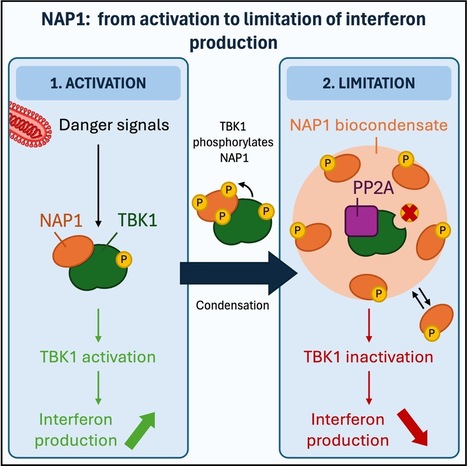

The authors show that the protein NAP1 is a rheostat, switching from activator to limiter of type I interferon (IFN) production via the sequestration of TBK1 (a key kinase in the IFN induction) in biocondensates where the kinase is deactivated by a phosphatase.
Type I interferons (IFNs) are induced and secreted following the recognition of pathogen-associated molecular patterns (PAMPs) by pattern recognition receptors (PRRs), triggering a signaling cascade. This cascade results in the activation of TANK-binding kinase 1 (TBK1), which phosphorylates the transcription factors IRF3 and/or IRF7. Phosphorylated IRF3/7 undergo homo- or heterodimerization, translocate to the nucleus, and induce the expression of type I IFN-related genes.
To prevent excessive IFN production, which can lead to interferonopathies, the IFN induction pathway is tightly regulated. This regulation involves post-translational modifications (such as phosphorylation and ubiquitination) and the action of several regulatory proteins, including the TBK1-adaptor proteins: NAP1, SINTBAD and TANK.
The authors demonstrate that during rabies virus infection or dsRNA exposure, TBK1-adaptor proteins NAP1, SINTBAD, and TANK form dynamic, liquid-like cytosolic biocondensates. They also show that NAP1 biocondensates selectively concentrate TBK1. Using NAP1 knockout cell lines, they revealed the dual role of NAP1: initially, NAP1 binds TBK1 and enhances its activity, promoting IFN production. Subsequently, TBK1-mediated phosphorylation of NAP1 triggers condensate formation. The biocondensates recruit both TBK1 and the phosphatase PP2A, which dephosphorylates and deactivates TBK1, thereby limiting IFN induction. Additionally, in patients with lupus or interferonopathies, NAP1 variants were identified, that fail to form biocondensates upon danger signal exposure. These variants sustain TBK1 activation without negative feedback, explaining immune dysregulation linked to NAP1 mutations.
Researchers from the I2BC and their collaborators show that condensate formation is thus an additional layer of regulation for IFN induction, extending beyond the post-translational modifications.
More information: https://www.nature.com/articles/s41467-026-76769-w
Contact: Yves Gaudin yves.gaudin@i2bc.paris-saclay.fr





