I2BC Paris-Saclay
18.9K views | +9 today
Your new post is loading...
Scooped by I2BC Paris-Saclay
October 29, 5:19 AM
Scoop.it!

One foldamer, two histone epitopes: mimicking an extended protein interface.

One foldamer, two histone epitopes: mimicking an extended protein interface. | I2BC Paris-Saclay | Scoop.it

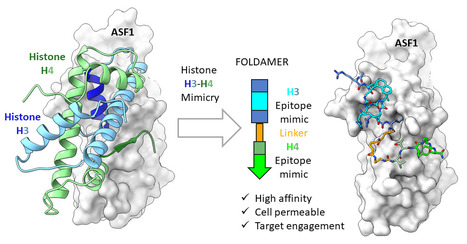
Can a synthetic molecule mimic an extended protein interface? Peptide-oligourea foldamers mimic two histone epitopes recognized by anti-silencing function 1, an emerging and challenging target in oncology, with nanomolar affinity and cell permeability.


Extended protein-protein interfaces are challenging targets for synthetic ligands competing with endogenous partners, as most peptidomimetics target a single recognition motif. The histone chaperone anti-silencing function 1 (ASF1), involved in chromatin assembly and genome maintenance and an emerging target in oncology, illustrates this challenge: its essential interaction with the H3-H4 histone dimer spans two epitopes, an H3 α-helix and an H4 β-strand.

To target this interface, the Molecular Assemblies and Genome Integrity team at I2BC (Université Paris-Saclay, CEA, CNRS) joined forces with Gilles Guichard’s team at CBMN (Laboratoire de Chimie et Biologie des Membranes et Nanoobjets) and IECB (Institut Européen de Chimie et Biologie) in Bordeaux. Their approach combines peptide-oligourea foldamer chemistry and synthesis with molecular design, structural biology, and biophysical characterization. Foldamers are synthetic molecules mimicking structural features of proteins.

High-resolution crystal structures obtained with researchers at Synchrotron SOLEIL guided the design of peptidomimetics combining both histone epitopes. These foldamers reproduce the natural H3-H4 binding mode on ASF1, with affinities reaching 6 nanomolar, and resist degradation in human plasma. This optimized compound binds endogenous ASF1 in cell extracts. Cell biology studies with the PICCEL facility at the CEA Fontenay aux Roses (formerly PARi) demonstrated their cell permeability and antiproliferation activity. 

Selected as a Very Important Paper (VIP) in Angewandte Chemie International Edition, this collaborative study highlights a strategy for targeting extended protein-protein interfaces. The resulting foldamers provide tools to investigate ASF1 function and may help target other challenging intracellular protein-protein interactions.


More information :

https://onlinelibrary.wiley.com/doi/10.1002/ange.4112426

Contact : Françoise Ochsenbein francoise.ochsenbein@i2bc.paris-saclay.fr

No comment yet.
Scooped by I2BC Paris-Saclay
October 1, 5:31 AM
Scoop.it!

Unveiling a missing component of the atypical type IV secretion system required for natural transformation of Helicobacter pylori.

Unveiling a missing component of the atypical type IV secretion system required for natural transformation of Helicobacter pylori. | I2BC Paris-Saclay | Scoop.it

Identification of a Missing Component of the Exogenous DNA Internalisation System During Natural Transformation in Helicobacter pylori.


Horizontal gene transfer plays a crucial role in the evolution of bacterial populations. In pathogens, it promotes the spread of antibiotic resistances and virulence factors. Helicobacter pylori, a bacterium infecting the stomach of 50% of the world's population and responsible for the majority of gastric ulcers and cancers, has a remarkable capacity to exchange genes via natural transformation. Through this pathway, bacteria can capture and incorporate into their genome DNA present in their environment. To do this, H. pylori uses an atypical DNA uptake system: a type 4 secretion system (T4SS) named ComB, rather than the pilus present in all other naturally transformable bacteria. Compared to classical T4SS, certain components appeared to be absent from this system.

In a study published in PLoS Pathogens, researchers from the Department of Cellular and Molecular Radiobiology (François Jacob Institute of Biology, CEA/UPSaclay, UP Cité, Fontenay aux Roses) and I2BC (CEA/CNRS/UPSaclay, Gif-sur-Yvette), in collaboration with a laboratory at the Pasteur Institute, identified an ATPase essential for this secretion system. Homology searches detected a gene, located outside the known operons of the ComB complex, capable of encoding an ATPase associated with a T4SS. Genetics and biochemistry experiments demonstrated that the protein encoded by this gene, designated as ComB11, is indeed an ATPase essential for natural transformation of H. pylori. Structural modelling revealed an interaction between this ATPase and the ComB4 component of the ComB system, confirming its membership in this atypical T4SS.

More information: https://journals.plos.org/plospathogens/article?id=10.1371/journal.ppat.1014140

Contact: Jessica Andreani jessica.andreani@i2bc.paris-saclay.fr

No comment yet.