Your new post is loading...

|
Scooped by
I2BC Paris-Saclay
November 10, 2021 8:31 AM
|
Agrobacterium tumefaciens fitness genes involved in the colonization of plant tumors and roots
High throughput analysis of fitness genes in a bacterial pathogen: towards the discovery of new targets to develop treatments. The pathogenic bacterium Agrobacterium tumefaciens provokes crown-gall disease on a wide diversity of host plants. It colonizes the galls it causes on host plants, poplar and tomato plant for instance. This pathogen also colonizes the roots of host plants and non-host plants, such as maize. We used a genome-wide approach (transposon sequencing) to discover Agrobacterium tumefaciens genes involved in reproductive success on tomato and poplar galls and tomato and maize roots. We used this knowledge to develop plant protection approaches against this pathogen. This wok was supported by the I2BC sequencing platform. More information here Contact person: Denis Faure
|
|
Scooped by
I2BC Paris-Saclay
October 14, 2021 2:54 AM
|
The Environmental and Agronomical Genomics 2021 symposium is jointly organised by France Génomique and the GDR Génomique Environnementale.
Last call for registration at the Environmental and Agronomical Genomics 2021 Symposium until 13th October. The Environmental and Agronomical Genomics 2021 symposium will be the opportunity to have an update on most recent environmental genomics research, as well as an overview of high scientific impact projects carried out in collaboration with France Genomique platforms. This year we are also celebrating the 10th anniversary of the GDR Génomique environnementale. Contact person: Denis Faure
|
|
Scooped by
I2BC Paris-Saclay
September 16, 2021 5:37 AM
|
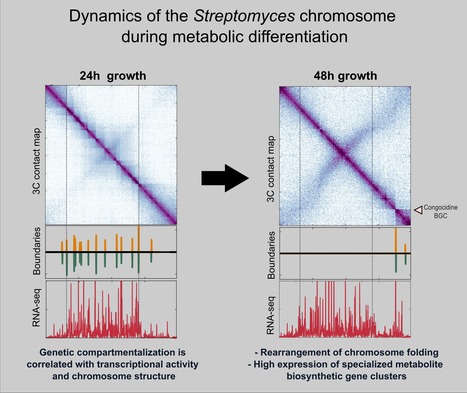
The folding dynamics of Streptomyces' chromosome during metabolic differentiation is revealed
A joint collaborative effort of the Microbiology, Genome Biology Departments and the Sequencing Facility of the I2BC unveiled the dynamics of the linear chromosome of Streptomyces ambofaciens, during metabolic differentiation. Streptomyces are soil bacteria mostly known for their complex life cycle (uni- to multi-cellular transition, sporulation, metabolic differentiation) and their prolific specialized metabolism (e.g. antibiotics and pigments), widely exploited in medicine, agriculture and the food industry. Their genome possesses remarkable characteristics including a large size (6-12 Mb) and a high GC content (circa 72%) and, even more unusual in bacteria, a linear configuration. Interestingly, Streptomyces chromosomes present a remarkable genetic compartmentalization, with a distinguishable central region harboring core genes and two terminal regions enriched in specialized metabolite biosynthetic gene clusters. The molecular mechanisms governing the structure and function of these compartmentalized chromosomes remain mostly unknown. In this work, teams of the Genome Biology, the Microbiology Department and the Sequencing Facility of the I2BC in collaboration with the DynAMIC (Lorraine University -INRAe) and the TIMC-IMAG ( Grenoble Alpes University - CNRS) Institutes, show that chromosome structure in Streptomyces ambofaciens correlates with genetic compartmentalization during exponential phase. Conserved, large and highly transcribed genes form boundaries that segment the central part of the chromosome into domains, whereas the terminal ends tend to be transcriptionally quiescent compartments with different structural features. The onset of metabolic differentiation is accompanied by a rearrangement of the chromosome architecture, from a rather ‘open’ to a ‘closed’ conformation, in which highly expressed specialized metabolite biosynthetic genes form new domain boundaries. Altogether, these results indicate that the linear chromosome of S. ambofaciens is partitioned into structurally distinct entities, suggesting a link between chromosome folding, gene expression and genome evolution. More details here Contact persons: Virginia Lioy & Stephanie Bury-Mone Follow the team
|
|
Scooped by
I2BC Paris-Saclay
June 9, 2021 7:28 AM
|
SEPSIS, le vrai visage de la COVID-19 : Mieux comprendre et mieux soigner
Dans le cadre de la Journée mondiale de lutte contre le sepsis, le 13 septembre 2021, la Fédération Hospitalo Universitaire (FHU) SEPSIS organise le symposium "SEPSIS, le vrai visage de la COVID-19 : Mieux comprendre et mieux soigner". Ce symposium se déroulera au Ministère des Solidarités et de la Santé (Amphithéâtre Laroque- 14, avenue Duquesne 75007 Paris). La matinée comprendra des interventions destinées plus particulièrement aux scientifiques, alors que l’après-midi sera consacrée à l’information du grand public par des conférences de vulgarisation. Pour participer, il est nécessaire de vous inscrire en ligne. Le programme et le bulletin d'inscription sont disponibles à l'adresse ci-dessous: https://www.fhu-sepsis.uvsq.fr/symposium-sepsis-le-vrai-visage-de-la-covid-19-mieux-comprendre-pour-mieux-soigner Contact : pierre.tissieres@i2bc.paris-saclay.fr
|
|
Scooped by
I2BC Paris-Saclay
May 25, 2021 11:24 AM
|
Bradyrhizobium atypical differentiation in Aeschynomene legumes
Multiomic analysis of a suboptimal symbiotic interaction where a soybean nodulator (Bradyrhizobium diazoefficiens) faces NCR peptides in Aeschynomene afraspera and undergoes atypical terminal bacteroid differentiation In the legume-rhizobium nitrogen-fixing symbiosis, some host plants produce antimicrobial peptides called NCR to control their bacterial partner and trigger its cellular differentiation. Consequently, intracellular bacteroids become polyploid, elongated and with a permeabilized membrane, collectively resulting in an altered bacterial viability. We call this phenomenon terminal bacteroid differentiation (TBD), which is associated to a higher return on investment to the host of the symbiotic process. In the study by Nicoud et al. published in mSystems, we analyzed the physiology of Bradyrhizobium diazoefficiens USDA110 in symbiosis with its natural host soybean, which does not trigger TBD, and in interaction with Aeschynomene afraspera, a host producing NCR peptides and inducing TBD. To do so, we combined whole-nodule metabolomics, with bacterial transcriptomics and proteomics. We found that the maladapted symbiosis between Bradyrhizobium and Aeschynomene is suboptimal (reduced benefit to the host) and that bacteria undergo an intense stress. Finally, we characterized bacteroid differentiation by a combination of flow cytometry and image based morphometry and found a disconnection of the canonical features of TBD, with bacteroids that fail to elongate and endoreduplicate, while their membranes become preamble and their viability reduced. https://doi.org/10.1128/mSystems.01237-20 Contact: benoit.alunni@i2bc.paris-saclay.fr
|
|
|
Scooped by
I2BC Paris-Saclay
October 14, 2021 3:05 AM
|
Presence of 2-hydroxymyristate on endotoxins is associated with death in neonates with Enterobacter cloacae complex septic shock
This is the first published evidence linking lipopolysaccharide structural moiety to neonatal sepsis outcome and opens the possibility of using the 2-hydroxymyristate marker as a detection tool for high-risk patients, which could help reduce their mortality. Enterobacter cloacae complex species are involved in infections among critically ill patients. After a recent E.cloacae outbreak of fulminant neonatal septic shock, we conducted a study to determine whether septic shock severity and its lethal consequence are related to structural features of the endotoxin (lipopolysaccharide [LPS]) of the strains isolated from hospitalized infants and more specifically its lipid A region. It appeared that the LPSs are very heterogeneous, carrying fifteen different molecular species of lipid A. The virulence was correlated with a structural feature identified by matrix-assisted laser desorption ionization–time of flight mass spectrometry and gas chromatography coupled with mass spectrometry: the presence of 2-hydroxymyristic acid as a secondary substituent in lipid A. This is the first published evidence linking LPS structural moiety to neonatal sepsis outcome and opens the possibility of using this fatty acid marker as a detection tool for high-risk patients, which could help reduce their mortality. More details here Contact person: Pierre Tissières Follow the team
|
|
Scooped by
I2BC Paris-Saclay
September 16, 2021 6:16 AM
|
Clostridioides difficile CRISPR-Cas system PAM specificity for interference and adaptation
First experimental evidence for type I-B CRISPR-Cas system adaptation in the emerging human enteropathogen C. difficile and a functional link between the adaptation and interference CRISPR machineries sharing similar tri-nucleotide PAM motif for recognition of foreign nucleic acid sequences. CRISPR-Cas systems provide prokaryotes with adaptive immunity for defense against foreign nucleic acid invaders, such as viruses or phages and plasmids. The CRISPR-Cas systems are highly diverse, and detailed studies of individual CRISPR-Cas subtypes are important for our understanding of various aspects of microbial adaptation strategies and for the potential applications. The significance of this collaborative work of French, Russian and US labs from I2BC, Skoltech and Waksman Institute of Microbiology is in providing the first experimental evidence for type I-B CRISPR-Cas system adaptation in the emerging human enteropathogen Clostridioides difficile. This bacterium needs to survive in phage-rich gut communities, and its active CRISPR-Cas system might provide efficient antiphage defense by acquiring new spacers within CRISPR arrays that constitute memory for further invader elimination. This study also reveals a functional link between the adaptation and interference CRISPR machineries. The definition of all possible functional trinucleotide motifs upstream protospacers within foreign nucleic acid sequences is important for CRISPR-based genome editing in this pathogen and for developing new drugs against C. difficile infections. More details here Contact person: Olga Soutourina Follow the team
|
|
Scooped by
I2BC Paris-Saclay
July 27, 2021 5:35 AM
|
Plant endosymbionts defend themselves against the hostile host environment
Rhizobium endosymbionts of legume plants use multiple mechanisms for resistance against antimicrobial peptides produced by the host plant cells. The nitrogen fixing symbiosis of legumes with rhizobium bacteria has a predominant ecological role in the nitrogen cycle and has the potential to provide the nitrogen required for plant growth in agriculture. The host plants allow the nitrogen-fixing rhizobia to colonize the cells of specific symbiotic organs, the nodules, in very large numbers in order to produce sufficient reduced nitrogen for the plant needs. Some legumes, including Medicago spp., produce massively antimicrobial peptides to keep this large bacterial population in check. These peptides, known as NCRs, have the potential to kill the rhizobia but in the nodule cells, they rather inhibit the division of the endosymbionts and trigger them into a morphologically differentiated state, resulting in a high nitrogen fixing activity. In this study published in mBio, the Plant-Bacteria Interactions team of I2BC shows that the bacterial resistance to the antimicrobial activity of the NCR peptides in the Medicago symbiont Sinorhizobium meliloti is multifactorial and requires peptide transporters, the lipopolysaccharide outer membrane and the stress response regulator RpoH1. More details here Contact: peter.mergaert@i2bc.paris-saclay.fr
|
|
Scooped by
I2BC Paris-Saclay
June 9, 2021 7:24 AM
|
Oxygen transport to gut symbionts: a new route to fight insect pests?
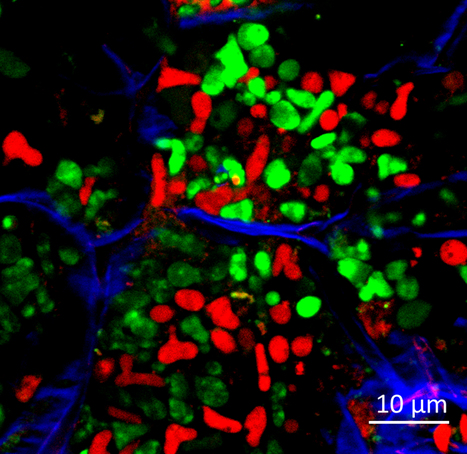
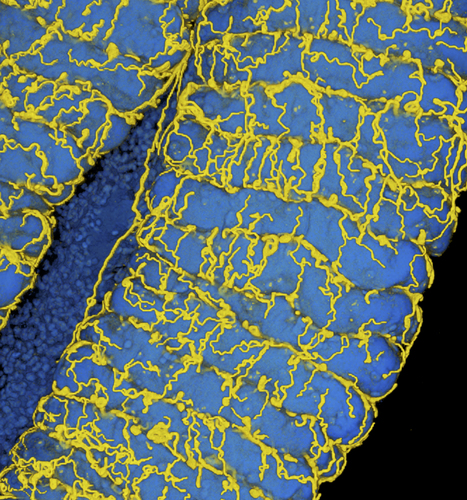
Colonization of the insect gut with symbiotic bacteria triggers the development of a tracheal network that supplies oxygen to the symbionts. The insect respiratory system consists of tubular tracheae that transport oxygen to the organs. The tracheal network is dynamic and responds to developmental, environmental and nutritional cues. In a recent article published in the Proceedings of the National Academy of Sciences USA, the Plant Bacteria Interactions team of the Microbiology Department of I2BC, in collaboration with the team of Yoshitomo Kikuchi at the National Institute of Advanced Industrial Science and Technology – Hokkaido in Japan, shows that, in the insect pest Riptortus pedestris, the establishment of an essential symbiosis in the gut with the aerobic bacterial species Burkholderia insecticola triggers the development of an extensive tracheal network enveloping the gut. Genetically blocking the trachea formation prevents this gut symbiosis. The researchers further discovered that the reactive oxygen species-generating enzyme Duox is crucial for the formation and stabilization of tracheae by forming protein cross-links in the tracheal matrix. Reactive oxygen species generated by Duox can be scavenged with antioxidants such as N-acetylcysteine, and feeding insects with this compound prevents tracheal formation and symbiosis. Since many insects obligatorily depend on their symbioses, triggering their collapse by the specific inhibition of the respiratory network with antioxidants could be a new route to fight insect pests. More details here: https://doi.org/10.1073/pnas.2020922118 Contact: peter.mergaert@i2bc.paris-saclay.fr
|
|
Scooped by
I2BC Paris-Saclay
May 25, 2021 9:59 AM
|
The key lipopolysaccharide modifications for antibiotic resistance in Escherichia coli
Escherichia coli acquires resistance to polymyxin B upon the activation of two-component systems, but this is at the expense of innate bile acid resistance. The lack of lipopolysaccharide phosphorylation accounts for bile susceptibility and impairs intestinal colonization in mice. The surface properties of bacterial cells play a key role in resistance to various antimicrobial agents. Gram-negative bacteria expose lipopolysaccharides (LPS) on their surface, which can undergo different structural modifications. However, some of these modifications may be beneficial in some circumstances, but detrimental in others. In this study, published in Frontiers in Microbiology, the team of Thierry Touzé, in collaboration with a team from Institut Pasteur, showed that Escherichia coli cells resist to cationic antimicrobial peptide polymyxin B, one last resort antibiotic, under conditions that simultaneously activate two-component regulatory systems PmrA/B and PhoP/Q. Among a set of modifications, they identified those responsible for this resistance, which occurs on the lipid A moiety (known as the endotoxin) from LPS. The acquisition of polymyxin B resistance came at the expense of loss of innate resistance to deoxycholate, a major component of bile. They provide evidences that bile susceptibility arises from the inhibition of LpxT-dependent modification, which consists in lipid A phosphorylation. Bile acids are abundant in the small intestine, where they modulate the commensal flora and the researchers further showed that the inactivation of lpxT impaired gut colonization in mice. These results highlight the importance of lipid A decorations and their tight regulation in the lifestyle of E. coli and probably other Enterobacteriaceae that exhibit the same modifications https://www.frontiersin.org/articles/10.3389/fmicb.2021.676596/full Contact: thierry.touze@i2bc.paris-saclay.fr
|