I2BC Paris-Saclay
15.4K views | +2 today
Follow
Your new post is loading...
Scooped by I2BC Paris-Saclay
December 20, 2021 4:32 AM
Scoop.it!

New arrivals on I2BC PIM facility

New arrivals on I2BC PIM facility | I2BC Paris-Saclay | Scoop.it

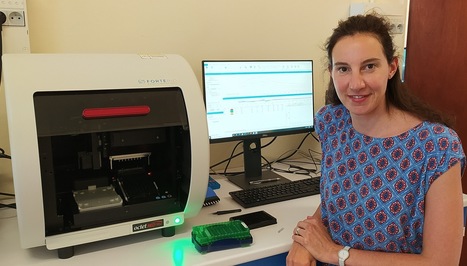
We are very pleased to announce that Magali Noiray arrived this summer to work on the PIM platform.This arrival coincides with the commissioning of BLI, a new machine dedicated to the study of macromolecular interactions.

Magali Noiray has a solid expertise in the field of the study of macromolecular interactions (SPR, ITC, DSC...) and worked for 10 years on the interaction platform of Chatenay Malabry (Pharmacy Faculty) specialized in nanomedicines and small molecules. She joined the PIM platform this summer to strengthen the team and to work with Magali Aumont. In parallel, thanks to funding obtained last year from the Ile de France region , we have obtained and put into operation a new device to replace the SPR. Based on Bio-Layer Interferometry (BLI), the fluidics-free ForteBio’s Octet® RED96 system is a multi-functional, label-free, real-time analysis instrument. It is ideal for rapidly screening protein-protein, protein-nucleic acids and protein-small molecule interactions. The Octet RED96 system can be used for a wide range of analyses. System provides up to 8-channel quantitation and kinetic measurements of molecules greater than 150 Da, compatibility with 96-well plates and cooling for temperature control down to 15°C.

Team Protein Interaction

No comment yet.
Scooped by I2BC Paris-Saclay
November 10, 2021 8:44 AM
Scoop.it!

The Physcomitrium (Physcomitrella) patens PpKAI2L receptors for strigolactones and related compounds function via MAX2-dependent and independent pathways

The Physcomitrium (Physcomitrella) patens PpKAI2L receptors for strigolactones and related compounds function via MAX2-dependent and independent pathways | I2BC Paris-Saclay | Scoop.it

Mass spectrometry was used to allow the characterization of the biosynthesis of a novel class of phytohormones, striptolactones, in the bryophyte Physcomitrium patens and to compare this processes with the more known vascular plants. Results on Physcomitrium highlight surprising evolutive innovations from vascular plant.

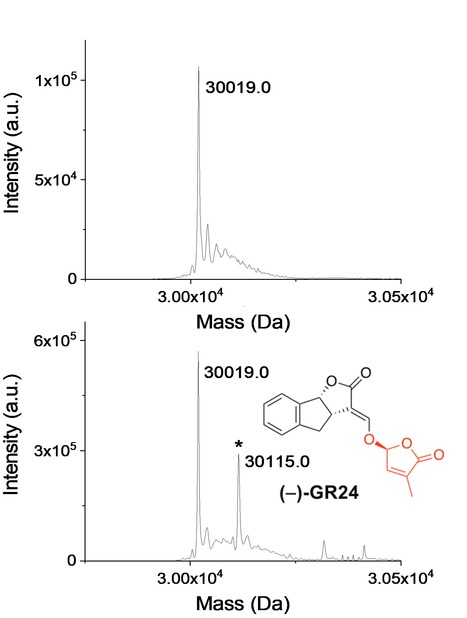
Strigolactones (SL) make up a novel class of phytohormones that are found across the whole land plant lineage. In vascular plants, the main hormonal role of SL is the repression of shoot axillary branching. However, SL are also a major symbiotic signal, granting the plant increased access to the nutrients and water contained in the rhizosphere. These two functions of SL led to the hypothesis that these molecules have been instrumental at the time of land colonization by plants, approximately 450 million years ago. Studying SL biosynthesis and signaling in the bryophyte Physcomitrium patens (P. patens, a non-vascular plant), and comparing these processes with the available knowledge in vascular plants, enables to investigate the evolution of SL cellular pathways in land plants. In angiosperms, the perception of SLs relies on a receptor called D14 (encoded by the same gene family as KAI2) along with the F-box protein MAX2. In moss, Max2 is not required for the SL response although it possesses 13 KAI2-like genes (PpKAI2L). An unusual aspect of SL perception is that the D14 protein is both a receptor and an enzyme that cleaves its substrate (and covalently binds part of the SL) in a signaling mechanism that is still under debate. To further investigate whether PpKAI2L proteins play roles as receptors of SLs and related compounds, we examined the covalent attachment of the artificial SL GR24 isomers to the PpKAI2L proteins by mass spectrometry (MS). Analyses revealed 96 Da increments (corresponding to the D ring mass) when AtKAI2 and PpKAI2L were incubated with GR24 isomers indicating that moss PpKAI2L proteins, like vascular plant receptors, covalently link GR24 enantiomers. As SL signaling is not conserved in P. patens, it appears that the known SL signaling pathway results from a vascular plants specific innovation. Likewise, SL response in P. patens would be the product of a convergent evolution. Therefore, the question as to how P. patens transduces the SL signal, downstream of perception by specific PpKAI2L proteins, remains open.

More details here

Contact person: David Cornu

No comment yet.
Scooped by I2BC Paris-Saclay
December 20, 2021 4:03 AM
Scoop.it!

The Physcomitrium (Physcomitrella) patens PpKAI2L receptors for strigolactones and related compounds function via MAX2-dependent and independent pathways

The Physcomitrium (Physcomitrella) patens PpKAI2L receptors for strigolactones and related compounds function via MAX2-dependent and independent pathways | I2BC Paris-Saclay | Scoop.it

Mass spectrometry was used to investigate the role of PpKAI2L protein in the moss Physicomitrium patens as receptor of a class of phytohormones , striptolactones, in the moss Physcomitrium patens and to compare this processes with the more known vascular plants. Results on Physcomitrium highlight surprising evolutive innovations from vascular plant.

Abstract from The Plant Clell article: Strigolactones (SL) make up a novel class of phytohormones that are found across the whole land plant lineage. In vascular plants, the main hormonal role of SL is the repression of shoot axillary branching. However, SL are also a major symbiotic signal, granting the plant increased access to the nutrients and water contained in the rhizosphere. These two functions of SL led to the hypothesis that these molecules have been instrumental at the time of land colonization by plants, approximately 450 million years ago. Studying SL biosynthesis and signaling in the bryophyte Physcomitrium patens (P. patens, a non-vascular plant), and comparing these processes with the available knowledge in vascular plants, enables to investigate the evolution of SL cellular pathways in land plants. In angiosperms, the perception of SLs relies on a receptor called D14 (encoded by the same gene family as KAI2) along with the F-box protein MAX2. In moss, Max2 is not required for the SL response although it possesses 13 KAI2-like genes (PpKAI2L). An unusual aspect of SL perception is that the D14 protein is both a receptor and an enzyme that cleaves its substrate (and covalently binds part of the SL) in a signaling mechanism that is still under debate. To further investigate whether PpKAI2L proteins play roles as receptors of SLs and related compounds, we examined the covalent attachment of the artificial SL GR24 isomers to the PpKAI2L proteins by mass spectrometry (MS). Analyses revealed 96 Da increments (corresponding to the D ring mass) when AtKAI2 and PpKAI2L were incubated with GR24 isomers indicating that moss PpKAI2L proteins, like vascular plant receptors, covalently link GR24 enantiomers. As SL signaling is not conserved in P. patens, it appears that the known SL signaling pathway results from a vascular plants specific innovation. Likewise, SL response in P. patens would be the product of a convergent evolution. Therefore, the question as to how P. patens transduces the SL signal, downstream of perception by specific PpKAI2L proteins, remains open. This work was conducted by a team of INRAE (Sandrine Bonhomme) in collaboration with other teams of french institute (ICSN) and laboratory (LBPV). Mass spectrometry analyses were performed at the I2BC proteomics platform.

More information here.

Contact person: David Cornu

No comment yet.
Scooped by I2BC Paris-Saclay
June 19, 2021 8:36 AM
Scoop.it!

Microfabrication room opening in I2BC

Microfabrication room opening in I2BC | I2BC Paris-Saclay | Scoop.it

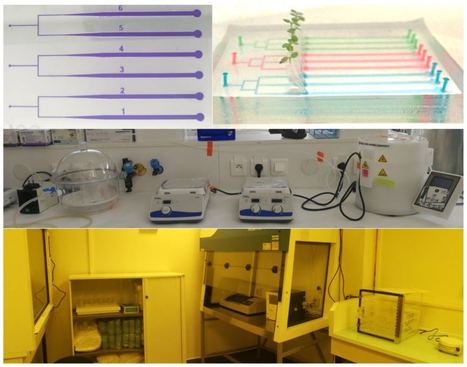
We are glad to announce the opening of the microfabrication room in Gif-sur-Yvette (room 00-120, Bâtiment 23). This equipment was funded by “Région Ile de France” under the DIM ELICIT (Domaine d’Intérêt Majeur “Empowering LIfe sCiences with Innovative Technologies”)

Microfluidics is the science of fluids manipulation at the microscale using channels with dimensions of tens to hundreds of micrometers. It is also a technology called Lab-on-Chip used in Physics, Chemistry and Biology. The properties of flows at the microscale allow to work faster and cheaper with smaller sample volumes. The polymer used to produce microfluidics chip is transparent and biocompatible and provides access to time-lapse live imaging of biological systems on a microscope. It has many applications like cells sorting, encapsulation of drugs, DNA sequencing, micro-organisms swimming, mixing, etc.
The microfabrication plateform is a clean room fully equiped to make microfluidic chips from the mold design and its characterization, to the polymer microchip fabrication. It is managed by Jessica MARION et Vassanti AUDEMAR who handle the equipment :
- Clewin 5 : software to design the chip
- Laminator (Peak) or spin coater (Laurell) and UV exposer (Kloé) : to produce molds
- Profilometer (Filmetrics) : to characterize the mold
- Plasma cleaner (Harrick Plasma) : to seal the microfluidic chip
We will be happy to welcome you.
Contacts : Sébastien THOMINE (sebastien.thomine@i2bc.paris-saclay.fr), Jessica MARION ( jessica.marion@i2bc.paris-saclay.fr ), Vassanti AUDEMAR ( vassanti.audemar@i2bc.paris-saclay.fr )

No comment yet.