Patient Power® is a service of Patient Power, LLC, based in Seattle with team members around the world. Patient Power was founded by two health communications pioneers, Andrew and Esther Schorr. They previously founded HealthTalk.com, a leader in support for people with chronic illnesses and cancer. Patient Power® is devoted to helping you, the cancer patient or survivor and your family through knowledge, to get the best medicine and return to or maintain good health.
'Putting pandemics in perspective', by Mark Honigsbaum, an article from History & Policy, the independent initiative working for better public policy through an understanding of history
Some Viral Hemorrhagic Fever causing agents like Lassa fever, Rift Valley fever, Marburg virus, Ebola virus and Bolivian hemorrhagic fever are highly contagious and deadly diseases, with the theoretical potential to become pandemics. Their ability to spread efficiently enough to cause a pandemic is limited, however, as transmission of these viruses requires close contact with the infected vector, and the vector only has a short time before death or serious illness. Furthermore, the short time between a vector becoming infectious and the onset of symptoms allows medical professionals to quickly quarantine vectors, and prevent them from carrying the pathogen elsewhere. Genetic mutations could occur, which could elevate their potential for causing widespread harm; thus close observation by contagious disease specialists is merited.
Accepting the 2006 TED Prize, Dr. Larry Brilliant talks about how smallpox was eradicated from the planet, and calls for a new global system that can identify and contain pandemics before they spread.
David Quammen talks about scary new emerging diseases—such as Ebola, SARS, bird flu, AIDS—and where they emerge from: wildlife. Most are caused by viruses. The phenomenon, when such a virus passes from wild animals into people, is called spillover. Two factors account for the increasing risk of spillovers that may lead to pandemics: disruption (of diverse ecosystems) and connectivity (of the global human population). This is our future.
The raise of Internet and advances in telecommunication and software services led to think the chance of connect every object. One of the first topics that arise when talking about the Internet of Things is the concept of ubiquitous society, where everything is traceable, everything can be identified and everything is connected together. These capacities createthe concept of Internet of Things, where sharing information between objects and devicesconnected to the Internet becomes reality. A short video explaining the appearance and evolution of Internet of Things is shown below.
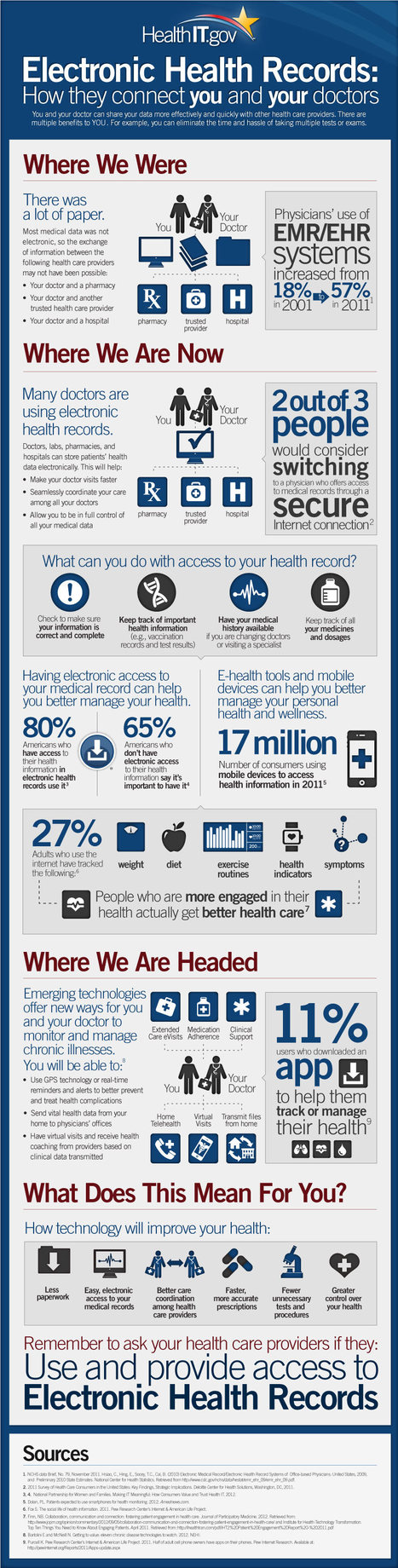
Check out ONC's Electronic Health Record History Infographic and learn about how electronic health records connect you and your doctor and how they are evolving.
Dave deBronkart visited his doctor’s office in 2006 with nagging shoulder pain. A subsequent X-ray showed that his shoulder would heal, but incidentally also revealed a shadow on his lung, turning what deBronkart expected to be a routine visit into diagnosis of a rare form of kidney cancer.
When Dave deBronkart learned he had a rare and terminal cancer, he turned to a group of fellow patients online -- and found a medical treatment that even his own doctors didn't know. It saved his life. Now he calls on all patients to talk with one another, know their own health data, and make health care better one e-Patient at a time.
An epidemic, whether naturally occurring or deliberately orchestrated, that introduces a viral substance as deadly as AIDS and as quickly propagating as SARS, is a major threat to human security.
SARS, avian flu, swine flu ... each virus outbreak raises the question: What can be done? A compelling answer from virus hunter Nathan Wolfe, who's outwitting the next pandemic by staying two steps ahead: discovering new, deadly viruses where they first emerge -- passing from animals to humans among poor subsistence hunters in Africa -- and stopping them before they claim millions of lives.
In our increasingly globalized world, a single infected person can board a plane and spread a virus across continents. Mark Honigsbaum describes the history of pandemics and how that knowledge can help halt future outbreaks.
To be held on 21 and 22 April 2014 at Singapore EXPO Convention & Exhibition Centre, the inaugural edition of IoT Asia is jointly organised by the Singapore Industrial Automation Association and the Singex Group.
The Internet of Things will create economic value of between $2.7 trillion and $6.2 trillion over the next twelve years with the biggest impacts felt in healthcare and manufacturing, according to a study by McKinsey.
The study, published in the January/February issue of the Annals of Family Medicine, shows EHR adoption by family physicians has doubled since 2005, with researchers estimating that the adoption rate will exceed 80 percent by the end of 2013. Findings also reveal a higher percentage of EHR adoption among physicians in comparison to a July 2012 study conducted by the CDC's Center for National Health Statistics, which reported that 55 percent of office-based physicians had adopted EHRs.
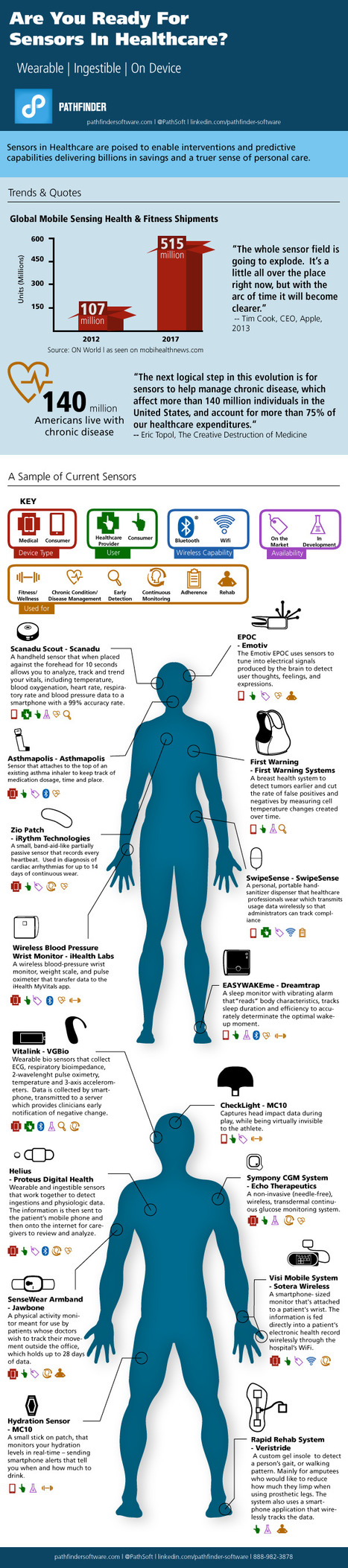
The above infographic created by Pathfinder Software illustrates how wireless sensors in healthcare is poised to reshape healthcare to help manage chronic disease through predictive analytics.
To get content containing either thought or leadership enter:
To get content containing both thought and leadership enter:
To get content containing the expression thought leadership enter:
You can enter several keywords and you can refine them whenever you want. Our suggestion engine uses more signals but entering a few keywords here will rapidly give you great content to curate.


 Your new post is loading...