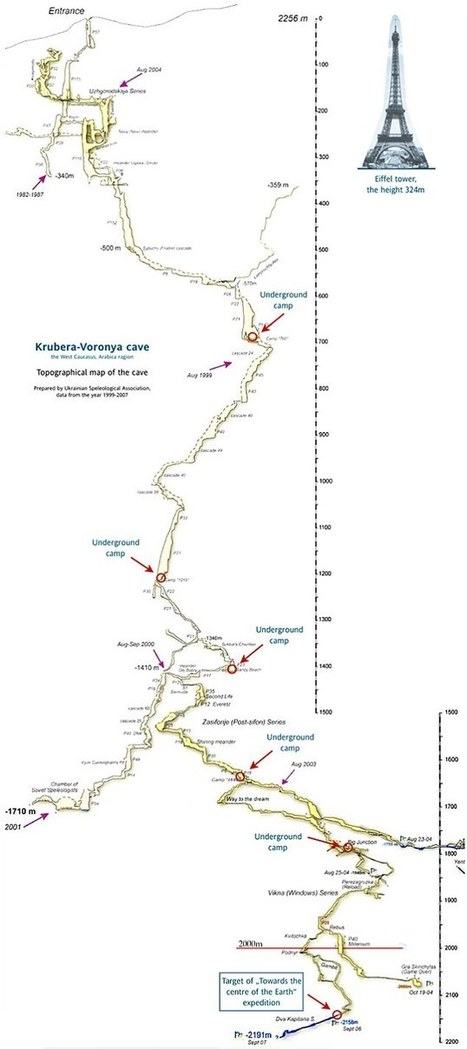
The Krubera cave is located in the Arabika Massif mountain range on the edge of the Black Sea in Abkhazia, which some argue is part of Georgia. It is said to be bottomless, but experts have managed to map Earth’s deepest cave. Intrepid explorers have charted every known twist and turn of the terrifying Krubera cave that measures 7,208ft (2,197meters) deep. And with every expedition the chasm seems to become deeper as divers plunge to new depths never visited by humans to extend the cave’s reach into the Earth.
The cave is called Voronya in Russia, which means crow's cave. The name was used as slang by Kiev cavers during the 1980s because of the number of crows nesting in the entrance pit. The Arabika Massif is one of the largest high-mountain limestone karst massifs (the main mass of an exposed structure) in the Western Caucasus, which is an area of southern Russia. It is composed of Lower Cretaceous and Upper Jurassic limestones that dip continuously southwest to the Black Sea and plunge below the modern sea level. The cave, which is named after Russian geologist Alexander Krubera, is the only chasm on Earth that's known to be deeper than 6,561ft (2,000m).
In 2005 he organized a series of expeditions and his team of 56 carried some five tons of equipment into the chasm. Much like scaling a mountain, the team had to cover certain distances so they could set up camp at depth of 2,300, 3,986, 4,630, and 5,380ft (700, 1,215, 1,410, and 1,640metres). The explorers were able to cook meals, sleep in tents and huddle together for warmth before venturing down the limestone rock faces for up to 20 hours at a time, sometimes though extremely cold water. It takes about 1 month to climb down to the bottom.
Via
Dr. Stefan Gruenwald


 Your new post is loading...