


Listening to jazz musicians improvise, how the piano player’s chords toy with the sax player’s runs and the standup bass player’s beats, it may seem like their music-making process is simply magic.
Via Creativity For Life

 Your new post is loading...
 Scoop.it! Listening to jazz musicians improvise, how the piano player’s chords toy with the sax player’s runs and the standup bass player’s beats, it may seem like their music-making process is simply magic. Via Creativity For Life 
No comment yet.
Sign up to comment
Scoop.it!

Astronomers have located the most distant galaxy ever measured in the universe, some 13.1 billion light-years from Earth. The galaxy, called EGS-zs8-1, is one of the brightest and most massive objects in the early universe, the scientists report in the journal Astrophysical Journal Letters. The finding pushes back the cosmic frontier of galaxy exploration to a time when the universe was only 5 per cent of its present age of 13.8 billion years. The galaxy existed so long ago, it appears to be only 100 million years old. The team of astronomers from Yale and the University of California, Santa Cruz say that EGS-zs8-1 is still forming stars rapidly, about 80 times faster than our galaxy, the Milky Way, which has a star formation rate of one star per year. "It has already grown more than 15 per cent of the mass of our own Milky Way today," says Pascal Oesch, lead author of the study from Yale University, New Haven, Connecticut. "But it had only 670 million years to do so. The universe was still very young then." Only a handful of galaxies currently have accurate distances measured in this very early universe. "Every confirmation adds another piece to the puzzle of how the first generations of galaxies formed in the early universe," says study co-author Pieter van Dokkum of Yale. "Only the most sensitive telescopes are powerful enough to reach to these large distances." The galaxy was first spotted in images from NASA's Hubble and Spitzer space telescopes. Calculating its exact distance from Earth was possible using the MOSFIRE instrument on the W.M. Keck Observatory's 10-meter telescope in Hawaii, researchers say. Via Dr. Stefan Gruenwald
Scoop.it!

Being creative, realizing our talents and crafting a fulfilling life involve self-awareness and respecting who we really are, including our unconscious depths. Many artists, psychologists and others refer to access to our creative inner depths as instinct... Via stan stewart
Scoop.it!

Food as it ripens or cooks and color gradients really get Brittany Wright, of Wright Kitchen, Seattle, going. Inspired by abstract artists, not food photography, her goal is to get people more familiar with what they eat by documenting how it changes. Via Ana Cristina Pratas
Scoop.it!

When you feel busy and overwhelmed innovation falls by the wayside, here's how to clear your mind and still get everything done. Via Creativity For Life

senameintr's curator insight,
May 15, 2015 3:09 AM
When you automate many task and spend time to travel you will get more creative ideas..
Scoop.it!

In his 2010 photo series 1503, photographer Christian Tagliavini recreates 16th century Renaissance portraits in eerie stylized images. Tagliavini spent six months painstakingly handcrafting all the costumes, including the rather elaborate hats. The models’ curiously long necks were achieved through deft photo manipulation.
Scoop.it!

It doesn’t matter whether you’re a writer, artist or hobbyist, this article is for anyone looking new ways to get their creativity flowing again. Via Creativity For Life
Scoop.it!

How to feel your way toward something honest, hidden under the trapdoor on the top of your skull. Via Creativity For Life
Scoop.it!
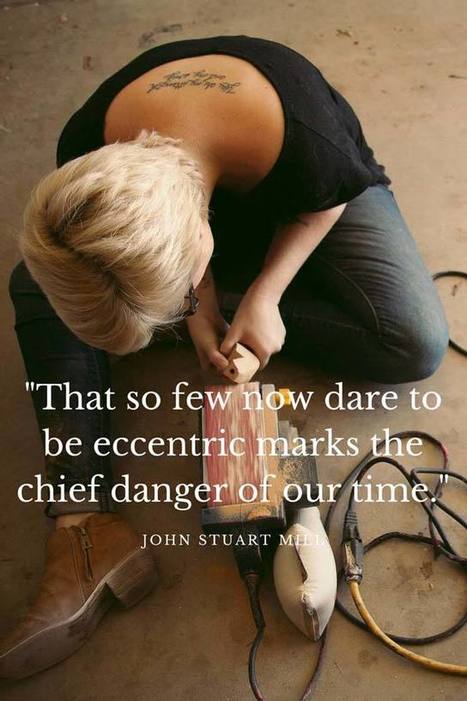
"Here's what most of us know about creativity: We know that you aren't born with it, and that it can be learned; we know that people can be at their most in group setting; we know that the expression of creativity isn't exclusive to the arts; and we know that you shouldn't wait around for inspiration to strike. But do we know that rewarding creative behaviour can stunt motivation? Do we know the creative brain depends on content just as much as it depends on imagination? Or that expecting one right answer all the time will actually prevent us from finding the right answer?" Via Beth Dichter

Beth Dichter's curator insight,
April 20, 2015 7:10 AM
Is it possible that we believe we are teaching our learners to be more creative, when we may be doing the opposite? This post from InformEd looks at ten habits that actually impede creative growth, although many of us believe that they promote it. Four are listed below, with brief explanations. * Thinking "outside the box" - If by thinking outside the box you believe that constraints are not necessary you may be wrong. This post says "originality may require constraints." * Rewarding good performance - I see this as the question of intrinsic vs extrinsic factors...and research is showing that providing rewards for completing tasks does not foster motivated children. * Using outdated teaching methods - education is constantly changing as we learn more about the brain and how we learn. How many of us hold on to methods that have been proven wrong, such as teacher-centered instruction, right brain/left brain paradigm, and teaching to the test? * Bringing technology to the student - technology has great potential, but it may also be a distraction. The post shares a story of a teacher who used Google Docs to help his students share knowledge, but quickly learned that they did not have the foundation to use Google Docs effectively. He reflected on what he saw happening in his classroom and realized that many students like to move while they think, and created an activity where students would have to work together using butcher paper, post-its and pens...and using this process taught the students how Google Docs works, but without the computer. There is much more information in the post so click through to see six more habits that are creativity killers.
Scoop.it!

Architects Anton Pramstrahler and Alex Niederkofler have unveiled their proposal for a wooden viewing tower near Bruneck, northern Italy, with a twisted body shaped like a tree trunk . The structure's spiralling form is intended to look like a tree that spreads out at its base and canopy – the result of a hexagonal section that rotates gradually as the tower ascends. The proposed location is a forest nearby, and the architects want to build 90 per cent of the tower's structure from wood to evoke its natural context.
Via Lauren Moss
Scoop.it!

What is the carbon footprint of one single Google search? How about a single email? These and many other questions are presented in the following infographic... Via Lauren Moss
Scoop.it!

The Makers: the ones mad for tinkering, experimenting, creating crazy things that move, blink and buzz. (Also known as the Inventor with 1000 Ideas or the DIY Guy/Gal). The Makers: the ones mad for tinkering, experimenting, creating crazy things that move, blink and buzz. (Also known as the Inventor with 1000 Ideas or the DIY Guy/Gal).

Ana C. Robles's curator insight,
April 24, 2015 8:57 AM
Inspiring and interesting Ted talks to Create.
Scoop.it!

In “How to Think Like Leonardo da Vinci”, Michael J. Gelb explains that by using mind mapping regularly, you can train yourself to be a more balanced thinker, like da Vinci. Gelb adds that mind mapping stimulates both brain hemispheres: it lets you develop a logical sequence and detailed organization of your material, while encouraging imagination and spontaneity. In fact, he explains that the note-taking styles of many of history’s geniuses feature a branching, organic structure complemented by lots of sketches, creative doodles, and keywords. Via Jeffrey Jablonski, Ph.D.
|
Scoop.it!

George Georgiou's project is designed to look at the topography and migrations of London: to explore the increasing diversity of a major Western City as the movement of people continues to change both the urban landscape and the community within it.
Scoop.it!

From
inhabitat

The Solar City Tower, designed by RAFAA, includes a bank of solar panels as well as pumped water storage to create energy during both the day and night for use in the Olympic Village.
Scoop.it!

The 600-foot-wide artwork, hanging hundreds of feet in the air, required 100 miles of rope.
Scoop.it!
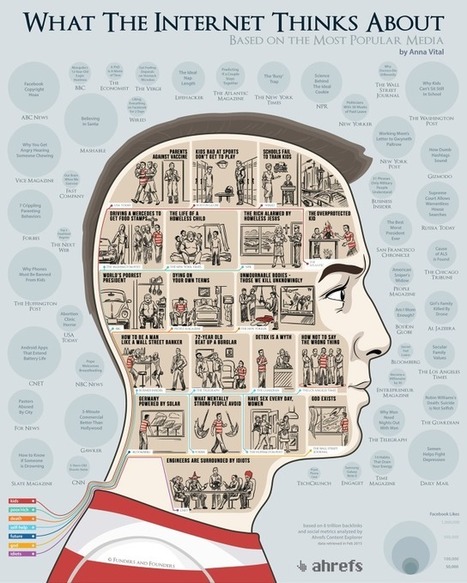
What does the Internet care about? What articles do we share the most? Using the data from the Ahrefs Content Explorer, the people at Funders and Founders Via Lauren Moss

Emilio Ruano's curator insight,
May 4, 2015 1:17 PM
At least, the concern about equality, energy and social welfare is there. I like the last one about engineers tho. Hahaha. 
Mackenzie Hamilton's curator insight,
October 13, 2015 8:36 AM
I think this article is awesome because they use data visualization to show what people share the most, visit the most, and search the most. Data is everywhere and people are using it everyday and sometimes don't even think about it.
Scoop.it!

As the only major U.S. city without formal zoning, Houston has a reputation as a freewheeling place where anything goes. But in truth, a complex patchwork of public and private regulation has evolved to impose order. In Houston, the lone major city in the United States that never has enacted zoning, the actual landscape hardly matches a dire hypothetical scenario. “If you drive around Houston after you’ve been to other major cities, you’ll find that, in many ways, we look very similar,” says Patrick Walsh, the city’s planning director. “We have commercial corridors with a lot of activity and a mix of uses; residential neighborhoods that are distinct and fairly uniform.” Via Lauren Moss
Scoop.it!

Student engagement is one of the most reliable predictors of gains in learning. We can all agree that students who actively participate in learning are m
Scoop.it!

Design and innovation consultancy IDEO has developed a series of self-driving vehicle concepts that could radically transform how we work, shop and travel.
Via Levin Chin
Scoop.it!

Norway’s Minister of Culture announced this week that a national FM-radio switch off will commence in 2017, allowing the country to complete its transition over to digital radio. It’s the end of an era. As Radio.no notes, Digital Audio Broadcasting (DAB) will provide Norwegian listeners more diverse radio channel content than ever before. Indeed, DAB already hosts 22 national channels in Norway, as opposed to FM radio’s five, and a TNS Gallup survey shows that 56% of Norwegian listeners use digital radio every day. While Norway is the first country in the world to set a date for an FM switch-off, other countries in Europe and Southeast Asia are also in the process of transitioning to DAB. requency modulation, or FM, radio was patented in 1933 and has been recording and sharing the human story for nearly a century. But its days are clearly waning. According to a 2012 Pew Study, while over 90% of Americans still listen to AM/FM radio at least weekly, more people are choosing to forgo analog radio for Internet-only services each year. It seems like it’s only a matter of time before many countries follow Norway’s example, although I’m not so sure I’m ready to part with my 80’s-era Grundig. Thing still sounds like a dream. Via Dr. Stefan Gruenwald
Scoop.it!

Social media for your small business is a great way to interact and connect with current or potential customers. Find out how you can leverage social media. Via The Fish Firm II
Scoop.it!

IDEO's Michael Hendrix shares his perspective on design thinking in preparation for his HOW Design Live presentation. Via A. Kosuke
Scoop.it!

In 1970, cities epitomized everything that was wrong with the planet. That's changed, partly because of Earth Day.
|






