


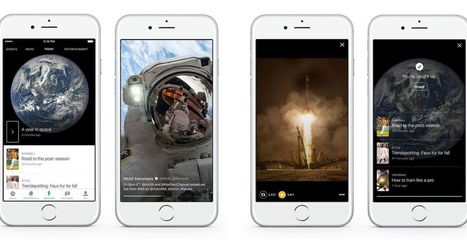
Twitter is opening up Moments to a slew of new partners, including brands, and plans to make the feature available to anyone in the next few months.
Via Jessica Kelly

 Your new post is loading...
 Scoop.it! Twitter is opening up Moments to a slew of new partners, including brands, and plans to make the feature available to anyone in the next few months. Via Jessica Kelly 

Jessica Kelly's curator insight,
August 10, 2016 6:50 PM
Who else is wondering what fabulous Moments they'll share? I'm thinking of when Facebook encouraged us to note Life Events, which immediately made want to post truly fascinating milestones, like "rearranged furniture." But that's me, of course, and yes, I'm pretty sure I have too much snark--and yes, there'll likely be some marketing value to this, eh? :>
Sign up to comment
Scoop.it!

For most people, firewood is simply an ingredient for bonfires, s'mores making, and storytelling. But for Paul Foeckler, the head designer and founder of onli…
Scoop.it!


Dr. Helen Teague's curator insight,
August 3, 2016 1:28 PM
Sternberg approach to creativity is as a process of discovering new ideas only to "sell" them later, to an audience of peers.
Scoop.it!

"People only post the highlights of their life on Instagram, so today the app adds its own version of Stories to poach goofy, off-the-cuff, everyday content.." Via Jessica Kelly
Jessica Kelly's curator insight,
August 2, 2016 4:03 PM
The title sums this up so well -- as does this: "You could call it Snapchat for adults, a way for brands to post more without overwhelming people’s feeds, an alternative to Instagram’s Like-driven success theater or a blatant ripoff." (Who else thinks it might be the last option in that list?)
Scoop.it!

Bonjour Cendrine, Do you offer guest blogging services in French? I am looking for writer to write and publish articles about social media on related websites to improve my website rankings (SEO).
Scoop.it!

If you manage social media profiles for your organization or client, heed these changes that the platform is rolling out.
Scoop.it!

Researchers have demonstrated a display that lets audiences watch 3-D films in a theater without extra eyewear. Dubbed “Cinema 3D,” the MIT / Weizmann Institute of Science prototype uses lenses and mirrors to enable viewers to watch a 3-D movie from any seat.
“Existing approaches to glasses-free 3-D require screens whose resolution requirements are so enormous that they are completely impractical,” says MIT professor Wojciech Matusik, one of the co-authors on a related paper whose first author is Weizmann PhD Netalee Efrat. “This is the first technical approach that allows for glasses-free 3-D on a large scale.”
Via Dr. Stefan Gruenwald
Scoop.it!

Want to create effective mobile learning for your corporate learning experiences? Check 7 key Dos And Don'ts Of Mobile Learning.
Scoop.it!

Jakub Marian has created a map of the best European countries, ranked in order of well-being.
Scoop.it!

Entrepreneur Network partner Evan Carmichael compiles tips from five innovative thinkers to help you discover where your talents and interests intersect.
Scoop.it!

The robot revolution is coming to your living room, and it's adorable.
|
Scoop.it!

It’s easy to assume that for extremely bright young pupils, life in the classroom is a snap. But when conventional school curricula fail to stimulate their hungry young brains, leaving them bored and stymied, these kids may get lost in the system. Some end up with C averages and slip into truancy, and many may never blossom to their full potential. It’s a big loss for lots of reasons, including the fact that these precocious kids represent a unique pool of talent for generating new ideas and innovations. And because of inadequate policies, we may be losing opportunities to nurture the Henry Fords and Marie Curies of the future.
Learn more / En savoir plus / Mehr erfahren:
http://www.scoop.it/t/21st-century-learning-and-teaching/?tag=Gifted+kids
Via Gust MEES

Gust MEES's curator insight,
August 11, 2016 9:49 AM
It’s easy to assume that for extremely bright young pupils, life in the classroom is a snap. But when conventional school curricula fail to stimulate their hungry young brains, leaving them bored and stymied, these kids may get lost in the system. Some end up with C averages and slip into truancy, and many may never blossom to their full potential. It’s a big loss for lots of reasons, including the fact that these precocious kids represent a unique pool of talent for generating new ideas and innovations. And because of inadequate policies, we may be losing opportunities to nurture the Henry Fords and Marie Curies of the future.
Learn more / En savoir plus / Mehr erfahren:
http://www.scoop.it/t/21st-century-learning-and-teaching/?tag=Gifted+kids
Scoop.it!

Pantone Studio launches today in the App Store and is targeted to digital designers and the color-obsessed.
Via Levin Chin
Scoop.it!

With the advent of the Internet of Things (IoT) era, strong demand has grown for wearable and transparent displays that can be applied to various fields such as augmented reality (AR) and skin-like thin flexible devices. However, previous flexible transparent displays have posed real challenges to overcome, which are, among others, poor transparency and low electrical performance. To improve the transparency and performance, past research efforts have tried to use inorganic-based electronics, but the fundamental thermal instabilities of plastic substrates have hampered the high temperature process, an essential step necessary for the fabrication of high performance electronic devices.
Via Mariaschnee, Dr. Stefan Gruenwald
Scoop.it!

According to our best theories of physics, the universe is a fixed block where time only appears to pass.
Last month, about 60 physicists, along with a handful of philosophers and researchers from other branches of science, gathered at the Perimeter Institute for Theoretical Physics in Waterloo, Canada, to debate this question at the Time in Cosmology conference. The conference was co-organized by the physicist Lee Smolin, an outspoken critic of the block-universe idea (among other topics). His position is spelled out for a lay audience in Time Reborn and in a more technical work, The Singular Universe and the Reality of Time, co-authored with the philosopher Roberto Mangabeira Unger, who was also a co-organizer of the conference. In the latter work, mirroring Elitzur’s sentiments about the future’s lack of concreteness, Smolin wrote: “The future is not now real and there can be no definite facts of the matter about the future.” What is real is “the process by which future events are generated out of present events,” he said at the conference.
Andreas Albrecht, a physicist at the University of California, Davis, presents his work on the nature of time. Those in attendance wrestled with several questions: the distinction between past, present and future; why time appears to move in only one direction; and whether time is fundamental or emergent. Most of those issues, not surprisingly, remained unresolved. But for four days, participants listened attentively to the latest proposals for tackling these questions — and, especially, to the ways in which we might reconcile our perception of time’s passage with a static, seemingly timeless universe. Via Dr. Stefan Gruenwald
Scoop.it!

As you all know, a very addictive augmented reality game has taken over our social media world. Business owners should pay attention to this growing trend Via janlgordon

janlgordon's comment,
August 11, 2016 2:28 PM
Thank you @Stephania Savva, Ph.D @MiniTool Software & @Anna :-)
Scoop.it!

It may not be the most beautiful home you've ever seen, but it's safe and was efficient to build.
Scoop.it!

Rather than being a creative activity, problem-solving sessions for many businesses are nothing more than an exercise in analytics. Via Eric_Determined / Eric Silverstein, Rosário Durão

AcrobaticDesigns's curator insight,
July 26, 2016 12:35 AM
#DesignThinking: here creativity takes over problem solving, leads to innovation which could benefit customer in the long run.
Scoop.it!

A long-known relationship between African men who harvest honey and a bird called a honeyguide allows both species to get the delectable treat.
When humans speak up, the little African birds called honeyguides listen—and can understand, a new study confirms for the first time. Honeyguides in northern Mozambique realize that when a man makes a special trilling sound, he wants to find a bees’ nest—and its delectable honey.
Birds that hear this trill often lead human hunters to a nest, receiving a reward of honeycomb.
Communication between domesticated species and people is well known, but “the fascinating point in the case of the honeyguide is that it describes such a relationship between a wild animal and humans,” says behavioral biologist Claudia Wascher of Anglia Ruskin University in Great Britain, who was not involved with the new research.
“This has not been described scientifically before.”
Though the science may be new, the relationship isn't: Honeyguides and people have been cooperating in Africa for thousands if not millions of years. Via Dr. Stefan Gruenwald
Scoop.it!

From
phys

It's called the Smart Flower Recognition System but it might never have happened were it not for a chance encounter last year between Microsoft researchers and botanists at the Institute of Botany, Chinese Academy of Sciences (IBCAS). Yong Rui, assistant managing director of Microsoft Research Asia (MSRA), was explaining image-recognition technology at a seminar—much to the delight of IBCAS botanists whose own arduous efforts to collect data on regional flower distribution were experiencing poor results. The IBCAS botanists soon realized the potential of MSRA's image-recognition technology. At the same time, Yong Rui knew he had found the perfect vehicle to improve image recognition while addressing a reality-based problem that benefits society. It also helped that IBCAS had accumulated a massive public store of 2.6 million images. Since anyone in the world could upload pictures to this flower photo dataset—and no human could possibly supervise the uploads—the MSRA team had to create algorithms to filter out the "bad" pictures. That was the first of many difficult problems facing researcher Jianlong Fu and his team in building a tool capable of discerning tiny anomalies among the many species of flowers. Via Dr. Stefan Gruenwald
Scoop.it!

If you haven’t jumped head-first into Instagram advertising and marketing, check out the infographic below from Buzzoid, highlighting the multiple benefits of using Instagram as a marketing tool.
Scoop.it!

Overconfidence is a powerful cognitive bias, this is why it happens and how you can avoid it. Research into overconfidence implicates it in impairing judgements across a range of situations including investors’ over-trading behaviour, managers' poor forecasting, their tendency to introduce risky products, and their tendency to engage in value-destroying mergers. Overconfidence is one of the most powerful cognitive biases because it is so ubiquitous, and causes us to make important judgements and decisions without a sensible degree of consideration. Fortunately, there are some strategies you can use to reduce overconfidence. Via u.grow
Scoop.it!

The chairman of JetBlue explains how a high-trust culture makes a better company (and life).
|






