


Yesterday, Earthlings first laid eyes on an actual image of a black hole — turning what lived only in our collective imaginations into concrete reality.

 Your new post is loading...
 Scoop.it! Yesterday, Earthlings first laid eyes on an actual image of a black hole — turning what lived only in our collective imaginations into concrete reality. 
No comment yet.
Sign up to comment
Scoop.it!

Researchers are developing a probiotic to make disease-causing bacteria self-destruct.
As resistance to antibiotics grows in the U.S., researchers are looking for new ways to fight germs like Clostridium difficile, a bacterium that can cause fatal infections in hospitals and nursing homes. One way to do that: a “CRISPR pill” that instructs harmful bacteria to self-destruct. CRISPR is the powerful gene-editing technology already being explored as a way to precisely edit human genes to cure diseases (see "Can CRISPR Save Ben Dupree?"). But the technology’s versatility is such that it’s being studied for a huge range of other uses. Just last week scientists in Boston showed they could craft CRISPR into cheap, simple diagnostic tests. Now scientists want to turn it into ultra-precise antimicrobial treatments to “specifically kill your bacteria of choice,” says food scientist Jan-Peter Van Pijkeren of the University of Wisconsin-Madison.
Scoop.it!

A virus that inserts itself into the genome of a type of banana plagues plantations in Africa, but CRISPR gene editing can be used to eliminate the viral DNA. Genome editing has been used to destroy a virus that lurks inside many of the bananas grown in Africa. Other teams are trying to use it to make the Cavendish bananas sold in supermarkets worldwide resistant to a disease that threatens to make it impossible to grow this variety commercially in future.
An Australian team has already genetically engineered the Cavendish to make it resistant by adding a gene from a wild banana. But because of the opposition to GM food worldwide, this variety may never be grown commercially. Using CRISPR is seen as preferable because some countries including the US do not regard genome edited plants as transgenic, depending on what has been done. Because the Cavendish is a sterile mutant that can only be propagated by cloning, there is no way to breed resistant varieties. Instead, several teams worldwide are trying to use CRISPR to make it resistant to Tropical Race 4.
Via Neelima Sinha, Dr. Stefan Gruenwald
Scoop.it!

From
phys

Aiming a laser beam at an aircraft isn't a harmless prank: The sudden flash of bright light can incapacitate the pilot, risking the lives of passengers and crew. But because attacks can happen with different colored lasers, such as red, green or even blue, scientists have had a difficult time developing a single method to impede all wavelengths of laser light. Today, researchers report liquid crystals that could someday be incorporated into aircraft windshields to block any color of bright, focused light.
Via Dr. Stefan Gruenwald
Scoop.it!

It’s a real art to create a cool business card that will help you stand out in a competitive environment. At Bright Side, we admire unconventional design solutions and have found 19 business cards that might be useful even in your own household.
Scoop.it!

Nearly one in two children with cancer are never diagnosed and may die untreated, according to a new model proposed in a study published in The Lancet Oncology by Zachary Ward and colleagues from Harvard University T.H. Chan School of Public Health. Via Dr. Stefan Gruenwald
Scoop.it!

Rocket fuel derived from water ice mined on the moon could generate $2.4 billion of revenue every year in the not-too-distant future, a new report estimates.
Scoop.it!

If you're a parent, you will probably agree that making food for your children everyday requires some superpowers. It surely is one of the hardest jobs of parenting. Many parents think that this will be easy and fun task for them, therefore, at first, they're enthusiastic and optimistic about it.
Scoop.it!

The ATLAS project will give combat vehicles autonomous targeting capabilities.
Scoop.it!

As it turns out, the future of work conversation is inherently a future of education conversation.
Scoop.it!

From
hbr
Recent developments in artificial intelligence (AI) point to an age where forgery of documents, pictures, audio recordings, videos, and online identities will occur with unprecedented ease. AI is poised to make high-fidelity forgery inexpensive and automated, leading to potentially disastrous consequences for democracy, security, and society. As an AI researcher, I’m here to sound the alarm, and to suggest a partial solution.
In February 2019, AI-based forgery reached a watershed moment–the OpenAI research company announced GPT-2, an AI generator of text so seemingly authentic that they deemed it too dangerous to release publicly for fears of misuse. Sample paragraphs generated by GPT-2 are a chilling facsimile of human- authored text. Unfortunately, even more powerful tools are sure to follow and be deployed by rogue actors.
A Via Dr. Stefan Gruenwald

Keith Winter's curator insight,
March 4, 2019 9:05 AM
Do you believe everything that you read on the internet? These days it's difficult to know what is true and what isn't, and it's getting worse every day. It's so easy to forge photos and videos and to get them shared on social media. It seems that a lot of people will believe anything.
Scoop.it!

At this particular moment in Earth’s history – although the sun’s diameter is about 400 times larger than that of the moon – the sun is also about 400 times farther away. So the sun and moon appear nearly the same size as seen from Earth. And that’s why we on Earth can sometimes witness that most amazing of spectacles, a total eclipse of the sun.
No one knows the odds, because we didn't have sufficient star-exoplanet-exomoon triplets to do reliable statistics on. Astronomers have discovered 893 planets in distant solar systems so far (as of June 21, 2013), but we don’t know much about their moons. Via Dr. Stefan Gruenwald
Scoop.it!

Scientists were delighted when a team of researchers recently found the world's largest bee (Megachile pluto) in Indonesia.
The team -- composed of natural history photographer Clay Bolt, entomologist Eli Wyman, behavioral ecologist Simon Robson and ornithologist Glenn Chilton -- spent years studying the bee and slogged around in humid Indonesia forests for days before stumbling upon one.
Only two other lucky fellows are documented to have seen it in person before. The first was British naturalist Alfred Russel Wallace, who discovered the giant bee in 1858 while exploring the tropical Indonesian island of Bacan. Entomologist Adam Messer became the second in 1981. Via Dr. Stefan Gruenwald
|
Scoop.it!

Scientists used 40-year-old Helios data to confirm the existence of 'the blobs' — enormous, extra-hot chunks of solar wind that engulf our planet every day.
Scoop.it!
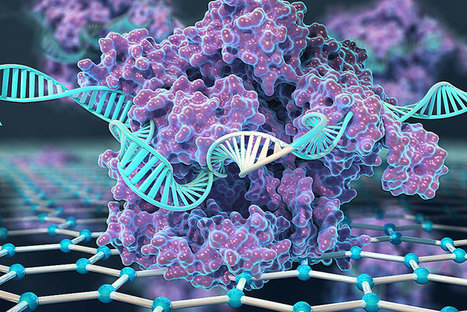
The device could be used to rapidly diagnose genetic diseases or to evaluate the accuracy of gene-editing techniques
Most methods for the detection of nucleic acids require many reagents and expensive and bulky instrumentation. Here, scientists now report the development and testing of a graphene-based field-effect transistor that uses clustered regularly interspaced short palindromic repeats (CRISPR) technology to enable the digital detection of a target sequence within intact genomic material. Termed CRISPR–Chip, the biosensor uses the gene-targeting capacity of catalytically deactivated CRISPR-associated protein 9 (Cas9) complexed with a specific single-guide RNA and immobilized on the transistor to yield a label-free nucleic-acid-testing device whose output signal can be measured with a simple handheld reader.
The team used the CRISPR–Chip to analyze DNA samples collected from HEK293T cell lines expressing blue fluorescent protein, and clinical samples of DNA with two distinct mutations at exons commonly deleted in individuals with Duchenne muscular dystrophy. In the presence of genomic DNA containing the target gene, CRISPR–Chip generates, within 15 min, with a sensitivity of 1.7 fM and without the need for amplification, a significant enhancement in output signal relative to samples lacking the target sequence. The CRISPR–Chip expands the applications of CRISPR–Cas9 technology to the on-chip electrical detection of nucleic acids. Via Dr. Stefan Gruenwald
Scoop.it!
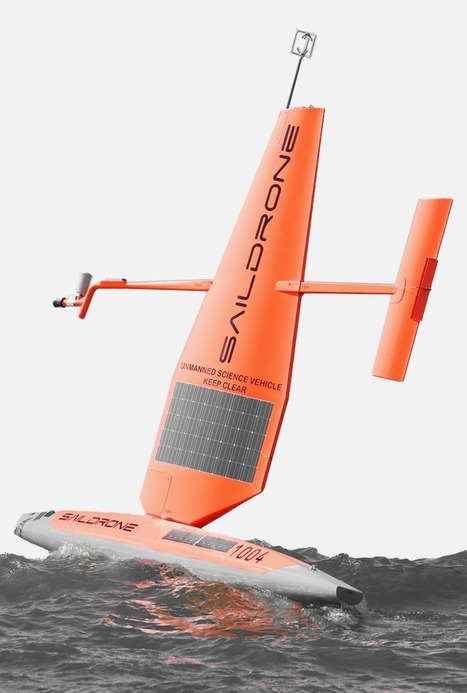
SailDrone makes wind powered + solar powered ocean drones to understand planetary systems affecting humanity. The company designs, manufactures, and operates their global fleet sail-drones — monitoring the state of the planet in real time. Their data sets can be used by commercial enterprise, research institutions, or private groups on specific missions.
SailDrone is making world history by offering high resolution, ocean data collection at-scale. Their sail-drone is 20 feet long, 18 feet high above the water, weighs 600 pounds. It can operate indefinitely: the wind is propulsion that pushes it along, a solar power panel charges the batteries that run the on-board computers + communications equipment.
Via Dr. Stefan Gruenwald
Scoop.it!

The Event Horizon Telescope (EHT), a network of eight radio observatories spanning the globe, has set its sights on a pair of behemoths: Sagittarius A*, the supermassive black hole at the Milky Way’s center, and an even more massive black hole 53.5 million light-years away in galaxy M87. In April 2017, the observatories teamed up to observe the black holes’ event horizons, the boundary beyond which gravity is so extreme that even light can’t escape. After almost two years of rendering the data, scientists are gearing up to release the first images in April, 2019.
Via Dr. Stefan Gruenwald
Scoop.it!

A deep learning model developed by NVIDIA Research uses GANs to turn segmentation maps into lifelike images with breathtaking ease.
Scoop.it!
Projection mapping is one of the most recent visual technologies that so far has been out of reach for consumers. The company Lightform is hoping to change that with its projector-mounted scanner and software. We get our hands on the Lightform device to see how it maps objects and environments in front of it--like a replica movie prop--and go through the software to learn how to create striking augmented visuals on top of the real world.
Via Dr. Stefan Gruenwald

Viviane DI NATALE's curator insight,
March 23, 2019 2:13 AM
Voici un merveilleux outil à décliner en boutique pour valoriser son affaire et augmenter son trafic !
Scoop.it!

Gravitational waves could help scientists solve a longstanding conundrum about the Hubble constant.
Scoop.it!

A bioethicist has added his voice to a global plea for a moratorium on heritable genome editing from a group of international scientists and ethicists in the wake of the recent Chinese experiment aiming to produce HIV immune children.
Scoop.it!
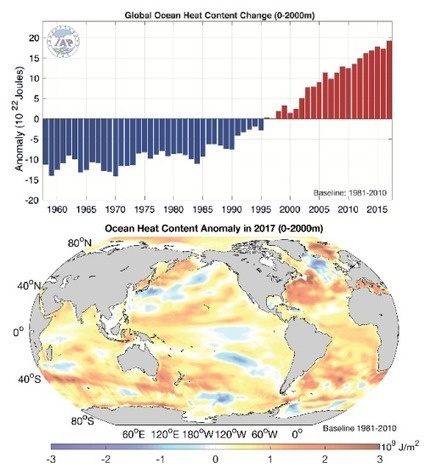
2017 was the warmest year on record for the global ocean according to an updated ocean analysis from Institute of Atmospheric Physics/Chinese Academy of Science (IAP/CAS). The oceans in the upper 2000 m were 1.51 × 10^22 J warmer than the second warmest year of 2015 and 19.19 × 10^22 J above the 1981–2010 climatological reference period. Owing to its large heat capacity, the ocean accumulates the warming derived from human activities; indeed, more than 90% of Earth’s residual heat related to global warming is absorbed by the ocean. As such, the global ocean heat content record robustly represents the signature of global warming and is impacted less by weather-related noise and climate variability such as El Niño and La Niña events. According to the IAP ocean analysis, the last five years have been the five warmest years in the ocean. Therefore, the long-term warming trend driven by human activities continued unabated.
The increase in ocean heat content for 2017 occurred in most regions of the world (Figure). The human greenhouse gas footprint continues to impact the Earth system. Increases in ocean temperature cause ocean volume expansion, which contributes to the global mean sea level rise. The increase in ocean heat of 1.51 × 10^22 J in 2017 resulted in a 1.7 mm sea global level rise. Other consequences include declining ocean oxygen, bleaching of coral reefs, and melting sea ice and ice shelves.
Via Dr. Stefan Gruenwald
Scoop.it!

Astronomers have detected a stealthy black hole from its effects on an interstellar gas cloud. This intermediate mass black hole is one of over 100 million quiet black holes expected to be lurking in our Galaxy. These results provide a new method to search for other hidden black holes and help us understand the growth and evolution of black holes. Via Dr. Stefan Gruenwald
Scoop.it!

His estimated age means he was born way back in the 1500s!
Can there really be a living higher animal that’s over five centuries old? It may seem impossible, but scientists have discovered one such beast living in the Northern Atlantic Ocean: a Greenland Shark. It’s long been known that this particular shark is older than most, but scientists had no idea just how old he was until recently. Now that they’ve pinpointed his age to be 512 years old, he’s claimed the title of world’s oldest living vertebrate. Via Dr. Stefan Gruenwald
Scoop.it!

Earth seems drenched with water from mountaintop to ocean bottom. But our home planet is a desert compared to some places the solar system, both in terms of its total water volume and the amount of liquid on Earth relative to its size.
Consider Jupiter's ice-encrusted moon Europa, which is smaller than Earth's moon. Scientists recently used 20-year-old Voyager data to find even more evidence that Europa has twice as much water as our planet. Even tiny Pluto may have an ocean nearly as large as Earth's.
Steve Vance, a planetary scientist at NASA's Jet Propulsion Laboratory, has kept a close eye on research about ocean worlds over the years. He has rounded up estimates of ice thickness and ocean depth throughout the solar system to calculate roughly how much water may exist. Via Dr. Stefan Gruenwald
|




