


Learn about how Project Loon balloons are designed, how they navigate through the stratosphere, and how they deliver Internet to specialized Internet antennae down on Earth.

 Your new post is loading...
 Scoop.it! Learn about how Project Loon balloons are designed, how they navigate through the stratosphere, and how they deliver Internet to specialized Internet antennae down on Earth. 
No comment yet.
Sign up to comment
Scoop.it!
Add photoreal images, abstract designs, and animation to your long exposure photos and timelapse.
Scoop.it!

We’re pretty keen on optimal timing for social media here at Buffer, and I figured it was high time I collected all the information we have about online communication into one place. I’ve collected research and stats on Twitter, Facebook, email and blogging to help you find the best time to communicate with others in each format.
The tricky thing I’ve come across is that since the Web is still so new, a lot of the research available to us is conflicting. We really need more time and more studies to get definitive answers about what works best, and the fact that our audience members are constantly changing their own activity patterns makes it even harder to work out for sure. Looking at the latest social media stats seems to only confirm that. So my suggestion would be to use this guide as just that--a guide to help you work out what to test for in your own audience, so that you can see what actually works best in your specific case.... Via Jeff Domansky, Lauren Moss
Scoop.it!

Nearly ten years after it began and eight years after Google was sued over it, Google’s program that scans books in order to make them searchable has been found legal.
Scoop.it!

As more people sign up for Facebook, it’s important to note that the site largely places privacy control in the user’s hands. The default setting for privacy is public, and many people don’t change it. So what steps can you take to manage your Facebook privacy like an expert? Via Lauren Moss

Bart van Maanen's curator insight,
December 13, 2013 8:04 AM
Gebruik deze infografiek als checklijstje van je privacy instellingen bij Facebook. 
Louise Robinson-Lay's curator insight,
December 13, 2013 3:26 PM
Some valuable tips on maintaining your privacy on Facebook. It is important to know who is watching you.
Scoop.it!
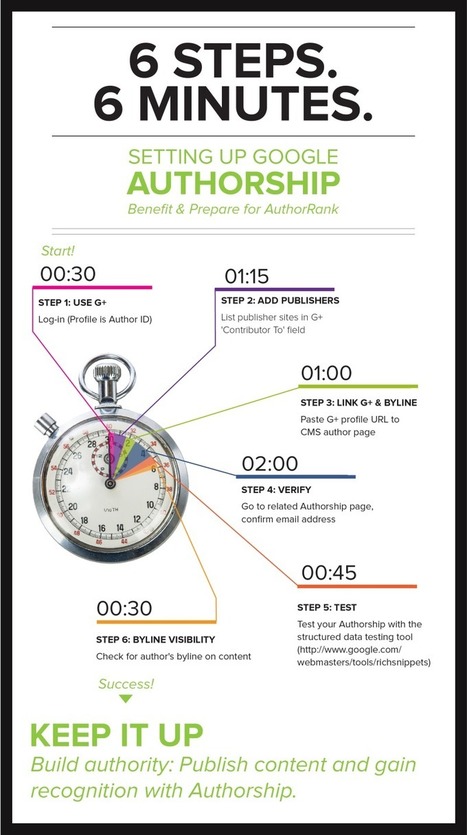
Why should you use Google+?There are lots of good reasons to pay attention to Google+, but for me it comes down to these three: Search is becoming socialGoogle+ Authorship is becoming a filter for quality contentGoogle+ has the best user experience of any social networkVisit the link to find additional insights, resource links, and useful Google+ information. Via Lauren Moss

Carlos Bisbal's curator insight,
November 14, 2013 9:28 AM
3 razones de peso por las que ya no puedes permitirte ignorar Google+ 
Jim Doyle's curator insight,
December 6, 2013 1:13 AM
3 Compelling Reasons Why You Can No Longer Afford to Ignore Google+
Scoop.it!
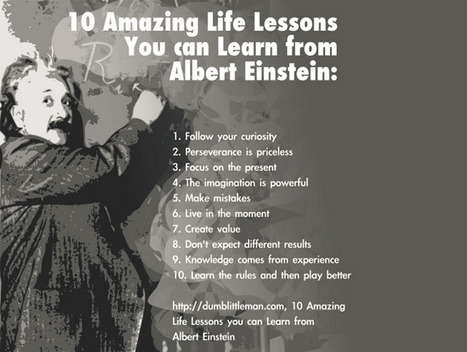
"When we hear the word genius, certain people come immediately to mind—Albert Einstein in mathematics, or Warren Buffett in investing—but what exactly sets these people apart? It’s easy to simply shrug and say to ourselves, “Those people are just different. They have something most people don’t, and it’s as simple as that.” But the steps taken to arrive at a place of genius are actually more concrete, and have less to do with innate talent, than you might think. When it comes to cultivating intelligence, mindset is a huge factor..." Via Beth Dichter

Beth Dichter's curator insight,
October 31, 2013 9:34 PM
Learn about the characteristics of genius in this post as well as five strategies to create a growth mindset in children. Two are listed below: * Perseverance * Praise the process, not the person 
Kathy Lynch's curator insight,
November 5, 2013 9:35 PM
I love this! Help your students discover their inner genius. Thanks Beth
Scoop.it!

Ryan McDonough's curator insight,
July 7, 2014 8:19 AM
Self explanatory visual on the benefits of gaming as a means of learning. Outlined are the rewards, mastery, engagement, intensity, exercise, readiness, and competitiveness. These types of graphics need to be displayed in the classroom. There's always parents who are unsure of how gaming qualifies as teaching. Can't they just sit their kid in front of an iPad all day at home? Well, in the appropriate setting, with the right direction and guidance, games are certainly good for learning. Some people just don't know that from experience yet.
Scoop.it!

How do game-based learning, gamification, and eLearning designers learn ways to increase engagement and effectiveness in corporate training? By looking at popular games!
Scoop.it!

We have been talking for some time now about how enterprise IT is increasingly focusing on Systems of Engagement to complement what has traditionally been a Systems of Record function. Systems of
Scoop.it!

This report highlights a number of key trends that will have a significant impact on the user experience and design of future collections and museums. Via Robin Good

Jennifer Moss's curator insight,
November 8, 2013 6:47 PM
This is like the 'Horizon Report' for museums. 
Erica Bilder's curator insight,
November 15, 2013 7:11 AM
I have nothing to add to Robin Good's terrific insights: Robin Good's insight:
Picture these scenarios: The Freud Museum, in the spirit of its namesake, becomes a provider of mental retreat and therapy (I wonder if the docents will be licensed psychoanalysis?) These, according to the 40-page report “Museums in a Digital Age” from Arups, may actually be some of the likely new profiles of prestigious museums 25 years from now.
The report projects that:
"...future museums will see personalised content, new levels of sustainability and a visitor experience extended beyond present expectations of time and space." A rising desire among audiences to shape their own cultural experiences (“Collaborative Curation”) The opportunity for museum to become “curators of experiences” that extend beyond the boundaries of traditional exhibits or programs, or beyond the walls of the museum itself.
Source: http://futureofmuseums.blogspot.it/2013/11/museums-in-future-view-from-across-pond.html ; The idea of "collaborative curation" of museum collections by the actual users-visitors, is particularly fascinating. "Just as current consumer trends shift towards collaborative consumption, in the future, museums may employ new patterns of collaborative curation,allowing for individually curated experiences and giving the public greater control over both content and experience.Increased visitor participation will allow people themselves to reinvent the museum experience, enabling content that can adapt to the preferences of users in real-time."
My comment: If you are a curator and are interested in exploring and understanding what the future of large collections and museums may look like and which forces are going to be driving such changes, this is a good report to read.
Insightful. Inspiring 8/10
PDF: http://www.arup.com/~/media/Files/PDF/Publications/Research_and_whitepapers/2013_Arup_FRI_MuseumsintheDigitalAge_final_web.ashx
Scoop.it!
There's been an explosion of collaborative consumption -- web-powered sharing of cars, apartments, skills. Rachel Botsman explores the currency that makes systems like Airbnb and Taskrabbit work: trust, influence, and what she calls "reputation capital."

Trish Sadar's curator insight,
November 27, 2013 10:01 AM
The currency of the new economy in everything:
Personal relationships, Leadership, Business, etc. is trust! |
Scoop.it!

Starting next fall, astronauts will be able to use a new 3D printer to fabricate the tools and materials they need in space.
Scoop.it!

Galtier Community School in Saint Paul decided to revolutionize education through design thinking via the American Architectural Foundation’s (AAF) Design for Learning program.
Scoop.it!

Manú Iñaki's curator insight,
February 11, 2014 2:33 PM
Los usuarios de smartphones son importantes para la mercadotecnia

willdonovan's curator insight,
February 27, 2014 7:42 AM
INFOGRAPHIC ALERT: The Social Case for Mobile 1st 
Brenton Millers's curator insight,
March 28, 2014 12:48 AM
This info graphic created by Unified shows statistics of how social marketers target people on a mobile platform.
Scoop.it!

Want a neat visual representation of what matters in SEO these days? You got it! Here's Search Engine Land's recently updated 'periodic table' graphic. Via Jeff Domansky, Lauren Moss

Linda Richardson's curator insight,
October 21, 2013 10:15 AM
Gotta love success in any form even a periodic table!
Scoop.it!

A new study unlocks the secrets to what's most shared on the popular social network. Curalate, a visual analytics and marketing firm, created algorithms to determine how over 30 factors -- including color, lightness and saturation -- affect an Instagram post's performance. The company analyzed more than 8 million images from the photo-sharing platform. The findings share are some tips to help businesses kick their Instagram presence into high-gear, including:
Keep it cool: Photos dominated by blues and other cool colors tend to garner more likes while photos with warmer oranges and reds do worse. Master monochrome: The more dominant a single color is on an image, the more likes it could get. Pictures dominated by a single hue receive 40 percent more likes than those that don't. With color, less is more: It can be tempting to ratchet up the vibrancy, flooding your image with color to make it stand out. But in today's overstimulated world, bright and vibrant colors can get lost. The proof is in the data: Curalate says less saturated images receive 18 percent more likes than their mover vibrant counterparts. Via Brian Yanish - MarketingHits.com, Lauren Moss
Louise Robinson-Lay's curator insight,
November 15, 2013 3:52 PM
Interesting to see what people prefer to see on Instagram and how they like their images to appear. 
Blake Hawley's curator insight,
November 18, 2013 2:56 PM
A lesson in humility. The data did not support my own notion of what a "good" instagram photo is. Proof that data speaks louder than intuition (when you have the data!)....insert duck face. 
Mosami's curator insight,
December 1, 2013 9:46 AM
light, blue, depth, monochrome, low saturation, texture. fun
Scoop.it!

"The end of "do not touch": Use the Smithsonian X 3D Explorer to explore and manipulate museum objects like never before. Create and share your own scenes and print highly detailed replica of original Smithsonian collection pieces." Via Beth Dichter

Vicki Hansen's curator insight,
November 24, 2013 7:42 PM
Awesome interactive for students. Hope it continues to expand objects. 
Van Duyse Olivier's curator insight,
December 1, 2013 6:41 AM
The new digital museum ... Opens opportunity's for digital education 
Ness Crouch's curator insight,
December 23, 2013 3:13 AM
What a great site for looking at both history and science! Very recommended!
Scoop.it!
Beth Dichter's curator insight,
November 3, 2013 8:46 PM
The graphic (above) provides a nice visual to help understand the difference between project based learning and traditional units with a final project. Where are the differences? Traditional units have lectures, activities, quizzes, a review, an exam the project. With project bases learning you begin with an event plus a rubric and then move through a series of activites that help students reach benchmarks. Project based learning is authentic learning. More information on this can be found in the post. 
Melissa Jenkins 's curator insight,
November 16, 2013 9:03 AM
Good visual as to how we should be shifting learning.
Scoop.it!

Picasso put it brilliantly when he said that if you "make a thing, a thing that is new, it is so complicated making it that it is bound to be ugly. But those that make it after you, they don’t have to worry about making it.
Scoop.it!

Have you ever felt like every time you mastered a new design technique, there's something else new and exciting that you see on websites? I know how you feel.
Scoop.it!
In a school governed by a strict regime, the pupils are informed that simple facts are no longer true. Two & Two ------ http://www.imdb.com/title/tt1701187/
Antonios Bouris's insight:
An excellent communication design lesson. Film talks by itself.

Alberto del Mazo's curator insight,
February 25, 2014 4:02 PM
Lección de matemáticas ... o de dictadura. Gran corto de Babak Anvari de 2012.
Scoop.it!

Twitter made its debut on the New York Stock Exchange Thursday morning at $45.10 per share, about 77% more than the $26 IPO price.
Scoop.it!

Here's what you should know before you decide to buy a PlayStation 4.
|






