The research demonstrating the health benefits of being creative was touched upon in my last post. We could continue to talk science but for me it is very personal story. During the mid to late 199...
Via Creativity For Life

 Your new post is loading...
 Scoop.it! The research demonstrating the health benefits of being creative was touched upon in my last post. We could continue to talk science but for me it is very personal story. During the mid to late 199... Via Creativity For Life 
No comment yet.
Sign up to comment
Scoop.it!

PetaPixel Via Creativity For Life
Scoop.it!

BIG presents a vision for the future of Denmark's Givskud Zoo where animals and humans "co-exist", and all the architecture is hidden within the topography. Named Zootopia, the proposal reimagines the 1960s zoo and safari park in central Jutland as a continuous landscape of forests, savannahs and rivers that centre around a sunken courtyard of visitors' facilities. "It is our dream – with Givskud – to create the best possible and freest possible environment for the animals' lives and relationships with each other and visitors," said BIG, the office led by architect Bjarke Ingels. Via Lauren Moss
Antonios Bouris's insight:
keyword: Co-existance!!!!

Catherine Devin's curator insight,
August 4, 2014 3:02 AM
Comme évoqué avec l'exemple de la bicyclette, c'est aussi en créant l'occasion d'expériences plaisantes que chacun peut s'ouvrir à de nouvelles pratiques plus durables ... et partant, être prêt à écouter aussi des informations relatives à la nécessité de sobriété dans les consommations et les déchets, puis modifier son comportement ?
Scoop.it!

Did you know that the best time to generate blog ideas is right before you sleep? Also that you can generate ideas while sleeping? Find out how! Via Alessandro Rea
Scoop.it!

"The long-term output of any school should be not just proficient students, but enabled learners. An “enabled” learner can grasp macro views, uncover micro details, ask questions, plan for new knowledge and transfer thinking across divergent circumstances. This doesn’t happen by content “knowledge holding,” or even by the fire of enthusiasm, but by setting a tone for learning that suggests possibility, and by creating a culture of can." Via Beth Dichter

Beth Dichter's curator insight,
August 4, 2014 9:35 PM
One of my favorite videos on growth mindset is Carol Dweck sharing the word yet, specifically where she says that if a student says "I can't do that" she says to tell the student to say "I can't do that yet." To me that is a way to shift the culture of the classroom, where students learn that as time goes on what they are able to do things they could not before. This post explores this culture of "can", sharing ideas on how you might move your classroom to reach this culture. Three areas are discussed. 1. Use the Gradual Release of Responsibility Model This is a model that many of us may already use. The post describes it as "show me, help me, let me." In my school we talk about "I do, we do, you do." 2. Intentionally Use the Individual Student as a Culture-Maker This requires that we find the time as we teach to "honor the contribution of others," specifically our students. Culture does not grow from a top down approach. 3. Diverse — and Authentic — Terms for Success Creating a classroom that is learner centered, where students also have input to help create authentic learning. More information on these concepts are in the post. 
Nancy Jones's curator insight,
August 5, 2014 11:36 AM
Love the ideas here and realize the challenge of the mission. Our kids need to embrace their mistakes as learning opportunities rather than expect immediate mastery and feedback with praise. i am thinking of making a classroom poster ( or posters) with the Word "YET" in giant letters and use that as our mantra.
Scoop.it!

The most intelligent organizations are overcoming battlegrounds and silos to maximize their return on customer intelligence. They're insisting on the "dog wagging the tail" by instilling customer experience context for all actions and decisions company-wide. They're applying customer intelligence to innovate the full customer experience "bundle". And they're equipping organizational learning by sharing, showing actionable patterns, focusing on what customers are trying to get done, and being proactive in enabling customers to love the company. . Via Edward Chenard

Mary Gravitt's curator insight,
August 5, 2014 11:00 AM
#B2B #Leadgenerations #Marketingappointmentsetting 
Patrice Laubignat's curator insight,
August 6, 2014 12:22 PM
Comment améliorer l'offre en interprétant les insights nés de l'expérience client ? Le contexte est-il décisif dans le ressenti intelligent de l'expérience ?
Scoop.it!

In order to be able to see a relationship between various ideas and information, we use mind mapping. Here is a list of 15 mind-mapping tech tools. Via Creativity For Life
Scoop.it!
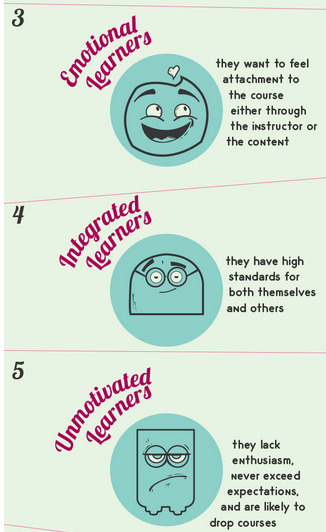
"The most challenging aspect of imparting effective online training is targeting the many learners taking the same program. Understanding the different types of learners, summed up in following categories, is beneficial to any designer looking to create personalized eLearning courses." Via Beth Dichter
Beth Dichter's curator insight,
August 5, 2014 9:47 PM
You may teach online or you may teach face-to-face or perhaps you combine the two, but in all cases the learners we work with have a variety of learning styles. Today we are told that each student should receive personalized learning opportunities. This post provides a look at ten types of learners you may find in your classroom (on or offline). By understanding the type of learners you will be able to design more effective lessons (and also personalize them to the best of your ability. Each type of learner is described in more depth under the visualization. 
Tony Guzman's curator insight,
August 6, 2014 9:07 AM
Great infographic describing the different types of learners we have in our classrooms.
Scoop.it!

Social Media Ads Cheat Sheet: Image Sizes for Facebook, Twitter, Instagram & More [INFOGRAPHIC]
Scoop.it!

While there are millions of small business owners across the United States, most of them can generally fit into one of "four distinct types," according to a new survey by sales and marketing software maker Infusionsoft. The company's 2014 Small Business... Via The Fish Firm II

Darlene Karpaski's curator insight,
August 7, 2014 5:59 PM
The coaching entrepreneurs I work with align heavily with the "Freedom Seeker" Traits and the "Passionate Creators." They've supported their families, community projects, spouses, adult parents all while building their businesses. They're passionate about changing the world but seek the freedom to schedule and work in a way that supports their own wellness. Conscious entrepreneurs are learning that putting themselves first isn't selfish. It's foundational to living out their mission.
Scoop.it!

Street art is gradually coming to be accepted as a legitimate and wonderful art form by more and more people, but that doesn't mean that street artists can rest on their laurels – they continue exploring with new ways to exploit public surfaces and cover them in beautiful art.
Scoop.it!

All too often, entrepreneurs get caught in the cycle of trying to be creative when they're too tired to think. Here's how to get those juices flowing and reconnect with yourself. Via Creativity For Life
Scoop.it!

The average American spends 13.6 hours consuming media every day from dozens of different sources. By 2015, analysts predict we'll watch close to 15.5 hours of media on a daily basis
|
Scoop.it!

A Croatian designer has turned a group of cranes into a giant light show, at one of the world's oldest working shipyards. Architectural lighting designer Dean Skira lit up the cranes at Uljanik Shipyard with 73 RGB LED spotlights weighing 40kg each, as part of a project called Lighting Giants. Via Lauren Moss
Scoop.it!

The terms 'critical' and 'reflection' are sorely misunderstood in education. Being critical is often misinterpreted as being negative. 'Reflection' is also frequently distorted to mean "reflect on what you are doing wrong". Too often the students that we teach give negative feedback when asked to be critical. So to counter act this, educators initiate strategies such as '2 stars and a wish' and SWNI (strengths, weaknesses, new ideas).
These strategies are designed to make reflective practices a more positive experience for students. It teaches them that being critically reflective is not just a negative activity, that it is important to be positive and give feedback to help improve or make something better. Learn more: - http://www.scoop.it/t/21st-century-learning-and-teaching/?tag=Criticism Via Gust MEES

Claudia Estrada's curator insight,
August 17, 2014 3:10 PM
This is the skill we all need to learn and urgently develop with our students.
Scoop.it!

Everyone has that person in the office. You know, the one who always seems to get way more done than everybody else, but who never seems stressed or frantically trying to finish an assignment. How does he or she get it done? Via Barb Jemmott

Lisa McCarthy's curator insight,
August 5, 2014 4:54 AM
A person can't be 100% productive all day. As much as you want to make the most of every minute, to get stuff done, to hustle, it's just not humanly possible. Concentration is like a muscle: It needs to rest to be able to function, and it shouldn't be overworked. Otherwise it'll simply burn out and take longer to get back into the swing of things.
Scoop.it!

While all thunderstorms command attention, some of the most rare and stunning storms of all spin up during the height of tornado season across the Great Plains. Via Barb Jemmott
Scoop.it!
Scoop.it!

There has never been a better year to look at the work of Kazimir Malevich, a pioneer of abstract art often seen as the greatest Russian painter of the twentieth century. 'Malevich: Revolutionary of Russian Art', first shown in the Stedelijk Museum Amsterdam, and now at London’s Tate Modern, is the most comprehensive exhibition of his work ever.
Scoop.it!

Denise Jacobs calls herself a “creativity evangelist”, helping people cultivate the tools and skills necessary for leading a creative life. These skills are important for everyone, but especially for creative professionals such as ... Via Creativity For Life
Scoop.it!

I've never spent more than two seconds thinking about a door handle beyond whether I should push or pull to open. Via Desife
Scoop.it!

Cinderellas aren’t found only in sports. Here is a list of entrepreneurs who have made an unlikely run to success. Via The Fish Firm II

Luigina Sgarro's curator insight,
August 7, 2014 3:41 AM
Let's find inspiration in the most unlikely fairy tales....
Scoop.it!

Creativity For All Via Creativity For Life
Scoop.it!

influenced by the 'windy city', the bike takes its name from chicago’s iconic elevated train lines that run throughout the metropolis.
|