Your new post is loading...
This group developed recommendations for the G20 to support economic growth and resilience through effective and transparent institutions. When civil society loses trust that economic resources will be fairly allocated – whether through corruption, loopholes created by outdated regulation, or a lack of openness by government – both the economy and civil society suffer.
Membership of this working group is open. Anyone can have input into the group’s recommendations, but only by posting on this website. Drafting of the group’s position paper was led by the discussion leaders and co-chairs. A draft position paper was posted online here on 29 April for further feedback.
The feedback we receive will help shape our final recommendations to the G20 Leaders.
The discussions here closed on 16 May. All policy position papers will inform the Australian C20’s communique which will be discussed and approved at the Summit in June.
C20 Conversations on Thu, June 5, 2014 at 03.14 pm - 547 download(s) C20 Conversations on Thu, June 5, 2014 at 03.10 pm - 235 download(s) View all
This working group developed recommendations for the G20 around infrastructure - the sustainable and socially responsible development of infrastructure can drive an inclusive growth agenda, but only if the benefits of infrastructure investment are shared in a way that reduces inequality and stimulates economic and community development. Drafting of the group’s position paper was led by the discussion leaders and co-chairs based on a series of focused discussions between February and May. An initial draft position paper was posted online here for further feedback before being finalised in its current form. The feedback we receive will help shape our final recommendations to the G20 Leaders. The discussions closed on 16 May. All policy position papers will inform the Australian C20’s communique which will be discussed and approved at the Summit in June.
C20 Conversations on Thu, June 5, 2014 at 02.55 pm - 363 download(s) C20 Conversations on Thu, June 5, 2014 at 02.54 pm - 134 download(s) View all
Welcome to the C20 Conversations In preparation for the C20 Summit in Melbourne, Australia on 20-21 June 2014, virtual discussions took place on this site on the policy themes below to help shape civil society's recommendations to the G20. Click on each theme to review the discussions and read the final position papers. Read more About the C20 The Civil 20 (or "C20") is a platform for dialogue between the political leaders of the G20 countries and representatives of civil society organizations. The goal of C20 is to facilitate the exchange of ideas and opinions about issues on the agenda of the G20 and issues of importance to civil society with a view to making substantive contributions to G20 policy. Read More Steering Committee The Australian C20 Steering Committee is the body charged with the responsibility of bringing to the attention of the G20, when it meets in Brisbane in November 2014, key and pressing concerns and interests of those who make up civil society in Australia, other G20 nations and civil society organisations globally. Read More - See more at: http://www.c20conversations.org.au/#sthash.pJY5C8mh.dpuf
All Resources ICC Communiqué to the G20 Leaders’ Summit 19, November 2014 The International Coordinating Committee of National Institutions for the Promotion and Protection of Human Rights (ICC) View ResourceC20: C20′s Response to the G20 Leaders’ Communique 18, November 2014 The C20's response to the content of the final G20 Communique from Brisbane 2014 Download ResourceC20 Briefing Paper: Inclusive growth 12, November 2014 'Inclusive Growth: Ensuring everyone shares in the benefits of the G20's growth target' Briefing Paper View ResourceC20 Paper: Statement to G20 Leaders’ Summit 9, November 2014 Submitted to G20 ahead of Leaders' Summit in Brisbane, Nov 2014 View ResourceC20 Position Paper: Inclusive Growth 31, October 2014 Prepared by the C20 Working Group Download ResourceC20 Statement to G20 Finance Ministers & Central Bank Governors Meeting 12, September 2014 Submitted to G20 ahead of Engagement Session in Cairns on 20 September 2014 Download ResourceC20 Position Paper: Powering up against Poverty 25, August 2014 C20's Briefing Paper on Energy Access Download ResourcePosition Paper Background: Inclusive Growth and Employment 7, August 2014 Download ResourceGovernance position paper 10, June 2014 Prepared by the C20 working group based on input through the C20 Conversations platform Download ResourceClimate and Sustainability position paper 10, June 2014 Prepared by the C20 working group based on input through the C20 Conversations platform Download ResourceInfrastructure position paper 10, June 2014 Prepared by the C20 working group based on input through the C20 Conversations platform Download ResourceInclusive Growth and Employment position paper 10, June 2014 Prepared by the C20 working group based on input through the C20 Conversations platform Download ResourceForeign Bribery 30, May 2014 Proposal by the C20 to the Anti-Corruption Working Group regarding their 2015-16 priorities Download ResourceAsset Recovery 30, May 2014 Proposal by the C20 to the Anti-Corruption Working Group regarding their 2015-16 priorities Download ResourcePublic Sector – transparency, integrity and accountability 30, May 2014 Proposal by the C20 to the Anti-Corruption Working Group regarding their 2015-16 priorities Download ResourcePrivate Sector – transparency, integrity and accountability 30, May 2014 Proposal by the C20 to the Anti-Corruption Working Group regarding their 2015-16 priorities Download ResourceDetecting Corruption – whistleblowing 30, May 2014 Proposal by the C20 to the Anti-Corruption Working Group regarding their 2015-16 priorities Download ResourceDenial of Entry 30, May 2014 Proposal by the C20 to the Anti-Corruption Working Group regarding their 2015-16 priorities Download ResourceTackling Money Laundering 30, May 2014 Proposal by the C20 to the Anti-Corruption Working Group regarding their 2015-16 priorities Download ResourceBackground paper on Food Security and Nutrition 14, March 2014 Prepared for the Development Working Group's informal consultation session on the G20 food security and nutrition review Download ResourceOpen Data: Joining the dots to maximise the value of transparency 18, February 2014 By the C20 Governance Working Group for the G20 Anti-Corruption Working Group Roundtable Download ResourceTackling Foreign Bribery 18, February 2014 By the C20 Governance Working Group for the G20 Anti-Corruption Working Group Roundtable Download ResourceExtractives and Natural Resources 18, February 2014 By the C20 Governance Working Group for the G20 Anti-Corruption Working Group Roundtable Download ResourceCurbing Corruption in the Supply Chain – public procurement processes 18, February 2014 By the C20 Governance Working Group for the G20 Anti-Corruption Working Group Roundtable Download ResourceAnti-Corruption Criteria for Major Sports Events 18, February 2014 By the C20 Governance Working Group for the G20 Anti-Corruption Working Group Roundtable Download ResourceCurbing Corruption in the Supply Chain – company supply chains 18, February 2014 By the C20 Governance Working Group for the G20 Anti-Corruption Working Group Roundtable Download ResourceGovernment Transparency and Beneficial Ownership 18, February 2014 By the C20 Governance Working Group for the G20 Anti-Corruption Working Group Roundtable Download ResourceC20 Infrastructure Working Group: background paper 2, February 2014 By the Secretariat for the C20 Conversations site Download ResourceC20 Inclusive Growth and Employment Working Group: background paper 2, February 2014 By the Secretariat for the C20 Conversations site Download ResourceC20 Governance Working Group: background paper 2, February 2014 By the Secretariat for the C20 Conversations site Download ResourceC20 Climate and Sustainability Working Group: background paper 2, February 2014 By the Secretariat for the C20 Conversations site Download ResourceContribution to the G20 Employment Taskforce – Enablers of Participation 28, January 2014 By the Inclusive Growth and Employment working group Download Resource
MEDIA RELEASE – Developing nations must be included in international tax reporting standardSeptember 15, 2014 The C20 (‘Civil Society 20’) welcomes today’s media reports ahead of the G20 Finance Ministers meeting in Cairns that Australia will adopt the Common Reporting Standard for the exchange of international tax information.
C20 Chair Tim Costello said civil society… Read more »Jobs at the heart of G20′s challengesSeptember 09, 2014 Ahead of tomorrow’s G20 Labour & Employment Minster’s Meeting (LEMM) in Melbourne, Sally Sinclair, Head of the C20′s delegation representing civil society at the meeting, outlines why the C20 believes the economic case can be made for more and better… Read more »MEDIA RELEASE – C20 believes ‘Inclusive Growth’ essentialSeptember 09, 2014 The C20 (‘Civil Society 20’) will make the case to the G20 Labour and Employment Ministers Meeting (LEMM) in Melbourne tomorrow that economic growth should create jobs, not just wealth for a few.
“Economic growth should not be an end… Read more »Huguette Labelle speaks about the C20, Civil Society and anti-corruptionAugust 04, 2014 Huguette Labelle, Chair of the board, Transparency International speaks about the C20, civil society and the importance of tackling corruption.… Read more »Tim Costello speaks at OECD Forum on trust in governmentAugust 01, 2014 In his capacity as Chair of the C20, Tim Costello attended the 2014 OECD Forum…, participating in a panel discussion on Institutional (In)Competence – 21st Century Politics, focusing on how the global economic crisis has undermined trust in governments. Read more »C20 Summit Report and videoJuly 30, 2014 Following the successful C20 Summit in Melbourne, a final report and video is now available which captures the work of the summit. The final report is now available via this link: C20 Summit Report…
Read more »Tim Costello speaks with Jeffrey SachsJuly 29, 2014 Tim Costello, Chair of the C20 Steering Committee and CEO of World Vision Australia speaks with Jeffrey Sachs, Director of The Earth Institute, about the importance of sustainable development.… Read more »Interview with Gillian TriggsJuly 28, 2014 Hear Gillian Triggs, President of the Australian Human Rights Commission, speak about human rights, civil society and the C20.… Read more »C20 Summit CommuniqueJune 23, 2014 The C20 (‘Civil Society’) Summit at the University of Melbourne was the first of the lead-in G20 ‘satellite’ conferences, providing a platform for dialogue between civil society and the political leaders of the G20 countries.
Over the two days on… Read more »Civil Society challenges G20 on inequality and sustainable growthJune 22, 2014 Global civil society has called on the G20 to tackle endemic corruption, confront the challenges of climate change and urgently address the social and economic time bomb represented by the world’s unemployed youth.
Meeting in Melbourne over the weekend to… Read more »
C20 Steering CommiteeJanuary 17, 2014 As an established engagement group under the Australian Presidency, the Australian C20 will actively join colleagues from business, the labour movement, young people and think tanks, in important debates about international economic reform. Read more »C20 launches online consultations with civil societyJanuary 17, 2014 Consultations with civil society ahead of next year’s G20 summit to be held in Australia commenced today with the launch of the C20 website. Read more »
The C20 Summit in June 2014 was a meeting of global civil society which offered the several hundred delegates a platform to discuss the key issues we collectively believe should be debated by world leaders in November. The discussions about equity and participation, infrastructure, climate change and resource security and governance led to strong recommendations being reflected in our Summit communique. These issues remained at the top of the C20’s agenda throughout our advocacy. Held at the University of Melbourne’s law school, and reflective of the size of the global constituency civil society collectively represents, the C20 Summit hosted both the Australian Minister for Foreign Affairs and the Minister for Social Services, as well as the Deputy Leader of the Opposition. The Summit was closed by Australia’s G20 Sherpa, confirming the importance of the challenges civil society is raising to the G20 leaders. We welcomed delegates from most G20 nations, including 90 panellists and speakers and 350 participants. We achieved prominent media coverage, including the opening speeches broadcast live on the national broadcaster ABC and the #C20 hashtag trended on Twitter further underlining the exchange of ideas the sessions were stimulating. The following day we addressed the Joint Sherpa and Deputy Finance Ministers, giving us the first opportunity to advocate our economic reform agenda. Well received, comments from Sherpas, including from the UK, Argentina, Mexico, South Africa and France, confirmed the credibility and strength of our interventions on tax, sustainable development and transparency. Most significantly, our call for a stand-alone agenda on climate change was applauded (at least in language terms). International colleagues from the UK, India, Russia, Turkey and China joined Australian C20 members in handing our communiqué to the Australian Prime Minister. Raising the critical importance of climate change being a stand-alone agenda, we also confirmed that G20 decisions need to be citizen focussed, advance transparency and tax reform, and that country action plans should have clear targets and achievements monitored. A copy of the full Program from the C20 Summit in June can be downloaded here: C20 Summit printed program - final version If you were unable to attend the event, or would like to watch our key note speeches and panel discussions again, they can be found at our YouTube page Australian C20. In addition you will also find interviews with Huguette Labelle, Gillian Triggs, Jeffrey Sachs and Tim Costello, plus other C20 materials. C20 photos for you to download, share and view free of charge can be found here.
Climate and Sustainability With the expected rise in the size of the global middle class, consumption of energy, food, water and mineral resources will rise commensurately, and with that increase, the impact on climate and fragile eco-systems become increasingly evident and solutions to address environmental degradation increasingly urgent. A strong, sustainable global economy depends on a healthy environment, which is why we have to act today to shift away from fossil fuels and strengthen support for the research, development, supply and financing of alternative energy and support for communities to adapt to a changing climate. A safe and healthy environment is also dependent on the sustainable and equitable use and allocation of resources critical for human development including food, land, water, and energy. Climate and Sustainability position paper 10, June 2014 Prepared by the C20 working group based on input through the C20 Conversations platform Download ResourceC20 Climate and Sustainability Working Group: background paper 2, February 2014 By the Secretariat for the C20 Conversations site Download Resource
Inclusive Growth and Employment Around the world, inequality is increasing both between and within nations, posing new challenges to development and sustainable growth. Tackling inequality has powerful economic benefits and is not only a key concern of civil society, but is also an imperative in achieving the G20’s Framework for Strong, Sustainable, Balanced and Inclusive Growth. Greater equality can ease social unrest and conflict, unlock investment and promote stronger economic growth and social cohesion by lifting people out of poverty. Improving participation rates for marginalized and vulnerable groups can dramatically improve global economic growth while enabling people to realise their full potential. More Inclusive Growth and Employment resources Infrastructure Infrastructure development can be a key driver of economic growth and development by creating jobs and boosting a country’s competitiveness and productivity. But large-scale infrastructure can often have negative impacts on communities, especially when the environment and the rights and needs of local communities are ignored. Investments in traditional infrastructure must be coupled with social infrastructure investments that enable the built environment to contribute to strong growth. Housing, caring and health services form part of the lifeblood of social infrastructure, without which the built environment will not maximise its growth potential. With a strong focus on the poorest people, sustainable and socially responsible infrastructure development can improve the lives of the poorest and most marginalized. More Infrastructure resources Climate and Sustainability With the expected rise in the size of the global middle class, consumption of energy, food, water and mineral resources will rise commensurately, and with that increase, the impact on climate and fragile eco-systems become increasingly evident and solutions to address environmental degradation increasingly urgent. A strong, sustainable global economy depends on a healthy environment, which is why we have to act today to shift away from fossil fuels and strengthen support for the research, development, supply and financing of alternative energy and support for communities to adapt to a changing climate. A safe and healthy environment is also dependent on the sustainable and equitable use and allocation of resources critical for human development including food, land, water, and energy. More Climate and Sustainability resources Governance Tax avoidance, evasion and corruption cost all countries money, entrenching poverty and hindering development – estimates suggest developing countries lose $100bn to $160bn annually to corporate tax dodging. Civil society advocates for transparent, effective governments which are able to deliver on important social outcomes through stronger and more inclusive growth. Improvements in tackling corruption, tax transparency and base erosion and profit shifting (BEPS) positively influence all countries’ abilities to collect the revenue necessary for sustainable growth. More Governance resources
"2009 G20 protests" redirects here. For the protests that occurred around the September 2009 summit in Pittsburgh, see 2009 G-20 Pittsburgh summit.
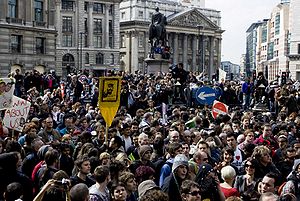
The 2009 G-20 London summit protests occurred in the days around the G-20 summit on 2 April 2009, which was the focus of protests from a number of groups over various long-standing and topical issues. These ranged from disquiet over economic policy, anger at the banking system and bankers' remuneration and bonuses, the continued war on terror and concerns over climate change.Although the majority of the protests and protesters were peaceful, the threat of violence and criminal damage were used by police as a reason to detain, or "kettle", protesters as part of Operation Glencoe. A bystander, Ian Tomlinson, died shortly after being pushed to the ground by a police officer. A second post-mortem has revealed that Tomlinson may have died from an abdominal haemorrhage. A police officer has been questioned under suspicion of manslaughter[5] and the inquest in Mr Tomlinson's death found that he was unlawfully killed.Contents 1 Timeline of the protests 2 Put People First 3 G-20 Meltdown 3.1 Squats 4 Climate Camp 5 Alternative London Summit 6 Policing 6.1 Operation Glencoe 6.2 Response to police tactics 6.3 Nicola Fisher video 6.4 Review of the policing of public events 7 Death of Ian Tomlinson 8 References 9 External linksTimeline of the protests Wikinews has related news: G20 protests: Inside a labour marchPut People First march; 28 March28 March 2009 35,000 people[6] joined the peaceful "March for Jobs, Justice and Climate" in central London, which was organised by "Put People First", a civil-society coalition organised in response to the London summit of more than 160 development non-governmental organisations, trade unions and environmental groups.[7]Their 12-point economic plan for democratic governance demanded democratised financial institutions to deliver secure jobs and public services, an end to global poverty and inequality, and a green economy.[8] The movement was initiated by the Jubilee Debt Campaign, Trade Justice Movement, British Overseas NGOs for Development and TUC.G-20 Meltdown – 1 April 12:30 pmA peace activist climbed over the railings into the Houses of Parliament as a symbolic gesture of 'power to the people'. When arrested by police he explained that "This is the people's parliament, and I am one of the people".28 March 2009 Marches in several French cities were organised by Association for the Taxation of Financial Transactions for the Aid of Citizens.[9][10]1 April 2009 12 noonAround five thousand people joined the G-20 Meltdown protest outside the Bank of England.[11] G-20 Meltdown was a radical anti-capitalist, socialist organisation conceived in Paris and formed in London in January 2009 prior to the G-20 summit.[citation needed] As well as the protest, they organised four nearby squats. Much of the protest, which was "kettled", was peaceful although there were violent confrontations. The police used batons and dogs and at least one policeman was injured; some protesters broke into a branch of RBS and a bystander, Ian Tomlinson, died after being hit with a baton from behind by a police officer near the protest.1 April 2009 12:30 pm Climate Camp in the City – 1 April 4 pmAbout two to three thousand people joined the Climate Camp in the City outside European Climate Exchange on Bishopsgate, which was peaceful except for when minor scuffles occurred after riot police 'kettled' the event at 7:30 pm. The street was cleared at about 2 am following day.[12]1 April 2009 2 pmSeveral hundred people joined a peaceful Stop the War Coalition march from the American embassy in Grosvenor Square to Trafalgar Square[13] which brought together protesters from the Stop the War Coalition, Palestine Solidarity Campaign, The British Muslim Initiative, and the Campaign for Nuclear Disarmament.[14]1 April 2009 4 pmAn 'alternative G20 Summit' with speakers including Tony Benn, Ken Loach, Ken Livingstone, John McDonnell and Caroline Lucas was scheduled to take place at the University of East London which was close to the main G-20 Summit venue.[15] At the last minute the university announced that the whole university would close for the duration of the summit on safety grounds, also that Prof Chris Knight, an expert in anthropology at the University for 20 years, had been suspended for "inciting criminal action, specifically violence against policemen and women and damage to banking institutions", and that the alternative summit was cancelled.[16] In the event, the summit did go ahead and was held on the lawns of the university and started an hour later than planned and an attendance of 200–300 people.[17]2 April 2009Around 200 people gathered for a vigil outside Bank following news of Ian Tomlinson's death, and were subjected to a police 'kettle' despite the vigil being peaceful.[citation needed] 200 anti-war protesters from the Stop the War Coalition protested at the ExCeL Centre.[18]2 April 2009'Spiderman', the French climber Alain Robert, climbed the Lloyd's building and unfurled a banner saying '"100 months" to save the world' in reference to the urgency of tackling climate change.[19]Put People FirstOn 28 March 2009, 35,000 people marched through London. At a rally in Hyde Park, they were addressed by GCAP co-chair Kumi Naidoo, TUC General Secretary Brendan Barber, environmentalist Tony Juniper, activist comedian Mark Thomas, and global justice author Susan George amongst others. They heard calls for international action to deliver tax justice, trade justice and a Green New Deal in both rich and poor countries.[20]The Put People First alliance of more than 160 unions, development, faith and environment groups called on the G20 leaders to recognise that "only just, fair and sustainable policies can lead the world out of recession, and that a return to 'business as usual' – with the associated poverty, inequality and climate change – is not an option".Christian NGOs including World Vision and Tearfund organised an ecumenical service on the day at Methodist Central Hall, overseen by the Bishop of London. Delegations joined the march from around the world, including Belgium, Czech Republic, France, Germany, Hungary, Italy, Luxemburg, Netherlands, Portugal, Romania, Slovenia, Spain, Korea, USA, Australia, South Africa, Zambia, Canada and the Philippines.[21]G-20 MeltdownRoutes of the marchesThis protest took place outside the Bank of England. The aim was to "create a carnival outside the bank" and to "overthrow capitalism".[22] Protesters referred to the day as "Financial Fools' Day", a reference to the protest taking place on April Fools' Day.[23]Protesters with one of the 'Four Horsemen of the Apocalypse'The protest started at 11:25[24] as four planned marches, each led by one of the 'Four Horsemen of the Apocalypse', converged on the Bank of England: the red horse against war approached from Moorgate; the green horse against climate chaos from Liverpool Street station; the silver horse against financial crimes from London Bridge and the black horse against land enclosures and borders from Cannon Street.[25] Protesters were at the Bank of England by 11:53.[citation needed] Protest chants included "build a bonfire, put the bankers on the top", and some protesters shouted "jump" and "shame on you" at bankers watching from windows.[23] The police cordoned off thousands of protesters at 12:52[24] and many of those within the cordon were not allowed to leave for up to seven hours.[26] Tom Brake, a Member of Parliament and legal observer who was among those 'kettled', has criticised this tactic.[27]A protester hanging banners from the Bank of EnglandProtesters from the group Space Hijackers were arrested for impersonating police, after being stopped while in a blue 10-ton armoured vehicle, wearing blue boiler suits and riot helmets.[28]The windows of a branch of the Royal Bank of Scotland were broken by a group of protesters at 13:45,[24] some of whom entered the building and looted office equipment and papers and threw smoke grenades, chairs and eggs[29] There was intense media attention to this event, with a ring of photographers surrounding the people breaking the windows[30] and David Howarth MP later commented that one of the unresolved mysteries of the day was why the moment that a masked person threw the first piece of scaffolding through the window it was observed by hundreds of photographers and film crews already in position.[31] Four people, including a 17-year-old girl, have been charged in connection to this damage.[32] RBS has asked for £40,000 in damages from the teenage girl, who has admitted burglary and criminal damage.[33]Following the damage to the bank there were violent confrontations with the police with police using batons against the protesters while trying to push them back.[30] Some protesters fought back, including one masked protester who hit police with a pole, resulting in one injury and a smoke or flour bomb was also thrown.[34] A branch of HSBC also had windows smashed.[30] A journalist reported that the police "were spat on, hit and had vile abuse screamed into their faces from inches away."[35]A professional photographer saw what they described as "agents provocateurs" instigating violence. One who was throwing bottles was challenged by protesters, who accused him of being a police officer. He ran to police lines and was allowed through after showing I.D.[36] Tom Brake MP has also said that members of the crowd told him about suspected agents provocateurs who had been encouraging the crowd to throw objects at the police. A police spokesman said that "We would never deploy officers in this way or condone such behaviour."[37]A protester dressed as V from V for VendettaWithout alternative facilities, people used the entrances to Bank Underground station as a urinal,[26] although the police said that temporary toilets and water were made available to protesters.[30] As people were eventually allowed to leave at about 20:00, they were asked for their names and addresses, and required to have a photograph taken. They are, under the law, obliged to provide their name and address,[38] however they did not need to provide the photograph, but those who refused were put back in the pen.[26]Commander Bob Broadhurst, the officer in charge of policing the G-20 protests said that the "overall mood" of the 1 April demonstrations was good although "unfortunately small groups of protesters intent on violence mixed with the crowds of lawful demonstrators."[39] A bystander, Ian Tomlinson, died after being pushed to the ground by a police officer.[40]SquatsProtesters set up four squats as bases close to the Bank of England on 31 March.[41] The police raided an occupied derelict pub in Shoreditch on the evening of the 31st which had been publicised as a 'convergence space for protesters'; they stopped and searched people entering the building and arrested three people, one on suspicion of assaulting a police officer.[41]On 1 April Payne House on Earl Street near Liverpool Street Station was promoted as venue for workshops, films and accommodation with space to house 'many, many people'. The venue was advertised as a drug-free and alcohol-free centre with no-photography allowed without permission.[42] Police later raided a large Victorian office building in Earl Street and another squatted building, the RampART Social Center, in Whitechapel on 2 April, detaining a total of at least 80 people and arresting four.[39] A video of the raid allegedly shows an officer pointing a Taser at protesters who are lying on the floor, which would be against police guidelines.[43]Climate CampSee also: Camp for Climate ActionProtesters at the climate campThe 'Camp in the City' (51.5152°N 0.0825°W) on 1 April 2009 aimed to draw attention to carbon trading, claiming that far from being a way of reducing release of climate change gasses in the atmosphere it is used as an excuse to continue doing just that.[44] The camp took place outside the European Climate Exchange in Bishopsgate[45]Prior to the actual camp a group of participants had played a game called 'capture the flag' in the area on 27 March which was used by the protesters to familiarise themselves with the locale.[46]Climate Camp organisers agreed to meet with police and exchange contact details shortly before the protest. The meeting was arranged by Liberal Democrat MP David Howarth, who was to mediate at the meeting which was to take place at the House of Commons. Scotland Yard confirmed that a meeting was to take place with Bob Broadhurst (police commander) and Ian Thomas (chief superintendent).[47]The camp, which was intended to last for 24 hours, started at 12:30 pm when a camp was established in a section of Bishopsgate between Threadneedle Street and London Wall with tents set up and bunting across the road reading 'Nature doesn't do bailouts'.[48] There were solar-powered sound systems, musicians and a food stall and some 1,000-plus relaxed people.[49]Riot police 'kettle' protestersThe atmosphere was still relaxed at about 5 pm when police with helmets, shields and batons began to surround areas of the camp using section 14 of the Public Order Act 1986.[49]At about 7 pm the police stopped allowing people to enter or leave the protest.[50] The police advanced on protesters who put their hands in the air and passively resisted while chanting "This is not a riot",[51] a tactic that emerged over the course of a number of Camp for Climate Action gatherings.[52] There were scuffles with the police in which several protesters were hit and kicked by the police and one policewoman needed medical attention.[53] Within the cordon people carried on playing music and preparing food and until the police began letting people leave at about 11:30 pm[50] and cleared the area of the last protesters at about 2 am.[49]Organizers of the Climate Camp have released a report of the protests and the police response, "Demonstrating Respect for Rights", which includes allegations of police using violence to clear the camp after journalists had left.[54] The camp legal team also released a video of the protests, which includes footage of a demonstrator being struck on the head by a police riot shield, and of another man being punched in the face as the crowd retreats from police.[55]Alternative London SummitMark Thomas – 1 AprilAn 'alternative G20 Summit' with speakers including Tony Benn, Ken Loach, Ken Livingstone, John McDonnell and Caroline Lucas was scheduled to take place at the University of East London, which is close to where the main G-20 Summit was held.[15] At the last minute the university announced that the whole university would close for the duration of the summit on safety grounds, also that Prof Chris Knight, an expert in anthropology at the University for 20 years, had been suspended for "inciting criminal action, specifically violence against policemen and women and damage to banking institutions", and that the alternative summit was cancelled.[16] In the event, the summit did go ahead and was held on the lawns of the university and started an hour later than planned; 200–300 people attended.[17]PolicingPolice lines at the G20 Meltdown protestOperation GlencoeRiot police at the protestScotland Yard officers drew up Operation Glencoe, the plan to protect the summit and prevent disorder. The overall commander (the Gold commander) was Commander Bob Broadhurst.[56]Before the event Commander Simon O'Brien said that the capital would see "almost unprecedented level of activity" of protest activity with seven officially notified demonstrations and possibly many more they don't know about. Scotland Yard described the G20 policing plan as one of the largest, most challenging and complicated public order operations it has ever devised. They said that the level and style of activity on the internet suggested a re-emergence of groups with similar aims to the anti-globalisation protesters who turned to violence in 2000 and 2001. They said they were determined to avoid the violent scenes of the 2001 G8 in Genoa in which one protester was killed and hundreds more injured.[57] In the days leading up to the summit, the Metropolitan police warned protest groups that the protests on 1 April would be "very violent" and that they were "up for it, and up to it" in the event of trouble.[58]An injured protester with police medicsThe police used the crowd-control tactic known as containment or the “kettle”, to hold 5,000 people inside a police cordon without food, drink or lavatory facilities.[59] This combined with riot police pushing into crowds with shields and batons. [60]Ian Tomlinson died after being shoved and struck by a police officer within a police cordon of the G-20 Meltdown protest near the Bank of England. Initially the City of London Police denied that any incident with the police had occurred, and the death was attributed to natural causes.Including a number of raids on squats on 2 April 2009, the police made over 100 arrests and said they had identified and would track down those who had broken the law. A teenage girl was convicted of criminal damage[61] An estimated 5,000 people took part in the protests.[62] It has been suggested that the policing of the event will turn out to have been the most expensive police operation in British history at an estimated cost of up to £8 million, or £1,600 per protester.[63]One raid on a climate change group the day after the main protests was ruled to have been illegal in March 2010, the Met Commissioner said that it was unlawful to arrest and search protestors and to force them to be recorded on film. Two protesters were each awarded £3000 compensation after the Met admitted the operation was unlawful as there were no reasonable grounds for suspicion.[64]Response to police tacticsThe police choice of "Operation Glencoe" as a codename was linked with the Glencoe Massacre.[65][66] In the build up to the protests the chairman of the Joint Committee on Human Rights, Andrew Dismore, MP, said that "The police have a duty under the Human Rights Act to facilitate protest and not frustrate it. If they act in a confrontational way and use confrontation language, they will start to provoke the kind of behaviour they are seeking to prevent. There may well be a fringe element that want to incite violence. But that doesn't mean police should criminalise every protester." David Howarth, a Liberal Democrat MP, said: "I am increasingly worried that what the police are saying about the protests will end up in a self-fulfilling prophecy. By talking up the prospect of violence they [the police] will put off peaceful demonstrators and start to attract other sorts."[67]Jenny Jones, a member of the Metropolitan Police Authority, said of reports of police brutality that "If the police were hitting people who were sitting down with their hands up, we have entered a new era of overt violent policing in Britain that will deter people from protesting and cut back our civil liberties". A police Commander said that their "tactics were proportionate and worked".[68] Jean Lambert, MEP, of the London Green Party, wrote an open letter to the Metropolitan Police Commissioner after the event asking for an explanation of the police tactics at the climate camp.[69]A number of allegations of police misconduct have been reported, including by a press photographer.[70] The IPCC has received 185 complaints relating to police actions at the demonstrations, 40 of which were ineligible[71] and 80 of which concern violence.[72][73] An officer is being investigated and has received a written warning after writing "Rob Ward can't wait to bash some long haired hippys up @ the G20" as a Facebook status update on the evening of 1 April. Liberal Democrat MP Chris Huhne has noted "the canteen culture of some parts of the Met".[73]The National Union of Journalists has considered taking legal action after Section 14 of the Public Order Act 1986 was used against journalists covering the protests on 2 April. The City of London police asked them to leave the area at the Royal Exchange for half an hour, and threatened arrest if they refused.[74] Section 14 is to prevent "serious public disorder, serious criminal damage or serious disruption to the life of the community". The police earlier apologised to journalists reporting the 1 April protests at the Bank of England: "Section 14 was applied outside the Bank of England to disperse protesters. There may have been some photographers caught up in that. If so we apologise. We respect the right of photographers to cover current events."[75]Sir Paul Stephenson, the Metropolitan Police Commissioner, expressed "concern that the video footage of some police actions are clearly disturbing and should be thoroughly investigated", and a need to be reassured that the use of the containment, or kettling tactic "remains appropriate and proportionate".[76] Denis O'Connor has said that some police behaviour "fell short of the police medal promise to "guard my people"."[77] Others have defended the policing of the protests. Sir Ken Jones, the President of the Association of Chief Police Officers, has criticised the lack of objectivity which he perceives has been shown by the media.[78] Jones went onto question the views put forward by Nick Hardwick, the Chair of the IPCC.[79] Jones also stated that he "can't think of any other country that doesn't use water cannons, CS gas, rubber bullets". The Police Federation has also criticised the IPCC, making a formal complaint about the "deplorable behaviour" of Nick Hardwick, Chairman of the IPCC, for passing "lofty and withering judgment on London's police officers".[77] Home Office Minister Lord West said in the House of Lords that "thousands of officers acted absolutely professionally and proportionately, thousands were actually able to demonstrate peacefully on our streets, criminal activity in the rest of the metropolis was kept to an absolute minimum and the police also maintained high levels of security. And I think we should be extremely proud of them. This does not excuse acts which are criminal and there are now investigations taking place for those particulars."[71] The Mayor of London, Boris Johnson, has defended the police,[80] and said that "I worry that there are large sections of the media that are currently engaged in a very unbalanced orgy of cop bashing".[81]Nicola Fisher videoMain article: Death of Ian Tomlinson § Nicola Fisher videoOn 14 April, media outlets published video taken during a vigil for Ian Tomlinson on 2 April outside the Bank of England, near to where he died. A sergeant with the Territorial Support Group is seen slapping a woman who was arguing with him, Nicola Fisher, across the face, then striking her legs with his baton. The officer's identification number was concealed.[82][83] The IPCC said it would investigate, and the officer was suspended.[83] Sir Paul Stephenson said that uniformed officers should always display their shoulder identification numbers, as "The public has a right to be able to identify any uniformed officer whilst performing their duty."[76] In September 2009, the officer was named as Sgt Delroy 'Tony' Smellie, and the CPS announced that it would charge him with assault.[84] The court case against Delroy Smellie commenced in March 2010 and he has been found not guilty.Another demonstrator, Katie Surridge, has alleged that she was pushed to the ground from behind on 1 April by the same officer who later struck Nicola Fisher. That incident has also been reported to the IPCC.[43] IPCC have announced that there is no case to answer.Review of the policing of public eventsOn 15 April 2009, Metropolitan Police Commissioner Sir Paul Stephenson asked the Chief Inspector of Constabulary to review policing tactics in the policing of public events. Denis O'Connor will review the policing of public events following allegations of two assaults by police during the G20 protests in London on 1 April. He will also assess whether the tactic of containment or kettling is appropriate and proportionate to ensuring people have the right to protest. He said the event was a "complex policing operation", and that footage of clashes with police will be reviewed to check if other incidents need to be examined. Sir Paul stressed that all uniformed officers must wear shoulder identification numbers to be easily identifiable by the public.[85] Among the tactics being reviewed is the crowd-control tactic known as the “kettle”, used to pen in protesters.[60] Bob Broadhurst, the commanding officer during the protests, blamed any misconduct of officers on the lack of training they receive in crowd control and on fear. He revealed during a Commons Home Affairs Committee that officers only receive 2 days of training a year.[86]On Tuesday 25 January 2011, Bob Broadhurst apologised to the home affairs select committee for telling then in May 2009 that no plain-clothes officers were present at the demonstrations; He admitted that numerous City of London police officers had been present at the demonstration, along with more than one Met officer, including PC Mark Kennedy.[87]On 14 April 2011 the high court has ruled that the Metropolitan police broke the law in the way they "kettled" protesters at the G20 demonstrations in 2009, and also criticised the use of force by officers.[88]Death of Ian TomlinsonMain article: Death of Ian Tomlinson Wikinews has related news: G20 protester dies after collapsing Wikinews has related news: Inquiry into death of vendor during G20 protests beginsIan Tomlinson, a newspaper vendor in the City of London, died within a police cordon of the G-20 Meltdown protest near the Bank of England. Initially the City of London Police denied that any incident with the police had occurred, and the death was attributed to natural causes. Days later, The Guardian published video showing Tomlinson had been pushed by a Metropolitan Police Service officer and hit with a baton minutes before he collapsed and died.[89]The Independent Police Complaints Commission (IPCC) subsequently ordered a second post mortem and set up an independent criminal inquiry to determine whether Tomlinson was assaulted by police, and whether that assault contributed to his death.[89] The results of this second post mortem have revealed that Tomlinson actually died from an abdominal haemorrhage. A police officer has since been questioned under caution in the ongoing probe into Tomlinson's death.[90]
2010 G-20 Toronto summit riots Date June 18-28, 2010 Location Toronto, Ontario, Canada Methods Black bloc, rally, demonstration Casualties Injuries 3 confirmed by Toronto EMS, plus an unknown number of injuries during arrests. On the police side. A total of 75 police officers received injuries during the G20.
The 2010 G-20 Toronto summit protests began one week ahead of the summit of the leaders of the G-20 on 26–27 June in Toronto, Ontario, Canada. The protests were for various causes, including poverty and anti-capitalism. Protests mainly consisted of peaceful demonstrations and rallies but also took form of a riot as a group of protesters using black bloc tactics caused vandalism to several businesses in Downtown Toronto. More than 20,000 police, military, and security personnel were involved in policing the protests, which at its largest numbered 10,000 protestors.[1][2] While there were no deaths, 75 officers were injured and only three other reported injuries, all of which were inflicted upon protesters by the police, at least 40 shops were vandalised, constituting at least C$750,000 worth of damage.[3] Over 1000 arrests were made, making it the largest mass arrest in Canadian history.[4] In the aftermath of the protests, the Toronto Police Service and the Integrated Security Unit (ISU) of the G-20 Toronto summit were heavily criticized for brutality during the arrests and eventually went under public scrutiny by media and human rights activists. Preliminary eventsEarly oppositionA Royal Bank of Canada branch in Ottawa was firebombed just before dawn on May 18, 2010.[5] The attackers posted video on YouTube showing a large fireball igniting inside the bank. The video then listed the manifesto of a previously unknown group calling itself the FFFC. The message stated that the attack against the bank was because of the growing suffering of Vancouver's poor in the shadow of RBC's major sponsorship of the 2010 Vancouver Olympics and Paralympics in Vancouver and Whistler, British Columbia and claimed these events were held "on stolen indigenous land."[6] In addition to social issues and aboriginal land claims, the video claimed the actions were sparked by environmental and deforestation related concerns surrounding the Alberta tar sands projects in "Kanada's" prairies, in which the video claims RBC is substantially involved and which G8/G20 decisions furthered.[7] The attackers also stated their intention to be present during the G8 and G20 summits the following month.[8] The projected recurrence of such acts of violence and the escalating rhetoric of anti-summit protest plans caused the G8/G20 Integrated Security Unit (ISU) to increase its security measures.[9][10] The attacks were quickly and widely criticized by the media, politicians, and other protest groups[11][12] Three suspects were arrested on June 19, 2010; with one, Roger Clement, being convicted in December 2010 while charges against the other two were stayed for lack of evidence. Clement, a 58-year-old retired federal government employee, formerly working for the Canadian International Development Agency, eventually received a 3½ year prison sentence, that included 6−months for vandalism of another RBC branch in February 2010.[13] Initial estimates of the damage, immediately following the attack, set the price-tag at around $300,000 and projected that the bank would be closed for several weeks. At the time of Clement's trial, reports stated that the branch was closed for months with total costs of $1,600,000.[7][8][14] An individual was arrested for vandalism on May 28, after being caught spray-painting anti–G-20 slogans on windows and automated teller machines in Downtown Toronto.[15] Two individuals were arrested in London, Ontario after attaching posters to public property encouraging disruption of the G-20 summit and canvassing protests.[16] Key groups which organized early in opposition to the summit included Canadian Labour Congress, Council of Canadians, Greenpeace, Ontario Coalition Against Poverty, Ontario Federation of Labour, Oxfam and the Toronto Community Mobilization Network.[17] Week prior to summitAn early demonstration on Yonge Street on June 24 demanding respect of First Nations treaty rights A small rally was conducted on June 17 in the Financial District by Oxfam Canada, urging Canada to end fossil fuel subsidization and take action on world poverty. The rally also spoofed the summit's high security cost.[18] An anti-poverty protest occurred on June 21, causing traffic congestion.[19] About 100 protesters marched from Allan Gardens on Sherbourne Street and continued on Yonge Street, Dundas Street, and Isabella Street. Police officers on bicycles and military helicopters patrolled the protest; one arrest was made.[19] A few protesters also attempted to occupy an Esso gas station, claiming corporations like Esso "have caused irreparable damage all over the world."[20] Other protester concerns were the Arab–Israeli conflict, capitalism, and the G8 and G-20 summits.[19] The protest was led by a Guelph-based group called Sense of Security, an anti-poverty group that was also supported by the Ontario Coalition Against Poverty.[20] The following day, about 200 people from Toronto's gay community marched through downtown attempting to raise awareness on homosexual rights.[21] Protesters chanted, "We're queer, we're fabulous, we're against the G-20."[22] The Canadian Broadcasting Corporation (CBC) labelled the protests as "peaceful" overall.[23] The first sizable G-20 protest, of about 1000 people, took place on June 24 with First Nations groups and supporters from across Canada demanding respect for treaty rights from the government.[24] Demonstrations moved from Queen's Park to the Toronto Eaton Centre along University Avenue and Queen Street West. Concerns of protesters were Canada's failure to sign the United Nations' Declaration on the Rights of Indigenous Peoples and the fact that no aboriginal chiefs were invited to the summits.[25] Also on June 24, activist Jaggi Singh, spokesperson for the group No One Is Illegal, suggested in a news conference that some protesters intended to attempt to breach the security fence in the coming days.[26] A larger protest was scheduled for June 25 in Toronto, the day the 36th G8 summit began in Huntsville, Ontario.[27] Protesters attempted to enter the security zone, but were later forced to return by police officers. By evening, protesters set up a tent city at Allan Gardens and stayed overnight to resume protests the following day, the opening of the G-20 summit.[28] During the summitJune 26: Riots and vandalismAs the G-20 leaders arrived in Toronto after the 36th G8 summit in Huntsville, Ontario wrapped up, a large group comprising as many as 10,000 people protested downtown during the afternoon of June 26.[29] At the protest, Jeff Atkinson, spokesperson for the Canadian Labour Congress, said, "We don't want G20 countries to cut stimulus spending until jobs recover." Greenpeace International director Kumi Naidoo reasoned that "if G-20 governments could spend billions of dollars to rescue banks in trouble, why not find money to help unemployed workers for the environment and for social causes." Sid Ryan of the Ontario Federation of Labour said in a speech, "It wasn't the workers of the world that caused the financial crisis. We don't want to see a transfer of wealth from the public sector to the private sector."[30] According to eyewitness accounts, about 200 marchers broke away from the protest route on Queen Street and headed south on Bay Street towards the convention centre, through Financial District. The media would describe the break-off as led by the black bloc, with demonstrators covering their bodies and faces in black clothes. Individuals using the same black bloc tactics have been suspected of being responsible for confrontations in other international summit protests.[31] Protesters dispersed to damage buildings and vehicles.[32] The intent as interpreted by some media was to distract police forces from the security zone so that other protesters could break in, but police maintained their blockades, protecting the fence.[33] Vandals smashed the windows of various office buildings and stores along Yonge Street, Queen Street West and College Street using hammers, flag poles, umbrellas, chunks of pavement and mailboxes.[34] Conflicts also erupted between purported anarchists and journalists who were recording property destruction.[35] After a few hours, many black bloc demonstrators changed into civilian clothes and dissolved into the larger crowd as security forces began to increase in presence. Police later maintained that some protest organizers were complicit in providing cover for the vandals.[36] This Starbucks branch was one of many shops to have damaged exteriors from the riots The first property reportedly damaged was a Nike clothes store. Toronto Police Headquarters was also damaged.[37] Media vehicles of the Canadian Broadcasting Corporation and CTV Television Network were damaged and four Toronto Police Service cruisers were smashed and set ablaze in various locations.[38] American corporations, such as Starbucks, appeared to be the targets of vandalism.[34] Other targets were Foot Locker, Sears Canada, McDonald's Canada, Tim Hortons, Urban Outfitters, Pizza Pizza, Subway, Swiss Chalet, and the Zanzibar Tavern, a local strip club whose owner had invited leaders to try G-strings instead of the G-20 summit.[34][39][40][41] An American Apparel store was damaged; the mannequins on display were taken out and used to further damage nearby stores.[34] Branches of Scotiabank, Canadian Imperial Bank of Commerce (CIBC), and the Toronto-Dominion Bank (TD) were also damaged. Toronto Police Headquarters, Toronto Eaton Centre, Sheraton Centre, Delta Chelsea and some buildings in Yonge-Dundas Square were put in lockdown mode, and three people were confirmed by the Toronto EMS to be injured during the protests.[42] Hospitals along University Avenue, which includes Mount Sinai, Toronto General, Princess Margaret, and The Hospital for Sick Children, were put into lockdown mode by police.[43] Toronto Transit Commission (TTC) bus and streetcar routes were halted in Downtown, as well as subway service between Bloor-Yonge and St. George stations.[44] GO Transit was requested by the ISU to reroute trains away from Union Station, and used Danforth and Exhibition stations as the termini for westbound and eastbound trains respectively,[45] but free shuttle bus service was made available to passengers from those stations. The TTC also provided free shuttle bus services.[46] The escalating violence caused Dutch violinist André Rieu to cancel his concert at the Air Canada Centre at the last minute.[47] Sound cannons were not used during the weekend, but tear gas was used for the first time in the history of Toronto,[48] being deployed in a few locations by muzzle blasts. Rubber bullets and pepper spray were also used against many protesters.[49][50] At the end of the day, Toronto Police Service chief Bill Blair announced that 130 people had been arrested.[51] Several media personnel, including a Canadian reporter for The Guardian, a CTV producer, and two photographers for the National Post, were also arrested.[52][53][54] Condemnations of the violence were made by Ontario premier Dalton McGuinty and Toronto Mayor David Miller.[55] In a press conference, Miller said, "All Torontonians should be outraged. They’re criminals who came to Toronto deliberately to break the law. They are not welcome in this city."[34][48] Referring to damage caused by black bloc protesters downtown, he claimed that calling the attackers protesters was "not fair to the people who came to [legally] protest,"[34] and that they were in fact "criminals."[34] In a statement, Dimitri Soudas, spokesperson for Prime Minister Stephen Harper, proclaimed, "Free speech is a principle of our democracy, but the thugs that prompted violence earlier today represent in no way, shape or form the Canadian way of life."[56] June 27: Police brutality protestsApproximately 480 arrestees were taken to the Eastern Avenue temporary holding centre during the previous day's protests; police initially gave numbers ranging from 32 to 130. While those with minor charges or dropped charges were released, those with serious charges were set to appear in a courthouse located on Finch Avenue and Weston Road in North York.[57][58] After closed services throughout the night, the following morning saw the resumption of regular TTC and GO Transit services, while G-20 leaders began formal discussions at the Metro Toronto Convention Centre. Lockdowns at University Avenue hospitals and the Toronto Eaton Centre were also lifted.[59] Additional officers from the Ontario Provincial Police were deployed, doubling the total number of officers to 20,000.[60] Four arrests were made during the twilight of June 27 after two security guards witnessed men emerging from a manhole on Queen Street West. The manholes were later welded shut.[61] About 100 additional arrests were made during a morning raid by Toronto Police Service at the University of Toronto. Those arrested were said to be in possession of black clothing and "weapons of opportunity" such as bricks and sharpened stakes.[62] During the mid-morning, protesters marched from Jimmie Simpson Park on Queen Street East to the front of the Eastern Avenue temporary detention centre, where a "jail solidarity" bike rally and sit-in consisting of about 150 people occurred during the afternoon, with demonstrators urging the release of those arrested the previous day.[63] Following several arrests during the rally, protesters began a sit-in interrupted by small muzzles of pepper spray and rubber bullets fired by police.[64][65] At least 224 arrests occurred by evening.[66] Another large group assembled at the intersection of Queen Street West and Spadina Avenue, presumably to conduct a protest, but were immediately surrounded by heavily armed police forces.[67] Numerous bystanders and media personnel were also in the crowd. Several arrests were made, including several members of the media and another CTV cameraman who was briefly held and then released; police later claimed that they had found weapons at the scene, and that they suspected the presence of more black bloc protesters within the crowd.[66][68][69] The blockade caused traffic diversions and the stoppage of streetcar service along Spadina Avenue. After several hours of detainment in record-breaking heavy rain, police released the remainder of the crowd during the night.[citation needed] AftermathPost-summit protestsA total of 1118 people were arrested in relation to the G-20 summit protests,[4] the largest mass arrests in Canadian history,[70] while nearly 800 of them were released without charge.[71] The remaining 231 people remained with charges before the court while 58 of them have had their charges withdrawn or stayed.[72] Smaller-scale, non-violent protests took place the following day, June 28, during the afternoon and evening. Nearly 1000 protesters marched to Toronto City Hall and Queen's Park to protest the treatment of arrested individuals at the Eastern Avenue holding centre and demanded the release of individuals still being detained, although police had earlier released several arrested on minor charges.[73] Large numbers of Toronto Police Service officers continued to patrol the demonstrations.[74] On June 29, a group of gay activists gathered outside a community centre where Toronto Police Service chief Bill Blair was scheduled to speak to demand his resignation for the treatment of women and homophobia within the detention centre.[75] Criticism of policingOn December 7, 2010, Andre Marin, Ontario Ombudsman, issued a report called Caught in the Act, an investigation into the legality of the Ontario Public Works Protection Act, and, more specifically Regulation 233/10, in Marin's words, "...known as the secret security regulation, a little known and widely misunderstood legal measure that was supposed to help the police keep the peace, but in my view wound up contributing to massive violations of civil rights."[76] Police were allowed to arrest anyone within five metres of the fence who would neither leave nor identify himself. A group of lawyers requested court injunctions against the Toronto Police Service from using newly purchased Long Range Acoustic Devices (LRAD), also known as sound cannons, during protests.[77] Sound cannons have been used in previous summit protests and have the ability to produce sound at ear-piercing volumes, potentially causing hearing impairment. The Ontario Superior Court of Justice later ruled that officers can use sound cannons, with a few restrictions.[78] The Toronto Star reported that the Executive Council of Ontario had implemented a regulation under the provincial Public Works Protection Act on June 2 granting the ISU sweeping powers of arrest within a specific boundary during the summit;[79] the rule was said to designate the security fence as a public works and, as such, allow any police officer or guard to arrest any individual failing or refusing to provide identification within five metres of the security zone. The regulation was requested by Toronto Police Service chief Bill Blair and debate in the legislature was not required. Orders in Council such as this one are announced in the Ontario Gazette, but the next issue of that publication was to be published after the order expired on June 28, a week after the summit ended. The new law came to light after a York University graduate student, who claimed to have been simply "exploring" the security zone but who did not provide identification when confronted by police, was arrested on June 24 under the regulation.[80] He later vowed to file a lawsuit against the law once the summit ended.[81] The Cabinet later confirmed that the new laws were not "special powers" and that those who were believed to have been arrested under the Public Works and Protection Act were in fact arrested under the Criminal Code of Canada.[82] The police chief later admitted that, despite media coverage, no such five-metre rule ever existed in the law.[83] Human rights investigationsIndividuals arrested during the protests who claimed to be bystanders not taking part in protests condemned the treatment they received from police at the Eastern Avenue holding centre.[84] According to testimonials given to the Toronto Star and La Presse by a few arrestees, including university students, journalists, street medics, teachers, tourists, photographers, and a former mayoral candidate, "[individual] rights were violated" and "police brutality [was present]." The detention centre was described as "cold" with "barely any food or water" and "no place in the cages to even sit," and "tantamount to torture." Other allegations included harassment, lack of medical care, verbal abuse, and strip searches of females by male officers.[85][86][87] At one point, a plainclothes officer reportedly told a detainee that the federal government had declared martial law.[88] Blair defended the conditions in the temporary detention centre, citing the fact that every room in the centre was under video surveillance, and that to the best of the officers' abilities, occupants were read their rights.[89][90] However, a Toronto Star commentator editorialized that "some of the elements of classic authoritarian detention were there, albeit in embryonic forms."[88] Amnesty International called for an official investigation into the police tactics used during the protests. The organization alleged that police violated civil liberties and used police brutality.[91] The Canadian Civil Liberties Association decried the arrests and alleged that they occurred without "reasonable grounds to believe that everyone they detained had committed a crime."[92] Toronto Police Service held press conferences to speak out against inappropriate actions of protesters, including displaying items alleged to have been seized from protesters. However, when confronted, Chief Blair admitted that some of the items were unrelated to the G-20 protests.[93] Police officers were also reported to attack detained journalists, while forcing other journalists to leave the scene of the protests.[94] Adam NobodyProtestor Adam Nobody, 27, was arrested in Queen's Park on 26 June. An amateur video uploaded to YouTube[95] showed at least a dozen officers surrounding and beating Nobody, who was not armed and did not appear to resist. He suffered a broken nose and cheekbone, and was charged with assaulting police. These charges were eventually dropped, and a Special Investigations Unit investigation was opened into the incident. This investigation was closed without any charges laid, because the SIU was unable to identify the officers. They had covered their identification badges, police witnesses all claimed to be unable to identify them, and the arresting officer had written an invalid ID number on Nobody's arrest record. Police chief Bill Blair insisted that a "forensic examination" had proven the video was "tampered with," removing proof that Nobody was an armed, violent criminal, but soon retracted this statement admitting he had no evidence to support it. Blair's claims led to increased attention to the case, new witnesses coming forward, and a second video corroborating the first. On 30 November the SIU re-opened its investigation, obtained the co-operation of a police officer who witnessed the incident, and laid charges against Const. Babak Andalib-Goortani. The SIU has the names of other officers involved but has not yet laid charges against them.[96][97][98][
Civil20 - 2014
On 12 June, 2013 the Australian Government confirmed its commitment to the continuation of the C20 as an integral part of the G20 process, following proposals submitted by Australian civil society. The Australian Government appointed a Steering Committee to lead the C20 throughout the Australian Presidency. The Australian C20 Steering Committee is committed to running a professional program of policy development that clearly demonstrates the value that civil society engagement brings to G20 policy, with a view to ensuring that the C20 forms an enduring and significant element of each future G20 Presidency.
For more information, please, visit http://www.c20.org.au
G20 Civil Summit 2013Civil20 Summit was held on June 13-14, 2013 in President Hotel in Moscow. The event was attended by over 350 people – representatives of civil society, international organizations, businesses and mass media, as well as officials.
Civil20 Address to the G20 Leaders We, the Civil20 participants and delegates of the G20 Civil Summit, endorse the initiative of the Russian presidency to incorporate civil society into the G20 consultations process. The Civil20 format has made it possible to set up a constructive and result-oriented dialogue between civil society and the government officials responsible for drawing up state policy. Such structured efforts should be continued under the subsequent presidencies. For this reason, We propose preparing a mid-term collaboration strategy between the Civil20 and the G20. We call on the G20 to make the accountability procedure transparent and to continue discussing the priority issues on the agenda with representatives of civil society. We hope that the accountability reports the G20 prepares on its key decisions will be transparent and comprehensive and that the G20 will include the Civil20 in their discussion. We pledge that members of civil society will also adhere to the principles of transparency and accountability. We will promote the implementation of our recommendations in the G20 countries, including by monitoring the performance of the commitments adopted in compliance with our proposals. We suggest that further Civil20 efforts be focused on drawing up general principles of collaboration between the state and civil society in the G20 countries. Collaboration should be based on rule of the law, balance of power, and information openness (transparency). Civil society should be autonomous from the state. Civil society is transboundary and depends not only on local and national interests. This is precisely why it can and should become an important part of the global political dialogue. Transboundary financial support of civil society organizations is a common practice. When the activity of NCOs is legal and transparent, international financial support and participation in international cooperation should not be grounds for doubting their legitimacy. Inclusive and forward looking societies depend on the distinctive and complementary roles of the public, private and civil society sector. Among these actors, civil society, as agents of the people, seeks to advance and preserve community interests and rights by promoting participation, transparency and accountability. It is therefore proposed that civil society organizations engaged in the G20 process will present to G20 Leaders existing good practice in the fields of civil society engagement with national authorities, and standards for civil society transparency and accountability. In 2013, Russia, as the G20 presiding country, expanded the consultations process with civil society by incorporating it into the discussion on its presidency priorities as a full-fledged social partner along with big businesses and trade unions. The G20 Civil Summit is the significant component of this process. We endorse a broader dialogue with civil society and hope that the G20’s experience will be continued and developed by subsequent G20 presiding countries. We encourage G20 countries to facilitate convention of annual regional, national and international civil society forums. The Civil20 has formed seven working groups that operate in keeping with the priorities of the Russian presidency, and also a task force on equality. These efforts have produced a set of G20 recommendations to the G20 countries and a thematic report on G20 Proposals for Strong, Sustainable, Balanced and Inclusive Growth, which is attached to this Address.
|
This group developed recommendations for the G20 to support long-term growth through the sustainable use of natural resources. A strong, sustainable global economy depends on a healthy environment, making the related challenges of climate change, climate finance and resource security a critical focus for the G20. As economic growth brings with it rising consumption of resources, the impact on climate and fragile eco-systems becomes increasingly evident and the solutions to address environmental degradation increasingly urgent.
Membership of this working group is open. Anyone can have input into the group’s recommendations, but only by posting on this website. Drafting of the group’s position paper was led by the discussion leaders and co-chairs. A draft position paper was posted online here on 29 April for further feedback.
The feedback we receive will help shape our final recommendations to the G20 Leaders.
The discussions here closed on 16 May. All policy position papers will inform the Australian C20’s communique which will be discussed and approved at the Summit in June.
Final Position Paper C20 Conversations on Thu, June 5, 2014 at 02.56 pm - 458 download(s) View all
Welcome to the C20 Inclusive Growth and Employment group
This group developed recommendations for the G20 to pursue the linked goals of boosting growth, creating quality jobs and reducing inequality. Tackling inequality has powerful economic benefits and is not only a key concern of civil society, but is also an imperative in achieving the G20’s Framework for Strong, Sustainable, Balanced and Inclusive Growth.
Drafting of the group’s position paper was led by the discussion leaders and co-chairs based on a series of focused discussions between February and May. An initial draft position paper was posted online here for further feedback before being finalised in its current form.
The feedback we receive will help shape our final recommendations to the G20 Leaders.
The discussions closed on 16 May. All policy position papers will inform the Australian C20’s communique which will be discussed and approved at the Summit in June.
C20 Conversations on Thu, June 5, 2014 at 02.25 pm - 686 download(s) C20 Conversations on Thu, June 5, 2014 at 02.34 pm - 156 download(s) View all
The ‘C20 Conversations’ platform is still available. Please visit www.c20conversations.org.au to see information about our recommendations and the development of our four key policy themes.
G20 seeking prosperity that can be shared by allNovember 11, 2014 This Opinion Editorial orginally appeared in the Canberra Times on 11 November 2014
The world of today is doing its best to give the impression that it is falling apart. We are witnessing outbreaks of fundamentalism in many destructive… Read more »The G20 will be judged on fairness, says C20November 10, 2014 The C20 (‘Civil Society 20’) is calling on G20 leaders to take action this weekend to improve the lives of the most vulnerable in society.
C20 Chair Tim Costello said the C20 was looking for an outcome on Sunday that… Read more »C20 Statement to G20 Leaders’ SummitNovember 09, 2014 The C20 has submitted its formal Statement to the G20 summarising the issues civil society believes need to be addressed at the Leaders’ Summit in Brisbane this weekend.
The recommendations, if implemented, would benefit those most in need, resulting in… Read more »C20 messages rejected ahead of G20 arrivalNovember 04, 2014 The C20 recently produced a series of advertising messages which were booked to be displayed in the international terminal at Brisbane Airport to promote our messages to visitors arriving for the G20 Leaders Summit.
Unfortunately after submitting the artwork, the… Read more »C20 Chair responds to Rupert Murdoch speech to G20 on inequalityOctober 29, 2014 Transcript and audio of interview on ABC 774 Melbourne with C20 Chair Tim Costello by interviewer Jon Faine on Tuesday 28 October 2014 JON FAINE:
The front page of today’s Australian newspaper, owned by Rupert Murdoch’s News Corporation, is an… Read more »Joint discussions held on infrastructure investmentOctober 03, 2014 …
Telstra CEO David Thodey and ACOSS CEO Cassandra Goldie, B20 and C20 Infrastructure Taskforce co-chairs respectively, yesterday (2 October) hosted a discussion on infrastructure with a number of Australian civil society and business leaders in advance of the G20 Leaders Read more »OPINION – Urgent reforms needed on murky world tax havensSeptember 22, 2014
The following Letter from the C20 was first published in the Australian Financial Review on 22 September 2014 with the accompanying AFR cartoon.
As Jennifer Hewett points out (“Why everyone is talking BEPS…”, AFR, September 18), the Australian
Read more »MEDIA RELEASE – C20 concerned over G20 Finance Ministers omissionsSeptember 21, 2014 The C20 (‘Civil Society 20’) has expressed concern at the absence of any reference to inclusive growth and jobs in the communique just issued by the G20 Finance Ministers and Central Bank Governors following their meeting in Cairns this weekend.… Read more »C20 MEDIA CONFERENCE – G20 Finance Ministers Meeting Cairns 20 September 2014 – Video & TranscriptSeptember 21, 2014
With C20 Chair Tim Costello and Deputy Chair Cassandra Goldie
Link to Media Conference Video here…
Transcript of video
CASSANDRA GOLDIE: Thanks very much. We’re here this morning representing the civil society participation in this very important national process, international
Read more »MEDIA RELEASE – C20 pushes for greater equity between and within nationsSeptember 19, 2014 The C20 (‘Civil Society 20’) will press home that G20 growth plans must address the urgent global challenges of financial transparency and growing inequality when it meets with G20 Finance Ministers in Cairns on Saturday.
C20 Chair Tim Costello highlighted… Read more »
Civil Society representatives gather to influence G20 AgendaJune 20, 2014 Representatives from around the world will converge on Melbourne over the next two days (20 & 21 June) to finalise the important issues civil society wants to see on the G20 agenda when it meets in Brisbane in November.
Speaking… Read more »Professor Don Henry joins speaker line-up for C20 SummitMay 29, 2014 Leading environmental advocate Professor Don Henry is the latest high profile name to join the national and international speaker line-up at the forthcoming C20 Summit in Melbourne on 20 and 21 June 2014.
The C20 (or ‘Civil Society 20’) Summit… Read more »MEDIA ALERT: G20 lead-in gets underway with C20 SummitMay 21, 2014 Global civil society will come together in Melbourne in June for the C20 Summit which is the first of the lead-in G20 ‘satellite’ conferences to debate policy suggestions to be put to the G20.
The C20 Summit on 20-21 June,… Read more »Huguette Labelle announced as keynote speaker at C20 SummitApril 15, 2014 Transparency International Chair Huguette Labelle will be a keynote speaker at the C20 Summit in Australia in June.
Ms Labelle has led a distinguished career as a Canadian Deputy Minister, university Chancellor, and international civil society leader, and currently holds… Read more »The G20 as part of a wider communityMarch 31, 2014 This article was written by C20 Chair Tim Costello as part of theLowy Institute’s publication, the Monitor….
Introduction: a broader economic debate
With the burning platform of the Global Financial Crisis to focus the minds of the world’s Read more »Message from the C20 Chair after the Finance Ministers MeetingFebruary 25, 2014 During a recent visit to India, I was almost overwhelmed by the human challenge of high unemployment, massive slums, and malnutrition. The chaos and deprivation – leavened by the enormous spirit of community in even the most crowded slum –… Read more »MEDIA RELEASE: Civil society voices required for global economic solutions to benefit allFebruary 23, 2014 The Australian C20 welcomes the positive decisions coming out of this weekend’s meeting of the globe’s top finance ministers and central bankers. However, it warned that action to lift the world out of the economic malaise needs to be focused… Read more »C20 Conversations site goes liveFebruary 03, 2014 Today we are launching the C20 Conversations website – an online platform where you can help shape civil society’s recommendations to the G20 Summit.
Please visit the C20 Conversations site and be part of the discussion.…
We are developing ideas Read more »Oxfam: Rapidly growing inequality is worsening poverty around the worldJanuary 20, 2014 “A new report from Oxfam sheds light on rapidly growing extreme inequality and how it worsens poverty around the world, as Prime Minister Tony Abbott prepares to spruik Australia’s G20 agenda at the World Economic Forum in Davos this week.… Read more »Global policy one of driftJanuary 17, 2014 What we have is a leadership vacuum. As governments insist on pretending that they have control over global economic forces, the profound disconnect between political leaders and citizens the world over becomes more stark. Read more »
Video Reflections: C20 Steering Group Members reflect on the G20 year under Australia’s PresidencyDecember 10, 2014 …
The Australian Presidency of the G20 in 2014 was the first time civil society had been formerly involved in the G20 consultation process.
Members of the C20 Steering Group, including Chair Tim Costello, Deputy Chair Cassandra Goldie and Sherpa Joanne Read more »Was the G20 outcome a success for civil society?November 19, 2014 …
C20 Sherpa Joanne Yates reflects on the C20′s engagement and outcomes in the G20 process under the Australian Presidency:
A G20 Report Card
Never before has Australia been more at the heart of global affairs. We have in 2015 simultaneously Read more »Quotes from C20 Chair Tim Costello following release of G20 CommuniqueNovember 16, 2014 Responding immediately following the release of the G20 Leaders’ Communique in Brisbane, C20 Chair Tim Costello, said:
“The world needed a break and this G20 has undoubtedly provided a step forward. We certainly haven’t gone backwards.
“We’ve seen inclusive growth… Read more »C20 Response to the G20 Leaders’ CommuniqueNovember 16, 2014 A downloadable copy of the C20′s response to the G20 Leaders’ Communique can be found here
…
The C20 Response:
The Australian C20 welcomes the commitment by the G20 Leaders to a two percent growth target above projection, but believes Read more »C20 set to deliver civil society’s G20 verdict: Was the Brisbane Leaders’ Summit a failure or success?November 16, 2014 …
Issued at 12 noon on Sun 16 Nov (prior to Communique release):
The C20 will deliver its verdict this afternoon on the outcomes of the Brisbane G20 Leaders’ Summit following the release of the communique by the Australian Prime Minister. Read more »C20 calls on Australia to show G20 leadership by pledging climate finance for developing nationsNovember 15, 2014 Australia must show leadership at the G20 Summit by pledging support for poor nations struggling to manage climate risk, according to key development and environmental leaders from the C20.
Responding to today’s $US3 billion contribution to the Green Climate Fund… Read more »C20 Media Conference at the G20 Media CentreNovember 14, 2014 …
The C20 was given the opportunity to present what it believes are the issues the G20 need to address in their Brisbane Action Plan this weekend including tackling growing inequality and climate change.
The full media conference video can be Read more »G20 legitimacy and credibility on the line says C20November 14, 2014 The legitimacy and credibility of the G20 is on the line in Brisbane and world leaders must agree on measures to tackle extreme and growing inequality between the rich and ordinary citizens, says the C20.
C20 Chair Tim Costello said… Read more »C20 Media Conference ahead of G20 Leaders’ SummitNovember 14, 2014
The full video of the C20 media conference in Brisbane on Thursday 13 November where C20 Chair Tim Costello, Deputy Chair Cassandra Goldie and C20 Sherpa Joanne Yates outlined the C20′s asks can be watched here…. Read more »C20 calls on PM Abbott to keep G20’s promise on inclusive growthNovember 12, 2014 A new report reveals that nearly a billion more people would be better off should Prime Minister Abbott rally G20 Leaders to adopt an inclusive growth target to reduce inequality, especially for those in the bottom 20 percent of their… Read more »
Infrastructure Infrastructure development can be a key driver of economic growth and development by creating jobs and boosting a country’s competitiveness and productivity. But large-scale infrastructure can often have negative impacts on communities, especially when the environment and the rights and needs of local communities are ignored. Investments in traditional infrastructure must be coupled with social infrastructure investments that enable the built environment to contribute to strong growth. Housing, caring and health services form part of the lifeblood of social infrastructure, without which the built environment will not maximise its growth potential. With a strong focus on the poorest people, sustainable and socially responsible infrastructure development can improve the lives of the poorest and most marginalized. Infrastructure position paper 10, June 2014 Prepared by the C20 working group based on input through the C20 Conversations platform Download ResourceC20 Infrastructure Working Group: background paper 2, February 2014 By the Secretariat for the C20 Conversations site Download Resource
Governance Tax avoidance, evasion and corruption cost all countries money, entrenching poverty and hindering development – estimates suggest developing countries lose $100bn to $160bn annually to corporate tax dodging. Civil society advocates for transparent, effective governments which are able to deliver on important social outcomes through stronger and more inclusive growth. Improvements in tackling corruption, tax transparency and base erosion and profit shifting (BEPS) positively influence all countries’ abilities to collect the revenue necessary for sustainable growth. Governance position paper 10, June 2014 Prepared by the C20 working group based on input through the C20 Conversations platform Download ResourceForeign Bribery 30, May 2014 Proposal by the C20 to the Anti-Corruption Working Group regarding their 2015-16 priorities Download ResourceAsset Recovery 30, May 2014 Proposal by the C20 to the Anti-Corruption Working Group regarding their 2015-16 priorities Download ResourcePublic Sector – transparency, integrity and accountability 30, May 2014 Proposal by the C20 to the Anti-Corruption Working Group regarding their 2015-16 priorities Download ResourcePrivate Sector – transparency, integrity and accountability 30, May 2014 Proposal by the C20 to the Anti-Corruption Working Group regarding their 2015-16 priorities Download ResourceDetecting Corruption – whistleblowing 30, May 2014 Proposal by the C20 to the Anti-Corruption Working Group regarding their 2015-16 priorities Download ResourceDenial of Entry 30, May 2014 Proposal by the C20 to the Anti-Corruption Working Group regarding their 2015-16 priorities Download ResourceTackling Money Laundering 30, May 2014 Proposal by the C20 to the Anti-Corruption Working Group regarding their 2015-16 priorities Download ResourceOpen Data: Joining the dots to maximise the value of transparency 18, February 2014 By the C20 Governance Working Group for the G20 Anti-Corruption Working Group Roundtable Download Resource
The C20 (or ‘Civil Society 20’) is a platform for dialogue between the political leaders of G20 countries and representatives of civil society organisations. Through the C20, civil society can have a say in the discussions shaping our global economy.
The Australian C20 Steering Committee is comprised of people with diverse backgrounds and experiences. The Australian Government appointed the Members of the Steering Committee in their own right due to their relevant and diverse experiences and talents, and/or because they also lead major Australian civil society organisations.
The Australian C20 Steering Committee has drawn on the networks, talents, concerns and wisdom of the international as well as Australian civil society in developing its policy approaches and in drafting its recommendations.
Within the context of the G20’s agenda, it is concerned primarily with promoting inclusive and sustainable growth.
Tim Costello Chair, World Vision Australia
Cassandra Goldie Deputy Chair, Australian Council of Social Service
Kelvin Alley Salvation Army
Joseph Assaf Ethnic Business Awards
Frank Brennan Australian Catholic University
Jody Broun Aboriginal Advocate
Ian Callinan High Court, retired Justice
Tara Curlewis National Council of Churches of Australia
Julie McKay Australian National Committee for UN Women
Dermot O’Gorman WWF
Rob Moodie Melbourne University
Marc Purcell Australian Council for International Development
Bills Scales Swinburne University
Sally Sinclair National Employment Services Association
Rauf Soulio Australian Multicultural Council
Helen Szoke Oxfam Australia
Greg Thompson Transparency International Australia
Joanne Yates C20 Sherpa
Why the C20 matters
The Group of 20 (G20) is a key decision-making forum for the global economy.
In 2008 the G20 played a key role in tackling the global financial crisis, and since then the leaders of the G20 nations have met regularly to discuss ways to promote growth and build economic resilience.
The issues discussed by the G20 like economic reform and tax, trade, infrastructure investment, anti-corruption, development and employment, shape billions of individual lives as well as government agendas.
What’s at stake?
Can you see a difference between:
Economic growth at any cost, and inclusive growth that narrows the gap between rich and poor, both within and between nations?
Infrastructure programs which are just about roads, rail and buildings, and an agenda that also includes social infrastructure like health and caring services?
A global economy reliant on fossil fuel subsidies, and one committed to tackling climate change and transitioning to sustainable energy sources?
In each case the C20 sought to advocate a greater understanding and consideration of the latter model as the one for the G20 to follow in its future decision making.
How we shaped the agenda
Through our public online consultation, we reached out to international civil society to choose the focus areas for our advocacy: inclusive growth and employment, infrastructure, climate and sustainability, and governance.
Between February and May an online crowdsourcing website – C20 Conversations – allowed everyone to help shape our recommendations around these key themes.
In June the C20 Summit in Melbourne discussed and confirmed these key recommendations.
From the C20 Summit in June to the Leaders’ Summit in November, we advocated our recommendations for inclusive economic reform, and for the need for climate change to be discussed as a formal agenda item at the Brisbane Summit.
The 2006 G-20 Meeting of Finance Ministers and Central Bank Governors was held in Melbourne, Australia between November 18 and November 19, 2006. Issues discussed included "the outlook for the global economy; developments in resource markets and ways to improve their efficiency; the impact of demographic change on global financial markets; and further reform of the International Monetary Fund and the World Bank."
The 2006 G-20 Meeting of Finance Ministers and Central Bank Governors was held in Melbourne, Australia between November 18 and November 19, 2006. Issues discussed included "the outlook for the global economy; developments in resource markets and ways to improve their efficiency; the impact of demographic change on global financial markets; and further reform of the International Monetary Fund and the World Bank."[1] VenuePolice roadblock near the Grand Hyatt The Grand Hyatt Melbourne Hotel was the venue for most of the events and was also the location where most of the dignitaries stayed. this year countries like Argentina, Australia, Brazil, Canada, China, France, Germany, India, Italy, Japan, Mexico, Russia, Saudi Arabia, South Africa, South Korea, Turkey, the United Kingdom, America and the European Union SecuritySecurity throughout Melbourne was extremely tight for the duration of the summit. As of midnight November 14 parking was banned throughout the eastern CBD surrounding the Grand Hyatt.[2] Concern had been sparked that Victoria Police may be overstretched due to the large amount of events in Melbourne that weekend, on top of the G20 summit there was a U2 concert at the Telstra Dome and a 'Make Poverty History' concert at the Sidney Myer Music Bowl. Victoria Police also warned that protesters may attempt to occupy inner-city buildings, and they recommended "corporations (should) consider hiring extra security."[3] G20 MeetingIn a first for the G20 meeting, an elite business group was able to address the Finance Ministers and Reserve Bank leaders. A new organisation, the Energy and Minerals Business Council comprising BHP Billiton, Rio Tinto and many of the world's most powerful mining and oil companies met in the same hotel and could lobby G20 delegates over a business lunch.[4][5] The meeting of finance ministers in their communique called for free markets in oil and other forms of energy, and warned that economic policy needed to be tightened to reign in big deficits and 'easy money'. "We need to take advantage of the present strength in the global economy to get policy settings right," they declared in their statement.[6] The ministers rejected Australia's timetable for reforming the International Monetary Fund and the World Bank, but reiterated their commitment to reform. Climate change was not on the formal agenda, but a strong push by chief secretary to the British Treasury, Stephen Timms forced global warming and the Stern Review on the Economics of Climate Change to be briefly discussed as part of the context of promoting free markets as the way to energy security.[7] The G20 communique said "We discussed the links between energy and climate change policy, including the role of market-based mechanisms, and agreed that the G-20 would monitor this issue."[8] Development aid was also given only brief discussion despite calls for development aid to be increased by Oxfam and other non-governmental organisations.[9] ProtestsOn Friday the 17th there were several invasions in buildings by small bands of protesters in Melbourne, such as Orica where over 100 protesters occupied the chemical services department, delivering a letter to the General Manager for mining chemicals, and faxing it to communities along a cyanide transport route.[10] All ANZ branches in the Melbourne CBD were closed during the afternoon of November 17 due to protest action against ANZ investment in military industries.[11][12][13] Behaviour of protestorsThe main anti-globalisation protest was organised by the StopG20 coalition for Saturday November 18.[14] This march stopped at the police barricades in Russell Street where a festive carnival atmosphere prevailed. Some protesters moved to other streets,[15] where confrontations with the police occurred, while most protesters who went to the main rally and march went home never being aware of the confrontations on other streets until they watched the news that evening.[16] On Collins and Russell Streets, barricades were ripped down and pushed at riot police who were called in to help quell the situation. A militant group of protesters known as the Arterial Bloc,[17][18] dressed in white clothing with hoods covering their faces, collected industrial bins and dumpsters and used Melbourne's tram tracks to slide them into barricades and police, resulting in minor injuries to several police, the most serious being a broken wrist. At one stage a police riot truck was attacked with its windows smashed.[19] By 15:00 local time, the nearby Grand Hyatt had gone into 'lock down'. The organizers of the protesters had expected up to 10,000 people to come,[20] however the number of people that showed was slightly over 3,000. Behaviour of policeA preliminary report by an independent human rights observer team noted "high level overall of police discipline and restraint in the face of deliberately provocative actions by some protesters, lasting many hours" and "Police command were seen to be encouraging the consideration of force as a staged option, rather than as a first response, which is to be commended." However the report noted that "Our timeline analysis points to a decline in police restraint over a period of time”.[21] Late Saturday evening about 100 Police attacked a festive gathering outside Parliament House.[22] On Sunday police in a running baton charge attacked a small group of anti-G20 protesters at the Melbourne Museum causing injuries to one person requiring an ambulance.[23] The same day, non-uniformed police detained a man, Drasko Bolejevic, after he was mistakenly identified as being involved with the G20 protests. Mr Bolejevic alleged he was abused and assaulted before being released from custody without charge two hours later.[24][25] Operation SalverVictoria Police set up Operation Salver to investigate further possible charges from the G20 protest.[26] In January 2007 police released to the media 28 photos of 'persons of interest' to their investigation. Terry O'Gorman from the Australian Council for Civil Liberties described their publication as an "impermissible and unfair practice" and "Because of the longstanding court rules that where identity is an issue, photographs should not be published, the police, in publishing these photographs, have gone beyond what is permissible and should be criticised for it,"[27] As of March 2007, 40 people have been arrested over the protest on charges including riot, affray, and criminal damage.[28] No police have been disciplined for their behaviour. Participating membersG20 countries: - 1. Argentina
- 2. Australia
- 3. Brazil
- 4. Canada
- 5. China
- 6. European Union, including
- 7. France
- 8. Germany
- 9. Italy
- 10. Turkey
- 11. India
- 12. Indonesia
- 13. Japan
- 14. Mexico
- 15. Russia
- 16. Saudi Arabia
- 17. South Africa
- 18. South Korea
- 19. United Kingdom
- 20. United States
See also
C20 Documents
Communiqué Meeting of Finance Ministers and Central Bank Governors Sydney, 22-23 February 2014Civil20 Address to the G20 LeadersSt. Petersburg Initiative to Ensure Strong, Sustainable, Balanced and Inclusive Growth C20-B20 Discussion Paper: Responsible Investment in InfrastructureCivil20 Proposals for Strong, Sustainable, Balanced and Inclusive GrowthCivil20 Recommendations to the G20C20 Working Group on Financial Architecture, Market Regulation and Sovereign Debt: Position paper 2 (Short Version by Igor Lavrovski)C20 Working Group on Financial Architecture, Market Regulation and Sovereign Debt: Position paper 1 (Short Version by Peter Lanzet)C20 Working Group on Environmental Sustainability and Energy: Position paper (Marine Protection, Short Version)C20 Working Group on Jobs and Employment: Position paper (Short Version)C20 Working Group on Environmental Sustainability and Energy: Position paper (Short Version)C20 Working Group on PostMDGs: Position Paper (Short Version)C20 Working Group on Food Security: Position Paper (Short Version)C20 Working Group on Financial Inclusion and Financial Education: Position Paper (Short Version)C20 Working Group on Anti-Corruption: Position Paper (Short Version)C20 Recommendations on G20 and Post 2015 Development AgendaC20 presentation for 2nd G20 Sherpas' MeetingCivil Society Proposals to the Russian G20 Presidency on Global Financial ReformsDraft Programme G20 Future Development Agenda in Post-Busan Cooperation Architecture 25 February 2013Draft Programme G20: Future Development Agenda in Post-Busan Cooperation Architecture InterAction: G20 Policy Paper - 2013 G20 Summit Recommendations (January 2013)Recommendations of the Group on Energy and Environment to G-20 in frame of Civil Society-20 process (DRAFT 2, January 2013)Recommendations of the Group on Energy and Environment to G-20 in frame of Civil Societey-20 process (DRAFT 1, January 2013)Civil20: Minutes Civil Troika conference call (January, 10, 2013)Commentary on the report "Mapping G20 Decisions Implementation"Report on Mapping G20 Decisions Implementation (Executive summary)Report on Mapping G20 Decisions Implementation (Full Report)Civil20 Process (Infogrpahic)Round Table on Financial Inclusion & Financial Education (December 12, 2012)Civil20: Round Table on Anti-Corruption
← ctrl previous next ctrl →
|