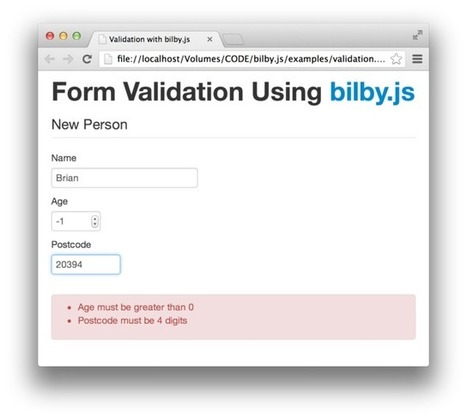
Everyone tells you that LINQ is a monad, but LINQ can be used to enocde other types of computations too. This article demonstrates that you can use LINQ to program using idioms, which are in some ways more useful than monads.
Dan Rosen (@mergeconflict) does an excellent job in this talk of demystifying monads through a thoroughly practical example of how the “monad design pattern” can be used to de-clutter y...
Brian Lonsdorf has a love-hate relationship with Underscore.js. Yes, it offers a bunch of tools included in today's functional programming paradigm (like map...
Some days ago, I was faced with the task of developing Dropbox connector that should be able to enumerate and download files from Dropbox. The ideal case for me is a wrapper library for .NET 3.5 wi...
The snippet shows a simple implementation of the dynamic operator (?) that uses Dynamic Language Runtime and the C# implementation of dynamic operations. The snippet shows how to invoke instance methods with single argument.
In this video tutorial, Dan Rosen will show you how to use Scala's capacity for monadic design to eliminate repetitive boilerplate in your code. You'll learn...
In a recent StackOverflow question, the poster asked about the choice between a function that takes a tuple and a function that uses the curried form. In this article I look at the problem from the C# perspective.
To get content containing either thought or leadership enter:
To get content containing both thought and leadership enter:
To get content containing the expression thought leadership enter:
You can enter several keywords and you can refine them whenever you want. Our suggestion engine uses more signals but entering a few keywords here will rapidly give you great content to curate.


 Your new post is loading...