Your new post is loading...
Humans are facing an existential crisis in climate change. We are also facing a crisis of collective action. As a species, we have every reason to slow the rise of global temperatures, but taking steps to cut carbon emissions is generally not in the short-term interest of individuals, companies, or countries. Where does that leave IT organizations?
IT systems all around the world consume ever-increasing amounts of electric power, making them a critical factor in increasing carbon emissions. Many people in the industry are acutely aware of IT's climate impact and want to see it reduced, but minimizing IT's carbon footprint will entail a cost that many small businesses and multinational corporations are reluctant to bear.
Curious about what might incentivize a shift to greener tech, I spoke to IT leaders who are pushing back on climate change. I found people working at every level of organizational leadership—from the top down to the bottom up—and pursuing a variety of strategies to reduce carbon consumption in company products and business models.
Via EcoVadis

|
Rescooped by
François GARREAU
from Sustainable Procurement News
October 14, 2022 2:13 AM
|
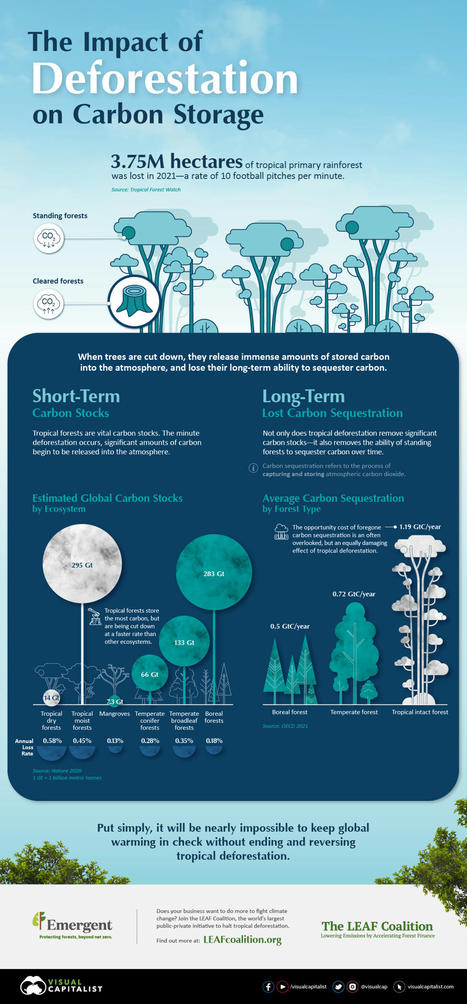
The Impact of Deforestation on Carbon Storage
A one degree change in temperature could have catastrophic consequences.
One of the most notable influences on rising global average temperatures comes from deforestation. In fact, combined emissions from deforestation are higher than the annual emissions of any other country (apart from the U.S. and China) and contribute to roughly 12% of total annual greenhouse gas emissions.
This graphic from The LEAF Coalition takes a closer look at the impact deforestation has on global greenhouse gas emissions through carbon storage.
Via EcoVadis
|
|
Rescooped by
François GARREAU
from Sustainable Procurement News
September 26, 2022 12:59 AM
|
Organizations are increasingly turning their focus to fighting climate change through sustainable practices. A 2022 report by Deloitte found that 89% of executives agree there is a global climate emergency. Sustainable organizations are also being rewarded financially for their efforts. A Korn Ferry study found that purpose-driven companies post compound annual growth rates of 9.9% compared to an average of 2.4% for S&P 500 companies overall. However, companies are still accused often of greenwashing, or the act of making false or misleading claims about the environmental benefits of a product, service, technology, etc. (Corporate Finance Institute, 2022).
Via EcoVadis
|
|
Rescooped by
François GARREAU
from Sustainable Procurement News
September 22, 2022 11:31 PM
|
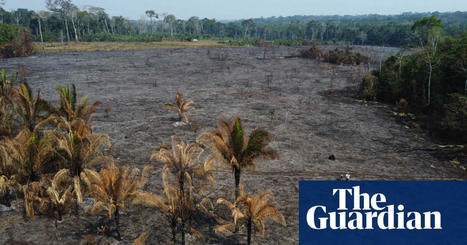
Indigenous leaders from the Amazon have implored major western brands and banks to stop supporting the ongoing destruction of the vital rainforest through mining, oil drilling and logging, warning that the ecosystem is on the brink of a disastrous collapse.
Representatives of Indigenous peoples from across the Amazon region have descended upon New York this week to press governments and businesses, gathered in the city for climate and United Nations gatherings, to stem the flow of finance to activities that are polluting and deforesting large areas of the rainforest.
Via EcoVadis
Unilever recently set out a range of commitments to tackle climate change as well as halt – and even reverse – the degradation of the natural world. This includes a target to reach net zero emissions from all products by 2039.
Via EcoVadis
|
|
|
Rescooped by
François GARREAU
from Sustainable Procurement News
November 1, 2022 2:16 AM
|
Sustainable or green IT is not new. In fact, it has been a topic of discussion among IT leaders for decades. But the concept of sustainability in general, which the United Nations defines as “meeting the needs of the present without compromising the ability of future generations to meet their own needs,” is something people and organizations are prioritizing more than ever — and for good reason.
Concerns about the environment and climate change are front and center among world leaders, environmental advocacy groups, and society at large. Corporate executives and boards want their organizations to do their part — or at least be perceived as doing their part — to help.
The push for better environmental, social, and governance (ESG) initiatives has taken a high priority at many organizations, and this encompasses more efficient uses of technology.
Via EcoVadis
|
|
Rescooped by
François GARREAU
from Sustainable Procurement News
September 29, 2022 11:25 PM
|
BCG recently conducted a global survey of 1,000 leaders in A.I. and climate that tells us more about that potential—as well as the barriers getting in the way. We found that 87% of respondents feel that advanced analytics and A.I., or simply “A.I.,” is a helpful tool in the fight against climate change today, but only 43% say that they have a vision for using A.I. in their own climate change efforts.
They see the greatest business value for AI in the reduction and measurement of emissions. In fact, there are many diverse ways in which global leaders can use A.I. to achieve their goals:
Via EcoVadis
|
|
Rescooped by
François GARREAU
from Sustainable Procurement News
September 24, 2022 2:06 AM
|
The country’s most sustainably minded retailers are placing more of an emphasis on sourcing — by both boosting locally and sustainably produced food and by requiring stricter environmental standards from their suppliers. This ranges from sourcing more sustainable seafood, including canned tuna, to ensuring that beef is being produced with no deforestation. Palm oil, coffee, eggs, soy and pulp are other commodities that are being more closely watched by grocers to ensure sustainable production.
In fact, the 2022 Sustainability Barometer released by London-based Mintel finds that from a global consumer perspective, concerns about water and food shortages are now being prioritized ahead of previous preoccupations with waste and plastic. Therefore, it makes sense for grocers to include messaging about their efforts in more sustainable sourcing and in combating climate change.
Several retailers, including Batavia, Ill.-based Aldi US, are committing that all of the fresh, frozen and farmed seafood they purchase will be third-party certified as sustainable or from fishery improvement projects by the end of 2025. Meanwhile, expect to see more of these grocers ramp up tracing efforts so that customers will also recognize their efforts in sustainability.
Via EcoVadis
Tackling food waste is vital to reducing carbon emissions and should be at the forefront of Australia’s climate policies, advocates say.
It is estimated that 7.3 million tonnes of food is wasted in Australia each year, costing the economy more than $20 billion annually.
Food waste is also a major environmental issue, with around eight per cent of global carbon emissions coming from wasted food, which rots in landfill and releases methane into the atmosphere.
Food rescue charity OzHarvest has recently teamed up with the Monash Sustainable Development Institute (MSDI) to release a new report examining Australia’s progress on tackling food waste.
Via EcoVadis
Supply chain emissions often exceed operational emissions
According to CDP, supply chain emissions are on average over twice that of a company’s operational emissions. In the energy and mining sector, upstream Scope 3 emissions exceed operational emissions by up to four times. For this reason, corportions can no longer afford to diregard their supply chain emissions.
Via EcoVadis
|