



European Social Innovation Competition

 Your new post is loading...
 Scoop.it!
nicoleta susanu's insight:
The 2015 European Social Innovation Competition has launched, with €50 000 in prize money for the top three projects. Based around the theme 'New Ways to Grow' the competition aims to support inviduals and organisations with entrepreneurial, game changing ideas for social innovation projects. he Competition invites Europeans to come up with game changing ideas that can advance Europe’s growth model, for example:
Deadline: 12:00 noon, Brussels time, on 8th May 2015. 
Scoop.it!
Research Participant Portal is your entry point for electronic administration of EU-funded research and innovation projects
nicoleta susanu's insight:
Topic:The cultural heritage of war in contemporary Europe Specific challenge: European nations and societies have had ambiguous relation to war since the beginning of the age of modern nation states. Wars were the culmination of patriotic efforts and cemented national identities. The horrors of wars pushed the same societies, nations and their elites to overcome traditional rivalries and to engage in the European construction that finally succeeded after World War II. The Nobel Peace Price received by the European Union in 2012 and the upcoming Europe-wide memorial events related to the first centenary of the outbreak of World War I and to the 70th anniversary of the end of World War II put in relief in an expressive way the many layers of the cultural heritage of war, whether for local communities, for national or for European identities. Scope: The multidisciplinary, geographically balanced and comparative research will aim at exploring the complex relationship that contemporary European societies have with the tangible and intangible cultural heritage of the major armed conflicts fought on their soil in the 20th century (inter alia World War I and World War II but also Balkan wars, civil wars, revolutions, etc.). The research will map the use of the cultural heritage of the selected major armed conflicts in memorial practices, media and popular culture, political appropriation, education, heritage preservation and related cultural heritage tourism. It will explore and conceptualise the role that this cultural heritage plays in local and national identities and in the practices and narratives laying the foundation of European identities. It will explore links between national cultural heritage traditions and assess how these can be better articulated, taking the impact of war on cultural memory into account. Deadline Date28-05-2015 17:00:00 (Brussels local time)
Scoop.it!
Research Participant Portal is your entry point for electronic administration of EU-funded research and innovation projects
nicoleta susanu's insight:
Specific challenge: Public administrations need to address the new challenges posed by the evolution of society. Financial constraints are making this task difficult. At the same time, expectations - in terms of burden reduction and efficiency of public services - are growing. The take-up of new technologies, such as social media and mobile technologies, leads to increased connectivity. The availability of open data and open services, in an open government setting support the collaborative forms of service design and delivery and they increase transparency. Expected impact: · Stimulating the creation, delivery and use of new services on a variety of devices, utilising new web technologies, coupled with open public data. · More personalised public services that better suit the needs of users. · Reducing the administrative burden of citizens and businesses (e.g. collecting information from citizens only once). · Increased transparency of and trust in public administrations. Deadline; 28-05-2015 17:00:00 (Brussels local time)
Scoop.it!

Research Participant Portal is your entry point for electronic administration of EU-funded research and innovation projects
nicoleta susanu's insight:
Marie Skłodowska-Curie Co-funding of regional, national and international programmes (COFUND-DP) Scope: Doctoral programmes address the development and broadening of the research competencies of early-stage researchers. The training follows the EU Principles on Innovative Doctoral Training (http://ec.europa.eu/euraxess/pdf/research_policies/Principles_for_Innovative_Doctoral_Training.pdf). Collaboration with a wider set of partners, including from the non-academic sector, which may provide hosting or secondment opportunities or training in research or transferable skills, as well as innovative elements of the proposed programme, will be positively taken into account during the evaluations. Each researcher must be enrolled in a doctoral programme. Attention is paid to the quality of supervision and mentoring arrangements as well as career guidance. Limitations regarding the researchers' origin and destination should be avoided. Researchers supported under this scheme should comply with the mobility rules of the Marie Skłodowska-Curie actions (i.e. compulsory trans-national mobility). Existing programmes can deviate from this rule if duly justified in the proposal by the applicant.
Scoop.it!
Research Participant Portal is your entry point for electronic administration of EU-funded research and innovation projects
nicoleta susanu's insight:
Specific challenge: The history of Europe and over sixty years of European integration have fostered the emergence of cultural heritage at different levels – local, regional, national and, recently, European. In all its forms, cultural heritage, values, institutions and language are crucial for the collective memories and sociability of groups but also for the personal development of citizens, enabling them to find their place in society. They also serve as a source of inspiration for the development of people's personalities and talents. Extending to the very heart of Europe and constituting a basis for EU construction, they play a key role in providing a sense of European belonging and EU citizenship as distinct from, but combined with, national citizenship. Cultural heritage and values are at the heart of our capability of overcoming the current EU crisis which could well provide the stimulus for revising EU policies so as to provide a solid basis for the emergence of a truly European cultural heritage and for passing it to future generations. The challenge is to explore and show how critical reflection on the historical, cultural and normative roots of Europe´s cultural and democratic practices and institutions contribute to an evolving European identity today. Scope: The multidisciplinary and comparative research will focus on the emergence of a European cultural heritage in a historical perspective and the best way to transmit it. The content and methodology of education and curricula should be taken into account, as well as the role of new technologies and media. It will address how the local, regional, national and European aspects of cultural heritage are interlinked, how they are understood or not by citizens and encouraged or not by various stakeholders and promoters of cultural heritage. It will also analyse how this interplay of cultural heritage at different levels impacts on Europeanisation and the citizens' perceptions on Europe. The research will focus on the place of critical reflection in sustaining this as a cultural resource. This research should include both tangible and intangible cultural heritage as well as less established or popular examples of cultural heritage in the area of the living arts and consider contemporary trends in arts and culture in the shaping of tomorrow's European cultural heritage in order to enrich the study differentiating between commercial and non-commercial aspects. The research will also focus on the multilingual nature of the European heritage, seeking to gain a deeper understanding of the axiological, linguistic, social and cultural aspects of multilingualism and how they ensure the transmission of cultural heritage across generations and borders. The links between the valorisation of this combined cultural heritage and various forms of formal and non-formal education and training, as well as the development of social, axiological, linguistic, cultural and political memories or imaginaries, should be studied in order to assess potential trends towards various forms of European cultural heritage and its links with Europeanisation. This should also include the assessment of the touristic potential of the EU level cultural heritage. The Commission considers that proposals requesting a contribution from the EU of between EUR 1.5 and 2.5 million would allow this specific challenge to be addressed appropriately. Nonetheless, this does not preclude submission and selection of proposals requesting other amounts.
Scoop.it!
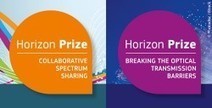
The European Commission is launching today two Horizon Prizes to reward innovators who find groundbreaking solutions in digital technologies. Two prizes of €500,000 are on offer for breaking the opt
nicoleta susanu's insight:
Two prizes of €500,000 are on offer for breaking the optical transmission barriers and collaborative spectrum sharing, through the EU's Horizon 2020 Framework Programme for Research and Innovation. The aim is to develop and demonstrate solutions to societal or technological challenges that have not yet been met. Contestants including innovators, SMEs and non-profit organisations acting alone or together with other entities, can formally register for the competition starting from May 2015. The deadlines for submissions are 17 December 2015 for Collaborative spectrum sharing prize and 15 March 2016 for Breaking the optical transmission barriers prize.
Scoop.it!

European Commission - Innovation Union - Home Page - European Union Women Innovators prize.
nicoleta susanu's insight:
The prize aims to raise awareness of the need for more female entrepreneurs and to inspire other women to follow in their footsteps. The first prize is worth €100 000, the second prize €50 000 and third prize €30 000. Who can participate in the contest? The contest is open to all women who have founded or co-founded their company and who have at some point of their careers benefitted from the EU's research framework programmes, the EURATOM Framework Programme, the Competitiveness and Innovation framework programme (CIP) or actions relating to research and innovation under the European Structural and Investment Funds (known as the Structural Funds prior to 2014). The contestant must reside in an EU Member State or a country associated to Horizon 2020, the EU's research and innovation programme. The company must have been registered before 1 January 2013 and have had an annual turnover of at least EUR 100 000 in 2013 or 2014. Expected results The Commission plans to award up to three "EU Prize for Women Innovators 2016" following a European-wide contest. The prizes are addressed to women who have founded or co-founded a company and who themselves or their company have benefitted from EU funding related to Research and Innovation. The prizes will not reward research or innovation proposed for the future, but only achievements that have been already obtained by the candidate. The contest will target women who have benefited from EU research and innovation programmes and who have combined their scientific excellence with an aptitude for business in setting up innovative enterprises. Entries will have to clearly state the involvement of the contestants in the research and innovation activities and the potential of their product or service to access the market, also highlighting the relevant economic and societal impact. Deadline: 20 October 2015 at 12:00 (Brussels local time)
Scoop.it!
Daphne call - Call for proposals - Transnational projects aiming to prevent, inform about and combat violence against women, young people and children linked to harmful practices – Action grants 2014
nicoleta susanu's insight:
The priority of the call will be to combat and prevent violence linked to harmful practices, such as female genital mutilation, forced or early marriage or forced sexual relationships, and so-called "honour crimes" committed against women, young people and children. Funding activities
Budget under this call for proposals is EUR 4.500.000 The funding under this call is based on the co-financing principle: the grant cannot constitute more than 80% of overall eligible project costs. The beneficiaries should ensure that the outstanding balance is covered from sources other than the EU budget (own resources of beneficiaries, contributions by donors, income generated by the project). The project budget must have revenue and expenditure in balance. Contributions in kind Deadline for this call for proposals is 3/6/2015 12:00 (noon) CET.
Scoop.it!
nicoleta susanu's insight:
Who are these guidelines for The knowledge of the principles of LFA and skills in drafting LFM are essential for all civil servants involved in the programming and design as well as the implementation and management of development projects, but also for all others working in nongovernmental organisations, local self-governments, consultant companies, etc. that are involved in project preparation, implementation and management. These guidelines also aim at providing instruction to develop a Logical Framework Matrix at the various stages of the project management cycle, in order to improve both the consistency and quality of project documents throughout the different stages of the project cycle.
Scoop.it!
nicoleta susanu's insight:
The Interreg CENTRAL EUROPE Programme supports regional cooperation among nine central European countries. The overall objective of the programme is “to cooperate beyond borders to make central European cities and regions better places to live and work” by implementing smart solutions answering to regional challenges in the fields of innovation, low-carbon economy, environment, culture and transport. The programme runs from 2014 to 2020 and invests EUR 231 million to co-finance transnational cooperation projects promoted by public and private organisations from central European regions. PROGRAMME AREA The CENTRAL EUROPE programme area includes all regions from Austria, Croatia, the Czech Republic, Hungary, Poland, Slovakia and Slovenia, as well as eight Länder from Germany (Baden-Württemberg, Bayern, Berlin, Brandenburg, Mecklenburg-Vorpommern, Sachsen, Sachsen-Anhalt, Thüringen) and nine regions from Italy (Emilia-Romagna, Friuli Venezia Giulia, Liguria, Lombardia, Piemonte, Provincia Autonoma Bolzano, Provincia Autonoma Trento, Valle d’Aosta, and Veneto). Priority axis 1 - Cooperating on innovation to make CENTRAL EUROPE more competitive Priority axis 2 – Cooperating on lowcarbon strategies in CENTRAL EUROPE Priority axis 3 – Cooperating on natural and cultural resources for sustainable growth in CENTRAL EUROPE Priority axis 4 – Cooperating on transport to better connect CENTRAL EUROPE BUDGET ERDF BUDGET AVAILABLE The programme will allocate up to EUR 80 Million ERDF to the first call for proposals. The recommended financial size of projects to be submitted in the framework of the 1 st call for proposals is in the range of EUR 1 to 5 million total cost. In exceptional cases, smaller or larger projects can be supported. CO-FINANCING RATES The following co-financing rates shall apply: - Up to 85 %for applicants of Croatia, the Czech Republic, Hungary, Poland, Slovakia, Slovenia; - Up to 80 % for applicants of Austria, Germany, Italy; - Up to 80 % for applicants located in EU regions outside the Interreg CENTRAL EUROPE Programme area DEADLINE FOR SUBMISSION Project proposals for step 1 of this call must be submitted through the eMS at the latest by Monday 13 April 2015, 18.00 CET.
Scoop.it!
nicoleta susanu's insight:
The main objective of the action is to intensify cluster and business network collaboration across borders and sectoral boundaries and to support the establishment of European Strategic Cluster Partnership to lead international cluster cooperation in fields of strategic interest – notably in support of the development of emerging industries. Applicant consortia are free to propose activities they consider relevant. However, it is essential that all activities are clearly related to the objective set out for each strand and duly justify:
The deadline for electronic submission is 31 March 2015 17.00 hours (Brussels time).
Scoop.it!
nicoleta susanu's insight:
The main aim of the programme is to reduce socio-economic disparities in Europe and to strengthen bilateral relations between the donor states (Iceland, Liechtenstein and Norway) and the Czech Republic. The Scholarship Programme aims at enhancing human capital and knowledge base in the Czech Republic and supports cooperation between Czech educational institutions and educational institutions in the donor states. Eligible Activities Three types of actions are supported under the Scholarship Programme: 1. Mobility projects and placements a. Mobility projects b. Student placements c. Education sector staff placements 2. Institutional cooperation projects 3. Contact Seminars and Preparatory visits Deadline for application submission for all supported actions within Call 2015 is: March 26, 2015 at 15:00.
Scoop.it!
nicoleta susanu's insight:
The Scholarship and Training Fund (STF) set up within EEA and Norway Grants aims to contribute to the social and economic cohesion within European Economic Area through activities in the field of education between Poland and the Donor States: Norway, Iceland and Liechtenstein. 1. Activities eligible for funding within Call Call is open for applications submitted within Mobility Projects in Higher Education - supporting student and staff exchanges between Polish and Donor States’ higher education institutions. The following categories of activities can be realized within projects: Student exchange (studies of 1st, 2nd and 3rd cycle) - eligible participants are students from Poland and from Donor States:
Staff exchange – eligible participants are HEI staff members from Poland and the Donor States:
Amount of funding Financing received within STF will cover 100% of total eligible project costs. No contribution of the applicant is required. The Call for proposals lasts from 2nd February 2015 until 2nd April 2015, until 16:00. The deadline refers both to the hard copy (paper) and the electronic version of the application submitted via application form generator.
|
Scoop.it!
COS-EYE-2015-4-01 Erasmus for Young Entrepreneurs - Executive Agency for SMEs
nicoleta susanu's insight:
Erasmus for Young Entrepreneurs is a cross-border mobility programme which gives new or aspiring entrepreneurs the chance to learn from experienced entrepreneurs running small businesses in other Participating Countries. This call will therefore support actions for organisations enhancing and facilitating the mobility of new entrepreneurs, and is not intended for entrepreneurs willing to participate in the programme. New entrepreneurs willing to participate in the programme will be supported directly by the selected IOs. Deadline:3 June 2015 17.00 hours (Brussels time)
Scoop.it!
Research Participant Portal is your entry point for electronic administration of EU-funded research and innovation projects
nicoleta susanu's insight:
Topic: Innovation ecosystems of digital cultural assetsREFLECTIVE-6-2015 Specific Challenge: The digital age has revolutionised our habits, behaviours and expectations. The utilisation of digital technologies for research in the humanities and social sciences demonstrates the need for innovation at the service of scholarship and its advancement. The shift to digital is impacting on identities and cultures and transforming the shape of the knowledge that we will transmit to future generations as well as the means by which we can interact with it. . This specific challenge responds to the growing urge to share the wealth of cultural resources, research and knowledge in our collections and recognises that new cultural assets are continually created. It will show how digital cultural resources can promote creativity and generate innovation in research design and methodology, lead to richer interpretations of the past, bring new perspectives to questions of identity and culture, and generate societal and economic benefits. Europe’s vast cultural heritage can be transformed into digital assets, whose integration and reuse through research-led methods can create value for European cultural institutions and heritage, tourism and the cultural and creative industries. The objective is to enhance the analysis of cultural resources to improve our understanding of how European identity can be traced, constructed or debated, and to use those resources to foster innovation across sectors. Scope: Support and promote access to and resue of digital cultural heritage resources (available in scientific collections, archives, museums, libraries and cultural heritage sites) as part of research and innovation. Projects should enable new models and demonstrations of the analysis, interpretation and understanding of Europe's cultural and intellectual history and/or capitalising on state of the art technologies (e.g. mobile and wearable devices), bring cultural content to new audiences in novel ways, through the development of new environments, applications, tools, and services for digital cultural resources in scientific collections, archives, museums, libraries and cultural heritage sites. The developed technologies or services should be generated in the context of humanities research perspectives (identity, culture, questions of place, historical and cultural knowledge) and/or facilitate the access, reuse and exploitation of digital cultural resources meeting real user needs. They should illustrate how they allow new research questions to be formulated on the basis of cross-collaboration and/or stimulate cross-border, cross-lingual multi-disciplinary reuse of Europe's cultural heritage, enabling collaboration and partnerships and co-production of knowledge across sectors and communities of researchers and users. Proposals should demonstrate appropriate methods of re-using and repurposing digital assets, paving the way for wider exploitation of Europe's cultural resources and boosting innovation.
Scoop.it!
Research Participant Portal is your entry point for electronic administration of EU-funded research and innovation projects
nicoleta susanu's insight:
Scope: Proposed fellowship programmes are encouraged to cover all research disciplines ("bottom-up"), but can also focus on specific disciplines. In this case the range of covered disciplines should allow reasonable flexibility for the researchers. Programmes that prioritise specific research disciplines based on national or regional Research and Innovation Strategies for Smart Specialisation (RIS3 strategies) will also be supported. Limitations regarding the researchers' origin and destination should be avoided. Given that the aim of the co-funded fellowship programmes is the support of individual fellows, research teams will not be funded. Researchers supported under this scheme should comply with the mobility rules of the Marie Skłodowska-Curie actions (i.e. compulsory trans-national mobility). Existing programmes can deviate from this rule if duly justified in the proposal by the applicant.
Scoop.it!
COS-ETPO-2015-2-01– Cooperation with the European Trade Promotion Organisations - Executive Agency for SMEs
nicoleta susanu's insight:
The European Commission aims to achieve two objectives:
This action includes three strands:
Scoop.it!
nicoleta susanu's insight:
The total financial value of the "Grants and inter-institutional cooperation" programme is of 5.000.000 Euro, out of which 4.500.000 come from donor countries and the rest is the contribution of the Romanian State. The programme is expected to start in June 2013 and end in December 2016. The programme will provide funding for the following measures:
ANPCDEFP estimates that until the end of the programme it will fund the mobility of around 336 students and 141 teaching staff (both outgoing and incoming), as well as 10 inter-institutional cooperation projects and 20 preparatory visits. The main beneficiaries of the programme are Romanian universities holding an Erasmus Charter approved by the European Commission, and the partners will be similar institutions or training/stage organisations from Donor States. Within inter-institutional cooperation projects, Romanian universities can associate with universities, research institutes, companies, NGOs, both from Donor States and from other countries that benefit from the EEA Financial Mechanism (Beneficiary States) CALLS FOR PROPOSALS: ROMANIA - SCHOLARSHIPS Outcomes of call
Budget: € 1,361,000 Deadline for applications: 30 March 2015 Preparatory visits Deadline for applications: 30 June 2015 Budget: € 65,000
Scoop.it!
nicoleta susanu's insight:
This guidance is based on and is replacing the COCOF note 09/0025/04-EN applicable to the period 2007-2013. It includes the new possibilities offered by the 2014-2020 regulations. Where simplified costs are used, the eligible costs are calculated according to a predefined method based on outputs, results or some other costs. The tracing of every euro of co-financed expenditure to individual supporting documents is no longer required: this is the key point of simplified costs as it significantly alleviates the administrative burden. Using simplified costs means also that the human resources and administrative effort involved in management of the ESI Funds can be focused more on the achievement of policy objectives instead of being concentrated on collecting and verifying financial documents.
Scoop.it!
A Beginner's Guide to EU Funding - Beginners Guide to EU Funding
nicoleta susanu's insight:
With references to websites about EU funding opportunities, available for the period 2014-2020, this guide provides basic information, especially:
The guide targets six main categories of potential applicants: small and mediumsized enterprises (SMEs), non-governmental organisations (NGOs), young people, researchers, farmers and public bodies. However, it may also be a valuable source of information for applicants from other fields.
Scoop.it!

Restricted Call for proposals (Member States) - Projects to support MS activities to improve gender equality in national policies and programme – Action grants 2014
nicoleta susanu's insight:
Priority will be given to proposals dealing with equal economic Proposals shall complement the efforts of the EU in the area of equality between women and men. Duplications of already existing initiatives will not be funded. Activities already funded or eligible for funding under other EU funds (e.g. European Social Fund) cannot be funded under this call for proposals. This call for proposals may provide funding for: effective national and/or transnational awareness raising activities aiming at:
- run campaigns showcasing e.g. popular male athletes completing domestic work or blue collar workers bringing home groceries, etc. Deadline for this call for proposals is 31/03/2015 12:00 (noon) CET
Scoop.it!
nicoleta susanu's insight:
OPEN CALL FOR EXPRESSION OF INTEREST TO SELECT FINANCIAL INTERMEDIARIES UNDER THE ERASMUS+ MASTER LOAN GUARANTEE FACILITY Eligible Financial Intermediaries This Open Call for Expression of Interest is addressed and restricted to Financial Intermediaries that are: a) in respect of Guarantees provided under the Facility, public or private entities (including credit or financial institutions), if applicable, duly authorised to carry out financing to Final Recipients according to the applicable legislation; b) in respect of Counter-Guarantees provided under the Facility: public or private guarantee schemes, guarantee institutions or other entities, credit or financial institutions, if applicable, duly authorised to issue guarantees according to the applicable legislation, in each case established and operating in one or more of the Programme Countries Deadline Before 30th September 2020. Applications will be assessed by EIF on a “first-come, first-assessed basis”.
Scoop.it!
nicoleta susanu's insight:
Crowdfunding is a way of raising money to finance projects and businesses. It enables fundraisers to collect money from a large number of people via online platforms. Main types of crowdfunding Peer-to-peer lending The crowd lends money to a company with the understanding that the money will be repaid with interest. It is very similar to traditional borrowing from a bank, except that you borrow from lots of investors. Equity crowdfunding Sale of a stake in a business to a number of investors in return for investment. The idea is similar to how common stock is bought or sold on a stock exchange, or to a venture capital. Rewards-based crowdfunding Individuals donate to a project or business with expectations of receiving in return a non-financial reward, such as goods or services, at a later stage in exchange of their contribution. Donation-based crowdfunding Individuals donate small amounts to meet the larger funding aim of a specific charitable project while receiving no financial or material return. Profit-sharing / revenue-sharing Businesses can share future profits or revenues with the crowd in return for funding now. Debt-securities crowdfunding Individuals invest in a debt security issued by the company, such as a bond. Hybrid models Offer businesses the opportunity to combine elements of more than one crowdfunding type
Scoop.it!
Guvernul Romaniei si guvernele din Norvegia, Islanda si Liechtenstein pentru implementarea Mecanismului Financiar al Spatiului Economic European (SEE) 2009 � 2014, prin care Romaniei i se aloca fonduri in valoare de 190,75 milioane de euro.
nicoleta susanu's insight:
Type of projects:
SPECIFIC OBJECTIVES: Increasing the number of higher education student and teacher mobilities between Romania and Donor States Increasing and strengthening institutional cooperation in higher education between Romania and Donor States. DEADLINES: The filled-in application form has to be sent electronically at the address see-burse@anpcdefp.ro in English: - until 31.03.2015 22.00 hours – for Mobility Projects and Inter-institutional cooperation Projects; - applications for Preparatory Visits will continue to be received under a rolling deadline (but no later than 30.06.2015, 22.00 hours ); they will be sent at least 6 weeks before the date when the visit is due to start
Scoop.it!
nicoleta susanu's insight:
Aims of the call is to achieve :
This action includes three strands:
The deadline for electronic submission is 19 March 2015 at 17:00 hours (Brussels time).
|









very good. Great idea.
http://www.slideshare.net/IngemarPongratz