To download, click on title above or link below.
Dickerson, S. L. (2014). (In)Tolerable Zero Tolerance Policy. eJournal of Education Policy. Available online at: http://nau.edu/COE/eJournal/Fall-2014(2)/

 Your new post is loading...
 Scoop.it! To download, click on title above or link below.

No comment yet.
Sign up to comment
Scoop.it!

From
capta

"As California’s new school funding law, the Local Control Funding Formula (LCFF) is a new way for schools to focus on student success.
The LCFF requires school districts to involve parents in planning and decision-making as well as in developing Local Control and Accountability Plans (LCAPs). The Local Control Funding Formula (LCFF) also:
Don’t let these opportunities pass you by — get involved today..." NEW FLIERSADDITIONAL RESOURCES
____________________ For main page, please see:
Scoop.it!
To download flyer above, please click title above or here: http://www.naacp.org/wp-content/uploads/2016/04/Postcards.pdf
__________________ See also: NAACP Letter 2016: Teacher's Guide Primary Source Set: http://www.loc.gov/teachers/classroommaterials/primarysourcesets/naacp/pdf/teacher_guide.pdf Racial Equity Resource Guide: http://www.racialequityresourceguide.org/resources/resources/§ionFilter=Racial%20Healing Rising Nazism and Racial Intolerance in the United States: http://www.hamptoninstitution.org/Rising-Nazism-and-Racial-Intolerance-in-the-US.pdf Ten Ways to Fight Hate: A Community Resource Guide: https://www.splcenter.org/sites/default/files/com_ten_ways_to_fight_hate_2017_web.pdf Preventing Youth Hate Crime: A Manual for Schools and Communities: https://www.justice.gov/archive/crs/pubs/prevyouhatecrim.pdf ______________ Resource list above provided by Rev. Jethroe Moore, President of the San Jose / Silicon Valley NAACP http://www.sanjosenaacp.org
Scoop.it!

By Emily Talmage
According to a 2015 report, widespread cases of physical and sexual abuse – including multiple deaths of healthy children – took place in homes that were part of the for-profit foster care organization known as the Mentor Network.
The report featured former Mentor caseworkers who accused the company of failing children because of its focus on extracting a profit from them – by cutting corners on expensive services, for example, or forcing social workers to carry extremely high caseloads. “I went there because I care about services for kids,” said one caseworker. “I eventually became a machine that cared about profits. I didn’t care about kids.” … Buzzfeed’s report was thorough enough to prompt a Senate investigation. But a key power-player, who has since left Mentor to form organizations influencing everything from juvenile recidivism to public education, has thus far been left off the hook.
Tripp Jones, now Principal at a company called 21c that specializes in developing the type of public-private partnerships that allowed the Mentor Network to flourish financially, served as member of Mentor’s executive team for eight years.
According to his company bio, Jones played a pivotal role in “building the systems” that enabled the company to grow from $250 million in revenue to $1.1 billion.
Then, Jones went on to serve as co-managing director at a company called New Profit, where he helped build a “social finance advisory firm” called Third Sector Capital Partners.
Jones and other perpetrators of this giant for-profit foster care firm are sheltered by powerful corporate cartels, making new demands for public-private profit opportunities. Jones sits on the boards of MassINC., New Profit, Time and Learning, Third Sector Capital Partners, MA Juvenile Justice PFS Initiative, and the Building on What Works Coalition.
And this is where education activists need to pay attention. New Profit and Third Sector Capital, both major proponents of the controversial and highly unethical “Pay for Success” model of public financing, are now closely linked with powerful education organizations and lobbyists."...
For full post, please see:
Scoop.it!
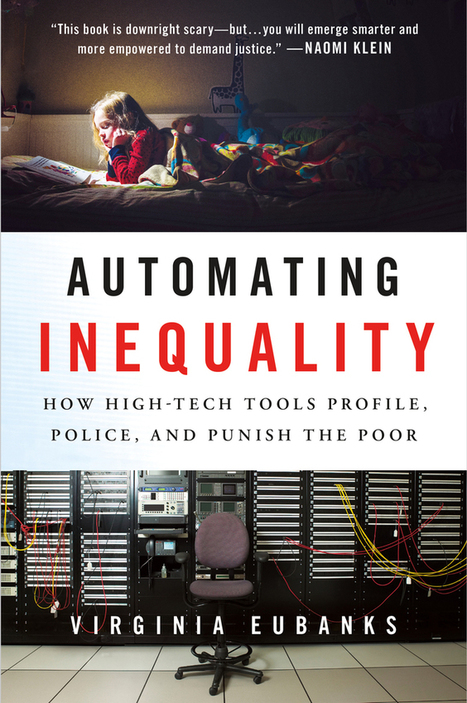
"The State of Indiana denies one million applications for healthcare, foodstamps and cash benefits in three years—because a new computer system interprets any mistake as “failure to cooperate.” In Los Angeles, an algorithm calculates the comparative vulnerability of tens of thousands of homeless people in order to prioritize them for an inadequate pool of housing resources. In Pittsburgh, a child welfare agency uses a statistical model to try to predict which children might be future victims of abuse or neglect. Since the dawn of the digital age, decision-making in finance, employment, politics, health and human services has undergone revolutionary change. Today, automated systems—rather than humans—control which neighborhoods get policed, which families attain needed resources, and who is investigated for fraud. While we all live under this new regime of data, the most invasive and punitive systems are aimed at the poor.
In Automating Inequality, Virginia Eubanks systematically investigates the impacts of data mining, policy algorithms, and predictive risk models on poor and working-class people in America. The book is full of heart-wrenching and eye-opening stories, from a woman in Indiana whose benefits are literally cut off as she lays dying to a family in Pennsylvania in daily fear of losing their daughter because they fit a certain statistical profile.
The U.S. has always used its most cutting-edge science and technology to contain, investigate, discipline and punish the destitute. Like the county poorhouse and scientific charity before them, digital tracking and automated decision-making hide poverty from the middle-class public and give the nation the ethical distance it needs to make inhumane choices: which families get food and which starve, who has housing and who remains homeless, and which families are broken up by the state. In the process, they weaken democracy and betray our most cherished national values.
This deeply researched and passionate book could not be more timely."
https://us.macmillan.com/automatinginequality/virginiaeubanks/9781250074317/
Scoop.it!

"There is reason why so many educators turn to GLSEN for resources when they want to teach about respect. For more than 25 years, we’ve been developing user-friendly, developmentally appropriate and research-based tools for educators just like you.
How can I be a supportive ally to LGBT youth? How do I discuss bullying, gender roles or family diversity with elementary students? How can I include positive representations of LGBT people in the curriculum? How do I inspire my students to be kind and speak up when they see bullying? GLSEN has resources that address these topics and much more.Take a moment to watch the video and explore GLSEN's educator guides and lessons to support your curriculum and practices.Find a resource you like? Download and use it, then share with colleagues."
Scoop.it!
|
Scoop.it!
Scoop.it!
Scoop.it!

By Joanna Redden "There is growing consensus that with big data comes great opportunity, but also great risk.
But these risks are not getting enough political and public attention. One way to better appreciate the risks that come with our big data future is to consider how people are already being negatively affected by uses of it. At Cardiff University’s Data Justice Lab, we decided to record the harms that big data uses have already caused, pulling together concrete examples of harm that have been referenced in previous work so that we might gain a better big picture appreciation of where we are heading.
We did so in the hope that such a record will generate more debate and intervention from the public into the kind of big data society, and future we want. The following examples are a condensed version of our recently published Data Harm Record, a running record, to be updated as we learn about more cases. 1. Targeting based on vulnerabilityWith big data comes new ways to socially sort with increasing precision. By combining multiple forms of data sets, a lot can be learned. This has been called “algorithmic profiling” and raises concerns about how little people know about how their data is collected as they search, communicate, buy, visit sites, travel, and so on.
Much of this sorting goes under the radar, although the practices of data brokers have been getting attention. In her testimony to the US Congress, World Privacy Forum’s Pam Dixon reported finding data brokers selling lists of rape victims, addresses of domestic violence shelters, sufferers of genetic diseases, sufferers of addiction and more. 2. Misuse of personal informationConcerns have been raised about how credit card companies are using personal details like where someone shops or whether or not they have paid for marriage counselling to set rates and limits. One study details the case of a man who found his credit rating reduced because American Express determined that others who shopped where he shopped had a poor repayment history.
This event, in 2008, was an early big data example of “creditworthiness by association” and is linked to ongoing practices of determining value or trustworthiness by drawing on big data to make predictions about people. 3. DiscriminationAs corporations, government bodies and others make use of big data, it is key to know that discrimination can and is happening – both unintentionally and intentionally. This can happen as algorithmically driven systems offer, deny or mediate access to services or opportunities to people differently.
Some are raising concerns about how new uses of big data may negatively influence people’s abilities get housing or insurance – or to access education or get a job. A 2017 investigation by ProPublica and Consumer Reports showed that minority neighbourhoods pay more for car insurance than white neighbourhoods with the same risk levels. ProPublica also shows how new prediction tools used in courtrooms for sentencing and bonds “are biased against blacks”. Others raise concerns about how big data processes make it easier to target particular groups and discriminate against them."...
For full post, see: https://theconversation.com/six-ways-and-counting-that-big-data-systems-are-harming-society-88660 Via Roxana Marachi, PhD
Scoop.it!
Abstract "This article considers proponents’ arguments for Pay for Success also known as Social Impact Bonds. Pay for Success allows banks to finance public services with potential profits tied to metrics. Pay for Success has received federal support through the Every Student Succeeds Act of 2016 and is predicted by 2020 to expand in the US to a trillion dollars. As school districts, cities, and states face debt and budget crises, Pay for Success has been advocated by philanthropists, corporate consulting firms, politicians, and investment banks on the grounds of improving accountability, cost savings, risk transfer, and market discipline. With its trailblazing history in neoliberal education, Chicago did an early experiment in Pay for Success. This article provides a conceptual analysis of the key underlying assumptions and ideologies of Pay for Success. It examines the claims of proponents and critics and sheds light on the financial and ideological motivations animating Pay for Success. The article contends that Pay for Success primarily financially benefits banks without providing the benefits that proponents promise. It concludes by considering Pay for Success in relation to broader structural economic considerations and the recent uses of public schooling to produce short-term profit for capitalists." Keywords Pay for Success; Social Impact Bonds; Chicago School Reform; Neoliberal Education; Corporate School Reform; Venture Philanthropy For full text, click title above or here: PDFSaltman, K. (2007) Capitalizing on Disaster: Taking and Breaking Public Schools. New York: Routledge.
Saltman, K. (2012) The Failure of Corporate School Reform. New York: Routledge 2012.
Saltman, K. (2010) The Gift of Education: Public Education and Venture Philanthropy. New York: Palgrave Macmillan.
http://epaa.asu.edu/ojs/article/view/2640/1918 Via Roxana Marachi, PhD
Scoop.it!

"The extent to which special student populations (ELL, Special Education and Economically Disadvantaged) gain access to charter schools is understudied. The new study Separate and Unequal?: The Problematic Segregation of Special Populations in Charter Schools Relative to Traditional Public Schools utilizes state, district, and local level data to understand the enrollment of high-need special populations in charter schools compared with non-charter public schools. In this article, we examine the extent to which charters in the state of Texas are serving high needs populations (English Language Learners, Special Education, and low-income students) at the same rates as traditional public schools. We first conduct statewide analyses to compare charter school and traditional public district demographics by locality. We also compare levels of segregation of those populations between traditional public schools by locality and charter status. We then conduct a local-level analyses to understand high-need students demographic patterns within the footprint of a large urban district to evaluate the extent to which students with greater than average instructional needs are served by charter schools in equal proportion to the neighboring public schools. We then conclude by descriptively examining the access and enrollment of high-need students in several popular “exemplar” charters. Summary of Findings We find that while Texas charters appear to be demographically similar to traditional public schools at the aggregate, the granularity provided by geospatial analyses demonstrate that charters under-enroll ELL students and special education students relative to nearby non-charter schools. State-level dissimilarity analyses show only modest disparities in segregation and access of high-need students within the Texas charter system compared to traditional public schools. However, local-level descriptive and geospatial analyses of charters in a large metropolitan area shows that there are large disparities in the enrollment of high-need students relative to traditional public schools nearby. (Please click on the article links above for more detailed findings)
We conclude by discussing implications and recommendations for law and policy. The policy implications that logically emerge from the geographic granularity of these data could either be first-order incremental or second-order substantial. On the one hand, a set of first-order changes to educational policy related to charter schools would seek to take what is in place and make incremental adjustments to policy that aim to better regulate public charter schooling. On the other hand, a second-order change would be an approach that is a substantial departure that would purposefully curtail growth that charters have exhibited over the past two decades."...
For full post, see: http://nepc.colorado.edu/blog/are-charters-beacons
Scoop.it!
Click here to download pdf of document: http://urbanhealth.jhu.edu/_PDFs/SDH_2015_Brief_2.pdf Via Roxana Marachi, PhD
Scoop.it!

By Tyler Whittenberg "Last month the W. Haywood Burns Institute for Juvenile Justice, Fairness and Equity (BI) conducted a webinar for the Healing Violence Alliance, highlighting the causes and consequences of racial and ethnic disparities in the justice system and how these disparities relate to community-based efforts to address violence. If you missed it, you can download the webinar. The BI offers a historical perspective on racism in the youth and adult justice systems, detailing how current policies exacerbate disparities created by the racist practices of our not-so-distant past. Systemic barriers, such as the zero tolerance policies, the criminalization of age-appropriate behavior, and the disparate use of law enforcement resources make it more likely that people of color are disproportionately affected by the collateral consequences of incarceration.
These consequences include disruptions in education, reduced income, loss of employment opportunities, separated families, housing evictions and other barriers that affect individuals, harm families and negatively impact community well-being. The individual, social and cultural trauma caused by mass incarceration and its collateral consequences are significant issues that system and community leaders must consider to effectively address the complex origins of community violence.
BI staff also outline their community-driven, data-informed approach to reducing racial and ethnic disparities in the justice system. The BI believes that successfully reducing disparities requires collaboration between system and community stakeholders. This collaboration must include substantial community involvement throughout the decision-making processes, full utilization of available community resources, and the development of new community-based interventions. Additionally, by emphasizing the ongoing use of quantitative and qualitative data during the decision-making process, advocates can make targeted improvements to policies that perpetuate existing disparities while avoiding many of the pitfalls associated with racial equity reform.
In addition to the BI webinar cited above, here are links to informational resources on working collaboratively with communities of color to reduce racial and ethnic disparities: Stemming the Rising Tide: Racial and ethnic disparities in youth incarceration and strategies for change — This report highlights troubling trends in the incarceration of youth of color and offers several strategies for addressing the causes of racial inequities that promote restorative justice and overall well-being for youth of color.
What Happens When the Bargain of Civil Society is Breached? — In many communities across this nation, children are expected to exhibit all of the characteristics of childhood—good and bad—as part of their normal adolescent development. However, in far too many communities of color, we have eliminated the space for children to exhibit age appropriate behavior by criminalizing their conduct through fear-based policies and practices. In this piece, BI founder, James Bell, discusses why we must apply a child well-being framework to young men of color.
A Shared Sentence: The devastating toll of parental incarceration on kids, families and communities — “More than 5 million U.S. children have had a parent in jail or prison at some point in their lives. The incarceration of a parent can have as much impact on a child’s well-being as abuse or domestic violence. But while states spend heavily on corrections, few resources exist to support those left behind. A Shared Sentence offers commonsense proposals to address the increased poverty and stress that children of incarcerated parents experience.”
Racial Equity Tools — “Racial Equity Tools is designed to support individuals and groups working to achieve racial equity. This site offers tools, research, tips, curricula and ideas for people who want to increase their own understanding and to help those working toward justice at every level – in systems, organizations, communities and the culture at large.”
Racial Equity Toolkit — “Racial equity tools are designed to integrate explicit consideration of racial equity in decisions, including policies, practices, programs, and budgets. It is both a product and a process. Use of a racial equity tool can help to develop strategies and actions that reduce racial inequities and improve success for all groups.”
For full post, please see: http://burnsinstitute.org/blog/community-tools-to-change-mass-incarceration-of-youth-of-color/
For main Burns Institute website, visit:
|