Your new post is loading...

|
Scooped by
Beth Dichter
May 20, 2012 1:10 PM
|
"Cell phones are a terrific tool to support student engagement and achievement in reading and writing. To follow are some ideas explaining how teachers are doing just that by using cell phones in the way they are most commonly used among youth -- for texting and group texting. We will also look at a newly emerging trend...using cell phones to write novels."
|
|
Scooped by
Beth Dichter
May 20, 2012 7:40 AM
|
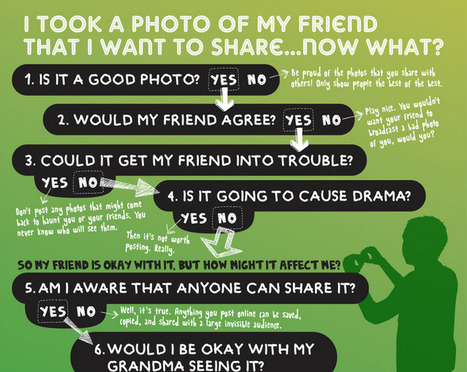
Have you heard about Common Sense Media's posters on digital citizenship? This one is geared to middle and high school students and asks students to think before they share, and provides questions to ask so that they "self-reflect before they self-reveal." You may download copies at the site.
|
|
Scooped by
Beth Dichter
May 18, 2012 10:54 PM
|
A look at three news articles published this week. Common Sense Media...has just released a new ratings iniative to evaluate the learning potential of websites, video games and mobile apps." This provides a "system which is more than just categorizing subject areas..." A look at Minecraft as a teaching tool. As well as sharing information from a recent study from the Joan Ganz Cooney Center they also discuss MinecraftEdu, a company working with Carnegie Mellon University to offer an educational version of Minecraft (http://minecraftedu.com/). The use of Twitter in the classroom which explores the potential of using Twitter within educational settings. And news from the Pew Internet and American Life Project on "millenials and their connected lives" and shares some of the predictions and arguments about millenials.
|
|
Scooped by
Beth Dichter
May 18, 2012 9:58 PM
|
This site has an interactive visual toolkit that explores: * Visual elements and principles: line, color, balance, space, shape, and movement/rhythm Each element/principle has three sections: * Watch an animated demonstration
* Find examples of the concept in works of art from museums
*Create your own composition A fun site to explore, there is also a section where you can see artists in action and an encyclopedia which "is an in-depth guide to learning more about the building blocks of composition. Here you'll see many examples of works of art that illustrate the visual elements and principles."
|
|
Scooped by
Beth Dichter
May 18, 2012 7:15 PM
|
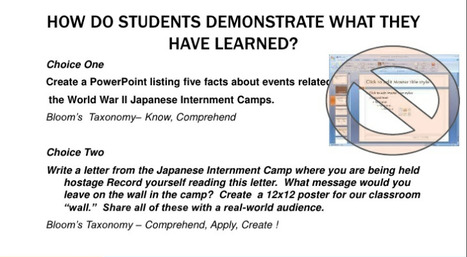
This post links to a SlideShare presentation that looks at educator "best practice" as well as student choice and Bloom's Taxonomy when it comes to designing digital lessons for assessment. When we look at digital lessons our goal is to meet the standards, and the tools we choose should help us enhance, extend and reinforce the material. This is an excellent example and a rubric is included.
|
|
Scooped by
Beth Dichter
May 18, 2012 12:13 PM
|
Every wondered what an educational video game has to have in order to be successful? Here's a list. * Define the learning objective * Describe the learning mechanic * Imagine what students are thinking * Pick a game mechanic * Create a theme where the mechanic can exist Read the article for more detail and information.
|
|
Scooped by
Beth Dichter
May 17, 2012 8:20 PM
|
These interactives provide educators and students with strategies, content, and activities that can enhance and improve students' skills in a variety of curricular areas. From Annenberg Learner comes a wide range of interactives. There are four math interactives (grades 6 -8 and 9-12); four in language arts (grades 2-5, 9-12 and grades ALL); nine in science (grades 7-9 and 9-12); four in history (grades 5-8 and 9-12); and one in art (grades 9-12).
|
|
Scooped by
Beth Dichter
May 17, 2012 6:54 PM
|
What would happen if you were to flip Bloom's Taxonomy, if you were to start with the most complex skills at the base and move to the least complex? Shelley Wright raises this issue stating "Many teachers in many classrooms spend the majority of their time in the basement of the taxonomy, never really addressing or developing the higher order thinking skills that kids need to develop. We end up with rote and boring classrooms. Rote and boring curriculum. Much of today’s standardized testing rigorously tests the basement, further anchoring the focus of learning at the bottom steps, which is not beneficial for our students." She then goes on to ask if this "creates the impresson that there is a scarcity of creativity..." An article that is sure to have you questioning your thoughts on Bloom's Taxonomy and perhaps change the way you teach in your classroom.
|
|
Scooped by
Beth Dichter
May 17, 2012 4:22 PM
|
"A free reference manager, academic social network and crowdsourced research catalog, Mendeley helps researchers organize their documents, collaborate and share with others online and discover the latest research. Through both a desktop application and website, this tool lets researchers build personal research libraries."
|
|
Scooped by
Beth Dichter
May 16, 2012 8:20 PM
|
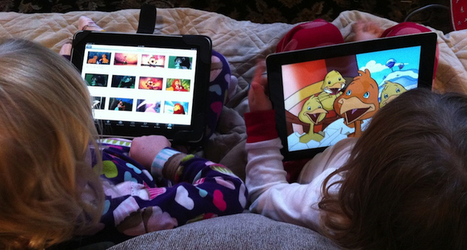
"A recent study by the Joan Ganz Cooney Center at Sesame Workshop found that 72 percent of the top-selling education apps in the iTunes store target preschool or elementary-age children, a significant increase from 47 percent in 2009. Study results also show that early learning apps for preschoolers and toddlers are the most popular app category and have experienced the greatest market growth." Today we see many pictures of young children watching or interacting with a screen. One question to ask "is whether interactive screen time can be considered a valid teaching tool for children as young as two and one-half."
|
|
Scooped by
Beth Dichter
May 16, 2012 8:00 PM
|
"Skype is a free and easy way for teachers to open up their classroom. Using this site, you can meet new people, talk to experts, share ideas and create amazing learning experiences with teachers from around the world." This site provides a number of partner organizations that are willing to collaborate over Skype. Check it out for more information.
|
|
Scooped by
Beth Dichter
May 16, 2012 3:44 PM
|
"Google is always looking for ways to enhance user experience and they are particularly good at integrating more tools into their existing products. This time they are offering some useful refinements to Google Docs. If you’re a researcher you’re gonna love this. Now when you are composing in Google Docs you will have access to a research pane which can bring up information relevant to what you are writing about. So if you are writing a paper about George Washington and you forgot to document a fact about his life, all you have to do is go into tools and bring up the research pane." I have tested this tool and it allows you to quickly find additional information without leaving the document you are working on. For many students this would prove valuable.
|
|
Scooped by
Beth Dichter
May 15, 2012 9:05 PM
|
The wired world has made it possible for people from all across the globe to connect and learn from each other. With Google's translated foreign pages you can quickly learn how news is being reported in other countries. This article shows you how to use "More search tools" in both general web and Google News results. By clicking on "More search tools" additional filters are available, including "Tranlated foreign pages." Additional tools are also presented.
|
|
|
Scooped by
Beth Dichter
May 20, 2012 8:00 AM
|
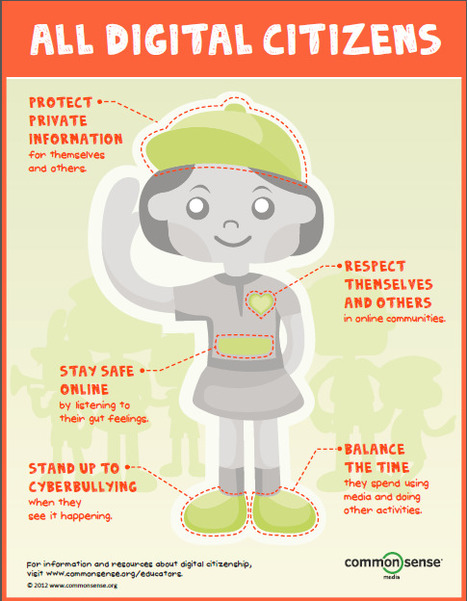
Have you heard about Common Sense Media's posters on digital citizenship? This one is geared to elementary school students. This poster would be great to share with students (and their families) to promote conversation about issues that they may face online. You may download copies at the site.
|
|
Scooped by
Beth Dichter
May 19, 2012 7:38 PM
|
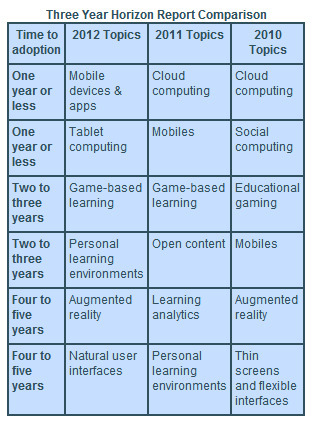
Mobile devices, tablets and apps could become mainstream with education in a year or less, according to the "2012 Horizon Report: K-12 Edition." While the report from the New Media Consortium won't be released until June, the Consortium for School Networking hosted a webinar on Tuesday, May 15, to preview the results. If you would like to download a "preview copy" you may register at the New Media Consortium website (no cost involved): http://www.nmc.org/publications/2012-horizon-report-k12.
|
|
Scooped by
Beth Dichter
May 18, 2012 10:34 PM
|
A new study that "uncovers the student employment gap, skill requirements, and sources of hire for the class of 2012." Highlights of the study include: * The entry-level job market * The types of students who are landing jobs * The skills employers are looking for * The sources employers use to hire * The ways students can stand out in the hiring process * Employer internship expectations * Eployers entry-level job expections * Employers talent needs
|
|
Scooped by
Beth Dichter
May 18, 2012 8:01 PM
|
"When you reflect on digital products in your classrooms or see student work created with technology tools at conferences, try to peer past the technology glitz and ask questions about rigor. Does the content have substance worth sharing? Are your students’ digital products demonstrating what they know and deeply understand about the topic beyond existing facts? Or are their digital products primarily demonstrating the exploration and acquisition of technology skills?"
|
|
Scooped by
Beth Dichter
May 18, 2012 2:25 PM
|
"This post includes a number of wonderings . . . For the past few days, there has been some controversy over a TED talk that included some commentary about classism...The basic premise was that the talk was censored from public viewing due to it being offensive to the wealthy folks that pay to attend the TED conference." Gerstein goes on to raise a number of questions we should consider, such as is "the digital divide...an intellectual or pedagogical one" and what schools are using/sharing the new Ted-Ed Lessons Worth Sharing? Great questions to ponder.
|
|
Scooped by
Beth Dichter
May 17, 2012 8:50 PM
|
From GPAs to letters of recommendation, it can be overwhelming for college applicants to get everything together. Learn about what really matters when it comes to admissions.
|
|
Scooped by
Beth Dichter
May 17, 2012 8:08 PM
|
"Mobile devices have made a huge impact on countless areas of our lives in a remarkably short span of time. This is certainly true for people who require “assistive technology”. I think of assistive technology as “…any technology that improves the functional ability of anyone who needs it.” By this definition, we all benefit from assistive technology of one sort or another!"
This post includes a video that shows how mobile technology assists "individuals who require more specialized assistive technology as well."
|
|
Scooped by
Beth Dichter
May 17, 2012 4:27 PM
|
More than one-third of employers use social media to research job and internship candidates before they interview — and that number’s only going up. Employers plan to hire 8.5% more interns in 2012, meaning more applicants will be pursuing a larger number of competitive internships. As a potential intern, your social media profiles will serve as an indicator of your skill set.
|
|
Scooped by
Beth Dichter
May 16, 2012 10:39 PM
|
Tablets and smartphones are playing greater and greater roles in the lives of kids -- but is that good? This infographic sheds some light.
|
|
Scooped by
Beth Dichter
May 16, 2012 8:12 PM
|
|
|
Scooped by
Beth Dichter
May 16, 2012 3:58 PM
|
"Common Sense Media partnered with Teaching Channel to produce this series of nine videos spotlighting how our lessons meet critical ELA Common Core standards for middle school. Check them out for inspiration from teachers and students in New York City and San Francisco Bay Area public schools. See how our lessons align and view the standards on the Common Core State Standards website." Video titles: Creating a Snapshop of Digital Media Use; Using Critical Thinking to Find Trustworthy Websites; Understanding "Fair Use" in a Digital World; Cyberbullying: What’s Crossing the Line?; Improving Research Skills with Effective Keywords; Online Talk: What’s Safe and What’s Risky?; Exploring the Concept of Online Privacy; Understanding the Impact of Digital Footprints; and The Good and Bad of Using Different Online Personas. The video lessons are geared to middle school students and if you are a registered educator with Common Sense Media you may acess a free online training.
|
|
Scooped by
Beth Dichter
May 15, 2012 10:29 PM
|
A free app that makes your lessons more engaging trough interactive multimedia presentations. Benefits of Nearpod include: * Create interactive classes with ease * Engage students * Share content in real time * Control students' devices (as in see student activity in real time) * Quickly assess student progress Applications are free; currently for iPad but Android and Window apps are in the works. Much more information is available at the website.
|