


Can't figure out the source of an image you found online? There's an easy trick you might not know about -- and it's an essential tool for citing sources.
This post describes how to use Google's Search by Image in detail...lots of screen shots too!

 Your new post is loading...
 Scoop.it! Can't figure out the source of an image you found online? There's an easy trick you might not know about -- and it's an essential tool for citing sources. This post describes how to use Google's Search by Image in detail...lots of screen shots too! No comment yet.
Sign up to comment
Scoop.it!

Mozilla recently announced a program called Webmaker and one of the components, Mozilla Thimble App is now available. "Mozilla Thimble App makes it ridiculously simple to create your own web pages. Write and edit HTML and CSS right in your browser. Instantly preview your work. Then host and share your finished pages with a single click. Easy, huh?"
Scoop.it!

"Print or digital? Adults grapple with which is the best way to read -- not only for themselves, but especially when it comes to their kids. Whether or not parents prefer print books over interactive e-books for their kids, the question is, what’s actually better for them?" However, this was not true when asking kids about the plot. Additional information is found in this post.
Scoop.it!

"Our high schools are relics of the past. Based on an antiquated economic formula designed for the Industrial Revolution, high schools in the United States and Canada are ill-suited for the emotional and intellectual well-being of our young people and profoundly out of step with the needs of our contemporary economy. We have been tinkering with the high school formula for decades, but the recipe for innovation has yet to be written... We need to revolutionize our basic high school structures: We need to tear apart the school day, the high school timetable, the school year, the four-year diploma..." What if we really looked at education in a new way? There are schools that are doing this, and being quite successful. This article looks at some emerging modesl that may help us change our schools.
Scoop.it!
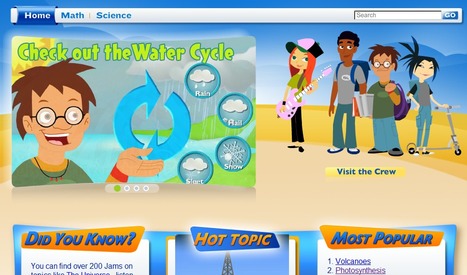
StudyJams is a free resource from Scholastic that helps reinforce key concepts and ideas. StudyJams provides over 200 lessons in math and science. Using short videos (and possibly slide shows), key vocabulary and concepts are reviewed. There is a quiz for each topic, and some topics include a song where one could sing along. Math topics include: Numbers; Multiplication and Division; Decimals and Percents; Geometry; Data Analysis; Problem Solving; Addition and Subtraction; Fractions; Algebra; Measurement; and Probability.
Scoop.it!

"As textbooks are being replaced by digital readers and traditional education moves online, it's important to understand the evolution of educational technology so that we might better understand where our #edtech tools came from—and where they are going."
Scoop.it!
Raytheon's MathMovesU program is an innovative initiative designed to engage middle school students in math by illustrating the connection between math, their passions and interests and 'cool' careers.
Scoop.it!
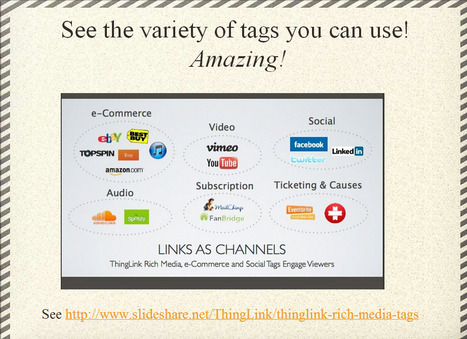
ThingLink allows you to "Make images come alive with music, videos and any web content." This slideshow provides 27 ideas of how might use ThingLink in your classroom.
Scoop.it!
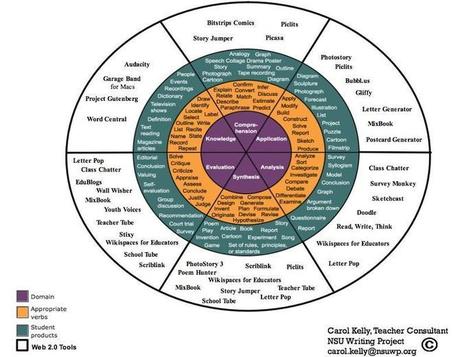
Two looks at Bloom's - one is a verb wheel and the other is a web2.0 wheel. The Verb Wheel shows the domains as well as appropriate verbs and possible student projects. The Web 2.0 Wheel also includes suggestions of Web 2.0 tools you might use.
Scoop.it!

Check out this selection of 10 free text to speech tools. All the tools are free, and some are browser specific. One that is not mentioned that you may also want to check out Natural Reader at
Scoop.it!

What would happen if school and real life were more connected? If two days a week you worked with a mentor in a field you were interested in? If students worked with advisers, whoserves as a "coach, mentor, teacher, and friend who guides and supports them in managing their personalized learning plan and Learning Through Internship/Interest placement?" This post explores this in-depth, looking at a school that is part of the Big Picture Company. One look at education reform that provides a wealth of ideas.
Scoop.it!

"We are gearing up for an exciting summer at the P2PU School of Ed. (In case you’ve missed it, this initiative is all about free, open, peer-centered professional development for K-12 teachers). Here is what we are planning for June and July. If you’d like to participate, please sign up. We’re also looking for co-facilitators for new groups and are always eager to get suggestions for new offerings." The current listing of classes is below. Check out the website for more information. * PhET Simulations for Science and Math * Global Dialog: International and Comparative Perspectives on Education * ePortfolios for Teachers * Making Writing and Literacy Learning Connections *Syndicated Education in Distributed Learning Environments * Reimaging Developmental/Basic Englich Curriculum *Curating our Individual Lives
Scoop.it!

When the pressure is off grades and performance, kids focus on learning for the sake of learning, not to show off what they know, writes Annie Murphy Paul in this interesting post about a study examining the lasting effects of summer camp. |
Scoop.it!

"The most impressive technology-rich classrooms don't look like classrooms. Instead, they look like creative businesses on deadline—like advertising agencies pulling together a big campaign, architectural firms drawing up blueprints, or software companies developing new programs." So, what would a new school look like? Reich compares schools to a "creative agency" where "enable students to collaborate with peers, pursue their interests, publish their work to the world, and take greater responsibility for their own learning."
Scoop.it!

"Nowadays teachers and students have a variety of ways to show what they know and to express themselves. Take a look at some of the hottest online and mobile tools for showing, explaining, and retelling in my infographic, "Show What You Know Using Web & Mobile Apps." These tools can turn students into teachers and teachers into super-teachers! Furthermore, most of the apps listed in the infographic are free of charge."
Scoop.it!
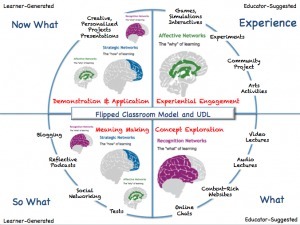
The National Center on UDL released a report , Universal Design for Learning (UDL): Initiatives on the Move this month (May 2012). This post provides a look at UDL and discusses how it might be incorporated into a flipped classroom. A link to the original report is provides as well as many other resources. If UDL is new to you this is a great overview. If you are interested in flipped classrooms and experiential learning this post looks at both while incorporating UDL.
Scoop.it!

"Tablet devices and the publishing they enable are leading us to reconsider what constitutes a textbook, and they certainly change the landscape of what it has traditionally meant to write and publish one. A new breed of rich-media publishing tools offers an evolving set of opportunities both for the creation process and for the kinds of resources that can be produced. These resources could include 3D charts and tables, interactive maps, continual updates, and quizzes with instant feedback. The integration of text with various kinds of media, coupled with broad access to new creation tools, could result in these resources becoming valuable parts of students’ digital learning landscapes." You may download this resource as either a pdf or an ePub from the site.
Scoop.it!

"I’m not the most dedicated Instagrammer (need to get out more) or the best photographer (wish I was) but like many other educators, I enjoy sharing my photos on Instagram. Why? It’s fun! Easy! I can quickly share photos taken on my iPhone when I’m out and about! Or have fun editing photos and sharing from my camera on my iPad! And in the process I’m learning more about photography, photo editing and other Instagram users. Here’s my advice to help you get started or get more out of using Instagram." A very detailed guide to help you with Instagram, with many images.
Scoop.it!
"Throughout the Twentieth Century, critical thinking instruction was part of the mission of our educational system at all levels--to varying degrees at various times. But towards the end of the century, around 1980, interest in critical thinking suddenly increased exponentially. Now, virtually all educational institutions claim to teach critical thinking. This website is focused on critical thinking. As well as the two questions above it will help answer: * Why teach it?
Scoop.it!

"Cultivate children's interest in science and the world around them using this broad range of educational resources. From standards-based lesson plans to informal activities that can be used at home or in any setting, the Expedition has created resources on a diverse range of subjects from geology to ecology." Are your students interested in the Mt. Everest? This site provides information on the current Mt. Everest as well as a multimedia library, facts on Mt. Everest and more.
Scoop.it!

Can we afford to keep ignoring this dominant means of communication? "We frequently discuss how we can do the best job of communicating with students, yet at the same time we continue to ignore and bypass the use of texting, a communication technique that is a part of most American high school and college students’ daily lives." This article provides references that contain "useful suggestions and ideas specific to leveraging text messaging in assigned course work."
Scoop.it!

Arc90, which has released a new tool called Readlists, "a free and incredibly convenient app for collecting, sharing, and enjoying bundles of articles, poems, recipes—you name it. It’s as simple as cutting and pasting links to ordinary web pages, that are then transformed into a clean reading view, but with the power to send them as specially tailored collections: to email, to Kindles, even as ePub-standard iBooks on your iPhone and iPad devices." Create your own collections, or see what others have collected.
Scoop.it!

"...There are countless learners in classrooms everywhere who would struggle to be successful with a written recipe. Many of these learners would do just fine with a recipe presented in video format. This illustrates the imperative that learners be offered information in multiple formats." For students who find it difficult to work with text video provides an alternative format to learn information. "Text is only one way to share information. Numerous alternatives are equally effective, if not superior."
Scoop.it!

How to determine the distance of stars using standard candles. "That’s precisely what the Royal Observatory Greenwich answers in this wonderful short animation, a teaser for a new exhibition titled Measuring the Universe: from the transit of Venus to the edge of the cosmos."
Scoop.it!

What is it about middle school and mathematics? Research shows us that middle school is a time that "many students disengage from math and don't regain their interest." A variety of factors are identified and there are clear suggestions on what may make a difference, such as "Offer a challenge that's well-matched to the child's skill level,with clear goals and unambiguous feedback." |





