Your new post is loading...

|
Scooped by
Beth Dichter
July 1, 2012 7:53 PM
|
When people talk about open educational resources (OER) they often state that the use of OER will save money. In this study "20 middle and high school science teachers...adopted open textbooks to understand the process and determine the overall costs of such an adoption." The conclusion states: "Simply substituting open textbooks for traditional textbooks did not appear to have an effect on student test scores...One area of particular interest is the teachers whose classes saw relatively large (23% and 14%) increases in their CRT scores after adopting open textbooks. One of these teachers said, “The better students write in their textbooks more.” If this comment turns out to be representative of a broader phenomenon, we hypothesize that student test scores will improve when professional development is provided to teachers to help them understand the new activities and pedagogies made possible by the open textbooks (e.g., students highlighting and taking notes directly in their books)." Additional information may be found in the article.
|
|
Scooped by
Beth Dichter
June 29, 2012 8:00 PM
|
MOOC - Massive Open Online Courses - are in the news more and more...and this list is extensive in the resources provided. Beginning with "A few godfathers and godmothers of thinking on MOOCs, connectivism, open education resources" it continues with links to "definitions and history of MOOCs in the media; debate and discussion about MOOCs, open education and online learning; instructor experience in MOOCs; student experience in MOOCs; related writing on open education resources; MOOC launches, backing, funding, startups and stops; MOOC - related models of credentialing; MOOC sites, classes and institutions who MOOC; and MOOC-ish iniatives and open education resources."
|
|
Scooped by
Beth Dichter
June 29, 2012 7:37 PM
|
"Slate magazine has been running several articles on education this week, including two today that are of interest. This one by Konstantin Kakaes is worth looking at more closely, if only because it somehow manages to gather almost every wrong idea about technology in education in existence into a single, compact article." Talbert critiques the article 'Why Johnny Can't Add Without a Calculator' making the point "Technology neither improves or diminishes learning. It’s the instructional design choices made and instructional practices used by individual teachers with individual students that do this." Can technology transform education? Read on to learn more.
|
|
Scooped by
Beth Dichter
June 28, 2012 10:51 PM
|
PBLU – Project Based Learning University – Brought to you by the Buck Institute for Education. If you have asked yourself “How can I create a Project Based Learning course for my students check out this resource. PBLU (in beta) currently has nine project based projects you may choose to use in your classroom. The current projects are focused in ELA and math and range from third grade through high school. Projects include Back in the Day (high school, nonfiction writing), Choose Your Own Adventure (Grade 4, ELA/Social Studies, I Know What You’re Thinking (8th Grade, Math) and Schoolyard Habitat Project (Grades 3 – 5, Science). More projects will be added, and you may make suggestions.
They are also providing a PBL Teacher Series, quoting from the website:
These classes build your skills for implementing high-quality projects. You tailor the learning experience to your needs and interests. In each class, you build a foundation. That’s the "how to." Then you apply what you have learned in your own classroom by implementing the project during the capstone class. That’s the "now DO."
This process may lead to a PBL Teacher Certification.
|
|
Scooped by
Beth Dichter
June 28, 2012 7:18 PM
|
Many teachers still have a lot of questions about what Common Core will mean for them; these resources are a good place to look for answers. The resources are divided into the following sections: * Groups and Organizations * Useful Resources * Curriculum Development * Blogs * State Tools * Articles and Presentations
|
|
Scooped by
Beth Dichter
June 27, 2012 11:52 PM
|
A longtime user dispels the myths that continue to make schools wary of adopting Google’s free platform of web productivity tools. "Google Apps for Education has emerged as a viable resource for K–12 schools that wish to provide their students with e-mail and collaboration tools but lack the money to pay for such services. The integrated, hosted communication and collaboration solution offers schools core functions such as e-mail storage and search (Gmail); scheduling (Google Calendar); instant messaging (Google Talk); document, spreadsheet and presentation creation and sharing (Google Docs); content management (Google Sites); and video hosting and sharing (Google Video)." There are 13 misconceptions about Google Apps for Education and this article addresses them. There is also access to the Google presentation.
|
|
Scooped by
Beth Dichter
June 27, 2012 10:47 PM
|
"In this post, you are about to discover one of my most resource-filled posts ever! One that is dedicated to highlighting some amazing free resources that will help support STEM-based PBL in the classroom." Find links to a wide variety of resources. Sections include * "resources that provide ideas or blueprints for an entire PBL project;" * sites that may be a foundation for a PBL unit; and * sites with free software for STEM based PBL
|
|
Scooped by
Beth Dichter
June 27, 2012 9:46 PM
|
The Flipped Classroom is one of the most talked about movements in education, perhaps surpassed only by the iPad and online learning itself in buzz. ClassroomWindow has taken the results of their survey on the Flipped Classroom and created an infographic to help visualize some of the numbers.
|
|
Scooped by
Beth Dichter
June 26, 2012 8:42 PM
|
Explore our collection of Google tricks to find new, faster ways to search, read email, manage your time, and more. In 2009 Online Colleges published '100+ Google Tricks That Will Save You Time in School" and with all the new products Google has developed a new list of tips has been developed. Topics include: Search Tricks, Google Specifically for Education, Google Plus, Google Docs, Gmail, Google Calendar, Google Mobile, Google Chrome Tips and Extensions, Google Books, Google Voice, and Handy Google Services and Apps. Lots of time saving tips!
|
|
Scooped by
Beth Dichter
June 26, 2012 6:37 PM
|
"Education lies at a peculiar crossroad in society. On one hand it has the responsibility of anticipating real-life skills by preparing us for an increasingly complex world – but education methodologies can only be formalized after practices have been defined. This dichotomy is particularly aggravated when it comes to technology, where fast-paced innovation and perpetual change is the only constant."
An infographic that looks at emerging technologies and projects where we may be in 2040.
|
|
Scooped by
Beth Dichter
June 25, 2012 10:50 PM
|
"Got serious research to do, itching for a bit of gossip or just fancy a random browse? wordonthewire is aimed at providing the savvy web user with a multi-platform search tool, all neatly packed into one application.
Knowledge is king, and nobody likes to feel left out of the loop. Let's face it, we all feel a little sheepish when we don't have a clue as to what the 'cool kids' are on about. Think of wordonthewire as your go-to guy when it comes to staying in the know.
With one click of the search button, this nifty web app serves up the latest results from a range of trending platforms - namely, YouTube, Twitter, Facebook and Bing."
wordonthewire - try it out and see what you think.
|
|
Scooped by
Beth Dichter
June 25, 2012 9:08 PM
|
"Wallwisher is a free and user friendly online tool that allows users to create a digital wall of multimedia sticky notes. In addition to text, the notes can include images, links and videos. Create a wall, then invite others to add stickies." Along with a list of ideas on how you might use Wallwisher in your classroom there are several examples to be seen and there is a Google Presentation with 'Nineteen Interesting Ways* to use Wallwisher in the Classroom (*and tips). Plus you can now use Wallwisher with an iPad. For more information on use with the iPad check out: http://blog.wallwisher.com/2012/05/wallwisher-yubi.html.
|
|
Scooped by
Beth Dichter
June 24, 2012 11:06 PM
|
"Jordan Hilkowitz is layering household products into a beaker for his latest science experiment. Right beside his mom’s coffeemaker on the kitchen counter, he is preparing a video entitled Layers and Density, describing each step for his 3,800 YouTube channel subscribers and more than 1.5-million viewers. It’s an extraordinary feat considering that five years ago, the 10-year-old autistic boy was non-verbal. Jordan, better known as Doctor Mad Science, also has an audience of researchers who are intrigued by the fact that social media could be useful therapy for children with autism."
|
|
|
Scooped by
Beth Dichter
June 29, 2012 8:40 PM
|
|
|
Scooped by
Beth Dichter
June 29, 2012 7:45 PM
|
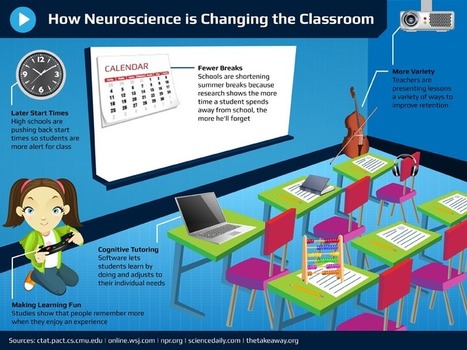
"There is often a big divide between what happens in the laboratory and the way laboratory findings are practically applied. The relationship between neuroscience research and education is no exception. While there are numerous educational products that claim to be based on neuroscience research (often quite dubiously so), the real impact of brain-based research on education has been much more subtle." This article "highlights some of the key ways that neuroscience is changing the classroom of today for the better." Topics include: cognitive tutoring, later start time in high schools, individualized education, making learning fun, and much more.
|
|
Scooped by
Beth Dichter
June 29, 2012 7:23 PM
|
"Social Media, Social Life: How Teens View Their Digital Lives is the latest research report from Common Sense Media's Program for the Study of Children and Media. We surveyed over 1,000 13- to 17-year-olds nationally to understand how they perceive social media (like Facebook and Twitter) affects their relationships and feelings about themselves. Read highlights from the study in the infographic below." To see the full report: http://www.commonsensemedia.org/sites/default/files/research/socialmediasociallife-final-061812.pdf
|
|
Scooped by
Beth Dichter
June 28, 2012 9:41 PM
|
Qwiki Creator allows you to create amazing interactive stories. A quick overview of the steps:
* Upload images or video from your computer or search for media (media assets)
* After uploading all media you will click on each piece an add title, captions, links, photo credits
* Narrate your Qwiki by uploading narration or record directly
* Set timings
* Preview the qwiki
* Publish
All Qwiki's you create are stored in your dashboard and appear on your channel.
Head over to Qwiki, sign up for an account, and create a Qwiki!
|
|
Scooped by
Beth Dichter
June 27, 2012 11:56 PM
|
"Microsoft 365 is an online version of Microsoft's well known Office suite. Office 365 for Education is free for schools and is already being used by many public school districts and colleges. Office 365 is cloud based and includes Microsoft Office Web Apps, Exchange Online, SharePoint Online, and Lync Online. This is Microsoft's answer to Google Apps for Education. It can be a good option for schools that are heavily invested in Microsoft apps as there would be almost no learning curve or training required. It includes Word, PowerPoint, Excel, Email, Calendars, web sites, and much more, including the ability to collaborate online with others and even run an online course."
|
|
Scooped by
Beth Dichter
June 27, 2012 11:34 PM
|
"Failure is such an uncomfortable topic in education. We are very failure adverse and consequently risk adverse. It is often seen as unacceptable for students to fail and this avoidance of failure is not mirrored in the real world beyond the safe environments of the school. I believe that we must use failure or getting stuff wrong as a tool for learning, that we must accept it as a part of the learning process, that we must use it to progress and develop. We should and must strive to succeed, but we need to allow opportunities for students to learn from their mistakes and in fact to provide opportunities for them to make mistakes."
|
|
Scooped by
Beth Dichter
June 27, 2012 10:25 PM
|
"...we need to find a way to embrace all forms of technology in the classroom and use them to our advantage. By training students to use technology appropriately and effectively and providing opportunities for them to reach learning targets through its usage, we create a situation in which students are engaged in learning. We also free ourselves from the constant cycle of fighting against students."
|
|
Scooped by
Beth Dichter
June 26, 2012 10:11 PM
|
Both Google and Microsoft have dramatically overhauled the way each handles search over the past few months. Read on to learn which search engine is best for "providing quick and handy summary information" and which is best for social searches.
|
|
Scooped by
Beth Dichter
June 26, 2012 6:59 PM
|
StudyBlue has been recognized as a 2012 Best Website for Teaching and Learning by the American Association of School Librarians. "StudyBlue is a free mobile study service that helps students learn. Using a Digital Backpack, students store, study, share, compare and ultimately master course material. Working alone or together... students create more than one million flashcards each week when school is in session. StudyBlue offers digital flashcards with images and audio, cloud storage for notes, personalized practice quizzes, crowdsourced study guides and more. Available online or as app for iPad/iPhone or Android.
|
|
Scooped by
Beth Dichter
June 25, 2012 11:03 PM
|
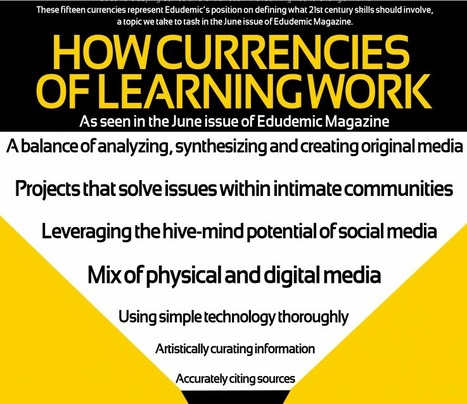
"Defining 21st century skills is an editorial matter. There are dozens of examples floating range with a range of authority behind them—some inspired, grassroots efforts, other core brands of multimillion dollar organizations making a national push...while learning will likely always have as its foundation the ability to read, write, and think, in the fast-paced, information-rich, socialized digital world of 2012, new currencies are emerging for learners to master–new skills, concepts, and thinking habits that are crucial to a consistent ability to absorb, process, and redistribute data and original thinking as a global citizen."
|
|
Scooped by
Beth Dichter
June 25, 2012 10:29 PM
|
The Surui tribe, native to Brazil's Rondonia state, released a detailed cultural map of their ancestral lands, embedded into Google Earth. “These days you can’t separate talking about culture from talking about technology, there’s no separation between these things,” Chief Almir Surui told Mashable. “You also can’t talk about sustainable development seperated from technology.” In June 2007 Chief Almir proposed a partnership with Googlea documentary, 'Trading Bows and Arrows for Laptops: Carbon and Culture,' shares the relationship between the tribe and Google Earth.
|
|
Scooped by
Beth Dichter
June 24, 2012 11:19 PM
|
Apple's popular tablet can be a great tool for students, parents, and teachers dealing with PDD and Autism Spectrum Disorders, or with other learning disabilities. This post discusses a number of apps that are geared to students with disabilities and also shares a free app, Autism Apps, that "provides easy access to what appears to be at least a hundred apps that are being used by and with people diagnosed with autism or other special needs. Apps are grouped into dozens of categories and a search tools is also provided, so users can easily search through their excellent database of apps. Each app listed may include screenshots (for both the iPad and iPod if available), reviews, video reviews, and an “Email to a Friend” function. This is really a top notch resource and we highly recommend it."
|