"A new Center on Education Policy report, Student Motivation—An Overlooked Piece of School Reform, pulls together findings about student motivation from decades of major research conducted by scholars, organizations, and practitioners...
Researchers generally agree on four major dimensions that contribute to student motivation (below). At least one of these dimensions must be satisfied for a student to be motivated. The more dimensions that are met, and the more strongly they are met, the greater the motivation will be."
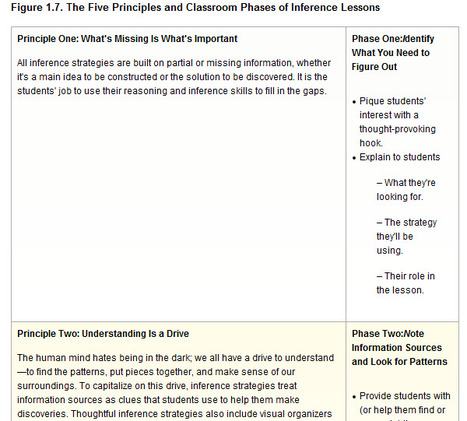
Though abstract and difficult to model, inference is an important skill to teach students -- it's the gateway to the kind of higher-order, critical thinking students need to succeed in school and work.
How can we model how to draw conclusions with students? This book explores four inference strategies:
* Inductive learning
* Mystery
* Main Idea
* Investigation
From this point they list five principles and corresponding phases of implementation, and you may read Section 1: Why Inference?
This section provides a sample lesson plans as well as many great examples - sample word lists, text passages, graphic organizers - that will help you with future lessons...and may lead you to choose to purchase the book!
Question: You wrote recently about the importance of teaching search skills. What do you make of the whole idea that kids no longer need to learn facts because they can find answers so easily online? Do you think that is true?
Answer: When I was growing up, we used to say that you don’t need to know everything, just know how to find it. I firmly believe the same today, but I now appreciate that an integral part of search literacy is knowing enough background information to make informed decisions about what sources to believe. The ability to evaluate sources is one of the linchpin skills students need for navigating research both online and off.
Free, timely topical activities and lesson plans for the K - 12 classroom offered by the nonprofit Educators for Social Responsibility Metropolitan Area.
This short video (5 minutes) provides a great overview on critical thinking. Some of the points made are: evaluate information and thought in a disciplined way, helping us refine our thought process; examine our biases; seek out knowledge and evidence; have an attitude of curiosity; widen our perspective; embrace skepticism, understanding claims, assumptions and biases; recognize the barrier of thinking in false dichotomies (black and white); and much more.
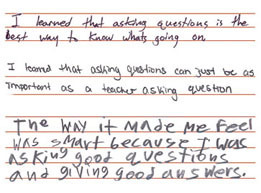
When students know how to ask their own questions, they take greater ownership of their learning, deepen comprehension, and make new connections and discoveries on their own. However, this skill is rarely, if ever, deliberately taught to students from kindergarten through high school. Typically, questions are seen as the province of teachers, who spend years figuring out how to craft questions and fine-tune them to stimulate students’ curiosity or engage them more effectively. We have found that teaching students to ask their own questions can accomplish these same goals while teaching a critical lifelong skill. (Make sure to click where it says Read Sidebar for the Question Forumulation Technique.)
The Buck Institute for Education commissioned the cutting-edge advertising agency, Common Craft, to create a short animated video that explains in clear lang...
Often I am asked why I tend to continue studying and taking professional training courses. These are questions which puzzle me, because despite the many years I have spent in classrooms, I have a...
Happy 2012 and welcome to the future! I wish all of you the very best as you enter a New Year! I hope you enjoy this timeless lesson... one that really does have a place in 21st century educatio...
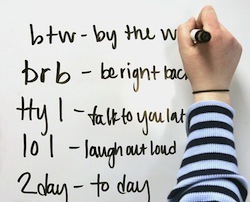
"Texting in school is a very popular topic with people able to argue both sides. Some schools are teaching text speak or SMS in school. The students put together glossaries and compare their versions to the formal written language. Many might argue but listed below are ten reasons schools should teach text speak."
"Common Sense Media partnered with Teaching Channel to produce this series of nine videos spotlighting how our lessons meet critical ELA Common Core standards for middle school. Check them out for inspiration from teachers and students in New York City and San Francisco Bay Area public schools. See how our lessons align and view the standards on the Common Core State Standards website."
Video titles: Creating a Snapshop of Digital Media Use; Using Critical Thinking to Find Trustworthy Websites; Understanding "Fair Use" in a Digital World; Cyberbullying: What’s Crossing the Line?; Improving Research Skills with Effective Keywords; Online Talk: What’s Safe and What’s Risky?; Exploring the Concept of Online Privacy; Understanding the Impact of Digital Footprints; and The Good and Bad of Using Different Online Personas. The video lessons are geared to middle school students and if you are a registered educator with Common Sense Media you may acess a free online training.
Our world is changing at an unprecedented pace. To prepare our students, lessons must go beyond the "3 R's" and foster 21st century skills. Skills like criti...
This is an updated version of the "Did You Know/Shift Happens" videos. Links to sources are available on the YouTube website.
A field guide to the art and science of the solid argument...six fantastic two-minute animations on various aspects of critical thinking, aimed at school ages 8 to 10, or kids between the ages of 13 and 15, but also designed to resonate with grown-ups. Inspired by the animation style of the 1950s, most recognizably Saul Bass, the films are designed to promote a set of educational resources on critical thinking...
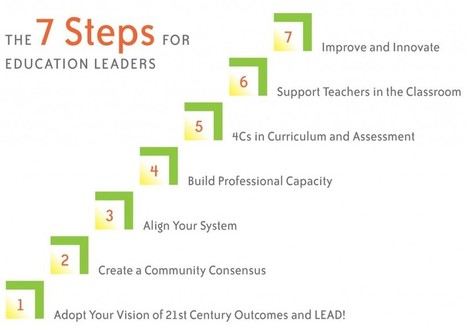
Seven steps to become a 21st century school or district, beginning with adopting a vision and embracing the four C's (critical thinking, communication, collaboration and creativity)...
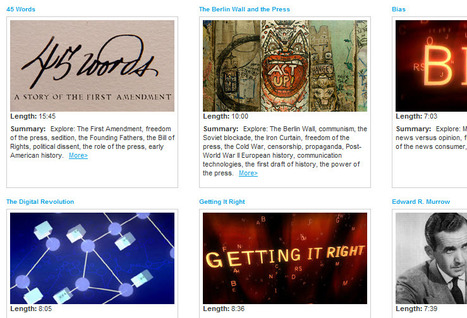
The Newseum Digital Classroom is a national news literacy website that provides high-quality digital media content in a curriculum-based structure for elementary, high school and college classes. The easily accessible materials meet the standards of learning requirements of many states and give students a deeper understanding of the five freedoms of the First Amendment...to promote critical thinking and civic responsibility and verify the timeless belief that an informed citizenry is the bulwark of democracy.
Connect online to interact with experts in the field, share ideas, and collaborate with people around the world who, like you, are committed to solving environmental challenges. Shout gives participants a framework for success, with resources and tools for exercising social responsibility while building the 21st-century skills of collaboration, innovation, and critical thinking. When students are connected through technology and empowered to build activities in their own way the learning experience extends far beyond the four walls of a classroom.
SpicyNodes provides an innovative means to add excitement to almost any area of study. As students become enamored with the presentation of their ideas, they increasingly focus on the quality of their work and develop the critical thinking skills necessary for the digital age.
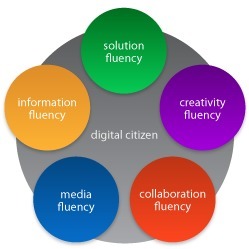
The 21st Century Fluencies are not about technical prowess, they are critical thinking skills, and they are essential to living in this multimedia world. We call them fluencies for a reason. To be literate means to have knowledge or competence. To be fluent is something a little more, it is to demonstrate mastery and to do so unconsciously and smoothly.
To get content containing either thought or leadership enter:
To get content containing both thought and leadership enter:
To get content containing the expression thought leadership enter:
You can enter several keywords and you can refine them whenever you want. Our suggestion engine uses more signals but entering a few keywords here will rapidly give you great content to curate.


 Your new post is loading...