Do you want your students to be more creative? Check out this video.
"If we want students and graduates who are more creative, innovative thinkers, we must find better ways to free them from the constraint of time.
At the end, the video states Creativity is not inspired by the pressure of time but by the freedom, the playfulness, and the fun. Does that describe most secondary classrooms you know? I know many that fit that description, but not anywhere near enough. Too many pressures regarding content coverage and/or accountability…"
How do you train an innovator? Which schools are doing it better than others? Are teachers equipped with the new skills required to educate students in this decade?
This post explores these questions and offers five "essential education and parenting practices that develop young people's capacities to innovate." The first one is "Learning to work collaboratively (innovation is a team sport!)."
The concepts of information and knowledge are also explored, beginning with the statement "Information may be free but knowledge also includes understanding, problem solving, communication, and collaboration, none of which is free." Are we addressing these 21st century skills as our students move from elementary school through high school, or our teachers "...compelled to teach to the tests for accountability purposes..."?
Additional topics are also explored, including AP testing (and the move to have students "demonstrate that they can apply knowledge learned and not merely regurgitate it" to the fact that many when you look at CEO's of most major companies "the majority did not go to an Ivy League school for undergraduate..."
"How can schools teach students to be more innovative? Offer hands-on classes and don't penalize failure. Tony Wagner on preparing students for the 21st-century economy.
In most high-school and college classes, failure is penalized. But without trial and error, there is no innovation. Amanda Alonzo, a 32-year-old teacher at Lynbrook High School in San Jose, Calif., who has mentored two Intel Science Prize finalists and 10 semifinalists in the last two years—more than any other public school science teacher in the U.S.—told me, "One of the most important things I have to teach my students is that when you fail, you are learning." Students gain lasting self-confidence not by being protected from failure but by learning that they can survive it..."
"One of my favorite books on leadership is The Future of Management by Gary Hamel. If you haven’t read it, I encourage you to do so...the essential premise is that current management models, which are centered on control and efficiency, are extremely ill-suited for an era in which adaptability and creativity drive organizational success. This has major ramifications for how we think about leading schools and preparing school administrators, of course."
The world is currently standing “on the cusp of a post-industrial revolution.” So writes Vijay Vaitheeswaran in his new book, Need, Speed and Greed: How the New Rules of Innovation Can Transform Businesses, Propel Nations to Greatness and Tame the...
"Stuck solving a problem? Seek the obscure, says Tony McCaffrey, a psychology PhD from the University of Massachusetts. “There’s a classic obstacle to innovation called ‘functional fixedness,’ which is the tendency to fixate on the common use of an object or its parts. It hinders people from solving problems.” McCaffrey has developed a systematic way of overcoming that obstacle: the “generic parts technique” (GPT),..."
Just as Francis Fukuyama once predicted the End of History, are we now facing a sort of technological end of history? Has truly radical innovation been forever replaced by incremental innovation that makes our lives easier, but not fundamentally different, from the way it was twenty years ago?...So what happened to the future?...This is a thought provoking piece that may make you look at the future in a different way.
Connect online to interact with experts in the field, share ideas, and collaborate with people around the world who, like you, are committed to solving environmental challenges. Shout gives participants a framework for success, with resources and tools for exercising social responsibility while building the 21st-century skills of collaboration, innovation, and critical thinking. When students are connected through technology and empowered to build activities in their own way the learning experience extends far beyond the four walls of a classroom.
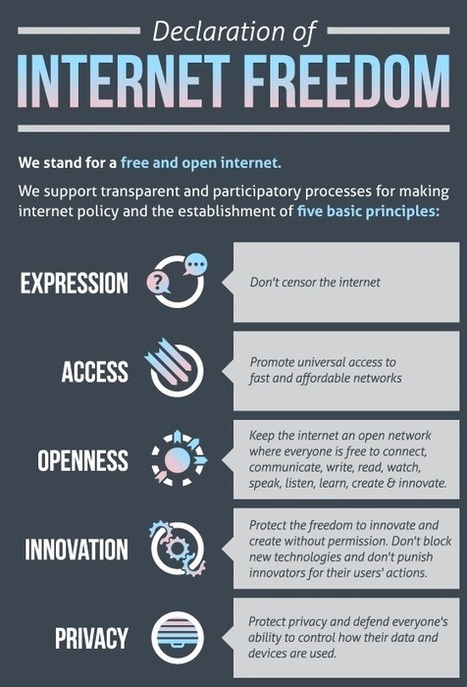
A whole bunch of organizations and individuals are getting together today to launch the beginning of a process, the creation of an Internet Declaration of Freedom. We've seen how the internet has been under attack from various directions, and we...
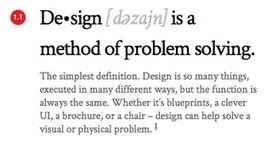
"One of the challenges we run into again and again in our teaching is the 'forest for the trees' pitfall...we stress both core facts and larger themes. This seemingly dual focus can sometimes puzzle our students as they try to internalize one notion or the other. Ideally, we try to show how the details and the ideas are actually the same thing. Or to borrow the words of the furniture savant Charles Eames, 'The details are not the details. They make the design.'"
Rich with resources and links this article explores how using design in our classrooms "combines all the top-tier thinking skills, such as creativity and ingenuity."
Tony Wagner has spent the last several years looking at how US schools can educate young people to become innovators, interviewing "scores of highly innovative 20-somethings." Read this article to learn much more.
Whenever I try to conjure up what innovation looks like, the same slideshow of images clicks across my mind: that photo of Einstein with his tongue sticking out, Edison with his light bulb, Steve Jobs onstage in his black turtleneck, introducing...
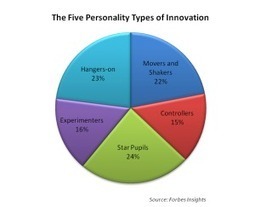
"Forbes Insights’ recent study, “Nurturing Europe’s Spirit of Enterprise: How Entrepreneurial Executives Mobilize Organizations to Innovate,” isolates and identifies five major personalities crucial to fostering a healthy atmosphere of innovation within an organization. Some are more entrepreneurial, and some more process-oriented – but all play a critical role in the process. To wit: thinkers need doers to get things done, and idealists need number crunchers to tether them to reality."
X-Prize founder and unabashed optimist Peter Diamandis sets out in his new book, Abundance: The Future is Better Than You Think (2012) (co-authored with Steven Kotler) to convince us that the future is so bright we all outta …...
A recent study by Mareike Wieth and Rose Zacks suggests that innovation and creativity are greatest when we are not at our best, at least with respect to our circadian rhythms...
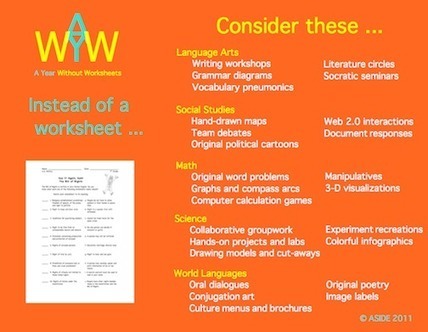
Innovative design crosses over all aspects of education. The American Society for Innovation Design in Education, or ASIDE, seeks to infuse curriculum with new approaches to teaching and thinking.
SymbalooEDU is a Personal Learning Environment (PLE) for teachers to visually organize and share the best of the web with students. The EDU version provides webmixes to various sites specific to your content area and the ability to create your own webmix.
To get content containing either thought or leadership enter:
To get content containing both thought and leadership enter:
To get content containing the expression thought leadership enter:
You can enter several keywords and you can refine them whenever you want. Our suggestion engine uses more signals but entering a few keywords here will rapidly give you great content to curate.


 Your new post is loading...


![Want students to be more creative and innovative? Give them the gift of time. [VIDEO] | Dangerously Irrelevant | Eclectic Technology | Scoop.it](https://img.scoop.it/2BFWzk7l8Nbb3Q9ATfCMXDl72eJkfbmt4t8yenImKBVvK0kTmF0xjctABnaLJIm9)