 Your new post is loading...

|
Scooped by
Beth Dichter
October 22, 2013 8:56 PM
|
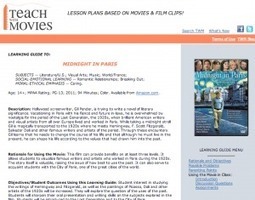
"TeachWithMovies offers access to more than 350 lesson plans and learning guides for movies and films. I’ve long been a big fan of reading and studying movies. I’ve been a fan of this site’s rich curricular materials for many years. I just discovered that I do not need to re-subscribe. The site is now available for free (though it will now host unobtrusive advertising and encourage voluntary donations)."
|
|
Scooped by
Beth Dichter
September 11, 2013 9:31 PM
|
We're thrilled to launch our next series of animations: This Thing Called Science. This series follows on from Critical Thinking, showing the way we think scientifically by considering skepticism, ...
|
|
Scooped by
Beth Dichter
May 16, 2013 10:49 PM
|
In 2008, Fran Simmons, an English teacher at NewDorpHigh School in New York—at that time one of the lowest-performing secondary institutions in the nation— devised a simple test for her students in an effort to keep district officials from pulling the plug. First, she asked her freshman class to read Of Mice and Men. Then, using information from the novel, she asked them to answer the following prompt in a single sentence: “Although George …” She was looking for a sentence like: Although George worked very hard, he could not attain the American Dream. What Simmons received was alarming in the truest sense of the word. Some students wrote passable sentences, but many could not manage to finish the line. More than a few wrote the following: “Although George and Lenny were friends.”
|
|
Scooped by
Beth Dichter
March 14, 2013 7:46 PM
|
"As educators, we constantly strive to prepare our students for the ‘real world’ that exists around them. We teach them how to read, write, and calculate. Then, of course, there are the less tangible skills we teach; such as how to work in a team, think critically, and be curious about the things they encounter each day. We want to prepare them to lead productive and successful lives once they leave us and enter into the realm of adulthood. But what lies ahead for our students in the future? Did educators of twenty years ago know that so much of our world would be based on computers and technology now? Could they have known what skills would be needed in the job market today?"
|
|
Scooped by
Beth Dichter
January 29, 2013 10:43 PM
|
|
|
Scooped by
Beth Dichter
January 22, 2013 9:41 PM
|
"So the iPad, then. Pop culture’s plaything and #edtech’s darling. It’s an app library, a media consumption device, and a mobile learning tool that makes yesterday’s graphing calculators, smartboards, and laptops look like abacuses. So we buy them then—by the truckloads, in fact. We stamp them as district-owned, give teachers a few PDs that show them some tools and advise them on “district policy,” and then expect miracles. It is unclear exactly how and where we expect those miracles to show up. Student satisfaction surveys? Learner engagement? Test scores?"
|
|
Scooped by
Beth Dichter
January 7, 2013 7:21 PM
|
"The student’s eyes drift to the classroom window and the teacher’s voice fades from consciousness. The daydream begins. It’s a familiar scene, one we have likely both experienced as students and struggled against in our students as teachers. But daydreaming is not what it might seem. Recent research in both psychology and neuroscience makes clear that daydreaming is an essential part of mental processing, reasoning and, yes, even learning."
|
|
Scooped by
Beth Dichter
December 4, 2012 10:36 PM
|
This post begins "The common understanding is that if students work hard in school they earn "A’s." For many however, there is a much straighter route to that "A." Some of the most creative learners are able to figure out what the course expectations are and do the minimum to meet them, and get the grade they want." What happens to students that are bored with the curriculum? What would happen if we moved away from grades, and replaced them with badges? It turns out that there is evidence from a July 2012 report called "Do Schools Challenge Our Students?" This report states "Many schools are not challenging students and large percentages of students report that their work is 'too easy.'" The post also provides some statistical information. The final portion looks at badges vs grades. It notes that switching from "traditional letter grades or percentage grades to badges signifying achievement could open up many possibilities for a more fine-grained tracking of student progress, address some of the criticisms regarding schools not teaching concrete skills, and motivate students to learn" (with additional information also included).
As the Common Core becomes a driving force behind public education it will be interesting to see how the issue of badges vs grades play out.
|
|
Scooped by
Beth Dichter
October 28, 2012 6:43 PM
|
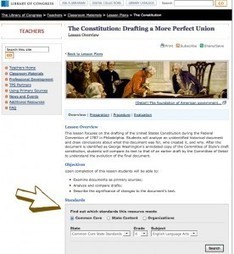
The Library of Congress (LOC) "has made its already fabulous teaching resources–designed to inspire analysis, critical thinking, and the value of working with primary sources–more findable for teachers by aligning them to the Common Core State Standards (CCSS)." This post, by Joyce Valenza, provides a great in-depth look at how to Search by Standards and also suggests some of the other tools available at the LOC.
|
|
Scooped by
Beth Dichter
August 31, 2012 6:27 AM
|
Are students today digital natives? And if they are, what does that mean? "Unlike the teachers and parents who have watched technology slowly phased into modern culture over the past three decades, today’s students have beten immersed in the digital era since birth." But does this mean thaty they have mastered all things digital? Will they approach 'all things digital' with enthusiasm? "In our experience, if students are not able to find answers to an Internet search in the first few results pages, they say “I can’t find it,” instead of adjusting their search, or reexamining the results in depth." This post explores this issue and provides some interesting perspectives on how to approach tools that may be new to them. A worthwhile read if you work with students and have noticed that they may become frustrated with tools that do not "instantaneously" gratify them.
|
|
Scooped by
Beth Dichter
July 2, 2012 8:50 PM
|
Despite being immersed in college classes that demand reading and writing about required topical material, students are often ill equipped to tackle higher cognitive thinking about their courses. This article reviews how to define critical thinking; reviews connections between critical thinking and Bloom's Taxonomy; and also a Forbes article that discusses critical thinking related to business. Additional references are provided that address critical thinking in college classes, but many of these references are also appropriate for secondary education. This post will help you learn more about how to develop critical thinking skills.
|
|
Scooped by
Beth Dichter
June 1, 2012 3:26 PM
|
Once an advocate for using social media applications and cell phones in class, this English teacher has changed his stance on the kinds of technology teachers should incorporate into their instruction. Are you using technology to promote critical thinking skills? Are the tools you are using ones that provide competence in necessary skills? Do they promote academic rigor? This article looks at many of these issues, and may have you re-consider how you are using technology in your classroom.
|
|
Scooped by
Beth Dichter
May 25, 2012 6:27 PM
|
"As a child, I grew up in a world that was dominated by left-brained thinking. Both my parents were in professions that required in-depth analytical thinking. The “rule” in my house was: “If you break something, try to fix it. Only THEN come ask Dad for help.”
Looking back now, I realize something I never understood then — what he had instilled was an ability to think critically. Along with creativity, collaboration, and communication, critical thinking is one of the four components of learning in the 21st century. Unlike the other three, critical thinking is often difficult to reduce to bite-size pieces of understanding and challenging to teach to others." Read on for an example of teaching critical thinking with a first grade class as well as a look at 3 underlying components to critical thinking.
|
|
|
Scooped by
Beth Dichter
October 16, 2013 7:43 PM
|
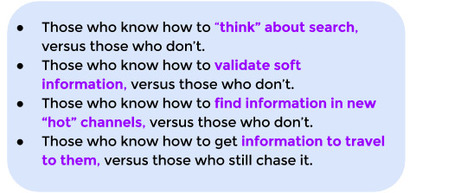
There is a new digital divide on the horizon. It is not based around who has devices and who does not, but instead the new digital divide will be based around students who know how to effectively find and curate information and those who do not.
|
|
Scooped by
Beth Dichter
June 4, 2013 10:43 PM
|
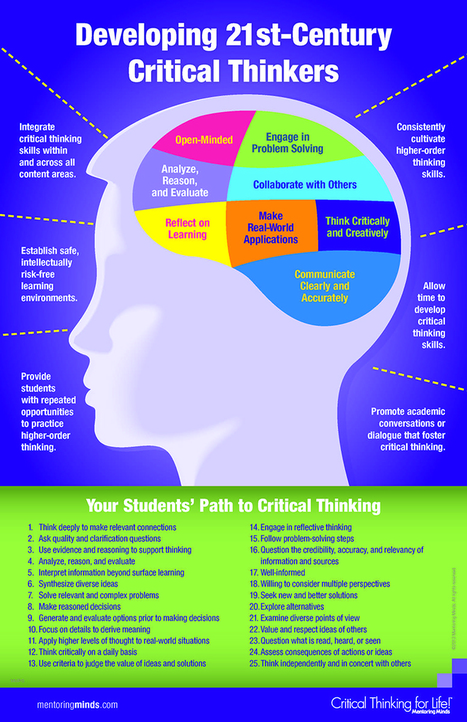
"As we venture into the 21st century, we as a society, are faced with more innovation and challenge than ever before. We now live in an interconnected world, where the Internet and global communications are simultaneously uniting and isolating us as a society. How do we raise critical thinkers to best face the challenges that face our modern society?"
|
|
Scooped by
Beth Dichter
April 25, 2013 10:09 PM
|
"What exactly is critical thinking? You hear about it all the time as a valuable 21st Century skillthat everyone should have, and one that a good education will help you develop. If it is so important, why aren’t there specific courses, seminars, self-help videos, or even whole schools focused on helping students develop it?"
|
|
Scooped by
Beth Dichter
February 24, 2013 10:06 PM
|
"Welcome to a continuing series of posts based on the eight essential elements (BIE) that make up Project Based learning. In this post I would like to focus on "significant content. I have ten ideas..."
|
|
Scooped by
Beth Dichter
January 23, 2013 9:38 PM
|
|
|
Scooped by
Beth Dichter
January 14, 2013 8:10 PM
|
"I believe that creativity is necessary in today’s classroom. In fact, creativity is one of the important 4 C’s (Critical Thinking, Collaboration, Communication, Creativity) that make up part of the foundation of a 21st century education. The remaining foundation is of course another C (Significant Content). I believe that when you put all of these C’s together you get two more C’s which make up the 'Common Core'."
|
|
Scooped by
Beth Dichter
December 14, 2012 10:33 PM
|
In this age of information how do we teach our students (or children) to be critical thinkers, to be able to look at the information available to them and filter out the good from the bad. This post explores ways to work with students in the curation process.
It looks at curating with friends (through social networks, curating resources, curating images, and curating links and content.
|
|
Scooped by
Beth Dichter
November 7, 2012 7:31 PM
|
A suggested but not exhaustive list of possible applications that may help foster 21st Century Skills in today's language learners. Although geared to language learners the applications suggested work well in any course. The skills listed (with applications to go with them) are: communication, collaboration, critical thinking and problem solving, creativity and innovation, information literacy, media literacy, technology literacy, flexibility and adaptability, iniative and self-direction, social and corss-cultural skills, productivity and accountability, and leadership and responsibility.
|
|
Scooped by
Beth Dichter
October 15, 2012 9:48 PM
|
How do we prepare students for 21st century learning? The Common Core Standards call for "more rigor, complex reasoning, problem solving, and critical thinking than traditional learning." How do we teach so that students meet these new standards? What professional development will need to be done so that teachers may provides their students with the necessary skills? As the titleof the article states, "How do we prepare students for compelex futures?" The post looks at a variety of materials that discuss skills and strategies that one might consider. In 2008 Tony Wagner suggested 7 areas that were critical for students to learn: * Problem-solving and critical thinking * Collaboration across networks and leading by influence * Agility and adaptability * Initiative and entrepreneurship * Effective written and oral communication * Accessing and analyzing information * Curiosity and imagination Materials from David Conley regarding "key cognitive strategies", Costa and Kallick and habits of mind, and other dispositions are also discussed. The last section of the post looks at "a new paradigm: on-going, formative, self-assessment."
|
|
Scooped by
Beth Dichter
July 25, 2012 2:37 PM
|
Here is an idea of one way to use infographics in your classroom. The specific infographic shown looks at Gross Domestic Product (GDP) and levels of English speaking citizens in a country. It appears that the higher levels of English speaking citizens, the better the GDP. Using infographics is a great way to helpe students raise questions that lead to deeper understandings. To see questions that might be raised with this specific infographic click through to the post.
|
|
Scooped by
Beth Dichter
June 27, 2012 11:34 PM
|
"Failure is such an uncomfortable topic in education. We are very failure adverse and consequently risk adverse. It is often seen as unacceptable for students to fail and this avoidance of failure is not mirrored in the real world beyond the safe environments of the school. I believe that we must use failure or getting stuff wrong as a tool for learning, that we must accept it as a part of the learning process, that we must use it to progress and develop. We should and must strive to succeed, but we need to allow opportunities for students to learn from their mistakes and in fact to provide opportunities for them to make mistakes."
|
|
Scooped by
Beth Dichter
May 27, 2012 9:47 PM
|
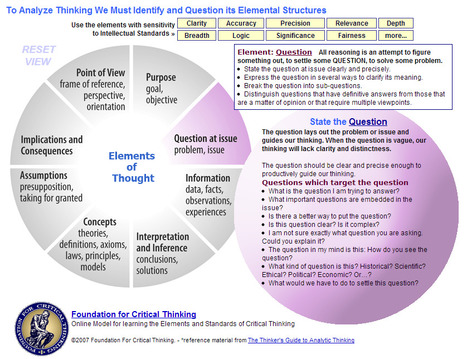
"Throughout the Twentieth Century, critical thinking instruction was part of the mission of our educational system at all levels--to varying degrees at various times. But towards the end of the century, around 1980, interest in critical thinking suddenly increased exponentially. Now, virtually all educational institutions claim to teach critical thinking.
But what is critical thinking?
How can it be taught?
And how can we tell whether it has been taught?" This website is focused on critical thinking. As well as the two questions above it will help answer: * Why teach it?
* How can critical thinking be assessed?
Additional resources are available for teachers, parents, institutions, students and more.
|


































This is good news!! Movies are a great way to engage the current generation and having this resource free is fantastic.