A better way to experience information....Qwiki, an online search tool, combines text, images and voice - allowing students to experience the information in multiple ways. An app for the iPad is also available.
Tell a four-year-old that she can eat one marshmallow now or wait 15 minutes and eat two. What does the child’s self-control, or lack of, tell us about her likelihood of future success?
Scribus is an Open Source program that brings professional page layout to Linux/UNIX, Mac OS X, OS/2 Warp 4/eComStation and Windows desktops with a combination of press-ready output and new approaches to page design.
Elementary school Principal Peter DeWitt writes about students' social and emotional health, and how educators can help young people find common ground. He can be found at www.petermdewitt.com.
Slatebox: visualize everything....create in real time and share the canvas...embed into your own website...free for individual use...pure HTML 5 + Javascript = Speed...this is simple yet elegant tool to for mind mapping.
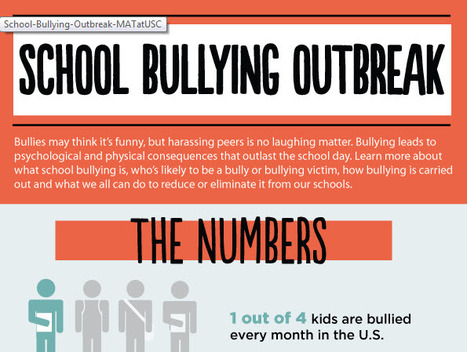
Is bullying an issue in your school? Did you know that 1 out of 4 kid are bullied everyone month in the U.S., that 1 in 10 drops out of school due to repetitive bullying? This infographic provides an eye opening look and "share facts about the methods, consequences and prentative measures related to bullies and bullied victimes in schools."
This is a very good article because apart from having a lot of information, it has lots of pictures and statistics. Also, it uses many simple to understand pictures and charts. If you need numbers in bullying, this article is just what you need.
We use Olweus Bullying Prevention program in our region. It is a school and district wide effort to end bullying, promote healthy peer relationships, and to help students deal with bullying. The program teaches students through frequent class meetings. Videos and discussions are used to help students problem solve through those tough situations they encounter at school. Elementary students make pledges to their school communities in regards to not watching or letting bullying happen, treating others nicely, not talking badly about others, etc. The conversations are a bit more in depth at the middle and high school levels. The goal is to provide children of all ages with tools and strategies to help them deal with bullying, whether they are being bullied or are witnessing it. In our schools, we have yet to survey students since implementation so the impact of the program is yet to be foreseen. What is clear, is that schools must do something to proactively prevent bullying. Consequences for bullying should be clearly stated in handbooks with parents and students understanding the seriousness.
although this is not a "traditional" article, it does touch base on an important topic; bullying. one in four kids are bullied every month in the US. this article contains various statistics about bullying such as prevention, consequences, methods of bullying, and so on. this gives insight on how to notice bullying and how to tackle it. statistics show that "35.5% of students believe schools can help prevent bullying". The author stood true to its title and gave tips on how to battle bullying as a teacher, Things to remind students to do when they are around bullies… Speak up against bullying. Say something like, “stop it.” Walk away. Act like you do not care, even if you really do. Tell an adult you trust. They may have ideas about what you can do. Stick together. Staying with a group might help." Sometimes it is hard to speak to someone about bullying with an adult but if teachers made themselves "friendlier" and more open, I'm sure more and more kids would open up about their struggles in school.
The nation's first online community designed exclusively to foster achievement in science, technology, engineering and math through the collaboration of STEM educators and the sharing of best practices.
Online Guides, Internet Library, Web Resources - FindingDulcinea. Online guides and suggested Web resources researched and written by real people. This site provides excellent resources and is worth checking out.
In this game, designed for ages 8-10, the CyberPigs play on their favourite Web site and encounter marketing ploys, spam and a close encounter with a not-too-friendly wolf.
The purpose of the game is to teach kids how to spot online marketing strategies, protect their personal information and avoid online predators.
The National Center on Universal Design for Learning is offering the UDL Series, web-based rich media presentations and resources to increase understanding of the UDL framework, enhance utilization of UDL tools, processes, and resources, support effective UDL implementation, and inform UDL advocates, families, and communities about professional development and policy initiatives.
Although most teachers have access to computers in their classes, only one in five say they have the right level of technology, according to a recent PBS national survey of teachers grades pre-K-12.
Limited budgets were cited as the biggest barrier to accessing technology, according to 63 percent of teachers.
Create your own song in less than a minute. Musicshake is the world's most fun and sophisticated online music community, allowing people to CREATE, LISTEN, DISCOVER and SHARE originally-created music. Free to use although you must pay to download your song. There is also an edu version.
To challenge and support each child at his or her own level, the educators of Forest Lake Elementary deploy a powerful array of digital-technology tools. Discover what your school can learn.
Inspired by an article about why challenging the brain is important for everyone, we've rounded up related Times articles and multimedia and listed ideas that can help any learner of any age or background.
Worldmapper is a collection of world maps, where territories are re-sized on each map according to the subject of interest. Reference maps, animations and more are available.
The lifting of restrictions around student devices was born of necessity—tight budgets, plus increasing tech adoption among kids. Practically speaking, BYOD means schools will need to purchase less equipment. The idea has merit, but needs serious consideration before it can be implemented.
To get content containing either thought or leadership enter:
To get content containing both thought and leadership enter:
To get content containing the expression thought leadership enter:
You can enter several keywords and you can refine them whenever you want. Our suggestion engine uses more signals but entering a few keywords here will rapidly give you great content to curate.


 Your new post is loading...
 Scoop.it!