


"Decades of research clearly demonstrate that for novices direct, explicit instruction is more effective and more efficient that partial guidance. ..Small group and independent problems and projects can be effective – not as vehicles for making discoveries, but as a means of practicing recently learned content and skills..."

Eclectic Technology
230.9K views |
+0 today
Filter by date
Tags
Tech tools that assist all students to be independent learners & teachers to become better teachers
Curated by
Beth Dichter
 Your new post is loading...
 Scoop.it! 
Internet Slang words - Internet Dictionary. Internet Slang. A list of common slang words, acronyms and abbreviations as used in websites, ICQ chat rooms, blogs, SMS, and internet forums.
Scoop.it!

Nearly two-thirds of Internet users also user social networking sites. As social media becomes mainstream, more users recognize the importance of protecting their privacy and managing their accounts. How are you taking control of your profiles?
Scoop.it!

"As the US Department of Education moves to rebrand No Child Left Behind and increase the significance of high-stakes testing, there is a counter-movement growing in the teaching work-force to provide relevant educational experiences that encourage students to do more than just memorize and recite facts."
Scoop.it!

While TV can be a great educational tool, it can also adversely affect their health, behavior, and family life.
Scoop.it!

From
visual

Like infographics and data visualizations? Visual.ly is the world's largest community of dataviz and infographics. Come explore, share and create.
Scoop.it!

The image of the 'creative type' is a myth. Jonah Lehrer on why anyone can innovate—and why a hot shower, a cold beer or a trip to your colleague's desk might be the key to your next big idea. From Imagine: How Creativity Works.
Scoop.it!

"Stuck solving a problem? Seek the obscure, says Tony McCaffrey, a psychology PhD from the University of Massachusetts. “There’s a classic obstacle to innovation called ‘functional fixedness,’ which is the tendency to fixate on the common use of an object or its parts. It hinders people from solving problems.” McCaffrey has developed a systematic way of overcoming that obstacle: the “generic parts technique” (GPT),..."
Scoop.it!

"So, it came down to one day, one test, at the Acropolis as the young men of Athens took out their #2 chisels to answer 30 questions on stone tablets. It is the annual timed test to prove the students’ knowledge and competence as they seek to become philosopher-kings. This valued test is the ultimate prize demonstrating not only the achievement of students, but also serves as the one key evaluation of the teacher..."
Scoop.it!

Beautiful Brains: Moody. Impulsive. Maddening. Why do teenagers act the way they do? Viewed through the eyes of evolution, their most exasperating traits may be the key to success as adults.
Scoop.it!

It’s innovation in education. And the time is right. OpenStax College offers students free textbooks that meet scope and sequence requirements for most courses. These are peer-reviewed texts written by professional content developers. Adopt a book today for a turnkey classroom solution or modify it to suit your teaching approach. Free online and low-cost in print, OpenStax College books are built for today’s student budgets.
Scoop.it!

"The very fact that I found the reflective piece, "Is Twitter encouraging a type of ‘Arab Spring’ within Education?" via Twitter would seem to indicate that Twitter is having some effect on changing the education landscape...[The article poses the question] 'Are we living through a process whereby social media is finally breaking down some of the traditional divides that have kept education transformation suppressed?' He then proposes ways in which Twitter is facilitating that process. Examining Harris’ ideas sheds some light on why Twitter is a good tool for jumpstarting large-scale educational reform."
Scoop.it!

Simple - Great OER content is out there. Gather that content, stitch it together, and engage learners w/o reinventing the wheel. Stretchy - Seamlessly integrate content with dozens of popular websites, apps, and social media services. Sticky - Make ANY web content engaging, interactive and shareable using the same tools your learners use every day. |
Scoop.it!

For those of us who love technology it seems hard to believe that there are those who despise it. Here's how I coped with a student who hated technology -- and how he surprised me.
Scoop.it!

"Spark curiosity in the classroom. Discovery Education and Intel have teamed up to create Curiosity in the Classroom, a website designed to bring teachers, students and families on a journey through life's biggest questions." This site has resources for teachers, parents and students. The teacher area has resources to help students explore careers at the forefront of featured topics such as Communications, Computers, Nanotechnology, Robotics and Artificial Intelligence for Grades 6-8 and 9- 12, including videos, webinars, pdf files. There is also an area called Profiles in Curiosity with the tag line 'Stimulate insightful conversation with your students about these modern day visionaries.'"
Scoop.it!
"There is a difference between personalization and differentiation and individualization. Barbara Bray and Kathleen McClaskey developed this chart on the differences on approaches to teaching and learning. The chart clearly explains that personalization is about the learner and the distinct difference in the learning environment." 
Mrs. Reinagel's curator insight,
July 13, 2015 1:03 PM
#VBBT2015 Food for thought or just another word for the same?
Scoop.it!
In this slideshow Buffy J. Hamilton discusses the concepts of transliteracy, providing a variety of definitions, and then explores how we can use these concepts as a process while working with students. If we embrace inquiry based learning, then participatory learning and transliterate learning are a part of the whole. The words connect, wonder, investigate, construct, express and reflect are explored with many resources and ideas provided to help you start this process in your classroom with your students. 
Angie Hammons's curator insight,
October 19, 2014 11:33 PM
This is a slide set from a presentation on transliteracy. This slide set provides a good foundation for understanding what transliteracy is. It is important to understand that you can't take digital literacy or information literacy and focus on them individually. Each of the different literacies are connected and should be recognized as such.
Scoop.it!
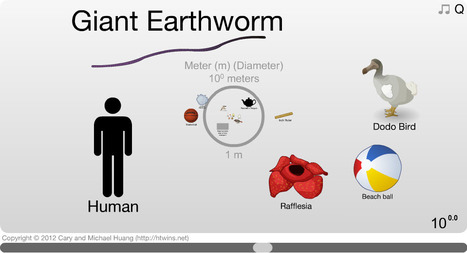
Explanation: What does the universe look like on small scales? On large scales? Humanity is discovering that the universe is a very different place on every proportion that has been explored. For example, so far as we know, every tiny proton is exactly the same, but every huge galaxy is different. On more familiar scales...
Scoop.it!
"TED-Ed's mission is to capture and amplify the voices of great educators around the world. We do this by pairing extraordinary educators with talented animators to produce a new library of curiosity-igniting videos. A new site, which will launch in early April 2012, will feature these new TED-Ed Originals as well as some powerful new learning tools...we are happy to extend an open invitation for the nomination of educators and animators and the suggestion of lesson ideas.
Scoop.it!

Just this weekend I’ve finished writing a lead article for my SLANZA friends in NZ for their Collected Magazine. School librarians everywhere are interested in the same things, so I was pleas...
Scoop.it!

Whether it's your first time here or you're a longtime SXSWer there's no arguing with the fact that over the next 5 days you'll be overwhelmed with the amount of information thrown at you. Last year we introduced Ogilvy Notes to help tame some of this insanity. Ogilvy Notes is a series of visual summaries of the biggest and best keynotes and panels at SXSW.
Scoop.it!

"You might not think of the Fourth Amendment while you're using Facebook and other online tools, but you probably should." The concept of privacy seems to be changing with the advent of social media. When you post online using social media do you think you are giving up your privacy rights?
And here is the 4th Amendment: The right of the people to be secure in their persons, houses, papers, and effects, against unreasonable searches and seizures, shall not be violated, and no Warrants shall issue, but upon probable cause, supported by Oath or affirmation, and particularly describing the place to be searched, and the persons or things to be seized 
Kailee Barnes's curator insight,
March 13, 2013 7:49 PM
This article suggests that sharing things online cold infringe upon your 4th amendment right. I think that it is a problem because people do just share whatever photos they want to, no matter how personal. Everyone can view this information without a Warrant, so it is questionable what else they could expect you to let them view without one.
Scoop.it!
"Professor Daniel Willingham describes why content knowledge is essential to reading with comprehension, and why teaching reading strategies alone is not sufficient..." This video is referenced in an article published on The Core Knowledge Blog titled 'Meet the Children Where The Are...and Keep Them There.' This articles discusses the "three big ideas embedded within the English Language Arts standards that deserve to be at the very heart of literacy instruction in U.S. classrooms, with or with or without standards themselves." Take the time to read the article and watch the video. The article is located at: http://blog.coreknowledge.org/2012/02/27/meet-the-children-where-they-are-and-keep-them-there/
Scoop.it!

"As both a consumer and curator of information, I spend a great deal of time thinking about the architecture of knowledge. Over the past year, I’ve grown increasingly concerned about a fundamental disconnect in the “information economy”: In an age of information overload, information discovery — the service of bringing to the public’s attention that which is interesting, meaningful, important, and otherwise worthy of our time and thought — is a form of creative and intellectual labor, and one of increasing importance and urgency. A form of authorship, if you will...."
Scoop.it!

When it comes to history, science, and global affairs, Americans are notoriously uninformed. Too many of us shrug off our inability to "do math," or speak a second language. And in effect, we assume that these capacities are somehow dispensable... |





