Published by the Bangkok Post, October 2, 2016
Ban Lada is one of 16 schools in the four southern provinces of Yala, Narathiwat, Pattani and Satun which are trialling "mother tongue first bilingual education", a pilot project conducted by Mahidol University.
LOST FOR WORDS:
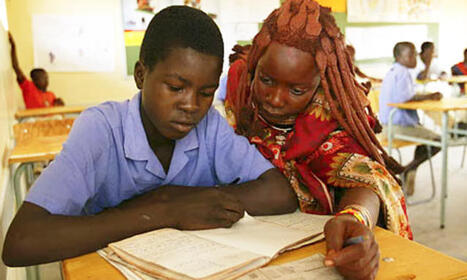
Rohkiyoh Abu and her daughter, Afifa. Ms Rohkiyoh hopes that her daughter won't face the challenges she had with learning Thai. PHOTOS: Chumporn Sangvilert
The programme allows Malay-speaking students to learn to read and write first in Malay as a bridge to bilingual literacy.
Thailand's public schools use Thai as the language of instruction since it is used in gross national literacy measurements.
There is no exception for the southernmost provinces of Pattani, Yala and Narathiwat, where the Patani Malay dialect is spoken.
The same policy applies in other regions where dialects are spoken.
But unlike the South, they share a similar cultural and linguistic background to people in central Thailand.
Patani Malay, known by Thais as Yawi and colloquially as Jawi, is similar to Malaysian and uses a written script which is a combination of Arabic and Roman (or Rumi).
Educated Muslim parents can tutor their children at home or send them to private schools which conduct lessons in Patani Malay.
Some send their children to pondoks, traditional boarding religious schools where Malay is used and Islamic studies constitute the only curriculum.
However, the Thai-only formal education system does not work well in communities that use ethnic languages.
"The students should learn from their mother tongue to fully receive knowledge," said Suwilai Premsrirat, project director of Patani Malay-Thai Bilingual Education at Mahidol University, who led a research team on bilingual education nine years ago.
Isra Sarntisart, a programme director of the Thailand Research Fund, added, "The Thai-only formal education has also caused the decline in the use of ethnic languages in Thailand."
The aim now is to get Thai Malays to master the Thai language while allowing them to embrace their own. There are several ethnic dialects spoken in different parts of the country, including Miabri in Phrae province and So, or Thavung, in Sakon Nakhon province.
The Thailand Research Fund has sponsored Mahidol University to design the "orthography" for diverse ethnic groups, including Malay-speaking students, so that they can better understand classroom teaching via their own tongue. Orthography is the systematic representation of a language's sounds by written script or symbols. In the projects Mahidol is developing, Thai script is used as the basis to develop the "sound" of the ethnic languages being spoken.
"The results of the students who graduated from bilingual programmes shows the positive result that the students could better interact in the classroom," Ms Suwilai said.
"In the past, some students dared not ask to go to the toilet because they could only seek permission to go out of the classroom in Malay."
The programme received the Unesco King Sejong Literacy Prize 2016 last month as part of International Literacy Day. Ms Suwilai went to Paris to receive the award.
MOTHER TONGUE
Wanna Udomsartsakul, the principal of Ban Lada School, said that the communities surrounding the school are low-income. Some are chilli farmers, while others work low-paid jobs in the city.
BILINGUAL THINKING: Suwilai Premsrirat, project director from Mahidol University.
"When they are at home, they speak Malay. Some parents cannot speak Thai. So when the students come to school and we ask them to speak in Thai, it is not easy."


 Your new post is loading...