Your new post is loading...

|
Scooped by
Dual Language Education of New Mexico
February 19, 2017 11:13 AM
|
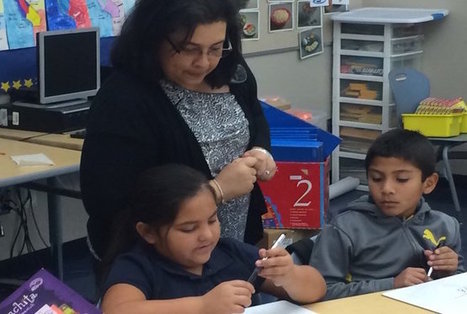
Published by the Santa Barbara Independent, February 19, 2017 Starting with two kindergarten classrooms in the 2017-18 school year, Carpinteria Unified School District will launch a dual-language immersion program in which teachers instruct in Spanish for 90 percent of the school day and in English for 10 percent. As students move up, the ratio changes gradually, becoming 50/50 by 5th grade.
The concept is designed to produce bilingual students and, early on, to close the achievement gap for students going into kindergarten with little to no English skills. Studies have found that if English learners initially establish academic foundations in their native language, they become more successful overa
|
|
Scooped by
Dual Language Education of New Mexico
February 17, 2017 4:54 PM
|
Published by the Columbia Basin Herald, February 16, 2017 State legislation woud help create dual language programs and recruit bilingual teachers.
|
|
Scooped by
Dual Language Education of New Mexico
February 15, 2017 9:26 PM
|
Published by the Mineola American, February 15, 2017 Many say that the best way to learn a new language is to immerse yourself in the country, but Mineola elementary school students are getting a similar experience without having to get on a plane with the help of the school district’s dual language program.
Published by Bakersfield.com, January 28, 2017 A group of Voorhies Elementary School third-graders huddled together on a carpet as their teacher, Julissa Moreno, called them to the whiteboard for a math lesson.
|
|
Scooped by
Dual Language Education of New Mexico
January 14, 2017 10:52 AM
|
Published by KENS5 News, January 12, 2017 San Antonio ISD is making changes in an effort to help students better prepare for the future. This year the district will phase out Mark Twain Middle School in favor of a new dual language academy, the first step in what promises to be a dramatic shift for the district.
Published by the Philadelphia Public School Notebook, January 3, 2017
Philadelphia, where 12 percent of public school students are English learners, has had a long history of experimenting with bilingual education. And recently, the city has seen a boost in enthusiasm for more comprehensive dual-language immersion programs.
But maintaining and expanding such programs has long been difficult, largely due to shifting state and federal priorities and fraught political debates over the years about how to assimilate immigrant students and teach them English.
Philadelphia has also had a particular problem in embracing bilingual education with the same vigor as other cities with high numbers of English learners. This is because Pennsylvania, unlike most other states, has never instituted a separate, stand-alone certification for teaching ESL – English for speakers of other languages. And its certification exams are administered only in English, which limits hiring for bilingual programs where teachers only need to be completely proficient in their native language.
For these and other reasons, recruiting a diverse teacher force has been an issue. According to District data, just 3 percent of teachers identify as Hispanic and 2 percent are Asian, although those figures don’t necessarily correspond to how many speak other languages or are qualified to teach English learners.
|
|
Scooped by
Dual Language Education of New Mexico
December 11, 2016 3:00 PM
|
Published by the South Bend Tribune, December 11, 2016 The South Bend Community School Corp. is starting a new program in the fall that will allow students to receive half of their instruction in English and the other half in Spanish.
The Dual Language Immersion program, which the school board approved at its meeting Monday night, will start on a small scale with 50 kindergartners at McKinley Primary Center. The plan is for half of the program’s students to be native English speakers and the other half to be English learners.
Julia Cordova-Gurule, the South Bend schools’ director of bilingual services, said the program will enable students to develop skills that will help them succeed in the global economy.
Published by the New York Times, November 22, 2016 Californians’ approval of a ballot measure on bilingual education gives Latino kids their cultural heritage back.
Published by the Los Angeles Times, November 22, 2016 Proposition 58, which cruised to an early victory on election night with 73% of the vote, overhauls English-only instruction in California, granting public schools more power over their own bilingual and multilingual programs.
To many educators, the move is a symbolic reversal of what they say was a discriminatory policy that required Latino immigrant children to speak and learn only in English and failed to prepare all students for a global economy. But the measure does not require schools to create new courses or curricula. It simply gives them permission to do so if they so choose.
Because of this, the onus will fall on local communities to push for new programs, teachers and education leaders said, and some could face challenges, as schools across the state continue to grapple with teacher and funding shortages.
Essential Politics November archives
Proposition 58 “makes nothing happen,” said Stanford University professor David Plank, executive director of Policy Analysis for California Education. “It expands the opportunities of districts and local educators to develop and implement programs they think will be good for their kids. But it leaves the decision about what those will look like to local actors.”
Education leaders hoping to stimulate the growth of bilingual classes in California face a monumental task. Less than 5% of public schools offer bilingual and multilingual programs, though there are now 1.4 million English learners statewide — about 80% of whom speak only Spanish.
|
|
Scooped by
Dual Language Education of New Mexico
November 28, 2016 5:18 PM
|
Published by NPR, November 25, 2016 Eighteen years after California voters severely restricted bilingual education, they've voted to bring it back. Proposition 58 passed by a wide margin. But what happens next won't be easy.
|
|
Scooped by
Dual Language Education of New Mexico
November 22, 2016 8:19 AM
|
Published by the Christian Science Monitor, November 21, 2016 With eye toward equity, schools in low-income, black neighborhoods try controversial approach. Part 1 of 2.
|
|
Scooped by
Dual Language Education of New Mexico
November 15, 2016 9:44 PM
|
Published by Inside Higher Ed., November 2, 2016
Princeton general-education proposal would require all students -- even those already proficient in a foreign language -- to study a language other than English. Most of the shrinking number of institutions with requirements let students test out of them.
|
|
Scooped by
Dual Language Education of New Mexico
November 7, 2016 11:28 AM
|
Published by the LA School Report, November 6, 2016 The growth of dual language programs — where students are taught 50 percent of the time in English and 50 percent in a second language in a classroom where roughly half the students are fluent English speakers and half are English learners — is part of shifting attitudes in California and LA Unified about bilingual public education and English-only instruction.
|
|
|
Scooped by
Dual Language Education of New Mexico
February 18, 2017 2:37 PM
|
Published by the Forsyth County News, February 18, 2017 Parents across Forsyth County should expect to receive an information sheet and survey regarding a proposed dual-language immersion program Forsyth County Schools is thinking of implementing in its elementary schools. At a Board of Education work session Tuesday, World Language Content Specialist Michaela Claus-Nix presented the board with the information sheet, saying it, along with the survey, will likely be sent out the week of Feb. 20. “It really is just a little bit of information for parents and for other stakeholders to learn about dual-language immersion: what is it, what the research says about dual-language immersion [and] what it is that parents can expect in the classroom,” Nix said. “I think we’re really trying to get a lot of information out up front in order to make it very clear it’s very different [from] what we had in the past.” The county’s previous language program was phased out years ago, with the district’s last class to have been taught foreign languages in elementary school is graduating high school in 2015, according Jennifer Caracciolo, a spokeswoman for FCS. The program would also differ from what is currently in place in middle and high schools throughout the county, which focuses on language instruction during only one class period per day. ... “We really have a unique situation in Forsyth County,” Nix said previously. “We have all the criteria that are already favorable for dual-language immersion. We do have a very fast-growing heritage speaker population, and we also already have staff members on hand who are very proficient in Spanish and other languages. We also have the community support; one pre-school already teaches students in Spanish immersion.”
Published by Coastalview.com, February 15, 2017 One year later, parents pushing for a Dual Language Immersion program in Carpinteria Unified School District got the school board on board with the pilot project to educate students in both Spanish and English.
Published by the Marin Independent Journal, February 2, 2017 In November, Californians voted yes on Proposition 58 with almost 73 percent support, lifting restrictions on bilingual education for English language learners and authorizing school districts to establish dual-language immersion programs for both native and non-native English speakers.
This was an important win for parents who want their children to begin learning a second language at an early age. .... While numerous communities in the Bay Area have established Mandarin immersion programs, there currently are none in Marin County, although several private schools offer Mandarin Chinese as a foreign language. If Marin parents are interested in having their children become bilingual in Mandarin Chinese, they may want to consider creating a charter school. The California Charter Schools Association’s website is a good resource for parents who are interested in creating a charter school in their community.
Published by Dual Language Schools.Org, January 13, 2016 When DualLanguageSchools.org first stumbled upon Dual Language Immersion Teacher Angela Palmieri, it was at the 2016 La Cosecha Dual Language Conference in New Mexico. She was presenting her Fulbright Distinguished Award in Teaching research on the integration of cultural pedagogical practices in Spanish dual language immersion programs based on Maori-medium cultural pedagogical practices in Aotearoa/New Zealand, which continues fueling her passion for dual language immersion and bilingual education.
Published by Education World, January 4, 2017 Why improving access to bilingual education should be a focal point of 2017.
|
|
Scooped by
Dual Language Education of New Mexico
December 16, 2016 11:51 AM
|
Published by Education Dive, December 16, 2016 A study of Portland Public Schools’ dual language program by researchers at the RAND Corporation and the American Councils for International Education provides unusually compelling evidence in favor of the power of the model for all students.
Published by EdWeek, December 7, 2016 In Oxnard, Calif., where nearly every child in the 17,000-student school district comes from a poor family, lack of ready access to books and other reading materials has been a huge barrier to developing strong literacy skills. That’s why Superintendent César Morales has leveraged the district’s 1-to-1 tablet initiative as a starting point for a massive bilingual-literacy initiative, to develop a deep love of reading in English and Spanish among his students and their families. Last year, Oxnard’s K-8 students collectively read more than 1 million books through the district’s reading program and showed growth on statewide reading tests. Under Morales, the district has invested in campus and community infrastructure to support the push for literacy—amassing an electronic lending library of tens of thousands of English-language and Spanish-language books.
Published by the Rocky Mount Telegram, December 8, 2016 NASHVILLE — The Nash-Rocky Mount Board of Education approved a partnership with Visiting International Faculty to implement a new dual immersion program that will offer Spanish classes for select kindergarten students at four elementary schools beginning next year. The new dual immersion program will be offered at Winstead Avenue Elementary School, Coopers Elementary School, Middlesex Elementary School and Bailey Elementary School. Each school will have one dual-immersion kindergarten class in the coming year. When the issue of the dual language immersion program last came before the board, school officials had not yet decided between offering Spanish or Mandarin as the target language. However, Eddie Hicks, executive director of school transformation for the school system, said that Spanish was ultimately selected because of the difficulty in finding fully-qualified Mandarin instructors for the classrooms.
Published by NPR, November 29, 2016 Kids are showing reading gains in dual-language classrooms. There may be underlying brain advantages at work.
|
|
Scooped by
Dual Language Education of New Mexico
November 27, 2016 1:53 PM
|
Published by the Kitsap Sun, November 21, 2016 Greysen Prichard, a fourth-grader at Vinland Elementary School, is not a native Spanish speaker. But as a student in the school's dual language program he's proficient enough to help younger students learn to read and write in Spanish.
Greysen last week was helping his first-grade "reading buddy" Eleanor Thoemke fill out a work sheet about turkeys.
"Un pavo es un ..."
"Pájaro," Eleanor wrote.
"A turkey is a bird."
Vinland's dual language program teaches reading and writing in a student's native language, at least initially, introducing their second language in other subjects. That differs from English language learner programs that offer instruction, with support, entirely in the student's second language.
"Research shows that when students learn in their first language, all of that knowledge and all of those skills transfer to the second language," said Martha Little, North Kitsap School District's elementary English language learners coordinator.
At Vinland, the linguistic flow goes both ways, as the program enrolls a roughly 50-50 mix of English language learners and native English speakers wanting to learn Spanish. Students who can read and write at grade level in their native language can usually become fluent in a second language in under four years, Little said.
|
|
Scooped by
Dual Language Education of New Mexico
November 15, 2016 10:04 PM
|
Published by LA School Report, November 10., 2016 With California’s voters passing Proposition 58 this week, millions of students will now have increased access to bilingual education. That’s especially good news for LA Unified, where the district’s English language learners significantly trailed their peers at other large districts in the state on the most recent standardized tests.
While LA Unified had plans to expand bilingual education with or without Prop. 58, the process will now be streamlined, as schools will be free to offer recommendations to parents on bilingual education, and parents won’t be required to sign a waiver form.
|
|
Scooped by
Dual Language Education of New Mexico
November 15, 2016 4:02 PM
|
Published by EdSource, November 14, 2016 The overwhelming approval by California voters of an initiative to end restrictions on bilingual education in its public schools marks another significant shift from the political expressions of racial and ethnic resentments that swirled across the state during the 1990s.
Its passage highlights the changes that have occurred in California over the past two decades – the inexorable shift to a multiracial and multiethnic society – along with a realization that multilingualism is a benefit, not a disadvantage, in a world of global communication.
With a 72.6 percent yes vote, the passage of Proposition 58 last Tuesday could not have been more definitive. The initiative received majority support in each of the state’s 58 counties.
Only two other propositions – out of 17 propositions on the ballot – received a similar unanimous statewide endorsement. The initiative passed easily in every county, ranging from a high of 80 percent in Alameda County to a low of 57 percent in Lassen County.
Prop. 58 effectively nullifies Proposition 227, a highly controversial initiative approved by 61 percent of voters in 1998. That initiative prohibited schools from offering bilingual classes unless parents signed a waiver requesting their children be placed in such classes.
|