


Published by the Denver Post, November 13, 2017
Kids in kindergarten through second-grade learn in Spanish or Mandarin Chinese at the K-8 Denver Language School, picking up formal English language instruction in third grade.

 Your new post is loading...
 Scoop.it! Published by the Denver Post, November 13, 2017
Kids in kindergarten through second-grade learn in Spanish or Mandarin Chinese at the K-8 Denver Language School, picking up formal English language instruction in third grade. 
No comment yet.
Sign up to comment
Scoop.it!

Published by the Daily Herald, November 15, 2017
Palatine Township Elementary District 15 is moving toward launching its first dual-language program in the 2018-19 academic year.
As part of the process, two consultants from Dual Language Education of New Mexico concluded a visit to four district schools Wednesday. District 15's dual-language program would have classes taught in English and Spanish.
Cheryl Wofel, the district's executive director of second-language programs, said the dual-language classes likely would begin in one or two buildings in the next academic season.
"I think that it would be beneficial for our Spanish-speaking students and our English-speaking students," Wofel said. "I think it builds on biliteracy, it builds on biculturalism. It just is good for everyone. I think that it would really promote bilingualism in our community as well."
Scoop.it!

Published by LA School Report, October 19, 2017
Demand for LA Unified’s dual language programs is so high that the district plans to expand from 16 schools offering the programs to as many as 35 schools next year. Meanwhile, the nation’s second-largest school district — where students speak 94 languages — is closing in on meeting its goals for improving test score
Scoop.it!

Published by the Hechinger Report, October 4, 2017
The Margarita Muñiz Academy, a public high school in Boston, is best known for its dual language immersion program. But bilingual education isn’t the school’s only innovation.
The Muñiz Academy opened in 2012 as one of Massachusetts’ first “innovation schools,” free from many district policies and granted flexibility with its curriculum, budget, school schedule and annual calendar, among other things. Besides offering all classes in both English and Spanish and embracing the language and culture of its a predominantly Latino student body, administrators prioritized a host of highly regarded improvement strategies in the school’s design.
The dual language model is considered key to the school’s success in boosting graduation rates, especially for native Spanish-speakers, but no one at the school considers it a silver bullet. Teachers and administrators, instead, take a holistic approach to educating teenagers. …
Scoop.it!

Published by the Richmond Times-Dispatch, October 1, 2017
Brad Handrich’s fifth-grade classroom at Cale Elementary looks — and sounds — like a Spanish class.
He speaks to his students in Spanish, and they speak back fluently. Signs adorning the walls are written in Spanish, as are many of the chapter books on the shelves.
But his class, like many others at Cale, is part of a dual-language immersion program, where half of the students’ day is taught in English and the other half in Spanish. “They’re learning the language because we’re not teaching Spanish — we’re teaching in Spanish,” said DeeDee Jones, principal of Cale.
The immersion program has been in effect at Cale since 2012, giving students the opportunity to learn the standard course material in a second language at a time in their lives when language acquisition is easiest.
Plans have been underway for more than a year now to create partial immersion programs at the middle schools that Cale feeds into — Burley and Walton.
The goal is to have these programs implemented at the start of next school year, when the current fifth-graders at Cale will enter middle school. This way, their dual-language exposure can continue seamlessly beyond their elementary education.
Scoop.it!

Published by Global Atlanta, September 18, 2017
A new state charter school — the first public dual language Japanese-English school in Georgia, is to open its doors to students residing in the state in August 2018. The International Charter Academy of Georgia (ICAG) was approved by the State Charter Schools Commission on Aug. 30 to develop a brick-and-mortar location in Gwinnett County. …
Scoop.it!

Published by The Columbian, September 13, 2017
Scoop.it!
Published by the Boston Globe, September 7, 2017
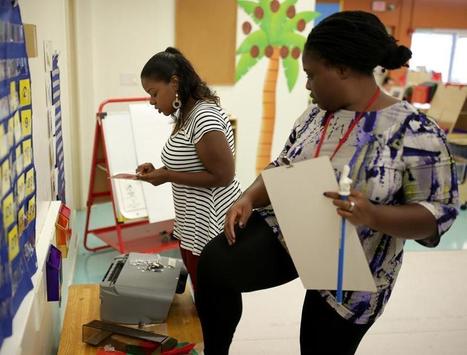
The BPS program, which allows both native and non-native speakers to learn in English and Creole, will be one of the few nationwide.
Scoop.it!

Published by the Orange County Register, August 29, 2017
Scoop.it!

From
wwlp

Published by WWLP.COM, August 25, 2017
A state proposal would allow English language learners to participate in bilingual education programs in Massachusetts public schools.
Scoop.it!
Published by the Minnpost.com, August 21, 2017
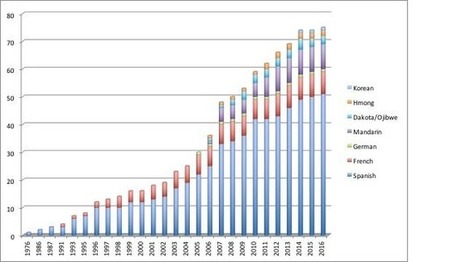
As immigrant communities continue to grow across the state — and as awareness of the need for more globally minded, multilingual employees in the local economy expands — more and more districts are looking to establish immersion programs.
Research has long shown the benefits of language immersion on student learning. But for some immigrant advocates, it’s increasingly become a matter of equity. Offering immigrant students an immersion experience — as opposed to a stand-alone elective language class — sends the message that schools truly see the value of their native language, some advocates say. In the Osseo Area Schools district, for example, parents are gearing up to advocate this fall for the adoption of a handful of dual language programs. Reflective of student demographics, that wish list will likely include languages that aren’t typically taught in school immersion programs, like Somali, Hmong and Vietnamese.
Scoop.it!

Published by the Seattle Times, August 14, 2017
As part of a larger bill to expand dual-language programs in the state, the Washington Legislature approved a $400,000 grant program to help school districts recruit bilingual high-school students to become future bilingual teachers and counselors.
Scoop.it!
Published by the San Francisco Chronicle, Aug 1, 2017 (THE CONVERSATION) by Catherine Snow, Harvard University
A recent report from the American Academy of Arts and Sciences calls for more attention to language teaching in the U.S. The report notes that U.S. students have much less access to foreign language instruction than students in other economically developed countries, and that Americans are thus much less likely to be bi- or multilingual.
In my view, it’s ironic that we have students walking up staircases at one end of their school building to attend Spanish foreign language classes while at the other end of the same building native Spanish speakers are being taught English and content in ways that lead to their loss of Spanish.
Too many Americans accept the claim that foreign language instruction is a dismal failure, that a very large percentage of students will never become fluent in another language and that investing in foreign language learning is likely to be a waste of time. Others might seek it out by volunteering in refugee centers or programs serving immigrant youth, or by seeking digital contacts with native speakers. [...] programs typically recruit kindergartners and build second language skills by teaching content through the second language. With such opportunities to improve foreign language instruction, let’s not give up on it entirely – let’s figure out how to complement it with the experiences that enable students to exploit it optimally! Via Dual Language Education of New Mexico
|
Scoop.it!

Published by the Metrowest Daily, November 15, 2017
FRAMINGHAM — Students entering the Potter Road Elementary School will begin receiving their lessons in a combination of Portuguese and English next year.
The school district announced Wednesday that it will launch a dual language Portuguese program for students in kindergarten and grade one during the 2018-2019 academic year.
Officials say the initiative will promote the school’s philosophy of creating an environment that values diversity. Details about the program are set to be released during informational meetings in early December, according to the announcement.
“Potter Road Elementary School is committed to providing all students with a challenging standards-based curriculum and to establishing relevant connections between classroom experiences and real life situations,” the announcement reads. “Ms. Paula Del Prete, Principal of Potter Road Elementary School, Mr. Lawrence Wolpe, Assistant Principal and their staff have been working closely with the Bilingual Department to strengthen the school culture and to establish productive partnerships.”
Close to 43 percent of students in Framingham’s 14 public schools speak a first language other than English, according to state data. That number is slightly higher at Potter Road, where about 45 percent of the roughly 500 students enrolled in the Northside school are learning English.
With a sizable population of Brazilian immigrants living in Framingham, Portuguese is among the most common languages spoken in local schools, followed by Spanish.
Framingham currently offers a similar two-way bilingual education program in Spanish and English at Barbieri Elementary School. Beginning in kindergarten and continuing in grade one, students spend 80 percent of their day learning in Spanish and 20 percent in English. The ratio shifts toward English in later years, and special subjects such as art, music and physical education are always taught in English.
Scoop.it!

Published by KTRE, November 14, 2017
The Lufkin ISD School Board and the president of the State Board of Education went back to elementary school Tuesday, and leaders said Burley Primary School isn't your typical kindergarten.
Tuesday's visit from President Donna Bahorich was just one stop in her tour of a total of nine schools, across Texas. However, Bahorich said this day was definitely one to remember.
"What I saw was intensive instruction in both languages, so that you do achieve that true bi-literacy for all students," Bahorich said.
Bahorich's presence at Burley also brought up the topic of a senate bill, passed in May, that allows elementary-level, dual language participation to count toward high school credits.
"I think it's a terrific opportunity," Bahorich said. "It's an additional opportunity, and it recognizes the value and the benefit of these dual language programs."
Betsy Mijares, the principal of Burley Primary, said that she thinks the program offers more than opportunity.
"To be bilingual and into those things in the medical field or surgeons," Mijares said. "It's just more marketable and it gives them an opportunity to grow in the career, they make more money. And, opportunity for scholarships as well. It gives them a better background."
The dual language program has shown years of success, starting 25 years ago, said LISD Superintendent LaTonya Goffney.
"I know a lot of colleagues are implementing these programs now because they see the necessity of it," Goffney said. "But, the fact that their was a visionary leadership even then, to implement a program just makes the manifestation of what we have now even greater."
Scoop.it!
Published by the Madera Tribune, October 4, 2017
Madera Unified School District has embarked on what Superintendent Todd Lile is calling “a new era” in local education.
Scoop.it!

Published by the Navajo-Hope Times, October 3, 2017
Educators and parents from across the Navajo Nation convened in Flagstaff for the 5th annual Johnson-O’Malley (JOM) Subcontractors Conference. The conference was held in the High Country Conference Center at Northern Arizona University.
Johnson-O’Malley is a federally funded program that supplements regular standard educational programs to address the unique needs of Native American students. The Navajo Nation, through the Department of Diné Education, contracts the program from the Bureau of Indian Affairs. The Nation then sub-contracts services with individual schools and districts, serving Navajo students, within the states of Arizona, New Mexico and Utah.
The explicit vision of the program is for Navajo students to attain proficiency in the Navajo and English languages, to maintain a balanced Hozho and to prosper in an independent, sovereign nation.
Some of the programs available, with JOM financial support, include: at risk counseling; bilingual teaching assistants; tutoring; home school liaisons; summer schools; Native curriculum development; and Native language, culture, history and government.
The programs are implemented with active parental involvement through local Indian education committees.
“The theme of our conference this year was Growing With Our Teachings,” said Eleanor Thomas, program manager, for the Navajo Nation’s Johnson-O’Malley Program. “We addressed some important issues such as updated information on the JOM Program and on language, culture and history, which affects Navajo life. Providing technical assistance to parents is one of our most important tasks.”
Scoop.it!

Published by the East Bay Times, September 21, 2017
After fifth grade, one of every four students in the Oakland Unified School District leaves for a charter, private school, or a campus in another city, often because their parents aren’t satisfied with the quality of education. Some parents opt for home schooling.
Scoop.it!

Published by Tucson.com, September 19, 2017
Until the legislature repeals the English-only policy TUSD should invest in bilingual programs for all students.
Scoop.it!

Published by Online Athens, Septemberf 6, 2017
One year in, a dual-language immersion program at Clarke County’s Oglethorpe Elementary School has parents knocking on the door to get their children in.
Scoop.it!
Published by Telegram.com, September 2, 2017
SOUTHBRIDGE - Some lessons appeared routine enough as classes resumed last week at Eastford Road School, a prekindergarten to Grade 1 building.
Scoop.it!

Published by the Middletown Transcriipt. August 29, 3017
Delaware has developed a certificate of multiliteracy to honor and recognize students with high levels of language proficiency in addition to English, Secretary of Education Susan Bunting announced Aug. 29.
The certificate applauds students for attaining high levels of language proficiency in multiple languages and also values native language proficiency for the 11,000 English learners in Delaware. Students can use the certificate as a credential to help differentiate them as applicants for jobs, college entrance or the military.
Scoop.it!

Publishedd by EdSource, August 24, 2017
As an initiative approved by California voters last November clears the path for districts to increase opportunities for students to become fluent in more than one language, the Fresno Unified School District is creating an educational track that will provide dual language instruction from preschool through 12th grade.
The goal of the program is for English learners and native English speakers to start mastering two languages earlier in their school careers, and to maintain those skills through classes at every grade level. .
Scoop.it!

Published by the Los Angeles Times, August 14, 2017
At Mountain View Elementary School in Tujunga about three-fourths of the population is of Armenian heritage. Parents have been looking for years for a way to pass on the language and culture to their children.
Scoop.it!

Published by CoastalView.com, August 10, 2017
The first two Dual Language Immersion classes in the Carpinteria Unified School District will begin with 48 kindergarteners at Canalino School on Aug. 22. Comprised of eight native Spanish-speaking students, eight bilingual students and eight native English-speaking students each, the two classes will be conducted 90 percent in Spanish the first year and decrease annually by 10 percent Spanish until it’s 50/50 in the fifth grade.
|




