Three terms that I hear being misused often by IT professionals new to the industry are “fault tolerance”, “high availability”, and “disaster recovery”. Here are some pictures that can help

 Your new post is loading...
 Scoop.it! Three terms that I hear being misused often by IT professionals new to the industry are “fault tolerance”, “high availability”, and “disaster recovery”. Here are some pictures that can help 
No comment yet.
Sign up to comment
Scoop.it!

Over the years, because of the competitive advantage that technology brings to Google, the company has been very secretive about its servers, storage, and networks. But every once in a while, though, Google gives the world a peek at its infrastructure and, in a certain sense, gives us all a view of what the future of the datacenter will look like.
Scoop.it!

Organizations such as Google, Amazon and Facebook posses sheer size, scale and distribution of data that pose a new class of challenges for networking, one which traditional networking vendors cannot meet.
Mickael Ruau's insight:
Google has been an advocate of SDN for quite some time, and is a member of the Open Networking Foundation (ONF), a consortium of industry leaders such as Facebook, Microsoft, Deutsche Telecom, Verizon and of course Google, promoting open standards for SDN, primarily the OpenFlow project which Google fully adopted. SDN and network virtualization have been major trends in the networking realm, especially with cloud-based deployments with their highly distributed, scalable and dynamic environments. All major cloud vendors have been innovating in their next gen networking. Most notably, Google has been actively competing with Amazon on driving its cloud networking to next gen, where Google presented its Andromeda project for network virtualization.
Scoop.it!

Facebook's enormous scale comes with enormous technological challenges, which go beyond conventional available solutions. For example, Facebook decided to abandon Microsoft's Bing search engine and instead develop its own revamped search capabilities. Another important area is Facebook's massive networking needs, which called for a whole new paradigm, code named data center fabric.
Mickael Ruau's insight:
Facebook made the design of “6-pack” open as part of the Open Compute Project, together with all the other components of its data center fabric. This is certainly not good news for Cisco and the other vendors, but great news for the community. You can find the full technical design details in Facebook’s post. Faceook is not the only one in the front line of scaling challenges. The open cloud community OpenStack, as well as the leading public cloud vendors Google and Amazon also shared networking strategies to meet the new challenges coming with the new workloads in modern cloud computing environment.
Scoop.it!
We’ve compiled our coverage of Apple’s data center expansion projects into a series of Frequently Asked Questions. Here’s the Apple Data Center FAQ (or “Everything You Ever Wanted to Know About Apple’s Data Centers”).
Scoop.it!
Le terme Network Fabric, littéralement un réseau "en étoffe" ou "en tissu", décrit une topologie de réseau dans laquelle des composants se transmettent des données via une matrice de commutation et sont donc directement connectables les uns avec les autres. La métaphore du « tissu » (« Fabric » en anglais) illustre l'idée que si ces composants réseaux et leurs relations étaient représentés sur une feuille de papier, la densité des lignes et de leurs croisements seraient telle que le schéma ressemblerait aux fils d'un métier à tisser qui, eux aussi, se croisent en permanence. L'origine des Fabrics se trouve dans les matrices de commutation téléphonique où chaque point vertical peut communiquer directement - ou quasi-directement - avec chaque point horizontal du réseau. En informatique, le terme Fabric est synonyme de "matrice". Les réseaux Mesh sont un type particulier de Network Fabric.
Scoop.it!
Jeffrey DeanVous pouvez partager vos connaissances en l'améliorant () selon les recommandations des projets correspondants. Jeffrey Adgate Jeff Dean (1968 - ) est un scientifique et ingénieur informaticien américain. Il est actuellement vice président chez Google. Il est notamment connu pour avoir créé le patron d'architecture MapReduce et avoir travaillé sur le système de stockage BigTable. En date de 2014, il est impliqué dans le projet Google Brain1. Jeffrey Dean est lauréat, avec Sanjay Ghemawat, du prix ACM-Fondation Infosys en informatique de 2012 « pour leur leadership dans le traitement scientifique et l'ingénierie des systèmes distribués à l'échelle de l'Internet ».
Scoop.it!

Proxy Server - Proxy server is an intermediary server between client and the internet. Proxy servers offers the following basic functionalities:
Scoop.it!

When working on new products, here's one hack I've used to avoid over-architecting for scale in the early stages but keeping teams focused on same goal. Shorthand is 1:10:1001: Do the minimum work involved to pilot the product in its most minimal form, supporting it manually or in a manner that wouldn't be economically sustainable…
Scoop.it!
This is basically a "lessons learned" talk. While dealing with resilient software design for several years meanwhile, I realized along the way that implementing a specific pattern like timeout detection, circuit breaker, back-pressure, etc. is the smallest of the challenges. As so often in software development, the actual pitfalls that keep you from being successful with your project - here, creating a robust application - are not to be found in the area of creating code. Based on my experiences, the actual pitfalls are to be found in areas that are at best loosely related to resilient software design.
Mickael Ruau's insight:
In this talk, I discuss some of those pitfalls that I have experienced more than once along my way. It starts with not understanding the goals of resilient software design, continues from a lack of understanding the characteristics of distributed system, over missing required feedback loops and deficiencies in functional design, to not understanding the trade-offs of applying resilience patterns, and ends with the problem of our continuous collective insight loss.
Scoop.it!

Getting an architectural artifact translated into a practical system implementation has always been problematic, but it doesn’t have to be. Via Emeric Nectoux
Scoop.it!
The goal of this paper is to study and define the concept of "antifragile software". For this, I start from Taleb's statement that antifragile systems love errors, and discuss whether traditional software dependability fits into this class. The answer is somewhat negative, although adaptive fault tolerance is antifragile: the system learns something when an error happens, and always imrpoves. Automatic runtime bug fixing is changing the code in response to errors, fault injection in production means injecting errors in business critical software. I claim that both correspond to antifragility. Finally, I hypothesize that antifragile development processes are better at producing antifragile software systems.
Scoop.it!

When stressed at the right level, a muscle or bone wold come back stronger. But can a software system be antifragile? Certainly there are some tools, platforms, architectural styles, methodologies that can help create software with antifragile characteristics. Let’s see some of the more popular ones.
|
Scoop.it!
Mickael Ruau's insight:
Venue
Authors
Research AreasPublication Year
Scoop.it!

Composable disaggregated infrastructure complements virtualization and SDI technologies to provide the efficiency and agility that today’s hyperscale data centers demand
Mickael Ruau's insight:
CDI virtuesIn a CDI-enabled data center the individual compute modules, non-volatile memory, accelerators, storage, etc. within each server are disaggregated into pools of shared resources — so they can be managed individually and collectively under software control. The disaggregated components can then be reconstituted, or composed, under software control, as workload-optimized servers irrespective of which racks the components happen to physically reside in. Studies show CDI can achieve TCO gains of up to 63 percent (55 percent capex, 75 percent opex) and technology refresh savings of 44 percent capex and 77 percent labor. These savings result from:
Facebook, Google, and other tier one Cloud Service Providers (CSPs) are actively investigating disaggregated architectures for their data centers. Some of their implementations are custom and most use proprietary software and APIs. To match the gains of the largest CSPs, organizations that don’t have the scale of a Google or Facebook need commercial off-the-shelf CDI solutions that anyone can adopt. The commonality of open technology standards will help the industry to achieve scale and make CDI generally available from a choice of suppliers.
Scoop.it!
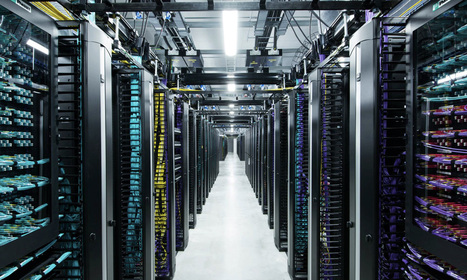
Facebook’s production network by itself is a large distributed system with specialized tiers and technologies for different tasks: edge, backbone, and data centers. In this post, we will focus on the latest developments in our data center networking and unveil the next-generation architecture that we have successfully deployed in our new Altoona facility: data center fabric.
Scoop.it!

Google Data Center FAQ & Locations. Google data centers are the object of great fascination, and the intrigue about these facilities is only deepened by Google's secrecy about its operations. We've written a lot about Google's facilities, and thought it would be useful to summarize key information in a series of Frequently Asked Questions
Scoop.it!

From
www

Ces dernières années les équipementiers réseaux orientent leurs produits de coeur de réseau vers les architectures « Switch Fabric ». A quoi correspond cette cette topologie? Juniper, Cisco, les grands noms proposent des solutions basés sur cette architecture avec comme arguments de ventes: l’architecture extensible, la performance, l’administration simplifiée.
Scoop.it!
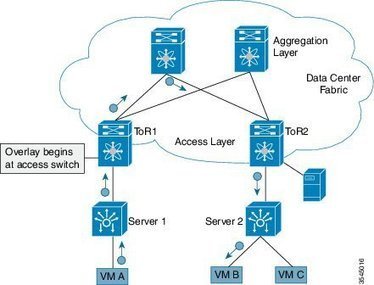
Dans un précédent article nous avons présenté VLXAN. STT, NVGRE et GENEVE sont d’autres exemples de protocoles d’encapsulation qui permettent de construire un overlay (à la manière d’IPSEC dans certains déploiements de Kubernetes sur un Cloud public) pour des réseaux de type SDN. Un point d’attention particulier est la façon dont les points de terminaison (VTEP : VXLAN Tunnel EndPoint) découvrent leurs pairs et renseignent la table de correspondance (ou mapping) @MAC <=> VTEP.
Mickael Ruau's insight:
Cisco fournit un ebook gratuit sur ce large sujet (A Modern, Open, and Scalable Fabric: VXLAN EVPN). Les autres constructeurs (par ex Arista, Juniper) ou bien éditeurs commerciaux (par ex. VMWARE NSX, plus exactement au niveau des Edge) ou OpenSource (ex Quagga et Cumulus Linux) supportent également BGP EVPN.
Contrairement aux schémas précédents issus de la documentation Cisco, dans les déploiements que nous effectuons en Cloud Public, comme dans la plupart des cas réels, la fonction VTEP est directement portée par l’Hyperviseur, soit nativement soit par le biais d’un container (exemple direct de NFV).
Scoop.it!
Using Vodalys (a specialist in mounting and streaming) as an example, find out how to deploy and orchestrate applications using containers in Kubernetes. The principle behind Kubernetes is to offer you scalability and transparent updates.
Scoop.it!

I gather here all the templates I built about system and software development process. I sort them according to the main tasks found in software development process:
Update july 2015: I added at the end of this page the templates for validation of software QMS tools and software in production equipment.
Scoop.it!
This slide deck basically tries to address functional service design not only from a maintainability point of view, but also form an operational point of view. How to spread your business functionality across your service landscape to maximize availability and responsiveness?
It starts with the observation that virtually all system landscapes these days, including cloud-native, are distributed systems. Due to the failure modes of distributed systems every remote communication basically is a predetermined breaking point of your system.
Scoop.it!
CODE LIKE A NINJA THE LISKOV SUBSTITUTION PRINCIPLE
Scoop.it!

An architecture decision record (ADR) captures a single design decision in a markdown file stored close to the code relevant to that decision. ADRs are lightweight and easy to use but require practice to use well.
This experience report shares lessons from the WIRE team, who have used ADRs to document design decisions for nearly two years as it worked to create microservices for the IBM Watson Discovery Service.
Mickael Ruau's insight:
ADRs can be used to teach design thinking, share decisions broadly, and as a mechanism for involving more people in the architecture design process.
Scoop.it!
From
arxiv
The goal of this paper is to study and define the concept of "antifragile
|