Devops for Growth
120.7K views | +2 today
Devops for Growth
For Product Owners/Product Managers and Scrum Teams: Growth Hacking, Devops, Agile, Lean for IT, Lean Startup, customer centric, software quality...
Curated by Mickael Ruau
Your new post is loading...

Popular Tags

Current selected tag: 'Conduite du changement'. Clear
Scooped by Mickael Ruau
July 11, 2019 4:51 AM
Scoop.it!

Votre antisèche pour vous orienter dans les théories du changement

Votre antisèche pour vous orienter dans les théories du changement | Devops for Growth | Scoop.it

La conduite du changement reste un art incertain, que diverses théories se proposent de codifier. Elles suggèrent des grilles de lecture pour décrire une réalité éminemment complexe, mouvante, chaotique : celle de la dynamique des organisations. « Planned change », « approche systémique », « capacité d’apprentissage organisationnel »… Que peuvent donc apporter ces doctrines au manager opérationnel ? Dans ce billet, nous en proposons un rapide survol, sans autre prétention que d’offrir un « mode d’emploi » des discours experts auxquels tout manager ne manquera pas d’être confronté.

No comment yet.
Scooped by Mickael Ruau
July 9, 2019 4:30 AM
Scoop.it!

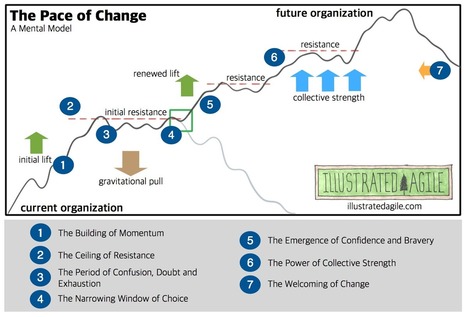
The Pace of Change ·

The Pace of Change · | Devops for Growth | Scoop.it

The Welcoming of Change

The organization has finally arrived. Not to a destination but to a whole new way of thinking about change. While exhausting and challenging at times, new change muscles have been developed by working through meaningful issues together.

Now, when the inevitable challenge come knocking on our door, we can look it straight in the eyes and say, “Hey, we’ve tackled much harder things than this!”

When we fall back to old habits we catch ourselves and correct them. When the competitive landscape changes we can recognize it quickly and swarm around fresh opportunities. When some begin to tire or struggle, we naturally pick them up. When even newer ways of working are discovered we introduce them seamlessly with minimal stress.

Change is no longer traumatic but welcomed.

No comment yet.
Scooped by Mickael Ruau
June 17, 2019 9:17 AM
Scoop.it!

re:Work - Changing the change rules at Google

re:Work - Changing the change rules at Google | Devops for Growth | Scoop.it
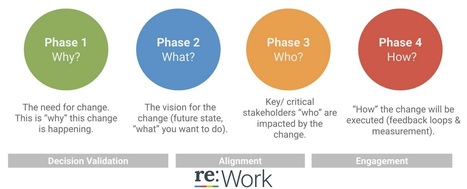
At Google, change is constant. But how we managed and messaged change wasn’t always working. So we developed a simple framework to rethink reorgs and it starts by asking “Do we even need this change?”
Mickael Ruau's insight:


But once you decide to make a change, how do you make it stick? When we use this framework, we do three things to “give legs” to change efforts and improve outcomes:

  1. Start with the “why” and “what.” As one of our leaders said, “Change is constant, but this framework allows us to test and clarify strategic business decisions before they are finalized.”
  2. Go slow to go fast. As early as possible, involve employees in creating solutions, rather than just sharing decisions, and you’ll front load the toughest conversations and make it easier to bring everyone along.
  3. Commit to landing, not just launching. Be sure you’re focused on effecting the change, not just announcing it. This will serve you in the long term because for more and more industries, change is constant.
No comment yet.
Scooped by Mickael Ruau
June 14, 2019 5:55 AM
Scoop.it!

Prenez de meilleures décisions avec le Nemawashi

Le Nemawashi et le management traditionnel Avec le management traditionnel :

* Les projets sont définis par la direction et sont mis en œuvre par les différents échelons de votre entreprise.

* Les décisions importantes sont prises en considérant principalement la voix de la direction.

* L’écoute des autres opinions est perçue comme une étape qui retarde le passage à l’action.


Avec le Nemawshi :

* Les décisions sont prises au *niveau opérationnel* et remontent ensuite votre *structure organisationnelle* .

* Les décisions sont le fruit d’un consensus où toutes les opinions sont considérées.

* L’écoute des autres opinions est perçue comme un gage de qualité qui améliore la décision qui sera prise.


Mickael Ruau's insight:

En japonais, Nemawashi signifie « tourner autour des racines » en référence aux soins qu’il faut apporter aux racines d’un arbre quand vient le temps de le planter. Le Nemawashi est un processus de communication visant à écouter et à prendre en compte les opinions d’un maximum de *parties prenantes* pour formuler votre décision.

(...)

Les 5 étapes du Nemawashi

1. Faites une *analyse des parties prenantes* .

2. Déterminez vos *cercles d’influence* et consultez les parties prenantes qui font partie de vos cercles de contrôle et d’influence.

3. Faites remonter les opinions et les préoccupations que vous avez recueillies à la direction.

4. Utilisez le *processus de pensée A3* pour définir et planifier la mise en œuvre de votre décision.

5. Utilisez également l’A3 pour communiquer la décision aux parties prenantes. Vous fermerez ainsi la boucle de communication.

No comment yet.
Scooped by Mickael Ruau
June 7, 2019 3:52 AM
Scoop.it!

Gestion du changement : les pièges à éviter

Gestion du changement : les pièges à éviter | Devops for Growth | Scoop.it

A l’heure de la transformation numérique, les modèles organisationnels et les modes de travail évoluent mais aucun changement ne peut être bien mené sans accompagnement des salariés. Ni sans une compréhension des enjeux et des différents facteurs qui entrent en ligne de compte pour permettre au changement de se réaliser.

No comment yet.
Scooped by Mickael Ruau
May 29, 2019 10:24 AM
Scoop.it!

Google - Site Reliability Engineering

Google - Site Reliability Engineering | Devops for Growth | Scoop.it

Note that the term change management has two interpretations: organizational change management and change control. This chapter examines change management as a collective term for all approaches to preparing and supporting individuals, teams, and business units in making organizational change. We do not discuss this term within a project management context, where it may be used to refer to change control processes, such as change review or versioning.

No comment yet.
Scooped by Mickael Ruau
March 7, 2019 3:59 AM
Scoop.it!

La stratégie des « petits pas »

La stratégie des « petits pas » | Devops for Growth | Scoop.it
Vous avez probablement souligné dans les articles précédents que la dernière question à se poser pour accroitre ses chances de réussir un projet personnel ou un changement collectif est : « que vais je faire dès demain? » ou « Qu’allons nous faire la semaine prochaine? » Je fais ainsi mienne l’idée que les meilleurs changements commencent par des résultats immédiats.... Lire la suite de
Mickael Ruau's insight:

Cinq conseils pour favoriser l’engagement de vos équipiers

1-Annoncer en public

Il est plus engageant de faire quelque chose sous le regard d’autrui que dans l’anonymat. Par exemple en annonçant ce que nous allons faire et quels sont les résultats attendus à court terme pour réussir le projet à plus long terme.

2- Répéter

Le fait de répéter un acte est plus engageant que de le faire une seule fois. Par exemple, vous confiez à un équipier une tâche exceptionnelle une seule fois. Une fois celle ci réalisée, vous lui annoncez : « maintenant que tu l’as fait pendant une semaine, tu peux bien continuer ».

3-Donner un caractère irréversible aux actes

Plus les personnes perçoivent qu’elles ne pourront pas faire marche arrière, plus elles  s’engagent. Par exemple, si vous souhaitez que vos équipiers d’approprient un nouveau logiciel de gestion, commencez par des applications faciles à réaliser et surtout, déconnectez les versions antérieures.

4- Commencer par des actes non coûteux

Pour avoir toutes les chances d’être accepté, un acte coûteux doit être précédé d’un acte moins coûteux. Aussi, pour faire accepter un acte moins coûteux, il est préférable d’amener préalablement les personnes à refuser un acte très coûteux. Par exemple , vous commencez par demander : « peux-tu prendre la responsabilité de ce projet pendant un an ? » Face à un éventuel refus ajouter: « Ok, cela ne te coûte rien de tester cette responsabilité seulement deux semaines. »

5- Susciter le sentiment de « bon vouloir »

Plus la personne se voit libre de faire ou de ne pas faire, plus elle fera. La simple évocation de ce sentiment par le manager : « vous êtes libre de … » amènent davantage les personnes à accepter l’acte.

Les petits ruisseaux faisant de grandes rivières, une succession de petits pas permet de réussir de grands projets. Ils assurent aussi la survie lors de situations catastrophiques. Chacun se consacre à de petites tâches à accomplir. Des survivants en montagne ou dans le désert, par exemple, expliquent qu’ils se sont d’abord fixés un cap, puis avancé en comptant les pas comme suit : « un pas pour maman, un pas pour papa, un pas pour tante Aline, etc. »

No comment yet.
Scooped by Mickael Ruau
February 12, 2019 6:25 AM
Scoop.it!

Appreciative Inquiry [3/6] : Comment impliquer les participants dans votre changement ? [Principe de Constructionnisme]

Appreciative Inquiry [3/6] : Comment impliquer les participants dans votre changement ? [Principe de Constructionnisme] | Devops for Growth | Scoop.it
Apprecative Inquiry : Découvrez comment utiliser le prinicipe de Constructionnisme pour engager les acteurs de votre changement
No comment yet.
Scooped by Mickael Ruau
January 29, 2019 2:24 AM
Scoop.it!

Scrum Alliance Webinar Replays - System Thinking for Transformative Change

Scrum Alliance Webinar Replays - System Thinking for Transformative Change | Devops for Growth | Scoop.it

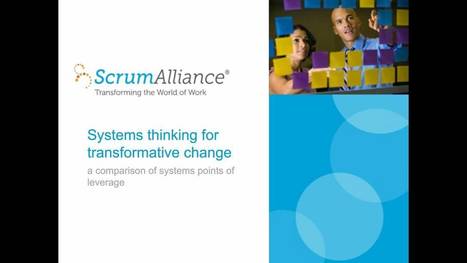
An organization’s culture often gets blamed for lack of transformation success. To address this issue, this session focuses on a systems view to organization transformation.

A small shift in one thing can produce big changes in everything. Consequently, the higher the leverage point, the more the system will resist changing it. Direct attempts at changing organizational culture don’t work; they lead to many haphazard attempts at behavior change but don’t result in lasting transformation within the organization. Many leaders attempt to shift organizational behavior but neglect underlying structures that give rise to dysfunctional behavior.

We compare and contrast different systems’ leverage points to draw distinction between leaders’ actions and, more importantly, mindset towards organizational transformation. Introduction to various systems thinking models with colorful examples from real world coaching situations will help you to think through your transformation challenges and help you learn why culture change is free when you replace willpower with knowledge.

Mickael Ruau's insight:

In this talk, we will cover the following topics:
1. What can nature teach us about transformations?
2. Culture vulture, strange loop, and Shu-Ha-Ri trap
3. Systems 12 points of leverage
4. Compare and contrast: "constants, parameters, and numbers" vs. "structure of information flows
a. "Dysfunctional measurement systems and compelling feedback loops
5. Compare and contrast: "Rules of System" vs. "power to self-organize system structure"
a. Fear and blame and psychological safety
6. Compare and contrast: "goals of system" vs "mindset out of which system arises"
a. Paradox of progress and choice
b. Results pyramid
c. Kantor's team context model and Gardner's mindset
d. Importance of dialogue in learning together - Dialogic leadership model
e. Visioning strategies - Peter Senge

Learning Objectives
1. Learning about systems structure can help in predicting future behavior and events
2. Attempts to directly change culture are futile: Culture follows structure
3. Systems understanding of common Agile transformation pitfalls
4. Introduction to various systems thinking models


Download the webinar presentation.

No comment yet.
Scooped by Mickael Ruau
January 22, 2019 3:51 AM
Scoop.it!

Gérer le changement quand vos troupes s'y opposent

Gérer le changement quand vos troupes s'y opposent | Devops for Growth | Scoop.it
Mettre en place le changement est un enjeu complexe. C’est l’un des rares principes en management à faire l’unanimité. Il est difficile d’instaurer un changement, car les gens se sentent naturellement et physiologiquement
No comment yet.
Scooped by Mickael Ruau
February 22, 2018 3:32 AM
Scoop.it!

PopcornFlow : l’évolution continue

PopcornFlow : l’évolution continue | Devops for Growth | Scoop.it

Lors du dernier Lean Kanban France, les 3 et 4 Novembre 2015, Claudio Perrone a présenté PopcornFlow, un outil simple – néanmoins puissant – d’amélioration continue permettant d’introduire le changement rapide et d’aider à une meilleure prise de décision

No comment yet.
Scooped by Mickael Ruau
January 13, 2018 4:43 AM
Scoop.it!

Pilotage du changement/Gestion des contraintes du changement — Wikiversité

Pilotage du changement/Gestion des contraintes du changement — Wikiversité | Devops for Growth | Scoop.it

Le management de projet vise à conduire un projet à son terme en considérant les contraintes et en faisant face aux imprévus. Dans le domaine des systèmes d’information, un projet est défini comme une réponse organisationnelle à une situation donnée. Euro-méthode qui est un projet européen de définition d’un cadre contractuel pour les projets de SI, définit le changement de système d’information comme étant « toute forme de modification, amélioration, automatisation du système d’information, ce qui inclut le développement, la maintenance, la conception, la rétro-conception, l’installation de solution, etc. ». Nous allons étudier le changement de système d’information de type ERP (Enterprise ressource planning) en français progiciel de gestion Intégré).


No comment yet.
Scooped by Mickael Ruau
September 19, 2017 2:28 AM
Scoop.it!

Choosing the Right ERP Implementation Methodology for Your Company

In the last few years we have seen two different implementation methodologies emerge. When buying a new ERP system you should make sure you understand the
Mickael Ruau's insight:

This “turnkey” methodology is being used by SAP with their All in One (AI1) industry templates, and by Oracle with their Accelerator templates. The pre configured industry templates and this methodology allow them to offer a low cost implementation to compete with the Tier II vendors.

Here are the pro’s and cons of each method are:

Traditional
Pro

  • Customer lead process. The customer takes responsibility for the project
  • Requires less vendor consulting support
  • Puts responsibility on the business team to understand the system
  • Requires the customer to gain self sufficiency in knowledge and use of the ERP system

Con

  • Requires a high level of ERP competency within the customer team
  • Requires a greater commitment of time from the customer team

Turnkey
Pro

  • Can yield a faster implementation path (16 weeks compared to 26 to 40 weeks)
  • Company must adopt vendor’s best practice processes

Con

  • The total cost of ownership will be higher over time
  • Can result in higher on going support costs
  • Puts a responsibility on the vendor consultants to learn the customer’s business
  • The customer places a greater reliance on the vendor for a successful implementation

Choosing the right methodology for your company is important.

If your company has strong ERP competency, and the majority of your team has had previous ERP implementation experience (within 5 years), than the traditional model can apply. This approach places the responsibility for a success on your team.

If your company does not have experienced ERP users and the users have been using an older legacy system for many years, the turnkey model may be your best choice. This model is also attractive to companies that have downsized and have lean staff that will struggle with the added burden of implementing a new ERP system.

No comment yet.
Scooped by Mickael Ruau
July 9, 2019 8:41 AM
Scoop.it!

Comment accompagner le changement dans le moindre effort ?

Comment obtenir de puissants changements dans la transformation que vit mon entreprise... sans y perdre toute mon énergie !
No comment yet.
Scooped by Mickael Ruau
July 9, 2019 2:59 AM
Scoop.it!

L'art du Nemawashi, ou comment prendre des décisions consensuelles dans l'entreprise - Le Monde Informatique

L'art du Nemawashi, ou comment prendre des décisions consensuelles dans l'entreprise - Le Monde Informatique | Devops for Growth | Scoop.it

Le Nemawashi est très pratiqué dans les entreprises japonaises pour obtenir l'adhésion et l'engagement des salariés.

No comment yet.
Scooped by Mickael Ruau
June 17, 2019 2:35 AM
Scoop.it!

Hindsight is 20/20

Hindsight is 20/20 | Devops for Growth | Scoop.it
There has been a lot of change in my space in the past year. A lot of it hasn't been managed very well (which creates a lot of 'people noise'). I've been exposed to a number of change management models over the years, including ADKAR and this cool exercise. I quite liked this tool about Levers of Influence…
No comment yet.
Scooped by Mickael Ruau
June 13, 2019 5:55 AM
Scoop.it!

Lorsque j'étais chez Toyota, nemawashi était un terme aussi commun que kaizen — Wiki Agile du @GroupeCESI

Lorsque j'étais chez Toyota, nemawashi était un terme aussi commun que kaizen — Wiki Agile du @GroupeCESI | Devops for Growth | Scoop.it

Les Japonais utilisaient souvent des métaphores comme "préparer le sol" ou "creuser autour des racines" pour réussir une plantation ou une transplantation, certains disaient aussi "poser les fondations". Je le décris souvent comme obtenir un consensus ou obtenir le soutien des autres, partager des idées, ENGAGER et impliquer les personnes dans un processus centré la plupart du temps dans un contexte PDCA (Plan Do Check Act).

No comment yet.
Scooped by Mickael Ruau
June 4, 2019 3:13 AM
Scoop.it!

Breaking the Code of Change - HBS Working Knowledge - Harvard Business School

Breaking the Code of Change - HBS Working Knowledge - Harvard Business School | Devops for Growth | Scoop.it

Two dramatically different approaches to organizational change are being employed in the world today, according to our observations, research, and experience. We call these Theory E and Theory O of change. Like all managerial action, these approaches are guided by very different assumptions by corporate leaders about the purpose of and means for change. In effect these two approaches to organizational change represent theories in use by senior executives and the consultants and academics who advise them. By "theory in use" we mean an implicit theory that one can deduce from examining the strategies for change employed.

Instead of this halfhearted approach, managers are better off picking a pure model: a clear Theory E approach with its benefits and costs or a pure Theory O approach with its benefits and costs.

Mickael Ruau's insight:

Theory E has as its purpose the creation of economic value, often expressed as shareholder value. Its focus is on formal structure and systems. It is driven from the top with extensive help from consultants and financial incentives. Change is planned and programmatic.

Theory O has as its purpose the development of the organization's human capability to implement strategy and to learn from actions taken about the effectiveness of changes made. Its focus is on the development of a high-commitment culture. Its means consist of high involvement, and consultants and incentives are relied on far less to drive change. Change is emergent, less planned and programmatic.


Table I-1 summarizes the E and O approaches to organizational change. In the remainder of this chapter we will present Theories E and O in more detail and discuss their benefits and costs. These theories are archetypes. Certain companies, including Scott Paper and Champion International, about which we developed cases, seem to be pure cases of these archetypes. An examination of many other organizations will show a mixture of these strategies, often in uneasy coexistence. We argue that both theories have validity.

Table I-1 Theories E and O of Change Purpose and Means Theory E Theory O Leadership Top-down Participative Focus Structure and systems Culture Planning Programmatic Emergent Motivation Incentives lead Incentives lag Consultants Large/ knowledge-driven Small/ process-driven

No comment yet.
Scooped by Mickael Ruau
May 24, 2019 9:58 AM
Scoop.it!

Conduite du changement : 6 conseils pour éviter la saturation de vos collaborateurs

Conduite du changement : 6 conseils pour éviter la saturation de vos collaborateurs | Devops for Growth | Scoop.it

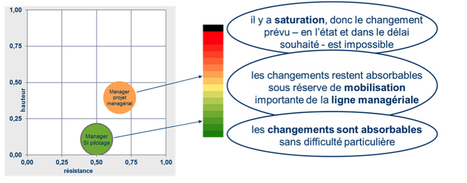
Avant de transformer une entreprise, mesurer la capacité des salariés à absorber le changement est indispensable.
Plus de mobilité, plus de digital, plus de verticalité.

No comment yet.
Scooped by Mickael Ruau
February 16, 2019 10:45 AM
Scoop.it!

Les bons réflexes pour s'adapter au changement

Les bons réflexes pour s'adapter au changement | Devops for Growth | Scoop.it
Pourquoi en situation de changement, certaines entreprises perdent de la valeur, alors que d’autres semblent rebondir, voire même sortir plus fortes de ce changement ? C’est ce à quoi je m’intéresse depuis maintenant une dizaine d’année, et ce que les sciences du management commencent à nommer Résilience Organisationnelle (RO).
No comment yet.
Scooped by Mickael Ruau
January 30, 2019 9:44 AM
Scoop.it!

Interest-Influence Grid

This is a useful map to help understand the need for communication and potential resistance to change. 'Interest' indicates their likely concern about change, whilst 'Influence' indicates their ability resist and hence stimulates your concern.

A way of using the grid is to put people's names on post-it notes and stick them on a wall-chart of the grid.

Mickael Ruau's insight:

Low interest, low influence

These are relatively unimportant people, but keeping in touch with them is a good idea, just in case their status changes.
High interest, low influence

These people can be difficult in that it is easy to ignore them as they apparently cannot derail the change, although if sufficiently upset they may gain influence by low-level blocking and other techniques of resistance to change.

Do remember that minorities can be very powerful, particularly if they band together or if they get powerful allies.
Low interest, high influence

People with a low interest in the change will not be particularly worried about what you are doing, so are are not too much of a problem in the actual change. A problem can appear when they are persuaded to act for those who oppose the change. It is thus important to keep them onside, for example with regular meetings that explain the truth of what is happening.
High interest, high influence

These people are both significantly affected by the change and most able to do something about it, either supporting or opposing changes. It is particularly important to engage these people in the change, ensuring both that they understand what is going on and also creating buy-in as they feel a sense of ownership of what is being done.

No comment yet.
Scooped by Mickael Ruau
January 25, 2019 2:19 AM
Scoop.it!

Four Types of Resistors When Adopting Agile

Four Types of Resistors When Adopting Agile | Devops for Growth | Scoop.it

While its important to confront resistance, be careful not to create an atmosphere of “us” against “them.” The real goal is to create a feeling that the transition to Scrum is inevitable and that, as the Borg of Star Trek taught us, “resistance is futile.” The need to foster this atmosphere does not give you carte blanche to ignore the feelings and reactions of employees or to steamroll Scrum into an organization. Instead, to paraphrase Nigel Nicholson in a 2003 article for the Harvard Business Review, when an employee resists, an effective leader looks at the employee not as a problem to be solved but as a person to be understood.

No comment yet.
Scooped by Mickael Ruau
January 18, 2019 10:46 AM
Scoop.it!

Conduite du changement : dissipons le grand malentendu !

Conduite du changement : dissipons le grand malentendu ! | Devops for Growth | Scoop.it
Pour transformer une organisation, l’accord des parties prenantes est un élément essentiel.

« Conduire le changement », ce n’est pas « faire changer » mais « changer ensemble ». Un contresens sur ce point voue irrémédiablement une transformation à l’échec. A quoi bon en effet s’échiner à faire bouger quelqu’un qui conteste l’existence d’un problème, en lui imposant une méthode qu’il récuse ? C’est pourtant bien à cela que se résument encore trop de projets de conduite du changement. Ces derniers contreviennent à un principe élémentaire ; pour qu’un changement advienne, il est nécessaire que les parties prenantes soient d’accord sur :

1- la nature du problème à résoudre

2- l’objectif à atteindre

3- la manière de passer d’une situation à l’autre

Accessoirement, il faut aussi qu’elles soient volontaires pour ce passage.
No comment yet.
Scooped by Mickael Ruau
January 20, 2018 4:45 AM
Scoop.it!

Les phases du projet d'implémentation d'un ERP

Les phases du projet d'implémentation d'un ERP | Devops for Growth | Scoop.it
Les phases du projet ERP et l'intervention des consultants ERP au cours de l'implémentation du progiciel
No comment yet.
Rescooped by Mickael Ruau from Communication gagnante
November 5, 2017 5:35 AM
Scoop.it!

Innovation : donner du sens au changement

Innovation : donner du sens au changement | Devops for Growth | Scoop.it
Blog sur : innovation, stratégie, marketing, développement personnel, changement, programme et projet, transversalité, organisations, management

Via Nicolas Calvo
No comment yet.