


IMPORTANT: Please enter $0 for the price. This is a FREE ebook and you do NOT need to enter your credit card.
My 7-step process to discovering the best startup opportunity for you

 Your new post is loading...
 Scoop.it! IMPORTANT: Please enter $0 for the price. This is a FREE ebook and you do NOT need to enter your credit card. 
No comment yet.
Sign up to comment
Scoop.it!
From
medium

The book provides hands-on instructions on how to go about customers, sales, marketing and building your company at different stages of your business. It can be dry at times, but looking back on it…
Scoop.it!

Recommendations from expert, Roman Pichler, that will help you improve your product management product discovery work.
Mickael Ruau's insight:
Focus on Problem Validation, not Solution Building Your product discovery work should focus on nailing the value proposition, target group, business goals, business model, and stand-out features of the product—not on writing user stories, designing the user interface, or building the actual solution. Your goal should be to mitigate the risk of building a product nobody wants and needs, not to figure out the product details. Having said that, it’s ok to address key UX and technology risks and evaluate important user interaction and architecture options as part of the discovery work. But the bulk of the UX design, user story writing, and technology work should be done after you have successfully validated the problem. To get your focus right, consider using a tool like my Product Vision Board to capture your idea, and identify assumptions and risks. Do Just-Enough Product Discovery Work Minimise the amount of time you spend on product discovery in order to accelerate time-to-market. You should aim to get a good enough product out as fast as possible, and then adapt it to the market feedback. There is no way to guarantee that the product strategy and business model are spot on, and that the new product or next version will be a success. But don’t rush the necessary work, and resist the temptation to jump start building the actual product. Explore the key assumptions and risks in your product strategy and business model by systematically testing and addressing them in an iterative fashion using, for example, observations, interviews, surveys, and prototypes. If you can’t confidently state why people are going to use your product, who those individuals are, what makes your product stand out from the crowd, and why it’s worthwhile for your business to develop and provide the product, then you are not in a position to build the actual solution. Instead, continue the discovery work (persevere or pivot), or stop and move on to another product idea.
Read more at: https://www.romanpichler.com/blog/product-discovery-tips/ Copyright © Pichler Consulting
Scoop.it!
ssentially, if you can validate your customer related assumptions then you have potentially found customers who will buy your product. Based on Customer Development Model created by Steve Blank In this article, you will learn 1) what is customer validation, 2) what assumptions you need to validate, 3) common mistakes businesses make during customer validation, and 4) the customer validation process.
Scoop.it!
Customer development - WikipediaCustomer development is a formal methodology for building startups and new corporate ventures. It is one of the three parts that make up a lean startup (business model design, customer development, agile engineering).
Mickael Ruau's insight:
HypothesesHypotheses are critical assumptions about how a business will work, and include assumptions about target market, pricing, and competitors.[5][18] Together, hypotheses make up the business model for a startup.[5][18] Testing hypotheses means that the founder has to “get out of the building” and answer three questions about the business:
Hypotheses can be tested in several ways. Creating an MVP is one way to quickly test mockups and ideas in the real world, especially with Web and mobile startups.[5][21] Hypotheses change as a result of testing and customer feedback.[5][17][18] The changed hypotheses are incorporated into new iterations of the startup business model.[5][17][18]
Scoop.it!

As pointed out by Eric Ries, a minimum viable product is that version of a new product which allows a team to collect the maximum amount of validated learning about customers with the least effort through a cycle of build, measure, learn; that is the foundation of the lean startup methodology.
Mickael Ruau's insight:
The Customer Development Manifesto moved around 17 principles:
Scoop.it!
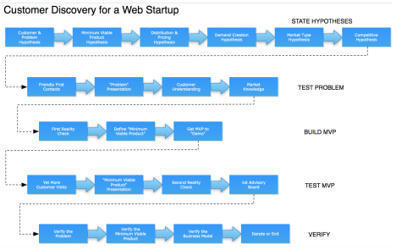
Customer Development is a technique startups use to quickly iterate and test each part of their business model. How you execute Customer Development varies, depending on your type of business. In my book, “The Four Steps to the Epiphany” I use enterprise software as the business model example. Ash Maurya, the CEO of WiredReach, has extended my work…
Scoop.it!
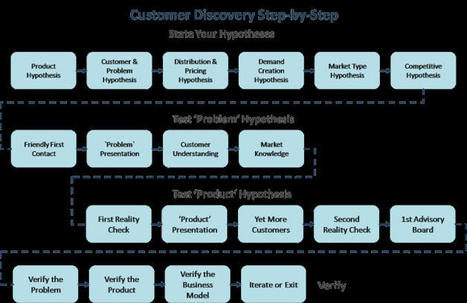
The 4 steps to the epiphany - Customer development - Customer Discovery part - ready-to-use templates - Guilhem Bertholet - guilhembertholet.com
Scoop.it!
The Entrepreneur's Guide to Customer Development
Scoop.it!
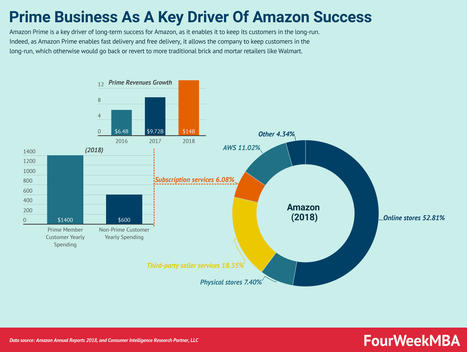
Amazon Prime is a key driver of long-term success for Amazon, as it enables it to keep its customers in the long-run. Indeed, as Amazon Prime enables fast delivery and free delivery, it allows the company to keep customers in the long-run, which otherwise would go back or revert to more traditional brick and mortar … Continue reading Why Amazon Prime Is The Key To Amazon Business Model Long-Term Success
Scoop.it!
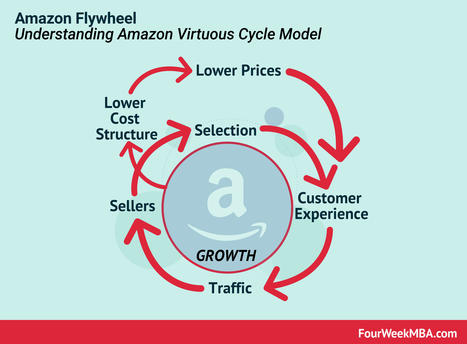
The Amazon Flywheel or Amazon Virtuous Cycle is a strategy that leverages on customer experience to drive traffic to the platform and third-party sellers. That improves the selections of goods, and Amazon further improves its cost structure so it can decrease prices which spins the flywheel.
Scoop.it!

Customer obsession goes beyond quantitative and qualitative data about customers, and it moves around customers' feedback to gather valuable insights. Those insights start by the entrepreneur's wandering process, driven by hunch, gut, intuition, curiosity, and a builder mindset. The product discovery moves around a building, reworking, experimenting, and iterating loop.
Scoop.it!

From
dzone
Understanding the customer acquisition cost (CAC) for your SaaS product is key to business success. Position your SaaS company to scale by reducing your CAC.
|
Scoop.it!

"In a startup no facts exist inside the building, only opinions." – Steve Blank Summary: In Four Steps to the Epiphany, Steve Blank lays out a customer development process that complements a startup's product development process. This post includes video and slides where Steve explains the ideas in his book. About a year and a…
Scoop.it!

Early-stage SaaS founder? You probably don't know where to focus on next. Read Hotjar's essential guide to grow your SaaS startup to the stratosphere.
Scoop.it!
Main Guides: Business Models Business Strategy Business Development Distribution Channels Marketing Strategy Platform Business Models Network Effects Main Case Studies: Amazon Business Model Apple Mission Statement Nike Mission Statement Amazon Mission Statement Apple Distribution More ResourcesWhat Is a Business Model? 54 Successful Types of…Eight Things You Need To Know About Business Model…Heuristics And Biases That … Continue reading 10 Fallacies In Business You Need To Know
Scoop.it!

Jim Semick shares advice on lean market validation. Quickly validate and bring your product to market with excited buyers from day 1.
Mickael Ruau's insight:
Scoop.it!
In the book “Traction: How Any Startup Can Achieve Explosive Customer Growth,” Gabriel Weinberg (DuckDuckGo Founder) and Justin Mares identified 19 channels for growth also known as traction channels: Targeting Blogs: niche blogs that you can leverage to get your product known to a very targeted audience. Publicity: or PR to get the word out about … Continue reading What Are The Key Traction Channels? Traction Channels In A Nutshell
Scoop.it!
Infographic PPT about starting, directing and scaling a startup, based on validated customer insights
Scoop.it!

When we build products, we use a methodology. For software, we have many - you can enjoy a nice long list on Wikipedia. But too often whe
Scoop.it!

Every startup journey begins with an idea. We have explored: Superforecasting: The Art and Science of Prediction, by Philip E. Tetlock and Dan Gardner to ensure you are picking the right idea and Predictably Irrational by Dan Ariely to help you on your journey. This week we review The Startup Owner’s Manual by Steve Blank and Bob Dorf to help you start to move your idea from concept to market.
Scoop.it!

Le product owner tient une place essentielle au sein d’un groupe de projet Scrum. Zoom sur son rôle et les compétences dont il doit faire preuve.
Mickael Ruau's insight:
Pour aller plus loin, téléchargez cet e-book pour développer votre processus d'implémentation client.
Scoop.it!

Today’s leading organizations are increasingly taking an agile approach to operations due to the myriad of benefits it provides. Here's how it has helped Amazon
Scoop.it!

Given stricter health guidelines in the wake of coronavirus, businesses that can quickly adapt will undoubtedly have a competitive advantage. That’s why building an engaged community around your business is now more important than ever.
Mickael Ruau's insight:
02. Think of Your Member JourneyFrom online stores to the service industry, your business’ end goal is to make a sale. Whether it’s a product, service, subscription—you name it. It’s important to keep your business offering in focus. While the customer journey varies depending on your business, it’s important to understand where your audience is at every touchpoint with your brand. Ask yourself the following questions:
Once you have a clear idea of how your customers think and feel when they interact with your business, you can kickstart conversations that address their needs. Doing your research and truly understanding your customer journey helps you shape meaningful dialogues and build rewarding relationships. Let’s see how this plays out with a real business that sells skincare products. It’s a rare case that people will start a conversation about skincare unless prompted. However, if you approach the conversation from the angle of “staying youthful” you’re bound to get people talking. Even the topic of “staying youthful” can spin off in many directions, or sub-communities (i.e., forever young, neverlanders, age ambiguous)—each with their own goals, motives and concerns. Now, you’re opening up an opportunity to introduce your product in a much more natural, personal way. Pay attention to the language your community uses when sharing their thoughts and align to them. While you want to position yourself and business as a thought leader, you need to stay true to the customers that actively engage with your products and services. This is the key to grabbing their attention and keeping them loyal to your business.
Scoop.it!

The general concept of Bootstrapping connects to "a self-starting process that is supposed to proceed without external input." In business, Bootstrapping means financing the growth of the company from the available cash flows produced by a viable business model. Bootstrapping requires the mastery of the key customers driving growth.
|





You read about Customer Development - but don't know where to startThis is perfectly normal - we all start here. By the end of Chapter 2 you WILL be doing Customer Development.
You read blogs ... but still don't understand the full processI will take you step-by-step from start to finish
.You tried Customer Development and gave upIt isn't you - this is very common. It turns out the real world does not work like the textbook examples. In Chapter 7 I will help you know what to expect.
You don't even know how to FIND customers TO developYep. This has happened to me too. It is especially common with technical founders like me. In Chapter 4 I show you a process for finding customers.
You don't know what to ask customers.The wrong questions are WORSE than no questions - I'll tell you how to identify the right ones and ask them.