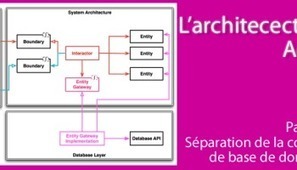
Après avoir lu Clean Code et Clean Architecture du même auteur, j’avais été déçu après la lecture du dernier. En effet, sur les 430 pages seulement quelqu’unes d’entres elles m’ont semblé…
On parle souvent des conteneurs comme un moyen d’accélérer les cycles de développement, mais ils permettent aussi de dérisquer (ou réduire les risques, si le néologisme vous fait grincer des dents ☺) les opérations de déploiement. Comment donc ? Grâce à un pattern sûrement familier à certain·e·s d’entre vous : les « infrastructures immutables ». Nous allons voir comment ce pattern réduit les risques, et comment les conteneurs le rendent accessible à des structures de tailles et de compétences variées.
An Introduction to Agile Emergent Architecture: Always Intentional Let’s Define Architecture By definition, architecture is about the major pieces of the system^1, and about satisfying the non functional requirements such as availability, usability, compliance, scalability, security, extensibility , maintainability, and all of the typical "ilities." It's important to remember that architecture does not cover anything…
Discover why the common ways of decomposition are flawed to the core and learn powerful and helpful techniques to leverage when designing a software system.
The creation of software diagrams has been scaled back as a result of the shift to agile methodologies. When diagrams are created, they are often confusing and unclear. The C4 model consists of a hierarchical set of software architecture diagrams for context, containers, components, and code. The hierarchy of the C4 diagrams provides different levels of abstraction, each of which is relevant to a different audience. Avoid ambiguity in your diagrams by including a sufficient amount of text as well as a key/legend for the notation you use.
Il est très fréquent de lire sur le web des assimilations de REST (Representational State Transfer) à un protocole simplifié qui se limite a généraliser l
Les systèmes logiciels sont sillonnés par les limites (Boundaries), le code de part et d'autre de ces limites est bien différent. Des exemples de limites son
La documentation des décisions d'architecture n'est généralement pas quelque chose d'évident. En l'espace de 5 minutes, je vous propose de vous présenter une solution efficace et légère : les ADRs.
Avec la transformation des entreprises, liée au développement du digital, les problématiques d’Architecture d’Entreprise suivent l’évolution des SI. Pour
The Twelve-Factor App methodology is a methodology for building software-as-a-service applications. These best practices are designed to enable applications to be built with portability and resilience when deployed to the web. The methodology was drafted by developers at Heroku, a platform-as-a-service company, and was first presented by Adam Wiggins circa 2011.
A number of commentators have argued that the relevance of the Twelve-Factor app concept is limited to Heroku.[3] The twelve factors are however cited as a baseline from which to adapt or extend.[4]
Les cinq caractéristiques suivantes sont fondamentales pour la conception d’une architecture évolutive :
Fonctions de qualité.Elles permettent d’indiquer à quoi ressemble l’architecture cible. A ce titre, elles varient considérablement d’une entreprise à l’autre. Certains systèmes nécessitent un très haut niveau de sécurité, d’autres une disponibilité élevée quand d’autres requièrent des temps de service donnés. Penser dès le départ aux fonctions de qualité permet de guider le processus décisionnel et le calendrier, et vous aide à préserver les exigences clés au fur et à mesure que le système évolue.
Dernier moment responsable.Traditionnellement, les décisions architecturales se prennent avant d’écrire un quelconque code. Dans une architecture évolutive, on attend le dernier moment responsable pour prendre des décisions. Pourquoi ? Parce qu’il existe probablement des informations plus détaillées à prendre en compte. La difficulté est toutefois de déterminer les décisions que l’on peut reporter. Ici, ce sont les fonctions de qualité qui doivent passer au premier plan.
Mettre le doigt sur les problèmes.Certaines choses sont plus difficiles à faire et peuvent poser de nombreux problèmes. Si vous les faites tôt et plus souvent, vous identifierez plus rapidement les problèmes qui en sont la cause. Plus vous les résoudrez, plus vous serez encouragé(e) à supprimer automatiquement ces problèmes.
La livraison continue.Elle permet de soutenir une pratique plus large de l’architecture évolutive, en introduisant deux nouveaux attributs architecturaux : la testabilité et la déployabilité. Dans une architecture testable, la plupart des défauts se décèlent à l’aide de tests automatisés. Dans une architecture déployable, vous pouvez déployer tel ou tel service sans orchestration ni temps d’indisponibilité conséquents. Cela permet également l’expérimentation et le test A/B, comme faire fonctionner plusieurs versions d’une même version en même temps.
S’organiser autour des capacités commerciales.La conception pilotée par le domaine permet de générer de la modularité au niveau du domaine plutôt qu’au niveau des couches techniques. Cela nécessite la mise en place d’équipes plurifonctionnelles par secteur professionnel et place les projets permanents et non plus les projets ponctuels au centre du processus. C’est vous qui bâtissez cette modularité, et c’est vous qui la gérez. Ainsi, il vous sera plus simple d’opérer des changements sans rupture suivant des limites clairement définies.
An architectural pattern is a general, reusable solution to a commonly occurring problem in software architecture within a given context. Architectural patterns are similar to software design patterns but have a broader scope. The architectural patterns address various issues in software engineering, such as computer hardware performance limitations, high availability and minimization of a business risk.
Many modern-day applications need to be built at an enterprise scale, sometimes even at an internet scale. Each application needs to meet scalability, availability, security, reliability, and…
TechAway n°13 - 06/04/2020 La création des services REST est la manière la plus populaire de connecter mes services. Mais, pourquoi pas prendre une alternative qui peut nous ouvrir beaucoup plus de possibilités et un peu plus de performance? Venez découvrir ou redécouvrir gRPC. On verra les bases de ce framework, ses avantages et comme l'utiliser avec un exemple concrète.
Note: The format of this article did not transfer over well from the previous site, so this pdf version might be much easier to read and distribute. Background We often coach organizations on scaling Scrum, where 4-12 Scrum Teams are working on the same Product or a set of closely related Products (Applications, Systems, etc).…
Master software architect Juval Lowy presents a simple design standard for software engineering, which will facilitate absorbing and adhering to correct design directives and guidelines.
Presented at NDC London (5th December 2014) Ralph Johnson defined architecture as "the decisions that you wish you could get right early in a project, but that…
Dans notre dernier Post sur l'Architecture basée sur les cas d'utilisation, nous nous sommes intéressés a la séparation du mécanisme de livraison et nous
Here are few pointers for Agile Engineering Effectiveness,
Coding practices to be aligned with Approach – Fundamental Definition of software has changed, 1980s – It was defined as a group of programs 1990s – It was defined as a set of components 2000 onwards – It is a set of Service (SaaS)
To align to this change, our development model should change from Structured System Analysis and Design (SSAD) to Object Oriented Analysis to Design (OOAD) to Service Oriented Analysis and Design (SOAD). Good Design – A key aspect before you start writing code is that test should not only test the functionality but also test the program structure as well for – adaptability, extendibility and reusability.
Follow “High Degree of Cohesion Less Degree of Coupling” – All related tasks to be put in one module and there should not be more than three parameters passed from one module to another.
Design Smells – Make sure your design doesn’t have following drawbacks:
Rigidity : The system is hard to change Fragility : Changes causes the system to break Immobility : It is hard to disentangle into reusable components Viscosity : Doing things right is harder than doing things wrong Needless Complexity : The design contains infrastructure that adds to no direct benefit Needless Repetition : Repetition of data and control, which can be abstracted and isolated Opacity : Hard to read and understand
Move beyond OOPs concepts, adopt SOLID Principles and follow Service Oriented Architecture (SOA). Below are the SOLID Principles, which help developers to eliminate design smells and build the best design.
Last week, I wrote about the mindset that computer systems can be understood, and behaviors can be explained, if we’re willing to dig deep enough into the stack of abstractions our software is built atop. Some of the ensuing discussion on Twitter and elsewhere lead me to write this followup, in which I want to run through a few classes of systems where I’ve found pursuing in-detail understanding of the system wasn’t the right answer. In these systems, detailed understanding of behaviors was either impossible, impracticable, or just a waste of time compared to other strategies for dealing with the system.
The Entity-Control-Boundary ( ECB), or Entity-Boundary-Control ( EBC), or Boundary-Control-Entity ( BCE) is an architectural pattern used in use-case driven object-oriented software design that structures the classes composing a software according to their responsibilities in the use-case realization. The Entity-Control-Boundary approach finds its origin in Ivar Jacobson's use-case driven OOSE method published in 1992,.
Robustness diagrams allow to visually represent the relation between entities, controls, boundaries and actors.[4] It uses graphical stereotypes introduced in Jacobson's early work:
Representation Relation with Role Symbol Actor Boundary Control Entity Actor Yes Yes No No Boundary Yes Part/whole Yes No Control No Yes Yes Yes Entity No No Yes Yes
The following robustness contraint apply:
Actors may only know and communicate with boundaries
Boundaries may communicate with actors and controls only.
Controls may know and communicate with boundaries and entities, and if needed other controls
Entities may only know about other entities but could communicate also with controls;
In principle entities should not know about boundaries and controls. In practice however, some variants allow entities, boundaries and controls to subscribe as observer to an entity.
Similarly, the constraint of a boundary class not knowing about another boundary classes only applies at the highest level, and not between classes that cooperate to implement the same boundary.
Relation to other architectural patterns
There is some similarity between ECB and Model-view-controller (MVC): entities belong to the model, and views belongs to boundaries. However the role of the ECB-control is very different from MVC-controller, since it encapsulates also use-case business logic whereas the MVC controller processes user input which would be of the responsibility of the boundary in ECB. The ECB control increases separation of concerns in the architecture by encapsulating business logic that is not directly related to an entity.[2]
The ECB can be used in conjunction with the hexagonal architecture, whenever the boundaries form the outer adapte layer.[10]
ECB is compatible with the clean architecture which merges ECB principles with other architectural design[11],.[12] Clean architecture places entities at the core, and surround them with a use-case ring (i.e. ECB control) and a ring with gateways and presenters (i.e. ECB boundaries). However, clean architecture requires a one-way dependency from outside to inside, which requires to split ECB controls into use-case logic and object coordination.
To get content containing either thought or leadership enter:
To get content containing both thought and leadership enter:
To get content containing the expression thought leadership enter:
You can enter several keywords and you can refine them whenever you want. Our suggestion engine uses more signals but entering a few keywords here will rapidly give you great content to curate.


 Your new post is loading...