


Scrube est un atelier agile pour fabriquer des cubes. Il permet de découvrir quelques concepts de l'agilité notamment les cérémonies de Scrum

 Your new post is loading...
 Your new post is loading...
Your new post is loading...
 Scoop.it!
Scrube est un atelier agile pour fabriquer des cubes. Il permet de découvrir quelques concepts de l'agilité notamment les cérémonies de Scrum 
No comment yet.
Sign up to comment
Scoop.it!
What do you need?
Scoop.it!

Découvrez un nouveau jeu basé sur le monde Agile pour améliorer ensemble notre culture Agile : ce jeu s'appelle l'Agile Pitchopoly.
Scoop.it!

I was introduced to this technique by Xavier Quesada Allue who told me he learned it from Tobias Mayer. A reference to this can also be found in Jean Tabaka’s book: Collaboration Explained (p207) entitled “Pass The Cards”
Scoop.it!

Sur une application, la documentation produit est l’élément dont la durée de vie est la plus longue. En effet, les technologies peuvent aller et venir dans le temps mais la documentation demeure l’héritage du projet. Pourtant, en Agile où les spécifications doivent être à jour – donc fiables et faciles à maintenir – et compréhensibles par l’utilisateur et le développeur, un flou demeure du fait des incertitudes sur leur rythme, leur nature en Agile et leur format. Ceci part du constat suivant :
Mais comment rapidement enseigner et montrer par l’exemple ce que sont les spécifications en Agile ? C’est tout l’enjeux du serious game créé par Alistair CockBurn que je vais vous présenter aujourd’hui : ARTISTS & SPECIFIERS !
Scoop.it!
Gamestorming is a set of co-creation tools used by innovators around the world. Get the playbook. Subscribe for news, tips and tools. Check out our web app, Boardthing. Contact us.
Scoop.it!

One of the first activities we undertake at the beginning of a development project is having our clients take the team through their vision for the project. Sometimes our clients need a little help forming that vision, especially for green fields projects. Yesterday we ran a couple of activities with a new client to help them define what will make the project a success. The activities we chose were: Success sliders and the Press Release exercise. In this post we’ll take you through how Success sliders works and how it helps to further define what will constitute project success.
Mickael Ruau's insight:
MethodStep 1 – Set up a poster or whiteboard in a grid of 6 rows by 5 columns. Step 2 – Label the rows with your success factors. In this case we’ve chosen subjects common to software development projects. Number the columns 1-5, 1 being least important and 5 being most important. Step 3 – Place post it notes in column 3 of each row. Tell your workshop attendees that they are now invited to rank the success factors from most important to least important for each item. The only constraints are that the total value of rankings must equal 18 and they must work together to agree.
Scoop.it!

L’état d’esprit ludique peut permettre de faire sauter certains verrous et la manipulation concrète de concepts, que ce soit sous forme de simulation ou d’analogie, est une aide puissante à l’assimilation de théories complexes.
Ce procédé a donc tout naturellement quitté les bancs de l’école pour envahir les entreprises, et ce quel que soit leur domaine d’activité.
La notion de penser hors du cadre strict du travail (« outside the box » diraient les anglo-saxons) pour obtenir de meilleurs résultats ou tout du moins des résultats différents, ne se limite pas au domaine de l’apprentissage, mais se généralise à de nombreux types d’activités, le but étant de favoriser la communication et de faire émerger des idées nouvelles.
L’un des fondamentaux de l’Agilité étant les interactions entre les individus, il n’est pas étonnant que le phénomène ludique rencontre un grand succès auprès des agilistes. Petit tour d’horizon des pratiques ludiques dans l’univers Agile.
Scoop.it!

Here are some examples of how they could be used…
The cards come in three different flavours:
There are a lot of overlaps between the colors, but that is unavoidable I guess. Whether you care about the colors or not, is totally up to you depending on how you want to use the cards. As I already mention, there are 96 topic cards (when this blog was written). The deck also contains a couple of suggestions on how to use them for discussions or in retrospectives (blue cards), and a couple of self-reflective questions (beige cards).
Scoop.it!

GetKanban vs Kanbanzine, le challenge ! Une analyse comparée des deux ateliers permettant de découvrir et d'expérimenter le Kanban.
Scoop.it!

Pour initier à la pratique de Kanban, nous proposons un jeu : Kanbanzine, nouveau jeu français, qui simule la création d'un magazine hebdomadaire.
Mickael Ruau's insight:
TÉLÉCHARGEZ KANBANZINE VERSION LIBRE Kanbanzine nous met collectivement à la tête de la rédaction d’un nouveau magazine hebdomadaire. Le premier numéro vient de sortir et a été un bide retentissant… Charge à notre équipe de redresser la barre !
Scoop.it!

Note : les jeux sont par ordre alphabétique pour les retrouver plus facilement. Pour créer une fiche jeu, ajouter une ligne au tableau, et créer ensuite une page en vous appuyant sur le modèle de fiche jeu.
Scoop.it!
The speedboat retrospective is one of my favorite visualization techniques I use in retrospectives. The origin of this technique goes back to Luke Hohmann, who presented it as one of the innovation games in his book “Innovation Games”.
Mickael Ruau's insight:
In the last few years, I got more and more in contact with the solution-focused approach. It is a technique that focusses on the solutions (as the name already implies) instead of the problems. If you are working with a solution-focused coach, she will always try to help you focus on the positive things or turn negative comments into positive wishes. This definition is quite simplified, but you get the point. If we apply solution-focused thinking to the speedboat exercise, the visualization would change into a sailboat and look like this:
Now we not only have anchors holding us back, but wind that blows to move us forward. This gives us the possibility of turning each anchor into a gust of wind. You can use this sailboat now in two ways:
|
Scoop.it!
Le gaspillage de la planification à long terme et le bénéfice de la flexibilité des projets Agiles Le jeu « The big payoff » a été créé par Alexandre Boutin et Erwin van der Koogh lors de la conférence Agile Games de Boston en 2011.
Mickael Ruau's insight:
Le matériel du jeu « The Big Payoff » inventé par Alexandre Boutin (@agilex) et Erwin Van der Koogh (@evanderkoogh) est enfin disponible en Français.
Scoop.it!
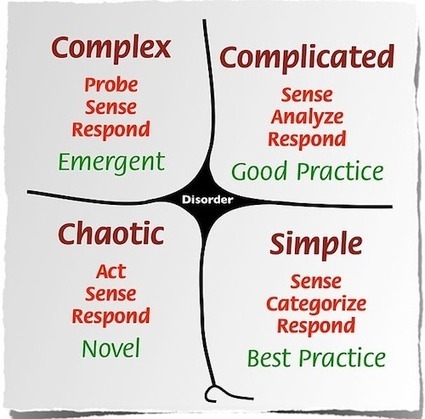
Pour continuer dans la série des jeux innovants qui gravitent autour de l’agile, je souhaite vous proposer cette fois le Cynefin Lego Game de Agile42.
Scoop.it!

The game is played by 4 teams, each with a unique persona and a unique “superpower”, i.e. a technique that only they can use to help resolve impediments confronting them.
Work is represented by feature and story cards which highlight the dependencies between these units of work. The objective of the game is to deliver the most feature value for the program/product-line by the end of the release cycle.
This highly-interactive game gives players hands-on experience in the basic principles of release planning, dependency management, and operation of a Scrum-of-Scrums.
To succeed, teams must address a number of common conflicts including: sequencing of work, unplanned work from other teams, local (our team) versus global (our product) optimization of value, managing work-in-progress, while leaving enough time for integration testing. To survive, teams must employ fast-paced decision-making to discover and resolve dependencies and make sprint plans for the next sprint.
This real-life simulation drives home the understanding that there is no time for big-analysis-up-front and that little unpleasant surprises lurk (seemingly) around every corner.
Mickael Ruau's insight:
Additional Resources
Scoop.it!

Découvrir l'agilité à travers 4 jeux pour appréhender les valeurs du manifeste Agile. Nœud humain - Artistes et spécifieurs - Marshmallow Challenge - Le goûter d'anniversaire
Scoop.it!

A simple, interactive, and collaborative game to experience at a high-level the ceremonies and common practices of Scrum through simulating a sprint. This game has been used as one part of a longer session focused on learning about Scrum. Prior to playing this game, the team has read the Scrum Guide, been given an overview of Scrum methodology, and has been exposed through various other activities to the Scrum roles and Scrum ceremonies. This game is used to experiment with how to put what they’ve learned into practice! Timing: 30 – 45 minutes
Scoop.it!

There are a lot of games and exercises that you can run yourself with your team/organization. Here’s a list of some of our favorites.
Mickael Ruau's insight:
White Elephant Sizing « TastyCupcakes.org InfoQ: Agile Games for Learning Learning Scrum through the Ball Point Game | Declan Whelan Trifork Agile Excellence: Exercise Introducing Story Maps Red Bead Experiment Video and Materials « Lean and Kanban Customer's Run: Iteration Planning Agile Airplane Game | Gist Labs Alistair.Cockburn.us | Elephant Carpaccio exercise Innovation Games | Serious Games for Business Play the Scrum Simulation (based on XPGame) for Great Learning (99+) AgileGames - Google Groups
Scoop.it!

The Fearless Journey game Players write cards listing Obstacles outside their control, situations that stop them from reaching their Big Goal Then together they discover and combine Influence Strategies to resolve obstacles respectfully & boldly Download it here today, and use it for FREE (but don’t modify it!) under a CreativeCommons 2.0 license Get inspired: follow up the game with your own Action Planning activity
Mickael Ruau's insight:
Here are the Strategy Cards for your language:
Scoop.it!

Connaissez vous "Agile Topics" ? Ce jeu contient 163 cartes présentant toutes un thème lié à l’Agilité. Comment l'utiliser ? Découvrez le dans cet article !
Scoop.it!

Scrum Master, coach agile, avez-vous déjà interagi avec des équipes interculturelles ? Découvrez le serious game LES DERDIANS !
Mickael Ruau's insight:
Avant toutes choses voici une définition du mot « Altérité » qui sera utile pour la suite : L’altérité, selon Angelo Turco, renvoie à ce qui est « autre », à ce qui est extérieur à un « soi », à une réalité de référence, qui peut être un individu, une chose, un groupe, un lieu…En d’autres mots, l’altérité c’est le fait d’être non explicitement différent. Avez-vous déjà interagi avec des équipes interculturelles ? Avez-vous rencontrés des difficultés liées à ces différences culturelles ? Comment les avez-vous gérées ? Aujourd’hui, nous allons décrire le SERIOUS GAME LE FABULEUX MONDE DES DERDIANS qui est un jeu que j’apprécie particulièrement car il est très riche d’enseignements sur les différences culturelles et sur leur gestion en pratique.
Scoop.it!
Scoop.it!
5 CLEFS POUR REUSSIR SON MARSHMALLOW CHALLENGE ! Grégory Alexandre de GOOOD! nous présente le serious game marshmallow challenge. Le marshmalow challeng
|







