


Quel est le bon jour pour commencer son sprint ? Quelle est la bonne heure pour le daily scrum ?

 Your new post is loading...
 Your new post is loading...
Your new post is loading...
 Scoop.it!
Quel est le bon jour pour commencer son sprint ? Quelle est la bonne heure pour le daily scrum ? 
No comment yet.
Sign up to comment
Scoop.it!

Scoop.it!
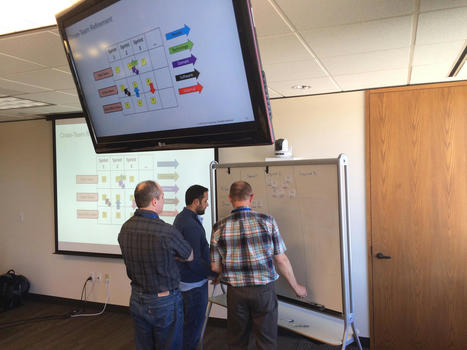
How effectively a Nexus works depends on its ability to eliminate dependencies. Eliminating dependencies simplifies integration. Scrum Masters who efficiently perform cross-team refinements save time. Saving time saves money.
Mickael Ruau's insight:
Feature Bazar: Scrum teams pitch which Product Backlog items they want to work on
At a Feature Bazar, the Product Owner presents the new features. Afterward, the teams select the topics they want to work on. Each feature should be chosen by at least two teams. By assigning teams to the features, the initial overview for the Cross-Team Refinement is quickly created.
Update the Cross-Team Refinement Board daily
Just as the Nexus Sprint Backlog is updated daily in the Nexus Daily Scrum when new dependencies occur in the current Sprint, the Cross-Team Refinement Board should also be updated daily. Only when the Cross-Team Refinement Board represents a real-time picture of all known dependencies, is it easy for the teams to resolve them. The Nexus updates the Cross-Team Refinement Board daily. Image by Richard Hundhausen. Representatives of the teams participate in the Cross-Team Refinement
Inviting all members of the Scrum teams to the Cross-Team Refinement is often neither practical nor necessary. In order to proceed in a focused manner, only representatives of the individual teams should be invited. Scrum teams select their representatives based on the work to be refined. Domain and technical knowledge are good selection criteria to quickly identify appropriate team members.
Alternate team and cross-team refinement
In cross-team refinement, cross-team dependencies are uncovered, eliminated, and forecasts are made about which team is likely to work on which Product Backlog item. In contrast, in team refinement, Product Backlog items are broken down, detailed, and estimated. Often, new cross-team dependencies are found in the team refinement. To eliminate these dependencies as quickly as possible, it makes sense to constantly alternate team and cross-team refinement.
Cross-team refinement should be a regular meeting
To reduce unnecessary scheduling, cross-team refinement should always take place on the same date. For me, it has proven successful to reserve at least one afternoon a week for the Cross-Team Refinement.
Not just visualize dependencies, but eliminate them
Visualizing dependencies in the Nexus Sprint Backlog to make them transparent is only the first step. The critical step is to consistently eliminate dependencies between teams. Ways to eliminate dependencies are: Interchange features between teams, break down Product Backlog items, build up missing knowledge in the team and change the likely possible processing order. Nexus Integration Team provides awareness of cross-team dependencies
In their daily teamwork, Nexus Integration Team members constantly keep an eye out for potential dependencies. If new dependencies are discovered, they encourage team members to make them transparent at the Cross-Team Refinement Board and look for ways to eliminate them early. In the long run, this creates awareness of the impact of cross-team dependencies within the teams.
Don't fall into the waterfall trap: Don't plan too far in advance, focus on the next sprint
Software development is complex. There are unknown unknowns. Therefore, it is impossible to anticipate all dependencies in advance, no matter how long refinement and planning are done. To avoid wasting time, the nexus should only refine the next one to three sprints in advance.
Trying to anticipate the implementation sequence of the Product Backlog is like a faucet: the further we turn it on, the closer we are to the waterfall.
Scoop.it!
From
slack

Vous souhaitez renforcer la cohésion d'équipe sans casser votre tirelire ? Découvrez comment appliquer les initiatives de nos clients à votre échelle.
Mickael Ruau's insight:
HubSpot facilite l’arrivée des nouvelles recruesLa société HubSpot, qui propose aux entreprises tous les outils pour une relation client réussie, est très investie dans sa culture de travail. C’est d’ailleurs une référence dans ce domaine : sa philosophie, qu’elle détaille au grand public sur un site dédié, compte près de 6 millions de vues. Pour Katie Burke, directrice des ressources humaines, la mission de HubSpot est à la fois simple et ambitieuse : « Nous tenons à ce que nos employés soient heureux lorsqu’ils arrivent au travail. » L’entreprise utilise notre plateforme collaborative pour épauler les salariés tout au long de leur formation. Sa botte secrète ? Un bot personnalisé qui accueille les nouveaux talents, les ajoute automatiquement aux canaux utiles (choisis par leur responsable) et revient régulièrement vers eux pour leur fournir de nouvelles informations au fil de leur onboarding. Pour renforcer la cohésion d’équipe et permettre à chacun de tisser des liens, HubSpot a aussi créé des groupes de discussion internationaux qui rassemblent des employés ayant des expériences communes. De plus, les quatre grands canaux de l’entreprise sont ouverts à tous les hubspotters, quelle que soit leur ancienneté. Résultat ? Les salariés se sentent impliqués dans le cœur de l’entreprise dès les premiers jours. Comment faciliter l’intégration à votre échelle
Scoop.it!
I don’t hire Scrum Masters because the role is the wrong shape to fit into my team, with the wrong set of responsibilities, and the people who might apply have insufficient qualifications for the job I need done. It is the Scrum Master role itself that I have a problem with. I just don’t need it. At least I don’t need the role as described in the Scrum literature and covered by the Certified Scrum Master course. In particular I don’t need:
Mickael Ruau's insight:
One of the specific responsibilities of a Scrum Master is “Removing impediments to the Development Team’s progress”. Which is why Mike Cohn characterises Scrum Masters as bulldozers. Removing impediments is really important but there is lots about project management that a Scrum Master doesn’t do – Planning, Monitoring and Control, Quality Management, Risk Management, etc. I have a particular beef about Scrum Masters and Risk Management. An impediment is an issue. It has manifested. It is already smacking you in the face. We shouldn’t even get to that point – that is the distinction between Issue Management and Risk Management. So I don’t hire Scrum Masters because I don’t need somebody who only removes impediments. I need somebody to take responsibility for delivery and manages accordingly, and that is what I hire project managers for.
Scoop.it!
 Loi scalante - WikipédiaOn nomme lois scalantes, ou parfois aussi lois de puissance , un certain nombre de lois constatées le plus souvent empiriquement et où interviennent des phénomènes d'invariance d'échelle , d'où leur nom, ou parfois d'invariance de repères.
Mickael Ruau's insight:
Les plus connues sont :
Scoop.it!

Change can be intimidating, particularly when it comes to your organization. This chapter will help ease you through those changes with finesse. Who knows? Maybe you'll even find yourself looking forward to change.
Mickael Ruau's insight:
This research has identified several factors that speed up or slow down the innovation-decision process and, as a result, the time it will take the change to become part of the environment. We consider three factors: the change agent, the culture, and the people. To begin a successful change effort, you will need to understand all three and how they work together.
Scoop.it!

In this interview made by Floyd Marinescu, co-founder of InfoQ, Linda Rising talks about the book "Fearless Change: Patterns for Introducing New Ideas" and offers examples of how the patterns presented in the book can ease the stress of Agile adoption.
Mickael Ruau's insight:
6. Continuing with the scenario, how do you convince them to take an idea? You bring in the cookies and some people will be convinced just because they are innovators and they like new ideas and some people will be convinced by the fact that the innovators are excited and you brought in the right kind of chocolate chip cookies, so you are slowly making headway. Other people on the technical environment are often convinced because they are early adopters and they need evidence. 7. Is one of your patterns "Convince the guru"? Yes. It is called "guru on your side". So, if you have the brown bag, the first person you might invite would be the local guru and give it a little head start because gurus do not get to go to conferences. They are too valuable. They are always working on 6 or 7 projects and they are loaded with deadlines, so they never let them out. They want to hear about this stuff, so you can overwhelm them, you can make them feel bad that they didn't get to go to the conference, but you give them a little preview, so when they come to the brown bag they already know enough, so they can nod at the right time and validate what you are saying and everybody in the room will be looking to the guru and say "Wow, he likes it, and we are having cookies and the innovators are excited" so they get caught up in that. 8. What comes next? Once you have had your meeting and you have raised the buzz, then what? Nothing convinces people more than experience. And of course, you have just been at QCon and you have never done Agile development or whatever the new thing is, so you get maybe some available innovator, or maybe now somebody who is a little more open and say "You know, maybe we could try, just an experiment, pair programming. I am working on this particular part of the project. Would you like to try that with me? And then we could see how it works for us, so a little trial run, just a little experiment". And then, if it works, if it really does work, you have an ally because the two of you have tried it.
Scoop.it!

Many people like to have formal documentation to read about Scrum. There are many books that you can buy and there are also many great free resources on the web. We can recommend the following FREE downloadable booklets: “Do Better Scrum“ by Peter Hundermark, a CSC and CST in Africa and Brazil. Provides a set of […]
Mickael Ruau's insight:
Some more FREE downloadable booklets on advanced topics:
Scoop.it!
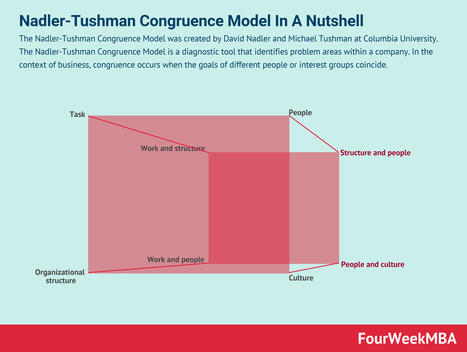
The Nadler-Tushman Congruence Model was created by David Nadler and Michael Tushman at Columbia University. The Nadler-Tushman Congruence Model is a diagnostic tool that identifies problem areas within a company. In the context of business, congruence occurs when the goals of different people or interest groups coincide. ContentsUnderstanding the Nadler-Tushman Congruence ModelThe four elements of … Continue reading Nadler-Tushman Congruence Model In A Nutshell
Scoop.it!

Each of us has an inner lizard that frets constantly about our safety. People come with brains that are pre-configured to scan everything you say for threats to their safety. Learning to recognize when you're operating under reptilian influence is a great start. This article introduces some techniques to help you manage the lizard within you along with those around you.
Mickael Ruau's insight:
Key Takeaways
Scoop.it!

Dans la série "la Voix du Coach", InfoQ FR échange avec Claude Aubry qui explique ses différents rôles, détaille ses interventions, et nous donne son point de vue sur le métier de coach agile et la diffusion de l'agilité en France.
Mickael Ruau's insight:
InfoQ FR : Comment percevez-vous le déploiement de l'Agile dans les organisations françaises ?
InfoQ FR : Comment analysez-vous le développement du coaching agile sur les dernières années ?
- L’appartenance à un type, c’est la mort de l’homme, sa condamnation. Si l’on ne peut le faire entrer dans une catégorie, s’il n’est pas représentatif, il possède déjà la moitié de ce qu’on est en droit d’exiger de lui : il est affranchi de lui-même, il détient une parcelle d’immortalité. -
Scoop.it!
Explore self-guided workshops called Plays that can help your remote team create new rituals that improve communication, alignment, and team empathy.
Mickael Ruau's insight:
6 Plays for adapting to remote teamwork My User ManualDiscover what everyone’s remote work preferences are to establish ground rules for better collaboration. Inclusive MeetingsEncourage diversity of opinion from all your remote team members as you move to virtual meetings. Stand-upsHelp everyone keep track of team progress and project blockers with quick, daily or weekly updates. "4Ls" RetrospectiveProvide a structure to celebrate wins, learn from mistakes, and provide honest feedback to improve future projects. Learning CircleCreate a structure for growing new skills as a remote team and for sharing cross-team updates. also recommededTeam Health Monitor
Assess your team’s strengths against eight attributes common amongst high-performing teams, address weaknesses, and come up with a plan of action.
|
Scoop.it!

J’ai récemment accompagné une équipe en leur faisant faire un sprint d’une journée. Mais pour quoi faire me direz-vous ? Pour leur apprendre à travailler ensemble, en même temps, sur la même chose…
Scoop.it!
Key Takeaways
Scoop.it!
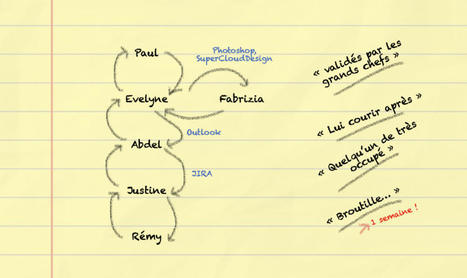
Verdict : un aller-retour superflu dans la pyramide de management, 6 intervenants, 4 outils, une dizaine d’interactions et une semaine de délai. Notre victime a succombé depuis bien longtemps. L’esprit d’initiative de Rémy est mort. Vous ne retrouvez de lui qu’un post-it écorné et marqué à l’encre Stabilo : “Le faux Agile™ m’a tuer”
Scoop.it!

Les Valeurs et Principes sont rigoureusement identiques à la version officielle du Manifeste. Leur numérotation respecte l’ordre du Manifeste.
Mickael Ruau's insight:
Manifeste pour le développement Agile de logiciels
Scoop.it!

A delivery manager guards the team’s time, to ensure continuous delivery is possible. Team time is precious time. Developers and other team members are capable professionals in their own discipline, self-organizing and cross-functional. But teams can only complete sprint tasks timeously when they are unhindered. The delivery manager is there to remove any and all things that are hindering or ‘blocking’ them, so the team can deliver the product. We use a mixture of agile techniques at GDS, borrowing heavily from Scrum to organise teams and sprints. In Scrum the delivery manager plays the role of the Scrum Master. The Scrum Master is a kind of ‘servant-leader’ (read that with a big ‘S’ and a little ‘l’), someone who enables the team by removing impediments and building an environment people can work in effectively (things as uncomplicated as ensuring everyone has a space to work and a wall to stand up in front of, on which to monitor progress). Other servant functions include planning for sprints and organising retrospectives. The delivery manager should also help other product teams and stakeholders to understand the work being done, as no team is an island. These jobs are neatly summed up by one of the twelve principles behind the Agile Manifesto: “Build projects around motivated individuals. Give them the environment and support they need, and trust them to get the job done”.
Scoop.it!
Table of Contents
Scoop.it!

Don Gray got me started, with his posting of 3x5 notecards for studying the patterns in the book, Fearless Change: Patterns for Introducing New Ideas, by Mary Lynn Manns and Linda Rising. I agree with him that it's a wonderfully helpful book, and I thought the idea of creating cards to carry and stud
Mickael Ruau's insight:
So, at Don’s suggestion, I re-formatted his format and created both OpenOffice and PDF versions of the cards. I hope you find them useful, but be sure to read the book! Not only is that fair to the authors, but the cards will make a lot more sense to you.
Scoop.it!
A powerful personal growth tool is the 30-day trial. This is a concept I borrowed from the shareware industry, where you can download a trial version of a piece of software and try it out risk-free for 30 days before you’re required to buy the full version. It’s also a great way to develop new habits, and best of all, it’s brain-dead simple. Let’s say you want to start a new habit like an exercise program or quit a bad habit like sucking on cancer sticks. We all know that getting started and sticking with the new habit for a few weeks is the hard part. Once you’ve overcome inertia, it’s much easier to keep going.
Scoop.it!

In business, there is a right way and a wrong way to do just about everything.This certainly extends to asking for favors or any other kind of help from...
Scoop.it!

Learn more about the effects of the dogmatic Scrum Master anti-pattern — Making Your Scrum Work #20 by Age-of-Product.com...
Scoop.it!

Derrière l’agilité salvatrice, promue et vendue par les experts, les formateurs et autres consultants, se cache un terme transparent dont la signification a été gommée par une mise en musique aux faux airs de taylorisme.
Mickael Ruau's insight:
Les entreprises doivent désormais intégrer significativement ce bouleversement dans leur modèle d’activité ou risquer de disparaître. Pour preuve, selon une étude de Constellation Research, depuis 2000, 52% des entreprises du Fortune 500 ont fait faillite, ont été rachetées ou ont cessé d’exister, « la numérisation des entreprises étant un facteur clé de cette accélération ». (...) Face à ce dictat de l’adaptation, les entreprises apprennent souvent à leurs dépens que réussir dans le numérique exige une autre façon de penser leur organisation. Il ne s’agit plus d’appliquer une logique prédictive, directive et de standardisation, typique des industries du XXe siècle, mais, au contraire, d’intégrer dans leur quotidien une capacité à s’ajuster aux caprices d’un marché incertain. S’adapter oui, mais comment ? En « étant agile », selon Steve Denning, auteur, consultant et ancien directeur du knowledge management à la Banque mondiale. Un avis partagé et mis en pratique par un nombre croissant de grandes entreprises et de start-up, comme en atteste le rapport « State of Agile », au point où, toujours selon Steve Denning, le monde entre aujourd’hui « dans une nouvelle ère : l’ère agile ». Du moins, en apparence. Mais avant de détailler les limites et les dérives de l’application actuelle de l’approche agile, commençons par définir et contextualiser ce terme.
Scoop.it!

C’est en janvier 2007 que j’ai écrit le premier article de présentation du rôle de Scrum Master. L’essentiel y était et je suis parti de cette base quand j’ai écrit la première édition de mon livre Scrum, c’était en 2009.
Mickael Ruau's insight:
Le portrait d’un Scrum Master idéalLa carte heuristique associée à l’article donne la vue d’ensemble. Je suis parti de l’édition 5, plus précisément des traits présentés dans les § 5.2 à 5.4 que j’ai essayé de mettre au bon endroit (attitude, compétence, capacité ou exigence). AttitudeLuc de Brabandère définit l’attitude comme l’état d’esprit. C’est une prédisposition mentale qui désigne une intention et n’est donc pas directement observable. Pour un Scrum Master, l’exercice n’est pas très difficile. Je constate d’ailleurs que la plupart des traits que Luc de Brabandère associe au penseur critique concernant son attitude peuvent l’être aussi au Scrum Master.
CompétencesUne compétence est une connaissance approfondie, reconnue qui confère le droit de juger ou de décider. On demande au Scrum Master deux compétences (héritées de son nom, pourtant pas très heureux) :
Dans l’édition actuelle du livre, je liste 8 compétences pour le Scrum Master. Avec cette grille de réflexion, je réduis à 2 ! Avoir des compétences fonctionnelles et techniques n’est pas requis, cependant cela peut aider. CapacitésUne capacité est une possibilité de réussite et de mise en oeuvre de compétences dans l’accomplissement d’une activité. Voici quelques capacités utiles à un Scrum Master :
Grâce à ces capacités, il applique ses compétences sur Scrum et l’animation dans ses activités (lors des rites, notamment et en particulier la rétrospective). ExigencesUne exigence est une contrainte à laquelle une activité doit satisfaire ou un impératif que l’on s’impose à soi-même. Voici 4 traits qui me paraissent être des exigences pour un Scrum Master. Les 3 premiers sont disséminés dans le chapitre de l’édition 5. J’y ajouté être utile pour que Scrum Master ne soit pas un bullshit job.
Ce petit exercice m’a convaincu de l’intérêt de cette grille, que je vais consolider dans l’écriture du chapitre Scrum Master (et que je vais appliquer également au Product Owner). Le chapitre de l’édition 6 sur le Scrum MasterComme on peut le voir sur la carte heuristique qui accompagne cet article, c’est tout le chapitre qui va être modifié pour la 6e édition. Il avait — relativement — peu changé depuis la première édition. Enfin surtout depuis la 3e, puisque dans les 2 premières c’était le SM ET l’équipe. Après réflexion, il va passer devant le chapitre sur le PO pour limiter le nombre de références avant. Le contenu va changer pour inclure les 4 parties du portrait idéal du SM en termes d’attitude, compétences, capacités et exigences, mais pas seulement. Même le paragraphe sur les antipatterns sera supprimé, chaque antipattern étant décrit au moment où je présente le pattern. C’est dans le paragraphe Mutations (le nom peut encore changer) que j’évoquerai l’impact du télétravail massif sur le rôle. J’ai reçu 5 témoignages sur ce sujet. En tête du chapitre, je vais placer les réponses aux questions Pourquoi le Scrum Master (définition, rôle) et Que fait-il ? (activités). N’hésitez pas à me donner vos impressions. Pour un autre point de vue, l’article de 2007 sur le SM.
|




