Your new post is loading...

|
Scooped by
Mickael Ruau
July 22, 2020 4:47 AM
|
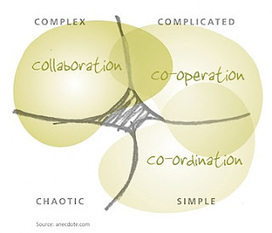
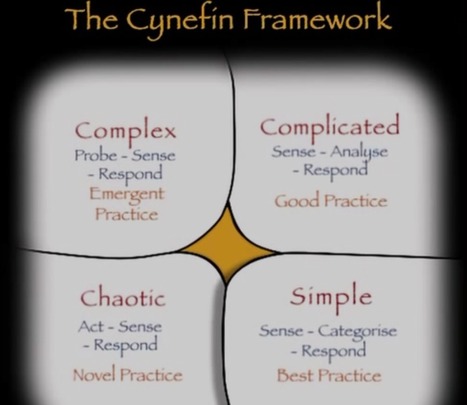
Cooperating or collaborating? In a comment yesterday, Stephen Downes, proposed that cooperation was better suited for complexity and collaboration fit better with complicated situations. Harold Jarche's initial concept drew from Shawn Callahan's post last December for Anecdote that used the Cynefin framework to differentiate between uses of coordination, cooperation and collaboration. My dictionary gives cooperation and collaboration two slightly different inflections to the idea of "working together", the exact title of Harold Jarche's post. The denotation is practically synonymous.
|
|
Scooped by
Mickael Ruau
July 22, 2020 4:29 AM
|
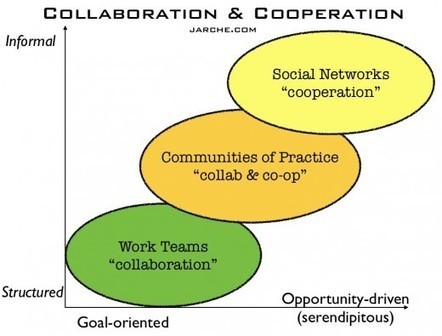
One can easily envision someone working on all three levels on any given day:
a small team producing a deliverable on a deadline for a client (coordination);
members of that team providing advice and information to other teams on related projects (collaboration);
team members working with a larger and looser network in identifying new business opportunities (cooperation).
|
|
Scooped by
Mickael Ruau
July 22, 2020 2:14 AM
|
Une polarité est un set d’opposés qui ne peut fonctionner correctement de manière indépendante.
Les 2 côtés de la polarité étant interdépendants, on ne peut pas choisir l’un comme une “solution” et négliger l’autre.
– Barry Johnson
Le verbe associé est important car il permet de bien comprendre la différence de mode opératoire :
On cherche à faire disparaître le problème en lui trouvant une solution, généralement par de l’analyse méticuleuse.
On cherche à moduler le problème en observant les effets de la polarité sélectionnée à un instant t et en acceptant de basculer sur l’autre selon le contexte.
Ainsi, on peut dire que l’objectif du Polarity Management est :
Obtenir le meilleur de chaque opposé en limitant les inconvénients de chacun.
|
|
Scooped by
Mickael Ruau
July 21, 2020 12:04 PM
|
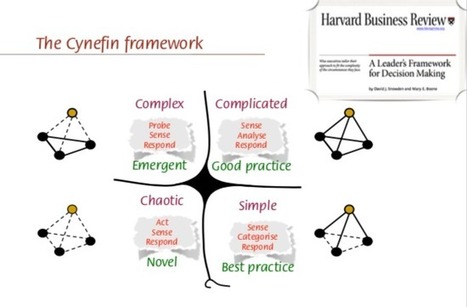
A quick recap before we go any further: the essence of Cynefin is that it helps you work out which domains you're in and which methods or tools work best there. For instance, process re-engineering may work wonders in the obvious domain but will be a horrendous fit for the others. In a complicated domain, you may want to use an audit, and call in the experts. A complex system on the other hand, could benefit from social network stimulation, using self-organizing teams and a reward framework. And when there’s chaos, acting as quickly as you can and then learning from what went right and wrong could save the day.
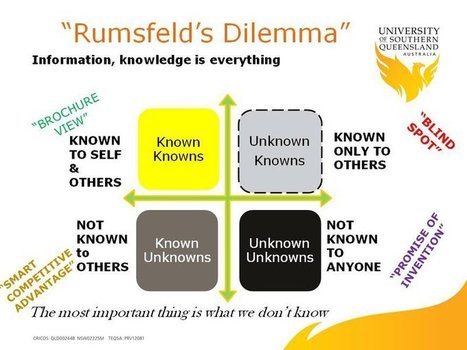
For those people who love their frameworks and matrices (you know who you are), I’ll just casually drop the Rumsfeld matrix here as well (Which is related to the Johari window but I won’t post that here as there ought to be limits to the amount of frameworks or matrices used in one piece), which might be a help in estimating the uncertainty of some of your projects. Dave and I did not talk about that in the interview, but it could be useful for those who are intrigued by the concept of ‘knowing what you don’t know’ he did refer to (ie known unknowns):
|
|
Scooped by
Mickael Ruau
July 21, 2020 11:59 AM
|
The Cynefin framework tends to be used in the main to categories situations within the four main domains (and for more advanced use all five). I’ve never had a problem with that but the dynamics are as important as the domains and they are too often neglected. A concerned effort over the last year in presentations and teaching has resulted in a higher utilisation so it’s time to move on the develop the boundary zones. I should make it clear that this is an additional layer to Cynefin so it does not need to be used per se.
|
|
Scooped by
Mickael Ruau
July 21, 2020 11:03 AM
|
|
|
Scooped by
Mickael Ruau
July 21, 2020 10:48 AM
|
Then I translate the Cynefin model slightly differently:
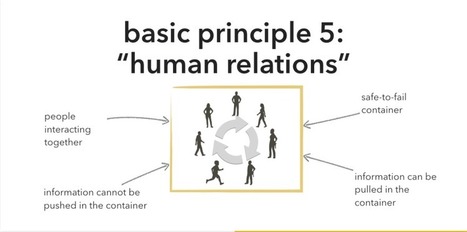
Complex: The “team members” are autonomously interacting together and co-create together a new “emerging” solution. Ex. Building on the top of each one’s idea.
Complicated: all participants are interacting together to analyse something to collect “good practices” or to validate an outcome.
Simple: The information shared from the “top” is evident for all participants in the system and doesn’t need to be discussed. Ex. Fire alarm = get out.
Chaos: nobody is interacting, and all the people are working in their area.
|
|
Scooped by
Mickael Ruau
July 21, 2020 10:31 AM
|
Le framework Cynefin a été développé par Dave Snowden. Ce chercheur gallois est spécialisé en gestion des connaissances, un domaine consistant à la capture, le développement et le partage efficace des connaissances au sein d’une organisation. Ce domaine a lui-même été popularisé par le japonais Ikujiro Nonaka.
Dans son article paru en 1991, Nonaka expose le fait que nous vivons dans une économie où “la seule certitude est l’incertitude”. Dans ce contexte, le seul avantage qu’ont les organisations pour être compétitives est le savoir. Pour lui, les compagnies qui ont du succès sont celles qui créent constamment du savoir et sont capables de l’utiliser immédiatement dans leurs produits. Ce sont des entreprises donc le métier noyau est “l’innovation continue”.
|
|
Scooped by
Mickael Ruau
July 15, 2020 2:05 AM
|
Picture this context
Single team Scrum is in use by many teams of different initiatives
Having genuinely tried, some teams are unable to use Scrum, as they cannot deliver potentially releasable value in 30 days or less. Even 90 days might be a struggle.
OK, one might say “can” and “cannot” are just opinions/attitudes.
In a scaling context, some patterns can deal with the kind of Scrum that does not yet deliver value per team from a Scrum Sprint.
The teams in this context are operating deeply in the complex space with more unknown than known.
Maybe in some cases, the team members’ belief systems are closer to Kanban.
And, maybe the teams have non-software knowledge work
|
|
Scooped by
Mickael Ruau
July 6, 2020 10:08 AM
|
Le concept de "signaux faibles" a été conçu dans les années 1970 par Igor Ansoff. Cet ancien consultant pour Lockheed et la Rand Corporation développe ce concept comme dans le cadre des ses enseignements sur management stratégique à l'Université Vanderbilt.
|
|
Scooped by
Mickael Ruau
June 25, 2020 2:43 AM
|
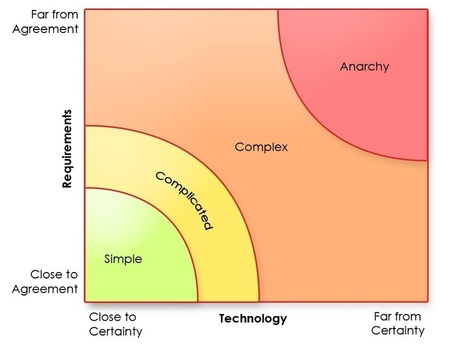
The Stacey complexity model explains, that each task can be put in one of the 4 categories: simple, complicated, complex, anarchy.
|
|
Scooped by
Mickael Ruau
December 20, 2019 5:27 AM
|
I've been a passionate Scrum practitioner since over a decade and I really value it. Scrum is the most used agile framework and it is well documented in the Scrum Guide. To avoid confusion with "Scrum", "Scrum X" is an evolution of the framework to support agile behaviour in a complex adaptive system that supports…
|
|
Scooped by
Mickael Ruau
November 18, 2019 2:55 AM
|
Use the Cynefin framework to identify the type of situation you’re in, so that you can decide how to move forward.
|
|
|
Scooped by
Mickael Ruau
July 22, 2020 4:31 AM
|
Real network models are new modes, not modifications of the old ones, and cooperation is how work gets done. Some examples:
Wirearchy: a dynamic multi-way flow of power and authority based on information, knowledge, trust and credibility, enabled by interconnected people and technology.
Heterarchies are networks of elements in which each element shares the same “horizontal” position of power and authority, each playing a theoretically equal role [wikipedia].
Chaordic refers to a system of governance that blends characteristics of chaos and order. The term was coined by Dee Hock the founder and former CEO of the VISA credit card association [wikipedia].
Combine the TIMN perspective with the Cynefin framework, and I created this table, looking at how work gets done:
|
|
Scooped by
Mickael Ruau
July 22, 2020 4:21 AM
|
I've been working on this interpretation of the Cynefin (kun-ev'in) sense-making and decision-making framework for months. This combines 4 sources; Cynthia Kurtz and Dave Snowden (2003), Dave Snowden and Mary Boone (2007), Dave Snowden blogging (2006) and Joachim Sturmberg and Carmel Martin (2008). See here for some of the Snowden references. I started this after…
|
|
Scooped by
Mickael Ruau
July 22, 2020 1:35 AM
|
Cynefin a été developpe par D. Snowden et Mary E. Bone et fut sujet d´une publication dans HBR en 2007 sous le titre “A leader´s framework for decision making”. En janvier 2011, j´ai eu la chance de…
|
|
Scooped by
Mickael Ruau
July 21, 2020 12:02 PM
|
It starts with normalising complexity and helping people understand that complexity is (and always has been) all around us and that it is not going away. Once we accept that, we can learn how to discern when we are dealing with something complex vs something ordered and the new approaches we need to adopt. (This is where the Cynefin framework is useful)
Ordered responses normally stamp out ambiguity, tension and difference in an effort to create certainty and stability. In complexity, these ordered responses are detrimental as they simply defer the complexity, create unintended consequences and reduce the overall fitness or resilience of the system. Instead, we need adaptive responses, and the task of enabling leadership is to create the conditions for adaptive responses to occur. Mary calls this adaptive space, and it is created in a dynamic between two processes: conflicting and connecting.
|
|
Scooped by
Mickael Ruau
July 21, 2020 11:16 AM
|
Implementing Lean is a journey witch encourters several pitfalls related to changing paradigms. Lean aim is linking the Product to the Market and change your s…
|
|
Scooped by
Mickael Ruau
July 21, 2020 10:58 AM
|
Aujourd’hui, notre société se complexifie de manière exponentielle. Les technologies se développent, les connaissances ne cessent de s’accumuler, l’environneme…
|
|
Scooped by
Mickael Ruau
July 21, 2020 10:46 AM
|
La différence avec une matrice 2×2 classique est qu’avec ce modèle, les données précèdent la catégorisation. Dans une matrice SWOT ou une matrice d’Eisenhower par exemple, il suffit de mettre les données dans la bonne case et on obtient une réponse rapide. Si ces matrices sont très utiles pour l’exploitation, elles perdent leur valeur pour l’exploration, ou lors des périodes de changement.
Dans le modèle Cynefin, ce sont les données qui définissent la situation dans laquelle on se trouve, et donc les comportements à adopter. Dans un monde irrationnel et imprévisible, ce modèle est particulièrement utile.
|
|
Scooped by
Mickael Ruau
July 21, 2020 10:30 AM
|
Note sur la contextualisation linéaire et le Value Stream Mapping (VSM) – une des difficultés que je rencontre avec le VSM est qu'il permet d'optimiser un processus existant, et dès lors, se concentre sur la question du faire bien et non sur celle du faire la bonne chose. L'alternative que je préfère est celle de la Contextualisation Linéaire où nous commençons par la perspective client et remontons les étapes pour définir ce qu'il faudrait faire. L'avantage par rapport au VSM est de permettre la transformation du processus en le formalisant. Cette idée provient de Mike Burrows.
|
|
Scooped by
Mickael Ruau
July 15, 2020 1:19 AM
|
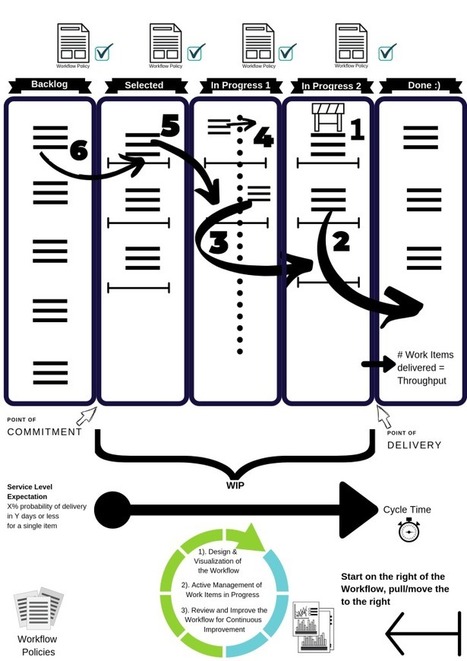
Kanban the Flow Strategy™ provides the basic structure for Kanban, which the reader can augment using models such as Evidence Based Management, Cynefin Sense-Making, Theory of Constraints, and scaling/descaling.
We have our quirks, and we consider some things as optional that maybe you thought were mandatory.
Download the Guide for Kanban – the Flow Strategy™ here.
|
|
Scooped by
Mickael Ruau
July 6, 2020 9:37 AM
|
La théorie du cygne noir ou théorie des événements cygne noir, développée par le statisticien Nassim Nicholas Taleb, notamment dans son essai Le Cygne noir , est une théorie selon laquelle on appelle cygne noir un certain événement imprévisible qui a une faible probabilité de se dérouler (appelé " événement rare " en théorie des probabilités) et qui, s'il se réalise, a des conséquences d'une portée considérable et exceptionnelle.
Identifier un cygne noir Les 3 critères définis par l'auteur sont : - l'événement est une surprise (pour l'observateur) ;
- l'événement a des conséquences majeures ;
- après le premier exemple de cet événement, il est rationalisé a posteriori, comme s'il avait pu être attendu. Cette rationalisation rétrospective vient du fait que les informations qui auraient permis de prévoir l'événement étaient déjà présentes, mais pas prises en compte par les programmes d'atténuation du risque. La même chose est vraie pour la perception des individus.
|
|
Scooped by
Mickael Ruau
April 27, 2020 7:00 AM
|
I recently provided a brief summary of the various book chapters that contain my writing.…
|
|
Scooped by
Mickael Ruau
December 19, 2019 5:26 AM
|
Speaking about projects in an agile context is always funny. In January, I had a conversation with my friends Mike and Michael in Vienna, and when addressed the point of project management, they began getting very emotional. In their positions as agile trainers, there is no project management in Agile. My perspective was precisely on…
|