Your new post is loading...

|
Scooped by
Mickael Ruau
July 12, 2022 6:38 AM
|
Découvrez les résultats de notre étude 2021 sur les salaires du secteur agile. Êtes-vous payé à votre juste valeur ?
|
|
Scooped by
Mickael Ruau
February 2, 2022 1:10 AM
|
Summary — Single Item Forecasting
In terms of a story pointless approach to estimating a single item, try the following:
Prioritise your backlog
Use your Cycle Time scatter plot and 85th percentile
Take the next highest priority item on your backlog
As a team, ask — “Do we think this can be delivered within our 85th percentile?”
(Note: you can probe further and ask ‘can this be delivered within our 50th percentile?” to promote further slicing/refinement)
If yes, then let’s get started/move it to ‘Ready’
(considering your work-in-progress)
If no, then find out why/break it down till it is small enough
Once we start work on items, use Work Item Age as a leading indicator for flow
Manage Work Item Age as part of your Daily Scrum, if it looks like it may exceed the 85th percentile — swarm/slice!
Please note: it’s best to familiarise yourself with what your 85th percentile is first (particularly in comparison to your cadence).
If it’s 100+ days then you should be focusing initially on reducing that time — this can be done through various means such as pairing, mobbing, story mapping, story slicing, lowering WIP, etc.
|
|
Scooped by
Mickael Ruau
December 28, 2021 12:52 AM
|
In the last few years, I’ve been using Modern Agile to coach the organization, the management, and the teams. It’s worked so well,that using Modern Agile to do a team reset was a given…the only question was “How?.” (Learn more about Modern Agile at http://modernagile.org)
I came up with a few ideas, perhaps you’ll come up with more. Let me know, and I will add them in — with credit to you, of course.
|
|
Scooped by
Mickael Ruau
December 20, 2021 1:52 AM
|
There are several benefits of establishing WIP limits. These include:
Agile teams have an objective, standardized way to decline new requests and explain why tasks are not being fast-tracked through the process. While this still won’t make internal or external customers happy, it is far more agreeable than just saying “no” and being unfairly criticized as inflexible or lazy.
Agile teams do not have to act like goldfish and dart frenetically from one item to another — which is not just inefficient, but it’s also exhaustive. Instead, they can focus on completing high quality work in the fastest possible manner, while minimizing distractions and interruptions.
Agile teams can build slack into processes, which allows for collaboration, collective problem solving, necessary meetings, and other activities that are essential to high-quality work, yet are not captured as formal work items.
Agile teams can more effectively identify actual and potential bottlenecks, and take targeted, practical action to alleviate or avoid them.
Agile teams can make better use of available resources, and deliver persuasive, data-driven business cases to managers and executives if additional resources are required.
Agile teams can cultivate a culture of support and teamwork — instead of “every woman and man for themselves” — which boosts engagement, performance, productivity, and accountability. This is particularly important and valuable given that agile teams must be inherently self-organizing and self-managed. With agile, either everyone reaches the finish line on time and intact, or nobody does.
Agile teams can use the visual language of WIP limits+Kanban boards to significantly reduce the need for status meetings (please keep your cheering and celebrating as quiet as possible, there are likely people in your work environment who are on the phone).
|
|
Scooped by
Mickael Ruau
December 10, 2021 1:28 AM
|
Tarif jour moyen
sur la base des Coachs agiles expérimentés actifs*
745€
*actifs sur Malt les 3 derniers mois
Tarif jour moyenpar niveau d’expérience
0-2 ans d'expérience
120€ et - Tarif moyen : 372€ 1 210€ et +
2-7 ans d'expérience
120€ et - Tarif moyen : 512€ 1 010€ et +
7 ans et + d'expérience
250€ et - Tarif moyen : 745€ 1 510€ et +
Synthèse des tarifs jour moyen pour les profils expérimentéspar spécialités sur Malt
Coachs agiles
745€
Product managers
682€
Scrum masters
677€
Chefs de projet
643€
Synthèse des tarifs jour moyen par villeen France sur Malt
Spécialité Tarif jour moyen Paris Lyon Bordeaux Lille Marseille
Coachs agiles 745€ 792€ 728€ 619€ 667€ 657€
Product managers 682€ 725€ 628€ 579€ 627€ 580€
Scrum masters 677€ 721€ 610€ 578€ 602€ 589€
Chefs de projet 643€ 691€ 591€ 547€ 608€ 554€
|
|
Scooped by
Mickael Ruau
December 7, 2021 4:54 AM
|
Let's talk about speed, more specifically, speed of software project delivery. It's amazing, nobody ever says, "I want to figure out how to go slower and be more methodical, and cautious." Everyone I talk to typically wants to figure out how to go faster. This was true when I was a consultant. It's been true in most of the jobs that I've held. Everyone wants to go faster, and yet, our intuition is a terrible source of ideas for how to go faster. The most common ways that I hear is, got to hold somebody's feet to the fire. Fairly violent. Got to set deadlines, because that's the way to create a sense of urgency. In my experience, these techniques, they tend to backfire. They don't go quite the way people expect.
|
|
Scooped by
Mickael Ruau
November 26, 2021 1:13 AM
|
When one is journeying into the unknown, plans have limited value simply because one doesn't know. The bigger the plan, and the more superficially complete the plan, the greater the challenges when innovating.
But why spend time on planning when you could get yourself a guide? Someone who has been over the same, or similar, territory before and can help you navigate the obstacles?
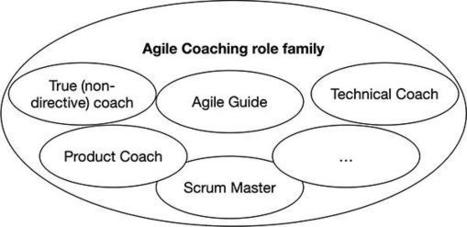
In truth many teams do secure the services of a guide. These people go by the name Agile Coach. However, even as the Agile Coach has become an accepted role in development teams a number of problems have built up with the role.
Conflicts in coaching
Question: should an Agile Coach present solutions?
When in the role as an Agile Coach I have spent days agonising when the organization and team expect me, their Agile Coach, to fix things. But I know, as a coach, I should help them find their own solution. Is it right for me to hold back my knowledge? Am I best serving my client by not doing what they expect me to do?
Question: When a team are content with their way of working, should an Agile Coach initiate change?
The biggest conflict in agile coaching is between the way organisations often view the coach role and the way coaches themselves see their role. Companies frequently see the coach as a change bringer, but coaches usually see their role as an enabler. In coaching terms this the difference between directive and non-directive coaching.
Many agile coaches take their lead from the earlier field of business coaching. Authors like John Whitmore and Myles Downey have long advocated a non-directive style of coaching where the coach helps the individuals resolve their own problems. Whitmore writes:
"Coaching is a management behaviour that lies at the opposite end of the spectrum to command and control. ... A skillful coach rarely provides or prescribes solutions." Coaching for Performance, Whitmore, 1992
In their work coaches often utilize the Socratic method to help coachees unlock problems and decide actions. Unfortunately, asking lots of questions, and not providing solutions, is usually not what companies expect from their coaches.
|
|
Scooped by
Mickael Ruau
November 10, 2021 12:37 AM
|
Reflections and findings triggered by the experience interview with Jimmy Janlén.
|
|
Scooped by
Mickael Ruau
November 4, 2021 1:31 AM
|
This blog post discusses how the Circles of Improvement from the book by Stephen R. Covey: The 7 Habits of Highly Effective People, work in Scrum.
|
|
Scooped by
Mickael Ruau
October 27, 2021 11:17 AM
|
Time-saving measures to change how you approach tasks and that shine light on all the options available to developers to get jobs done on time and under budget.
|
|
Scooped by
Mickael Ruau
October 25, 2021 5:26 AM
|
Table of Contents
CHAPTER 1: Introduction to Intercultural Communication
CHAPTER 2: Social Categorization, Stereotyping, and Discrimination
CHAPTER 3: Beliefs, Values, and Cultural Universals
CHAPTER 4: Introduction to Race and Ethnicity
CHAPTER 5: The Impacts of Social Class
CHAPTER 6: Gender and Gender Inequality
CHAPTER 7: Socialization and Human Sexuality
Ancillary Material
Submit ancillary resource
About the Book
Intercultural Communication examines culture as a variable in interpersonal and collective communication. It explores the opportunities and problems arising from similarities and differences in communication patterns, processes, and codes among various cultural groups. It explores cultural universals, social categorization, stereotyping and discrimination, with a focus on topics including race, ethnicity, social class, religion, gender and sexuality as they relate to communication.
|
|
Scooped by
Mickael Ruau
October 22, 2021 8:12 AM
|
J’ai déjà des Scrum Masters, pourquoi ai-je besoin d’un coach d’équipes agiles?
Que vous ayez commencé l’adoption de certaines pratiques agiles au sein de votre entreprise ou non, le coach d’équipes vous aidera concrètement à :
Choisir la méthode la plus appropriée pour votre entreprise parmi les différentes méthodes disponibles (Scrum, Kanban, ScrumBan, etc.).
Accompagner les membres de vos équipes dans la mise en place des rôles, des activités, des rencontres et des outils nécessaires au bon fonctionnement. Lorsque tous les rôles ne sont pas comblés au sein de votre entreprise, le coach d’équipe agile peut aussi prendre en charge l’exécution de certaines activités.
Sélectionner les meilleures personnes pour jouer les différents rôles requis par la méthode sélectionnée.
Former et transférer les connaissances requises aux membres de votre équipe.
Développer vos Scrum Masters afin de les amener au prochain niveau.
Animer certaines rencontres.
|
|
Scooped by
Mickael Ruau
October 17, 2021 1:03 AM
|
When we introduce Scrum to an organization, many people are skeptical of the monetary benefits and ROI of the Scrum Master position. The question I am often asked is - "How do you justify the salary of the Scrum Master?"
|
|
|
Scooped by
Mickael Ruau
February 7, 2022 12:08 PM
|
|
|
Scooped by
Mickael Ruau
January 25, 2022 2:28 PM
|
Why are so many organizations stuck in the "middle" of DevOps evolution? What's preventing them from achieving higher levels of organizational performance des…
|
|
Scooped by
Mickael Ruau
December 27, 2021 1:51 AM
|
I am sure the concept is not new but it was introduced to me by a very talented Agile mentor (thanks Ben *grin*) a number years ago.
With a view to helping other Scrum practitioners, I thought to outline my structure and experience with a recent "Reset" I conducted with my current team.
My primary reason for doing it with the team was they had successfully implemented the practices for Scrum but didn't really understand the values or principles behind it and suffered from the very common situation of "Doing" Agile not truly "Being" Agile ie compliant not committed.
"Reset" Agenda
Scrum in 10 minutes
The Values of Scrum
High Performance Tree
Our Team Vision
Scrum in 10 minutes
Many may ask "Why would a mature team need to revisit the fundamentals of Scrum?" to which I would reply, purely to see either where their journey began or where they may have gotten lost. Although my team were 12 months into using Scrum it was really interesting to cover off the 4 meetings (Planning, Daily Standup, Sprint Review and Retrospective) and 3 artifacts (Product and Sprint backlogs and the burn down chart) and discuss the usage and value of each.
A really good example of how to deliver this (and the one I used as a reference) is done by my Mentor/Coach Lyssa Adkins (http://www.youtube.com/watch?v=_BWbaZs1M_8).
|
|
Scooped by
Mickael Ruau
December 10, 2021 5:21 AM
|
What metrics do you need to understand whether you're going to achieve enterprise outcomes for agile transformations...
|
|
Scooped by
Mickael Ruau
December 8, 2021 12:58 AM
|
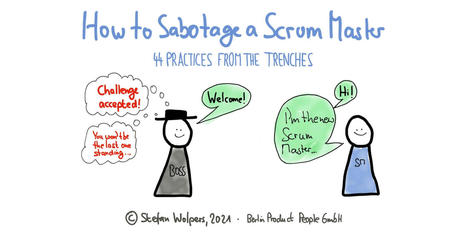
How to Sabotage A Scrum Master: 44 Anti-Patterns from the Trenches to Avoid — Scrum Master Survival Guide #11 by PST Stefan Wolpers...
|
|
Scooped by
Mickael Ruau
November 29, 2021 1:09 AM
|
Comme vous le savez, Jeff Sutherland et Ken Schwaber nous ont proposé une nouvelle version du Scrum Guide en novembre 2020. Mais que propose...
|
|
Scooped by
Mickael Ruau
November 16, 2021 11:49 AM
|
Key Takeaways
Simple Lean tools and techniques are excellent impediment removers by establishing root cause and countermeasures
Scrum wastes such as high backlog inventory, are often ignored due to overall net performance gains and are now problematic for remote Scrum teams
Scrum can be deemed wasteful when following the ceremonies to the letter of the Scrum Guide, particularly when remote
A continuous improvement mindset is reinforced, and in some cases reignited, by embracing Lean, a philosophy of continuous improvement
Lean is a psychological safety enabler for a Scrum Master by allowing failures or problems to be discussed as soon as they are detected
|
|
Scooped by
Mickael Ruau
November 10, 2021 12:24 AM
|
Dix sprints de 1 jour vous permettent d’achever 10 cycles de travail et d’apprentissage ensemble, 10 fois plus rapidement qu’une équipe typique. Et cela vous force à identifier les compétences et pratiques critiques comme trouver de petites poches de valeur et collaborer ensemble sur quelque chose au lieu de juste de remettre son travail de l’un à l’autre en séquence, ignorant facilement les compétences et pratiques dans un sprint de 2 semaines.
Vous dépenserez plus de temps dans les cérémonies de sprint. Aussi, ne devriez-vous probablement pas les adopter pour toujours. Mais si vous ressemblez à mes clients, vous serez étonnés de constater combien vous aurez réalisé.
|
|
Scooped by
Mickael Ruau
October 28, 2021 1:19 AM
|
À l’instar des autres pratiques de développement, la revue de code ou le mob programming ne peuvent pas se mettre en place indépendamment de considérations sur la culture de l’entreprise qui souhaite encourager ces pratiques. Certaines cultures d’entreprise favorisent activement la formation d’équipes en cohésion (principalement en ne plaçant pas d’obstacles à leur formation). Dans d’autres cultures, la notion même d’équipe est dénuée de signification réelle. De la même manière qu’aucune pratique de développement ne saurait être « copiée/collée » d’une entreprise à l’autre sans considération du contexte, il est apparent que toutes les entreprises ne sont pas égales devant le défi que constitue le développement d’un logiciel de qualité. La présence ou non des revues de code dans leur corpus de pratiques est à mon sens une preuve de cette inégalité.
|
|
Scooped by
Mickael Ruau
October 25, 2021 7:51 AM
|
Table of Contents
I. Groups & Teams Overview
1. Defining Teams and Groups
2. The Psychology of Groups
3. Cooperation
4. Social Comparison
5. Shared Information Bias
6. Judgment and Decision Making
II. Groups & Teams (In)Action
7. Professional Writing
8. Persuasive Presentations
9. Gantt Chart
10. Groups and meetings
11. Organizational culture
12. Inattentional Blindness
13. Teams as Systems
14. Performance Evaluation
III. Group & Team Theory
15. Power in Teams and Groups
16. Leadership
17. Structuration Theory
18. Symbolic Convergence Theory
19. Conformity and Obedience
20. Hofstede's Cultural Dimensions
21. Intercultural and Plane Crashes
22. Conflict and Negotiation
23. Nonverbal Communication
|
|
Scooped by
Mickael Ruau
October 25, 2021 5:25 AM
|
Table of Contents
I. Group & Team Communication Overview
1. Introducing Small Group Communication
II. Forming Groups
2. Understanding Group Formation
3. Identifying Group Roles
4. Establishing and Maintaining Group Norms
5. Working in Diverse Teams
6. Negotiating Power in Groups
III. Sustaining Groups
7. Cultivating a Supportive Group Climate
8. Navigating Group Conflict
9. Confronting and Preventing Social Loafing
10. Making Decisions in Groups
11. Engaging in Group Problem-Solving
12. Identifying Leaders
13. Leading in Groups
IV. Putting Group Communication Skills into Practice
14. Facilitating Group Meetings
15. Enhancing Creativity in Groups
16. Presenting as a Group
|
|
Rescooped by
Mickael Ruau
from Workplace News
October 22, 2021 3:08 AM
|
Remote work can be as effective as in-person work with the right people and collaborative processes.
Via Kate Lister
|


 Scoop.it!