


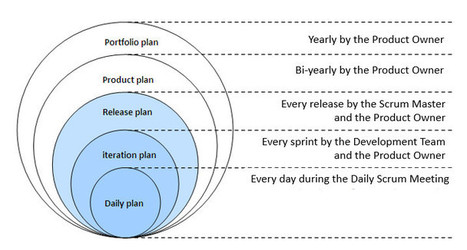
There's a common misconception in Agile that there's no planning. That's not true. But there's also over-planning. You've got to find the right balance.

 Your new post is loading...
 Scoop.it! There's a common misconception in Agile that there's no planning. That's not true. But there's also over-planning. You've got to find the right balance. 
No comment yet.
Sign up to comment
Scoop.it!
Thunderdome is an open source agile planning poker app that helps teams estimate story points.
Scoop.it!

From
pokrex

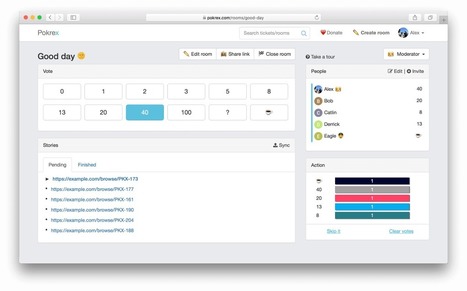
Pokrex browser extensions allows user to import tickets into Pokrex and update story points or story size back to JIRA. We have extensions for both Chrom
Scoop.it!

The blog post that prompted this episode is about a well-defined project. Or so Marcus thought. In this segment, we explore how he started to predict in that project, collecting some data and projecting that into the future. We also discuss some of the failures, and problems with probabilistic forecasting. Finally, we discuss the idea that making decisions is the goal of using data, not making predictions.
Scoop.it!

Mountain Goat Software offers Planning Poker® cards for your use in estimating. Each deck contains enough cards for four estimators to each hold cards with the following values: ?, 0, ½, 1, 2, 3, 5, 8, 13, 20, 40, 100, and ∞. The cards are printed on the finest quality card stock available. Each deck comes in a box
Scoop.it!

David Hawks and Reese Schmit combine their knowledge and discuss why re-estimating story points is wasted effort. Focus on consistency instead!
Mickael Ruau's insight:
Fight the temptation to re-estimateSome teams believe that velocity is a measure of how much they got done. With this mindset, velocity proves their work and effort. Therefore, it is tempting to change the estimate if more work (and bigger size) was needed to finish the story. However, velocity is a measurement used to determine what teams can get done in the FUTURE. Teams never have perfect information when they are estimating and planning upcoming work. If a story was estimated to be an 8 and it ended up being way easier (let’s say in the 2 range), don’t change it. The past should stay in the past. Anomalies are concerning, only if it happens a lot. We are looking for consistency in story point estimation not accuracy. Also important to note that it’s important to estimate the whole backlog with same fidelity (understanding) of knowledge. Re-estimation of story points…
Scoop.it!
The topic of normalizing velocities across teams is inevitable when working across multiple agile teams. This can get to be a religious debate so it is important to remember that normalizing velocities doesn't really matter to avoid conflict and misunderstanding.
Mickael Ruau's insight:
Portfolio ForecastingOperating at scale requires early estimation of large blocks of work without necessarily consulting the teams that may take on that work. This is necessary to minimize wasting team time on features that may not provide good ROI or be aligned to strategy. Quickly the question turns to velocity normalization, based on some incorrect assumptions.
Achieving these conditions would be challenging in optimal conditions and it is unnecessary to pursue this level of precision. The truth is, if the early-estimators are consistent and largely accurate in their relative assessment across features, normalization by teams does not matter. The reason is that individual teams must re-estimate that work according to their own scale and it will not have a significant impact on duration. It's a matter of changing units, e.g. Fahrenheit to Celsius, which should not impact real value. For this reason, I recommend that the SWAG not be in story points, but in some other measure like t-shirt size (or dog breeds) to help detach from the natural tendency to fit one scale into another. After some data has been gathered, that SWAG can be a good indicator of duration, given some assumptions. But if the early-estimators are measuring in story points, teams can still independently estimate in their own scales.
(...) High-performing teams learn and the work shifts quickly. So, keep the history short and in general do not worry about team performance more than 3 sprints in the past as a decision point.
Scoop.it!

Story points are a unit of measure for expressing an estimate of the effort required to fully implement a product backlog item or any other piece of work.
Scoop.it!

How to establish a common definition of a story point across multiple teams within an organization.
Mickael Ruau's insight:
The best way I've found to do this is to bring a broad group of individuals representing various teams together and have them estimate a dozen or so product backlog items (ideally in the form of user stories in my opinion). Not each estimator needs to understand every item but most people should understand most items. The items being estimated do not need to be new items; some could be from a project finished recently that many estimators remember or worked on. Some items could be artificial; perhaps the team is asked to estimate, "a typical transaction activity report." If that meant something to most estimators, it would be a good candidate item.
Scoop.it!
I've become a HUGE fan of David Hussman's "Dude's Law". Before you do anything, you need to know WHY you're doing it, not just HOW to do it. The purpose of Normalized Story Pointing is to enable high-level estimation of work for a SAFe Release Train comprised of closely aligned teams, any one of which may pull a Feature off the Program Backlog for implementation. Normalized Story Points should not be used for:
Scoop.it!
Story points in Scrum are not about the complexity of developing a feature; they are about the effort required to develop a feature.
Mickael Ruau's insight:
Adding Risk and UncertaintyRemember I said it was a simple brain surgery. (I’m not even sure that exists, but go with me for another minute.) If there was a risk the surgeon began the surgery and discovered he also needed to do some extra work during the surgery, that would be factored in and the estimate increased. So if we know a surgery will be simple we might call it 5 points. But if there’s a risk the surgery uncovers other work to be done, we would increase the estimate to a higher value. The Right Person for the Job Should Do The JobOur example of the surgeon and the little kid points points out another aspect of agile estimating. We should assume that the right person for the job will do the work.
|
Scoop.it!
This presentation covers basics of agile planning. This includes, release planning, iteration planning, predicting velocity and using buffers.
Scoop.it!
From
github
Make agile estimating and planning easy with our online planning or scrum poker tool - hlcfan/pokr
Scoop.it!

One of the most controversial updates to the 2011 Scrum Guide has been the removal of the term “commit” in favor of “forecast” in regards to the work selected for a Sprint. We used to say that the Development Team commits to which Product Backlog Items it will deliver by the end of the Sprint. Scrum now encourages the Development Team to forecast which Product Backlog Items it will deliver by the end of the Sprint.
Mickael Ruau's insight:
In Scrum, the Development Team is now asked to forecast the specific work that can be done in a Sprint, rather than “commit” to it. This allows teams to focus on the things that matter in professional software development like quality, value, and continuous improvement, rather than satisfying an arbitrary obligation.
Scoop.it!

Neil Killick proposes ways to reduce risk and uncertainty, calculate a product’s price, determine delivery dates and roadmap, do Scrum and XP without using estimates.
Scoop.it!

It is a blog of a database administrator, SQL, Java and AngularJS developer. You can find here articles related to software development.
Scoop.it!
In my last 5 Minute DevOps, I attempted to define user stories in a testable way. Real developers should test, after all. Now that we have a story, how do we communicate when it can ship?
Mickael Ruau's insight:
A skilled team can slice stories so that everything is a “1” or a “2”. At that point, all we need do is agree as a team a story can be done in that time range and track the throughput of cards. Anything else is focused on ceremony instead delivery. If you are using story points, you need to focus less on getting better at “pointing” and focus more on what really delivers value. Decompose work and ship it.
Scoop.it!

SAFe4 suggests that Story Points should be normalized across the Release Train. Additionally, it provides a method for estimating the first Sprint that could be considered inconsistent with the idea of Story Points. Let us take a closer look at the idea.
Mickael Ruau's insight:
Story Points are not a business metric. Neither is Velocity. They are simplified planning metrics intended to minimize planning effort while providing sufficient confidence in the created plan. The metrics are subject to the same constraits as in single-team Scrum, i.e. the following anti-patterns need to be avoided: Do not:
Scoop.it!

Sprint planning meetings should be quick and inexact. Learn why teams that try to think of everything are doing it wrong.
Scoop.it!

Traditional software development estimating techniques are slow, long lasting exercises and as such are totally unsuited to Agile processes. New methods of estimating have emerged which fit the Agile model, requiring minimal effort to provide ‘just enough’ information to support prioritization and decision making. This paper offers an introduction to the most popular of these techniques, as well as a look at how such practices work in larger, multi-team projects in which normalization has become the subject of disagreement.
Scoop.it!
The dangerous aspect comes from once you have a standard unit for measurement across teams, someone is inevitably going to use it to compare the performance of teams.
Even if everyone swears till they are blue in the face that they won't use it for cross team measurement, there will always be the suspicion that this will happen eventually. This will cause teams to distort their measurements so that it seems that they get more story points done.
My fear is that this will break the feedback loop of yesterday's weather and knock the planning process off kilter.
I'm always suspicious about these things because while it would be incredibly valuable to have a way to measure productivity I think the nature of software is such that we CannotMeasureProductivity.
Mickael Ruau's insight:
We move people around between projects at ThoughtWorks and I've never heard anyone complain about difficulty of estimating when coming onto a new team due to differences in story points.
Scoop.it!

Comment estime-t-on vraiment dans le monde de l'agilité ? Parle-t-on de complexité ou de point d'effort ? Est-ce la même chose ?
|





