Devops for Growth
116.2K views | +3 today
Devops for Growth
For Product Owners/Product Managers and Scrum Teams: Growth Hacking, Devops, Agile, Lean for IT, Lean Startup, customer centric, software quality...
Curated by Mickael Ruau
Your new post is loading...

Popular Tags

Current selected tag: 'gestion de projet'. Clear
Scooped by Mickael Ruau
August 18, 2020 2:51 AM
Scoop.it!

Stakeholder Management 101: Types of Stakeholders & How to Manage Them

Stakeholder Management 101: Types of Stakeholders & How to Manage Them | Devops for Growth | Scoop.it
Learn the types of stakeholders you’ll work with as a project manager, with stakeholder management tactics & tools for managing each relationship with ease.
Mickael Ruau's insight:


  1. First, I want to acknowledge the variety of stakeholder “types” and do my best to define the most common with which I have collaborated in my career as a project manager. These include:
    • Marketing Stakeholders
    • Technical Stakeholders
    • Sales Stakeholders
    • Executive Stakeholders
  1. Secondly, I want to provide insight on how to best approach these different types of stakeholders—whether you work with one or multiple per project.
No comment yet.
Scooped by Mickael Ruau
August 14, 2020 1:16 AM
Scoop.it!

Monte Carlo simulation of risk and uncertainty in project tasks

Monte Carlo simulation of risk and uncertainty in project tasks | Devops for Growth | Scoop.it
Introduction When developing duration estimates for a project task, it is useful to make a distinction between the  uncertainty inherent in the task and uncertainty due to known risks.  The former is uncertainty due to factors that are not known whereas the latter corresponds uncertainty due to events that are known, but may or may…
No comment yet.
Scooped by Mickael Ruau
August 12, 2020 1:14 AM
Scoop.it!

Monte Carlo simulation of multiple project tasks – three examples and some general comments

Monte Carlo simulation of multiple project tasks – three examples and some general comments | Devops for Growth | Scoop.it
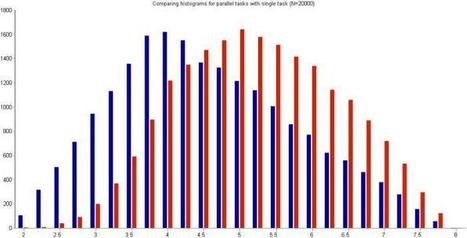
Introduction In my previous post I  demonstrated the use of a Monte Carlo technique in simulating  a single project task with completion times  described by a triangular distribution.  My aim in that article was to:  a) describe a Monte Carlo simulation procedure in enough detail for someone interested to be able to reproduce the calculations and b)…
No comment yet.
Scooped by Mickael Ruau
August 8, 2020 4:19 AM
Scoop.it!

Web-Based Monte Carlo Simulation for Agile Estimation

Web-Based Monte Carlo Simulation for Agile Estimation | Devops for Growth | Scoop.it
A web-based tool for calculating project estimates using a Monte Carlo simulation was recently made publicly available. It was created in the hopes that agile teams will use it to facilitate conversations between scrum masters and product managers, focusing on realistic outcomes and not overly optimistic projections.
No comment yet.
Scooped by Mickael Ruau
August 7, 2020 11:14 AM
Scoop.it!

Peopleware: Productive Projects and Teams Book Review | Pluralsight

Peopleware: Productive Projects and Teams Book Review | Pluralsight | Devops for Growth | Scoop.it
The modern workplace disregards the fact that engineers feel best creating quality work, which often requires the right space and opportunities to think about the solution they're working on.

Many companies push for faster development cycles, impossibly tight deadlines and a management approach that treats people like they're easily replaceable parts. It's not an easy task to reverse this reality for your team, but this book is the blueprint you need.

Peopleware is divided into six parts:

Managing the Human Resource
The Office Environment
The Right People
Growing Productive Teams
Fertile Soil
It's Supposed to Be Fun to Work Here
Mickael Ruau's insight:

The Most Important Things You'll Learn from Peopleware: Productive Products and Teams

  • Stop looking at team problems from a technological standpoint. A sociological approach is necessary for knowledge workers.
  • Create a working environment capable of fostering concentration. Open floor plans and cubicle farms make it next to impossible for software engineers to achieve "flow," which is a state of focus that permits them to think. Give them the right space and privacy to create quality work. This process is not one size fits all. Watch how your team works to find an ideal configuration.
  • You can't fix every single problem that's impacting your team's productivity, but you can tackle issues one at a time with an eye for the long-term.
  • More hours worked does not equal a greater quantity or quality of work. Avoid overtime as much as possible, outside of crunch situations. Accept that less productive time, termed “under time”, will happen throughout the project.
  • Your hiring process should include a development portfolio and input from current team members.
  • Strive to achieve goal alignment between team members, as this helps you create a working unit capable of more than the sum of its parts.
  • Your team members know there's more to life than work, and you face high turnover if you don't give them the balance they need.
  • A culture of quality is necessary to keep your team happy with the work they do. Realistic project timelines and pushing back against moving upper management goalposts is an essential part of creating this environment.

If you only remember one line from Peopleware

“The manager’s function is not to make people work, but to make it possible for people to work.”

No comment yet.
Scooped by Mickael Ruau
August 3, 2020 8:41 AM
Scoop.it!

A3 ou comment résoudre des problèmes en 8 étapes

A3 ou comment résoudre des problèmes en 8 étapes | Devops for Growth | Scoop.it
L’A3 est un des outils les plus importants du Lean Management et de l’amélioration continue. Son utilisation peut aussi bien servir à résoudre des problèmes du quotidien qu’à gérer un projet de manière plus globale. Sa structure en 8 étapes sert de fil conducteur à une communication visuelle et factuelle. Ce document construit pour évoluer au cours du projet a le grand avantage d’objectiver les discussions: le problème, l’objectif, les causes sont clairement décrits et chiffrés. D’ailleurs, nous vous recommandons l’utilisation de graphiques, images, ou schémas qui rendront la feuille encore plus impactante . Les mesures et le plan de leur implémentation sont également visibles par tous les intervenants. Enfin, la feuille A3 n’oublie pas de mentionner les étapes de vérification et de standardisation du processus. Il n’est donc pas étonnant que les Project Managers s’en servent comme support de présentation face à leurs interlocuteurs.
No comment yet.
Scooped by Mickael Ruau
July 21, 2020 2:34 AM
Scoop.it!

Want to ship on time? Try this approach

Want to ship on time? Try this approach | Devops for Growth | Scoop.it
How the Bubble Framework works

Essentially, it’s a data-driven feedback loop that enables dev teams to actively respond to change – specifically by accurately tracking progress and anticipating risks of delay – and course-correct accordingly. With the estimator, I used historical data from Jira to compute a project lead time in the form of a probability distribution. Unlike traditional estimation methods, no team estimates are necessary, which not only saves time and hassle but also enables unbiased and instant forward visibility for planning and course correction throughout a project. In developing the algorithm, I drew heavily from two established methods of estimation: the visual component is based on a tool developed by the Critical Chain Project Management community, and the estimate function is rooted in the Monte Carlo method. In essence, what I brought to the table was the pairing of the visual tool and the estimation algorithm to create a short feedback loop that relies on historical data rather than team estimates, thus avoiding some common pitfalls of progress tracking and estimation.
No comment yet.
Scooped by Mickael Ruau
July 17, 2020 1:28 AM
Scoop.it!

The art of delivering value on time

Christophe Achouiantz (@ChrisAch) The Art of Delivering Value on Time (The Art of Succeeding) Christophe Achouiantz Lean/Agile Coach
No comment yet.
Scooped by Mickael Ruau
July 16, 2020 8:46 AM
Scoop.it!

List of software development philosophies - Wikipedia

List of software development philosophies

This is a list of approaches, styles, and philosophies in software development. It also contains programming paradigms, software development methodologies, software development processes, and single practices, principles and laws.

No comment yet.
Scooped by Mickael Ruau
July 10, 2020 8:03 AM
Scoop.it!

Publication de la mise à jour 2019 du "Guide d'audit de la gouvernance du système d’information de l’entreprise numérique"

Publication de la mise à jour 2019 du "Guide d'audit de la gouvernance du système d’information de l’entreprise numérique" | Devops for Growth | Scoop.it
Le guide est un outil pratique à destination de toutes les parties prenantes du SI de l’entreprise pour évaluer la gouvernance du SI et améliorer sa performance.
No comment yet.
Scooped by Mickael Ruau
July 10, 2020 6:09 AM
Scoop.it!

Comité de pilotage du changement

Comité de pilotage du changement | Devops for Growth | Scoop.it
Composition du comité de pilotage, rôles et missions du Comité de pilotage, alignement et échos systémiques pour conduire le changement
No comment yet.
Scooped by Mickael Ruau
July 6, 2020 8:05 AM
Scoop.it!

Make A Project Initiation Document In A Flash (Here's How!)

Make A Project Initiation Document In A Flash (Here's How!) | Devops for Growth | Scoop.it
A Project Initiation Document (PID) is project documentation you can use to define the project scope, management, governance, and success criteria. Make a PID the right way—download the free project initiation document template and follow our PID best practices to start your projects right.
No comment yet.
Scooped by Mickael Ruau
August 15, 2020 3:19 AM
Scoop.it!

The drunkard’s dartboard: an intuitive explanation of Monte Carlo methods

The drunkard’s dartboard: an intuitive explanation of Monte Carlo methods | Devops for Growth | Scoop.it


  1. Define a domain of possible inputs – in our case the domain of inputs is defined by the enclosing square of side 1 unit.
  2. Generate inputs randomly from the domain using a certain specified probability distribution – in our example the probability distribution is a pair of independent, uniformly distributed random numbers lying between 0 and 1.
  3. Perform a computation using the inputs – this is the calculation that determines whether or not a particular trial is a hit or not (i.e.  if the x,y coordinates obey inequality  (1) it is a hit, else  it’s a miss)
  4. Aggregate the results of the individual computations into the final result – This corresponds to the calculation of the probability (or equivalently, the area of the circle) by aggregating the number of hits for each set of trials.


To summarise: Monte Carlo algorithms generate random variables (such as probability) according to pre-specified distributions.  In most practical applications  one will use more efficient techniques to sample the distribution (rather than the naïve method I’ve used here.)  However, the basic idea is as simple as playing drunkard’s darts.

No comment yet.
Scooped by Mickael Ruau
August 13, 2020 1:16 AM
Scoop.it!

The Flaw of Averages – a book review

The Flaw of Averages – a book review | Devops for Growth | Scoop.it
The two forms of the flaw of averages

The book makes a distinction between two forms of the flaw of averages. In its first avatar, the flaw states that the combined average of two uncertain quantities equals the sum of their individual averages, but the shape of the combined uncertainty can be very different from the sum of the individual shapes (Recall that an uncertain number is a shape, but its average is a number). Savage calls this the weak form of the flaw of averages. The weak form applies when one deals with uncertain quantities directly. An example of this is when one adds up probabilistic estimates for two independent project tasks with no lead or lag between them. In this case the average completion time is the sum of the average completion times for the individual tasks, but the shape of the distribution of the combined tasks does not resemble the shape of the individual distributions. The fact that the shape is different is a consequence of the fact that probabilities cannot be “added up” like simple numbers. See the first example in my post on Monte Carlo simulation of project tasks for an illustration of this point.

In contrast, when one deals with functions of uncertain quantities, the combined average of the functions does not equal the sum of the individual averages. This happens because functions “weight” random variables in a non-uniform manner, thereby amplifying certain values of the variable. An example of this is where we have two sequential tasks with an earliest possible start time for the second. The earliest possible start time for the second task introduces a nonlinearity in cases where the first task finishes early (essentially because there is a lag between the finish of the first task and the start of the second in this situation). The constraint causes the average of the combined tasks to be greater than the sum of the individual averages. Savage calls this the strong form of the flaw of averages. It applies whenever one deals with nonlinear functions of uncertain variables. See the second example in my post on Monte Carlo simulation of multiple project tasks for an illustration of this point.

Much of the book presents real-life illustrations of the two forms of the flaw in risk assessment, drawn from finance to the film industry and from petroleum to pharmaceutical supply chains. He also covers the average-based abuse of statistics in discussions on topical “hot-button” issues such as climate change and health care.
Mickael Ruau's insight:


Early in the book, Savage presents five tools that can be used to develop a feel for uncertainty. He refers to these tools as mindles – or mind handles.  His five mindles for uncertainty are:

  1. Risk is in the eye of the beholder, uncertainty isn’t. Basically this implies that uncertainty does not equate to risk. An uncertain event is a risk only if there is a potential loss or gain involved. See my review of Douglas Hubbard’s book on the failure of risk management for more on risk vs. uncertainty.
  2. An uncertain quantity is a shape (or a distribution of numbers) rather than a single number. The broadness of the shape is a measure of the degree of uncertainty. See my post on the inherent uncertainty of project task estimates for an intuitive discussion of how a task estimate is a shape rather than a number.
  3. A combination of several uncertain numbers is also a shape, but the combined shape is very different from those of the individual uncertainties.  Specifically, if the uncertain quantities are independent, the combined  shape can be narrower (i.e. less uncertain) than that of the individual shapes.  This provides the justification for portfolio diversification, which tells us not to put all our money on one horse, or eggs in one basket etc. See my introductory post on Monte Carlo simulations to see an example of how multiple uncertain quantities can combine in different ways.
  4. If the individual uncertain quantities (discussed in the previous point) aren’t independent, the overall uncertainty can increase or decrease depending on whether the quantities are positively or negatively related. The nature of the relationship (positive or negative) can be determined from a scatter plot of the quantities. See my post on simulation of correlated project tasks for examples of scatter plots. The post also discusses how positive relationships (or correlations) can increase uncertainty.
  5. Plans based on average numbers are incorrect on average. Using average numbers in plans usually entails manipulating them algebraically and/or plugging them into functions. Savage explains how the form of the function can lead to an overestimation or underestimation of the planned value. Although this sounds a somewhat abstruse, the basic idea is simple: manipulating an average number using mathematical operations will amplify the error caused by the flaw of averages.

Savage explains the above concepts using simple arithmetic supplemented with examples drawn from a range of real-life business problems.

No comment yet.
Scooped by Mickael Ruau
August 11, 2020 1:13 AM
Scoop.it!

An introduction to Monte Carlo simulation of project tasks

An introduction to Monte Carlo simulation of project tasks | Devops for Growth | Scoop.it
Introduction In an essay on the uncertainty of project task estimates,  I  described how a task estimate corresponds to a  probability distribution.  Put simply, a task estimate is actually a range of possible completion times, each with a probability of occurrence specified by a distribution.   If one knows the distribution,  it is possible to answer questions  such as:  "What is…
No comment yet.
Scooped by Mickael Ruau
August 7, 2020 11:22 AM
Scoop.it!

Agile Pinoy Downloads –

The following files are available for FREE DOWNLOAD.

Checklists

Templates

Reviewers

No comment yet.
Scooped by Mickael Ruau
August 7, 2020 11:13 AM
Scoop.it!

Note de lecture : Peopleware: Productive projects and teams (2nd edition), par Tom DeMarco & Timothy Lister –

Note de lecture : Peopleware: Productive projects and teams (2nd edition), par Tom DeMarco & Timothy Lister – | Devops for Growth | Scoop.it
Ce livre concerne le management, ou plutôt la gestion de projets mais dans le sens où la gestion d’un projet est d’avantage une question de faciliter la synergie de groupe que de méthodologies formelles. Qu’ont donc en commun les projets ayant abouti à des succès remarqués ? Une gestion du projet et des ressources particulièrement méticuleuse ? Parfois. La formation d’un groupe d’experts hautement qualifiés ? Pas toujours. L’utilisation d’un processus élaboré distribuant tâches rôles et responsabilités de façon rigoureuse et détaillée ? Rarement. Peopleware expose les traits communs de ces projets : la formation d’une équipe soudée, volontaire, complémentaire. Mais aussi la fierté d’appartenir à un groupe d’excellence, d’évoluer dans un environnement où la contribution individuelle et collective est reconnue.
Mickael Ruau's insight:

Ce texte n’est pas une théorie sur les relations humaines, mais une suite d’essais adressant des aspects particuliers du sujet et s’appuyant sur des exemples concrets issus de la longue expérience de consulting des deux auteurs. Même si ils n’en ont pas la forme, ces essais sont pratiquement des patterns, ce qui en fait un ouvrage en avance sur son temps, car publié en 1987 pour la première édition. D’avant-garde, ce livre l’est encore d’avantage car il pose tout les fondements des méthodes agiles tels que l’extreme programming ou le lean development, par exemple.


Le livre est découpé en 6 parties totalisant 34 chapitres (ou essais). Le total n’étant que de 226 pages vous comprendrez que chaque chapitre n’excède pas quelques pages, ce qui renforce encore leur analogie avec les patterns. Les thèmes abordés au long de ces 6 parties sont : gestion des ressources humaines, l’environnement du bureau, le choix des bonnes personnes, la croissance des équipes productives, l’épanouissement dans le travail et quelques sujets connexes regroupés en dernière partie.

No comment yet.
Scooped by Mickael Ruau
August 3, 2020 8:36 AM
Scoop.it!

Gestion de projet Lean : le projet A3

Gestion de projet Lean : le projet A3 | Devops for Growth | Scoop.it
Le document A3 va être à la fois un outil de communication simple et visuel sur le projet, un support de suivi et va permettre d’un coup d’œil de juger du bon avancement du projet associé.

Le projet va donc être décrit sur une feuille A3.
Mickael Ruau's insight:


Comment remplir votre A3 ?

3 cartouches du haut :

  • Le contexte qui explique le lancement du projet.
  • La description du problème à résoudre
  • Les objectifs finaux du projet

2 cartouches centrales :

  • Description plus détaillée de la situation de départ avec ses anomalies et ses difficultés.
  • Description plus détaillée de la situation d’arrivée après déroulement du plan d’actions porté par le projet

N’hésiter pas à associer à ces deux descriptions des photographies qui rendront votre A3 plus factuel, plus visuel et qui permettront ainsi d’en améliorer son attractivité (la communication autour d’un projet étant toujours l’une des clés de sa réussite)

Plan d’actions et planning macro du projet

Vous allez globalement lister les actions, affecter les responsables de chacune d’entre elles et réaliser le Gantt du projet en maillant à la semaine (un projet A3 sera maximum de 6 mois sinon décomposez le en plusieurs phases)

Ce planning sera suivi à la semaine et vous maintiendrez l’état d’avancement de chaque action en verdissant les cases initialement grisées si votre avancement est conforme à vos attentes ou en les coloriant en rouge si un dérapage est observé (l’avancement à la semaine peut se faire au fluo pour une maintenance aisée)

3 cartouches du bas :

  • Vous allez spécifier l’équipe projet (membres actifs) et les sponsors
  • Les indicateurs mesurant la performance en notant les performances de départ, les performances actuelles et les performances visées en fin de projet.
  • La dernière cartouche sera réservée au retour d’expérience (le fameux REX) afin de lister les points d’apprentissage qui devront être pris en compte et appréhendés pour améliorer le déroulement des futurs projets.

Tout en haut du A3 à droite vous trouverez la couleur du projet qui sera maintenu toutes les semaines par le chef de projet :

  • Vert = tout va bien et se déroule conformément au planning établi
  • Rouge = difficulté à lever pour garantir le succès et le bon timing du projet.
No comment yet.
Scooped by Mickael Ruau
July 22, 2020 5:37 AM
Scoop.it!

PMFinder – Blogue par des experts en gestion de projets

PMFinder – Blogue par des experts en gestion de projets | Devops for Growth | Scoop.it


Dans son livre Adaptive Project Framework: Managing Complexity in the Face of Uncertainty, Robert Wysocki explique avoir observé qu’en ce début de 21e siècle, tout domaine confondu, environ 70% des projets nécessitaient une gestion de projet «adaptative» (tel qu’illustré dans la figure ci-bas).
Le paysage de la gestion de projet
Fig. 1 - Le paysage de la gestion de projet (R.Wysocki) (Traduction et adaptation par Claude Émond)

«Adaptative» est le mot qu’il utilise pour caractériser une approche «agile structurée» comme le Scrum, en opposition à une gestion de projet «extrême» ou l’agilité n’est plus structurée, mais plutôt improvisée, spontanée et réinventée constamment.
No comment yet.
Scooped by Mickael Ruau
July 17, 2020 12:21 PM
Scoop.it!

The Top 8 Tips for Managing Complex Software Projects

The Top 8 Tips for Managing Complex Software Projects | Devops for Growth | Scoop.it
Some projects are so complex, you think they must be a joke. But they're oh-so-for-real. Here are the principles and tactics you need to pull it off.
No comment yet.
Scooped by Mickael Ruau
July 16, 2020 8:48 AM
Scoop.it!

Software development process - Wikipedia

Software development process

In software engineering, a software development process is the process of dividing software development work into distinct phases to improve design, product management, and project management. It is also known as a software development life cycle ( SDLC).

No comment yet.
Scooped by Mickael Ruau
July 10, 2020 9:06 AM
Scoop.it!

Quel rythme pour les instances de pilotage ?

Quel rythme pour les instances de pilotage ? | Devops for Growth | Scoop.it
En début de projet, il est nécessaire de s’assurer que :

L’énergie déployée par les équipes est bien dirigée
L’organisation est en place et bien comprise

De plus, il est nécessaire de resserrer les premiers contrôles. Il est judicieux de diviser par 2 les ratios. Donc pour une tâche moyenne de 2 semaines, point d’avancement tous les 3 jours, premier copil après 2 semaines. Vous pourrez revenir ensuite à un délai normal entre les contrôles.
Je conseille d’appliquer la même règle :

Au début d’une phase sensible
Après une forte correction
Après une redéfinition du périmètre
Pour des tâches sur le chemin critique
No comment yet.
Scooped by Mickael Ruau
July 10, 2020 6:12 AM
Scoop.it!

Conduite du changement : les instances - Questions de management, le blog d'Eric Delavallée


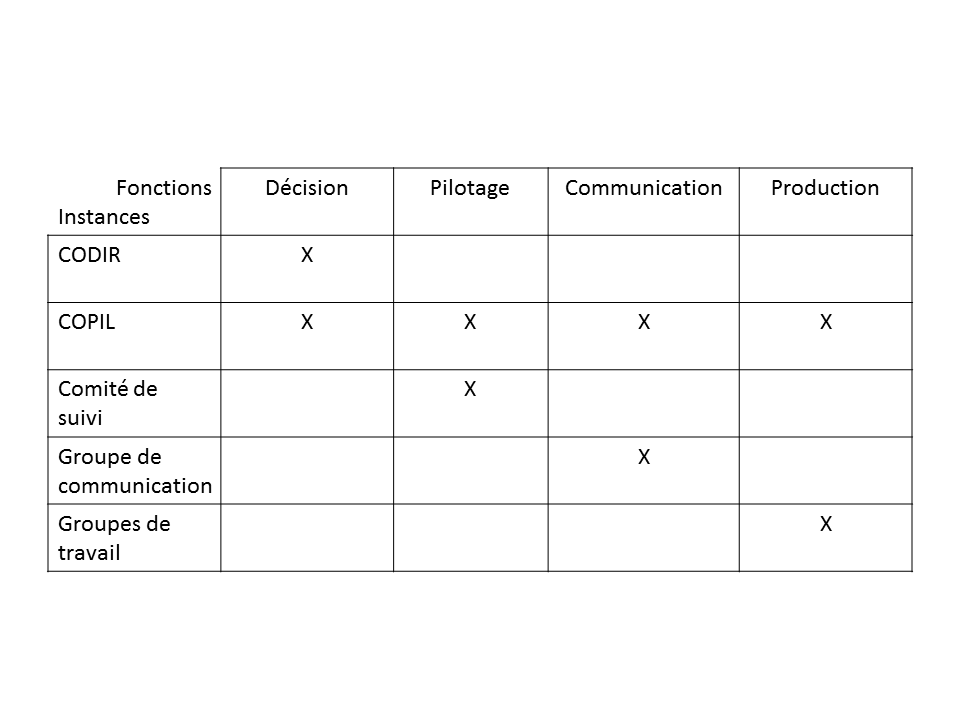
Chaque fonction doit être correctement remplie

Au niveau du choix des instances, les options sont donc multiples. L’important est de bien s’assurer que chaque fonction nécessaire à la conduite de la transformation sera correctement remplie. A cet égard, la matrice ci-dessous est un outil précieux.

Par ailleurs, une manière très opérationnelle d’affecter les responsabilités à chacune des instances retenues est d’utiliser la fameuse grille RACI (R : Responsible ; A : Accountable ; C : Consulted ; I : Informed) très courante dans les démarches de design organisationnel.

No comment yet.
Scooped by Mickael Ruau
July 9, 2020 6:23 AM
Scoop.it!

Create A Project Communication Plan (+ Template)

Create A Project Communication Plan (+ Template) | Devops for Growth | Scoop.it

What to Include in Communication Plans

While the specifics of your communication plan will vary depending on the project type and scope, there are a few key items that should be included in every project communication plan you create:
Key stakeholders: Note all key stakeholders, including your primary client contact. Include contact information such as phone numbers and emails, so that anyone who accesses the communication plan is able to find this information.
Team members: Include the main team members from your project team along with their roles. This is handy for anyone new to or unfamiliar with the project. List who on your team is involved in the communication of deliverables, leading strategic discussions, or how you’ll handle technical conversations between stakeholders and your team.
Communication methods: Outline the main communication methods and different channels you will be using to contact stakeholders, such as email, phone calls, in-person meetings, video meetings, Slack, social media, or any others. Include notes on stakeholder’s preferred channels.
Communication type: Include types of communication, how that communication will be shared, what will be included, and who that communication will be with. For example, you might be providing weekly status reports to the client. Think about how you will provide this, who it will be provided to, and what information needs to be in the report.
Communication style: This can be broken down by stakeholder and communication method. Does a certain stakeholder prefer formal communication only, or can you be a little more casual in your tone?
Meeting schedule: While you can adjust this as needed throughout the project, having an initial idea of how often you’ll be meeting with stakeholders is helpful. Depending on the scope of the project, you might also want to outline how often you’ll be emailing the client. Include internal team meetings as well in your meeting schedule.
Key messages: For each stakeholder, determine the key message or information that will need to be communicated with them throughout the project. This also includes any information or feedback you will need from them.
Communication goals: A communication plan that includes communication goals can help ensure you make decisions based on what you’re trying to achieve.
No comment yet.