


Steve Blank and I worked hard at the Customer Development Manifesto, "rules" for startups and big companies alike when they commit to the customer development process. They're part of chapter two of The Startup Owner's Manual and always worth a read

 Your new post is loading...
 Scoop.it! Steve Blank and I worked hard at the Customer Development Manifesto, "rules" for startups and big companies alike when they commit to the customer development process. They're part of chapter two of The Startup Owner's Manual and always worth a read

No comment yet.
Sign up to comment
Scoop.it!

Launching a successful new business concept requires a strong purpose, a focus on research, an innovative business model, and a willingness to adapt.
Via Oliver Durrer swissleap.com
Scoop.it!
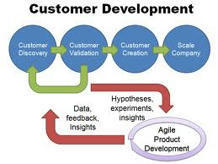
This model does not replace the Product Development model, it works in conjunction with it.
Mickael Ruau's insight:
The Customer Development model is different because it is iterative. It is okay to fail several times before getting it right.
The model makes it okay to fail because it prevents businesses from moving forward even if it hasn’t found the right customer.
Scoop.it!

From
www

Why "Crossing the Chasm" MattersGeoffrey Moore and others noted that many new technologies and products are quickly adopted by technically savvy early adopters but struggle to achieve greater market penetration until the products and services become acceptable to the "early majority." The early majority seeks "whole products," not simply new technologies, so to succeed as an innovative entrepreneur you must conceive your innovation not for the savvy early adopter, but for the more cautious early majority. The "chasm" is the market gap between early adopters (a small percentage of the market) and the early majority (a much larger segment of the market).
Mickael Ruau's insight:
Accelerating to the Early MajorityFor innovative entrepreneurs, this means that you've got to overcome two issues quickly. First, you've got to establish trust in your company or brand as quickly as possible, since you operate in an existing market where other competitors are known. Second, you've got to understand, and build for, the early majority, so your products are understood and can be acquired by a large segment of the buying public. Selling exclusively to early adopters won't scale your business. Creating the best technology but neglecting to build awareness about your company and trust in your brand can equally lead to disaster. Innovative entrepreneurs are a special breed - combining the thrill and risk of introducing a new idea while simultaneously building a new business and brand in the face of stiff competition. This is why the rewards are often so large, and why the failure rate can also be high. Successful innovators and entrepreneurs plan for and design for the early majority.
Scoop.it!
In this blogpost, I copied the 14 rules from the book The customer development manual and gave my opinion based on the experience I have with creating startups and introducing new products.
Mickael Ruau's insight:
Rule 8: Existing companies are based on the balance sheet and lost-profit account.
Scoop.it!

Customer Validation is when the things get serious and real. The goal of business is to build a repeatable sales road map, Second stage of..
Scoop.it!
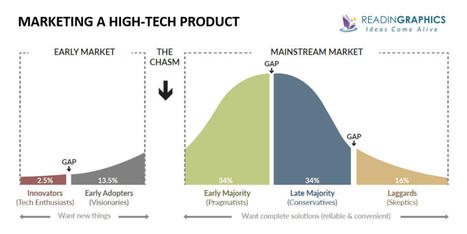
In this Crossing the Chasm summary, we'll briefly explain the strategies for launching a high-tech product, with decision-making guidelines for investors, engineers, marketers and managers in the high-tech community.
Scoop.it!

No campaign plan survives first contact with the enemy Field Marshall Helmuth Graf von Moltke I was catching up with an ex-graduate student at Café Borrone, my favorite coffee place in Menlo Park. This was the second of three “office hours” I was holding that morning for ex students. He and his co-founder were both…
Scoop.it!

Customer development. I love it. Finding out what works and what not is super important and often overlooked by entrepreneurs who what to ship asap. I too want to ship asap, but I also want to ship…
Mickael Ruau's insight:
Once, I was the guy who thought ‘if I build this, they will come’. And of course, they didn’t. Don’t make the same mistake, read this.
Scoop.it!
Entrepreneurship activities to find early adopters are central to any entrepreneurship curriculum. This exercise demonstrates where and how to find a business model’s Early Adopters
Mickael Ruau's insight:
Comments
This exercise uses mechanical pencils, and a 10-minute competition between students, to introduce Early Adopters in a way that not only contrasts them with Early Majority and Late Majority customers, but also demonstrates where and how to find a business model’s Early Adopters. We are very proud that this exercise was a finalist in the prestigious USASBE 3E Competition, which recognizes the best experiential entrepreneurship exercises at the USASBE 2019 Conference! The key questions this lesson plan answers are:
Scoop.it!

Steps to Build a Minimum Viable Persona
Scoop.it!

The moment that you’re talking about a person’s problems, they’re happy. If you’re there to solve that person’s problem then they’re willing to have that conversation. That’s how you get them to help. The moment you’re talking about yourself, your solution or the fourth or fifth problem on their list then you’re wasting their time. – Brant Cooper, Lean Entrepreneur Co-Author
Mickael Ruau's insight:
An interesting founding story can help cut through the noise and generate curiosity with early adopters. As a founder seeking face time with prospects, you must be able to answer the age old WIIFM (What’s In It For Me). The Top 10 Ways How to Get Early Adopters Interested
Here are the top ten things you can offer to motivate early adopters to meet with your team:
All early adopters are different. You will need to do your research to understand the best way to motivate these prospects, but you have to talk to the problems they care about if you want to recruit them for your customer development panel.
Scoop.it!

Get Busy on Social MediaNine out of every 10 consumers believe businesses should take time to answer questions from customers on Facebook. But only 25 percent of companies actually do this. Facebook in particular (and social media in general) can be one of the best places to find your early adopters without having to spend a great deal of money on expensive surveys. Interact with your target market on Facebook, and you’ll quickly find your potential early adopter group.
Mickael Ruau's insight:
Put Yourself in Your Target Market’s Shoes — LiterallyPhysically put yourself where your target market is. You should be well aware of the gathering spots of your target market. From there, you’ll be able to discern the leaders and early adopters. The early adopters are usually the people who are being talked to and about. Take note of who seems to be leading the charge when it comes to visiting booths if you’re at an industry show, or who is deemed the local expert if you’re on an online forum. To rub elbows with these early adopters, it’s best to become known as an expert yourself. Interact without trying to hard-sell. Offer advice and solutions for the problems they face. Don’t worry about cannibalizing your products; people simply want to know they’re dealing with an expert before they start to open up. Most people are not DIYers, nor do they want to become an all-in-one do-it-yourself entity. If you are the person who provides the answers, then you are the person that early adopters will look to when it comes time to solve a problem.
|
Scoop.it!
Jobs to be Done is a customer development framework with great potential. Here you'll learn the JTBD basics, my step-by-step process (together with templates you can copy) of conducting interviews, and ways you can use the insights throughout your organization.
Scoop.it!

Steve Blank has developed a formula called The Lean LaunchPad to help build many successful startups.
Mickael Ruau's insight:
Customer Validation If you're at this step, you believe that you don't need to pivot, that you have validated your hypothesis and have product/market fit. And so now, there are 4 phases to this process:
Scoop.it!

This is the fourth in a series of stories summarizing the key takeaways from Steve Blank’s seminal book, The Startup Owner’s Manual.
Mickael Ruau's insight:
Put simply, Customer Development is a structured process for testing your business model hypotheses. It’s used to test assumptions and make corrections quickly. The Customer Development model is applied over four steps:
The first two steps are search activities, while three and four focus on execution. Entrepreneurs cycle through each step until they achieve enough measurable progress to move onto the next step, making adjustments along the way in pursuit of a scalable business model.
Scoop.it!

The original Chasm concept was first recognized and described by Lee James and his colleagues, all of whom worked for Regis McKenna Inc. in the Pacific Northwest.
Mickael Ruau's insight:
The chasm model fails in the area entrepreneurs and product leaders need mostUsing a “D-Day analogy” Crossing the Chasm tells managers to marshal all available resources in collaboration with selected partners/allies and create a minimum viable [whole] product that meets the target customer’s compelling reason to buy, thereby establishing a foothold in a niche segment of the mainstream market. Unfortunately this prescription does not help address the number one challenge faced by most emerging high tech companies. For entrepreneurs and managers alike, the primary question to answer is: how much of our limited resources should be allocated to the products/services we offer today, and how much should be allocated to the products/services we want to offer in the future? Obviously, this is not a critical question for startups with just one product. But managers of companies with an existing product recognize that every resource allocated to a new product could, in the short term, be allocated to the success of an existing product. And for new products or innovations there is no real way to predict return on investment. Crossing the Chasm does not provide a useful answer to this fundamental question….or even worse, it encourages managers to wait until the chasm to truly invest in the needs of mainstream customers. ConclusionTogether this means Crossing the Chasm is not a model that an uninitiated entrepreneur can take and “run with.” A lot of experience and high-tech business acumen is required to use it properly…at selected times. Unfortunately, there is widespread misunderstanding and misapplication of the chasm model.
Scoop.it!

You must collect data when you get out of the building. But analyze it with a critical eye. Don't just add up the columns. Look for insight!
Questions for You
Mickael Ruau's insight:
Suggested Readings
Tools and exercisesBlank, Steve. Slideshare. The Tactics of Conducting Customer Discovery. Blank, Steve. Founders Workbook. A companion to the Startup Owner’s Manual. (Website: Zoomstra.com/foundersworkbook)
Scoop.it!

Crossing the chasm decides if product innovation will be successful, or has to leave the market. Innovators have to build first reference customers in the mainstream market to prove their business model and a compelling offering.
Mickael Ruau's insight:
As she states in her quote, the fundamental principle to winning first reference customers in the mainstream market is to target a specific niche segment as your point of attack and focus all your resources on achieving the dominant leadership position in that segment. Starting with a niche market ensures focusing on a very specific customer problem and probably little to no competition. The mistake most product managers make is to focus on a broad market segment because they fear a niche market will not be profitable enough. This thinking is misleading as the mere focus should be on getting a foot in the mainstream market. Find your niche and use those customers as a reference to attack adjacent segments. In order to do so successfully, each product manager needs to understand the ‘Technology Adoption Life Cycle’ model. This is a sociological model that describes the adoption or acceptance of a new product or innovation, according to the demographic and psychological characteristics of defined adopter groups. The process of adoption over time is typically illustrated as a classical normal distribution (see figure 1). We can see that innovations face a chasm between the early and the mainstream market. Crossing the chasm decides if the innovation will be successful, or has to leave the market. Innovators have to build first reference customers in the mainstream market to prove that they have a promising business model.
Scoop.it!

Modern entrepreneurship began at the turn of the 21st century with the observation that startups aren’t smaller versions of large companies – large companies at their core execute known business models, while startups search for scalable business models. Lean Methodology consists of three tools designed for entrepreneurs building new ventures: The Business Model Canvas – to write down all…
Via Oliver Durrer swissleap.com
Scoop.it!

Finding out who your customers are and what they need is an important step for building a strong startup and launching a successful business.
Scoop.it!

What Is the Early Adopter Tax?The early adopter tax refers to the premium that early adopters pay for new technology as new tech always costs more upon release. In addition to the cost, the early adopter tax includes the bugs and defects in new technology that have not yet been ironed out, as well as missing out on the new features that are included in successive iterations. How Do You Market to Early Adopters?The best ways to market to early adopters include understanding what they need, meeting them in person, providing them with a product they can use right away, targeting specific individuals and companies, addressing an existing alternative, and telling a story. What Percentage of People Are Early Adopters?Approximately 13.5% of people are early adopters.2
Mickael Ruau's insight:
The term "early adopter" comes from a book by Everett M. Rogers, titled, Diffusion of Innovations (1962) in which he discusses five types of adopter stages for products. The five types are (1) innovator, (2) early adopter, (3) early majority, (4) late majority, and (5) laggard.1 Advantages and Disadvantages of Being an Early AdopterEarly adopters of hardware that is content-reliant may face a lack of ways they can use their equipment until producers catch up. For example, early adopters of recorded media players may have only had a shortlist of titles they could choose from when the hardware was first released from manufacturers. The expectation is that over time, more content would become available for the chosen media format, but there is no guarantee. For instance, after the introduction of high-definition television, early adopters waited for television broadcasters to supply more and more of their shows in the new format that took advantage of the higher visual clarity. When it came to high-definition home video playback, a format war arose between manufacturers of Blu-ray and HD DVD players. Early adopters of either disc player were anticipating their format would eventually win out as the high-definition video disc of choice for the market. In those early years, entertainment companies released movies and the video content might have been published on either one of the formats. This left early adopters with limited options on the content their disc players could access. Only rarely did content get published by entertainment companies for both standards. Eventually, the Blu-Ray platform became universally adopted for high definition video discs, leaving early adopters of HD DVD players with unsupported equipment that would have to be replaced. Early adopters may enjoy a period of prestige by being the first to own a new form of technology, yet they also face the high probability that the equipment or service they are using will be made obsolete in future iterations of the product. In addition, the price they pay to be an early adopter is high as the technology is new. This also results in a loss of value as successive iterations will be more advanced. As a result, early adopters experience more defects in new technology that hasn't been fully tested. As early adopters are the first to use a product they can provide feedback to the manufacturer about where the product can be improved, thereby having some influence on the technology. This unique position can also lead them to be a thought leader on the new tech as they are one of the few people who know how the technology works. If they position this right, it can lead to competitive advantages. Pros
Cons
Scoop.it!
A must-read for anyone building web apps, packed with keep-it-simple insights, contrarian points of view, and unconventional approaches to software design.
Scoop.it!

Basically every product should have a “cool ways our customers are using our product” blog. Customer development (product) + best customers feel special (retention) + those customers share to their audience (growth) + best practices shared to new/all customers (onboarding)
Scoop.it!
In case you realise after the interviews that the first customer segment in your priority list does not match the criteria, start interviewing the second in your list.
Mickael Ruau's insight:
Verify If They Are Early Adopters Or NotAfter a few meetings, you should be able to review the notes, and see which features (age, sex, job, salary, etc) are common among the ones that match with all the four elements of identifying an early adopter customer segment:
|





Rule No. 7: Agree on Market Type. It Changes Everything
One of the radical insights guiding this book is that not all startups are alike. One of the key ways in which they are different is in the relationship between a startup’s new product and its market. These product/market relationships generally fit one of these descriptions:
What confused entrepreneurs for decades is that the traditional product introduction model works when introducing a product into an existing market with a known business model (i.e., known customers, channels and markets). However, since the majority of startups are not pursuing known markets (those in new or re-segmented categories), they don’t really know who their customers will be. These types of startups are searching for a repeatable and scalable business model.
Market type influences everything a company does. Strategy and tactics that work for one market type seldom work for another. Market type determines the startup’s customer feedback and acquisition activities and spending. It changes customer needs, adoption rates, product features and positioning as well as its launch strategies, channels and activities. In sum, different market types require dramatically different discovery, MVPs, and sales and marketing strategies.
In existing markets, where customers exist, marketing is relatively easy: users can describe the market and the attributes that matter the most to them. The new product or service typically runs faster, does something better or cheaper, or otherwise improves on a customer-defined attribute. Users, the market, and competitors are known, and competition involves comparing the product and its features with others.
In a new market, a company lets customers do something they couldn’t do before by creating something that never existed before. Or it dramatically lowers costs to create a new class of users. By definition, new markets have no customers yet, so there’s nobody to know what the product can do or why they should buy. This makes getting feedback and creating demand particularly challenging, since the product is unknown to users and the market is undefined and unknown, and costly to develop.
The key isn’t competing, but instead understanding whether a large customer base exists and whether customers can be persuaded to buy. A classic founder error in a new market is the “fast-burn” spending of sales and marketing funds, a practice that may be appropriate when selling to existing customers in a known market, but makes no sense in a new market. The new-vs.-existing axis is at the core of the market-type definition.
Re-segmenting an existing market is useful when the incumbent is too difficult to attack head-on (like Amazon, Facebook, or Microsoft). A re-segmentation strategy is based on the startup’s market and customer knowledge, ideally identifying a market opportunity that incumbents are missing, which usually takes one of two forms: a low-cost strategy or a niche strategy. (Unlike differentiation, segmentation forges a distinct spot in customers’ minds that is unique, valuable, and in demand.)
Low-cost re-segmentation is just what it sounds like. Are there customers at the low end of an existing market who will buy “good enough” performance at a substantially lower price?
Niche re-segmentation looks at an existing market and asks whether some segment of this market would buy a new product designed to address more specific needs. Can some sizable portion of the market be convinced that a characteristic of the new product is radical enough to change the rules and shape of an existing market? See Chan Kim and Renee Mauborgne’s work on “Blue Ocean Strategy” for another way to think of re-segmenting a market.
Cloning an existing business model is a powerful technique when an existing business has been proven in one country but has not yet been introduced in another. Startups in Russia, India, Indonesia, Brazil, Japan and China (each with its own large local market and language and cultural barriers) can adopt, borrow, or copy a successful American business model and customize it for local language and buying preferences. (Soon ideas from those countries will be cloned in the U.S.)
For example, Baidu in China and Yandex in Russia are the equivalent of Google in their respective markets. And Qzone, RenRen, PengYou and Kaixin are the Facebooks of China, while Vkontakte and Odnoklassniki play the same role in Russia.
Startup companies generally enter one of these four market types and ultimately must commit to one. The consequences of a wrong market-type choice will prove to be severe in the customer creation stage. While market type is ultimately a “late-binding decision,” a working hypothesis helps frame early customer discovery issues.