 Your new post is loading...

|
Scooped by
Mickael Ruau
November 17, 2021 6:38 AM
|
Having a basic understanding of web based applications is a good foundation for designing a working Web API. But, if you want to create a good API you need a lot more than that. Designing a good API is hard work and it’s easy to feel overwhelmed when it’s your job to make one.
|
|
Scooped by
Mickael Ruau
November 11, 2021 6:10 AM
|
Jessica Tai discusses lessons learned by Airbnb from its migration to microservices, covering cross-team collaboration strategies, designing observability access control, and planning for unified APIs.
|
|
Scooped by
Mickael Ruau
November 11, 2021 5:32 AM
|
This article describes a vendor/technology-neutral reference architecture for a cloud native digital enterprise that can be mapped into different cloud-native platforms (Kubernetes and service mesh), cloud providers (Microsoft Azure, Amazon AWS, and Google GCP), and infrastructure services.
|
|
Scooped by
Mickael Ruau
November 3, 2021 10:22 AM
|
The first part of this article series discussed architecture evolution and strategic architecture patterns for technology trends like microservices, serverless, and containerization. Architectures based on principles such as loose coupling, extensibility, and interface-based design will be more resilient during major shifts in technology platforms. Well-designed solutions stand the test of time by insulating business logic from technology components that become obsolete over time.
The second part focused on architecture stabilization gaps and anti-patterns such as distributed monoliths and "Death Star architecture." It demonstrates the need to balance architecture and technology stability.
This third part explores the importance of service interaction in a microservices-based architecture, the typical challenges of distributed systems, and how advanced architecture patterns like service orchestration and service mesh can help address those challenges.
|
|
Scooped by
Mickael Ruau
November 3, 2021 10:20 AM
|
Key Takeaways
When managing dependencies for distributed microservices, you must consider different types of growth when evolving the product, such as the number of users, user behavior, and the interactions between services and subsystems.
Stateless services are often easier to manage than stateful ones.
Colocate service components for greater performance, easier failure isolation, and SLO alignment.
Having isolated serving stacks may prevent a global outage of your service. This includes the dependencies of your service run by 3rd parties or in the Cloud.
Some architectural strategies may allow your service to have a graceful degradation during an outage instead of immediately returning errors to the user, e.g., having a cache between the API and the database.
When building an SLO, take into account the current SLO of all backends and the different user journeys, including edge cases for bad responses and degraded experiences.
Work with backend owners and allow extra time for resource allocation and architectural changes.
Last year, during QCon Plus, I shared some of the Pitfalls and Patterns in Microservice Dependency Management that I encountered while working at Google for over 10 years. Rather than being focused on any particular product or team, this talk was about sharing my own experiences and personal learnings as a software engineer at Google.
With that in mind, I presented. Each of these scenarios had key moments of epiphany, where I realized the importance of various aspects within the microservices environment.
|
|
Scooped by
Mickael Ruau
November 3, 2021 8:48 AM
|
Project development using agile methods is nothing new. In this article, we will discuss how the system's architecture design fits into Agile development.
|
|
Scooped by
Mickael Ruau
October 28, 2021 4:46 AM
|
Cole Turner shares his experience in implementing new experiences across dozens of Netflix microservices, how they navigate assumptions, from ideation to delivery, and how those assumptions impact decision-making.
|
|
Scooped by
Mickael Ruau
October 21, 2021 9:28 AM
|
Learn eight categories of engineering craft classifications that will help you grow as a software architect to develop depth and awareness.
|
|
Scooped by
Mickael Ruau
October 20, 2021 8:04 AM
|
Dans un monde où il est de plus en plus facile de rendre le code sûr et naturel, cela devient de plus en plus critique. Dans cet article, nous couvrirons un modèle qui rendra votre API naturelle, intuitive et sécurisée avec Fluent-API.
|
|
Scooped by
Mickael Ruau
October 5, 2021 4:21 AM
|
Les nouvelles technologies d'information et de communication (NTIC) ont révolutionné le paysage de l'entreprise. Au début des années 2000, l'informatique avait pour rôle de faciliter le travail : il stocke des données, permet de les partager afin d'éviter les ressaisies ou toute autre tâche répétitive. Au cours de la dernière décennie, l'émergence des systèmes d'information a fait passer l'outil informatique aux stades de référent et d'opérationnel.
Ce nouveau statut requiert un niveau de qualité supérieur, d'autant plus que la quantité d'informations traitées croît de manière exponentielle. On va alors chercher à améliorer les performances du SI sur les axes de la qualité, de la cohérence et du respect des exigences.
Pour assurer cette fonction, un nouvel acteur est apparu dans l'environnement des systèmes d'information : l'architecte fonctionnel.
|
|
Scooped by
Mickael Ruau
October 1, 2021 8:00 AM
|
C4 model is a lean graphical notation technique for modelling the architecture of software systems. It is based on a structural decomposition of a system into containers and components and relies on existing modelling techniques such as the Unified Modelling Language (UML) or Entity Relation Diagrams (ERD) for the more detailed decomposition of the architectural building blocks.
|
|
Scooped by
Mickael Ruau
October 1, 2021 3:07 AM
|
Un article de Wikipédia, l'encyclopédie libre. La modélisation C4 (de l'anglais " C4 model ") est une technique de notation graphique allégée pour la modélisation d'architectures logicielles,. Elle est basée sur la décomposition structurelle d'un système en conteneurs et composants.
|
|
Scooped by
Mickael Ruau
September 23, 2021 5:21 AM
|
SoundCloud a récemment publié un article sur leur implémentation du pattern Backends for Frontends, adopté en 2013 alors qu'il commençait à migrer vers une architecture microservices.Jorge Creixell,...
|
|
|
Scooped by
Mickael Ruau
November 17, 2021 6:16 AM
|
Kalele Leading experts in Domain-Driven Design (DDD), Event-Driven, and Reactive Architecture. Providing consulting, programming, and world-class training services to clients who seek quality, expert results in software architecture and development.
|
|
Scooped by
Mickael Ruau
November 11, 2021 5:40 AM
|
Key Takeaways
Evolutionary Architecture comes from both technical and organizational excellence.
The architecture adapts faster to the changes when business and IT work as a single team.
Not all business subdomains evolve in a similar manner, and neither does the architecture.
Experimentation mindset helps validating the architecture against actual needs.
System thinking is required to avoid ending up with unbalanced architecture.
|
|
Scooped by
Mickael Ruau
November 8, 2021 6:16 AM
|
A photo-sharing app built by NGINX and implemented using the Fabric Model from the Microservices Reference Architecture. - GitHub - nginxinc/mra-ingenious: A photo-sharing app built by NGINX and implemented using the Fabric Model from the Microservices Reference Architecture.
|
|
Scooped by
Mickael Ruau
November 3, 2021 10:21 AM
|
Key Takeaways
Evolutionary Architecture comes from both technical and organizational excellence.
The architecture adapts faster to the changes when business and IT work as a single team.
Not all business subdomains evolve in a similar manner, and neither does the architecture.
Experimentation mindset helps validating the architecture against actual needs.
System thinking is required to avoid ending up with unbalanced architecture.
|
|
Scooped by
Mickael Ruau
November 3, 2021 8:49 AM
|
Among the most fundamental of distributed computing concepts is the endpoint. We know every piece of software – objects, microservices, applications, you name it – by its inputs and outputs, and we call such points of interaction endpoints.
Over the history of distributed computing, endpoints have come in many flavors: sockets, IP addresses, interfaces, Web Services, and ingress, to name a few. Regardless of their nature, other pieces of software must be able to find the appropriate endpoints, connect (or bind) to them, and interact with them.
Endpoints also represent holes in our attack surface, so securing them is always of tantamount importance. At their most basic, endpoints are part of our physical distributed computing architecture. However, if all we had to work with were physical endpoints, we’d have little to no flexibility, and hence, limited programmability and severe limitations to their usability. For these reasons, we’ve implemented many approaches to abstracting endpoints over the years. Today we must continue this trend as we build out our cloud-native infrastructure.
Within the new cloud-native computing paradigm, however, abstracted endpoints take on a new meaning.
|
|
Scooped by
Mickael Ruau
October 30, 2021 8:48 AM
|
Un backoffice métier, socle de la transformation digitale
Compte tenu de leur caractère critique et cœur de métier, les applicatifs legacy ont bien entendu évolué. L’utilisation d’ateliers de génie logiciel (AGL) dédié aux environnements IBMi a, par exemple, permis de maintenir l’existant et de concevoir de nouvelles fonctionnalités, tout en limitant les risques de dettes techniques. Mais certains de ces AGL n’ont pas évolué, voire ont disparu, si bien qu’il devient compliqué voire impossible de maintenir ces applications.
Dans ce cas de figure, les entreprises n’ont alors pas d’autre choix que de convertir ces programmes en langage natif IBMi. Il est d’ailleurs à noter que certains éditeurs proposent des solutions de conversion automatique du code en RPG Free Format, redonnant ainsi une nouvelle jeunesse aux applications legacy.
En parallèle, de véritables stratégies ont été mises en œuvre dans un souci d’équilibre entre offrir de nouveaux services, en créant de la valeur autour des données issues de ce back office métier, et maîtriser les coûts de développement. La modernisation des systèmes d’information construits autour d’un legacy AS/400 – IBMi s’appuie ainsi sur trois piliers.
Le premier d’entre eux est la modernisation des interfaces applicatives (UI : user interface) pour améliorer l’expérience utilisateur (UX), même si dans certains cas, l’écran vert et noir reste tout à fait adapté et offre l’avantage de pouvoir saisir les informations très rapidement.
La modularisation des applications (Service-Oriented Architecture et/ou Event-Driven architecture) constitue le second pilier : elle permet de créer de nouveaux services numériques évolutifs pour fournir, par exemple, de nouvelles interfaces utilisateur développées avec les derniers langages et framework. Le système legacy reste dans ce cas dédié au cœur du métier. Cette approche nécessite de bien penser l’urbanisation du système cible, avec la mise en place d’API et plus globalement l’utilisation de modules middleware.
Enfin, désormais intégré au sein d’un SI moderne, l’AS/400 - IBMi doit bénéficier, pour ses propres cycles de maintenance et de développement, des dispositifs d’intégration continue, étape préalable au DevOps, lesquels représentent le troisième pilier de sa modernisation.
|
|
Scooped by
Mickael Ruau
October 26, 2021 10:18 AM
|
By the way non-embedded engineers, you essentially write firmware too whenever you bury SQL in your code or when you spread platform dependencies throughout your code. Android and iPhone app developers do it when they don’t separate everything they should from dependency on those platforms.
I’ve been involved in a lot of efforts where the line between the product code (the software) and the code that interacts with the product’s hardware (the firmware) is pretty fuzzy at best, fuzzy to the point of non-existence
|
|
Scooped by
Mickael Ruau
October 21, 2021 9:22 AM
|
This post discusses how application architecture has evolved over the years. From monolithic, service-oriented, to microservices, and event-driven architecture.
|
|
Scooped by
Mickael Ruau
October 7, 2021 5:08 AM
|
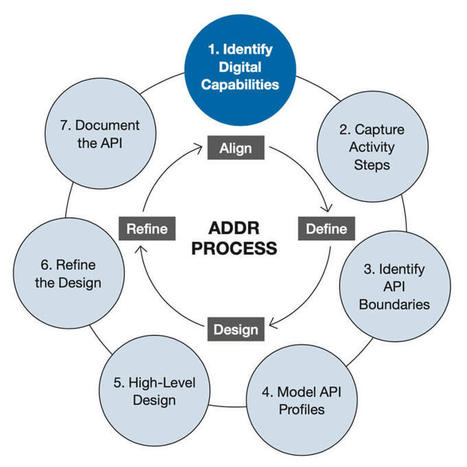
James Higginbotham affirme qu'un processus de conception d'API "encourage l'efficacité tout au long du processus de livraison". Cet effet se produit parce que l’objectif principal est le contrat d’API pour les besoins des utilisateurs et des développeurs. La résilience aux changements d’implémentation interne au fil du temps est un avantage des process de conception d'API.
Le process ADDR de l'auteur divise le processus de conception d'API en cycles composés de sept étapes regroupées en quatre phases. Ces phases (traduites en français) sont Aligner, Définir, Concevoir et Affiner.
L'idée est d'aligner toutes les parties prenantes, puis de traduire leurs exigences dans des définitions de fonctions numériques, résultant en une conception technique d'API. Cette conception est ensuite affinée grâce aux commentaires, à la documentation, au prototypage et aux tests. Étant donné que l'ADDR est un processus itératif, les apprentissages de chaque itération sont pris en compte pour la suivante.
L'auteur souligne que la conception d'une API est une étape distincte et critique de la livraison de logiciels tout en reconnaissant que les équipes peuvent concevoir et livrer des API avec succès sans suivre un processus de conception formel.
D'autres auteurs ont exprimé leur point de vue sur la conception d'API. Ils tendent à converger vers les mêmes conclusions.
|
|
Scooped by
Mickael Ruau
October 5, 2021 2:01 AM
|
Conway's Law asserts that organizations are constrained to produce application designs which are copies of their communication structures. This often leads to unintended friction points. The 'Inverse Conway Maneuver' recommends evolving your team and organizational structure to promote your desired architecture. Ideally your technology architecture will display isomorphism with your business architecture.
|
|
Scooped by
Mickael Ruau
October 1, 2021 7:58 AM
|
|
|
Scooped by
Mickael Ruau
September 29, 2021 3:24 AM
|
Avec Internet et les nouvelles technologies, les échanges d’information au sein d’une même entreprise mais aussi avec l’extérieur (partenaires, fournisseurs, clients, etc…) se développent à vitesse grand V. Les entreprises sont alors confrontées à des problématiques complexes d’intégration. La mise en place de formats pivot est une réponse idéale à l’intégration de flux au sein du Système d’Informations de l’entreprise.
|



















This series focuses on three key areas of "meta-language" for Web APIs: API Description, API Discovery, and API Profiles. You’ll see articles covering all three of these important trends as well as interviews with some of the key personalities in this fast-moving space.
This InfoQ article is part of the series “Description, Discovery, and Profiles: The Next Level in Web APIs”.