Your new post is loading...

|
Scooped by
Mickael Ruau
September 30, 2019 9:26 AM
|
Automating things in software development is more than useful and using Ansible is one way to automate software provisioning, configuration management, and application deployment. Normally you would install Ansible to your control node just like any other application but an alternate strategy is to deploy Ansible inside a standalone Docker image. But why would you … Continue reading "Dockerizing all the things: Running Ansible inside Docker container"
|
|
Scooped by
Mickael Ruau
September 26, 2019 9:23 AM
|
How we built an efficient CI/CD pipeline
|
|
Scooped by
Mickael Ruau
September 24, 2019 9:33 AM
|
Présentation Ansible Ansible est un logiciel libre appartenant à Redhat, pour configurer, assurer la gestion de configuration de serveurs. Ansible n’utilise aucun agent pour la gestion des noeuds (Agentless), Ansible utilise uniquement ssh. Il faut que Python soit installé sur l’ensemble des noeuds pour pouvoir être géré par Ansible.
Ansible peut configurer des serveurs en ligne de commandes, soit à partir de fichier de définition principalement au format yaml, c’est pourquoi on parle d’infrastructure as code : la mise en oeuvre, l’installation, la vie d’un serveur est codé dans un fichier.
|
|
Scooped by
Mickael Ruau
September 24, 2019 9:20 AM
|
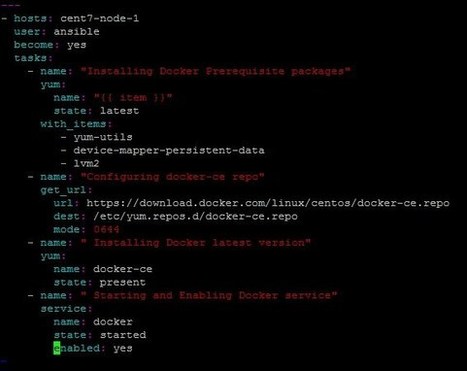
In your efforts to run hosts for Docker containers, you will inevitably come across the need to install Docker automatically via configuration management.
|
|
Scooped by
Mickael Ruau
April 30, 2019 8:51 AM
|
Retrouvez la présentation d'Ori Pekelman de Platform.sh lors de la conférence du Paris Container Day
|
|
Scooped by
Mickael Ruau
November 15, 2018 1:34 AM
|
A tool for exploring a docker image, layer contents, and discovering ways to shrink your Docker image size.
|
|
Scooped by
Mickael Ruau
March 17, 2018 5:42 AM
|
Docker, c'est la solution qui grimpe en ce moment. Vous en avez certainement entendu parler ces derniers temps. Cet article a pour but de comprendre les bases de Docker. il est le premier d'une série de 4 articles intégralement dédiés à Docker.
|
|
Scooped by
Mickael Ruau
February 2, 2018 2:01 PM
|
Les deux outils sont complémentaires. Mais là où Docker gère le cycle de vie des containeurs Linux, Kumbernetes gère leur orchestration. Et plus encore.
|
|
Scooped by
Mickael Ruau
July 25, 2017 6:29 AM
|
Learn how to secure and protect your Docker containers with the Docker Security Best Practices.
|
|
Scooped by
Mickael Ruau
April 18, 2017 11:08 AM
|
Dagda est un outil open source codé en Python qui va vous permettre de faire une analyse de vulnérabilités connues dans vos images et/ou conteneurs Docker. Cet outil permet aussi de monitorer les conteneurs actifs afin de détecter d'éventuelles activités anormales. Pour réussir cela, Dagda récupère les infos concernant les logiciels installés dans votre image > Lire la suite
|
|
Scooped by
Mickael Ruau
February 17, 2017 4:56 AM
|
From the dev.to() community. Sharing ideas that makes us all better developers.
|
|
Rescooped by
Mickael Ruau
from Cloud Central
January 5, 2017 8:52 AM
|
Container-based applications introduce unique security challenges; here’s how to address them
Via Peter Azzopardi
|
|
Scooped by
Mickael Ruau
October 7, 2016 1:22 AM
|
Unikernels are a burgeoning technology, ripe for deployment in a range of situations, from cloud-hosted microservices to Internet-of-Things platforms. By compiling and linking only the required code, they offer a range of benefits over traditional OS-hosted deployments, notably efficiency and, through smaller attack surfaces, security. While increasing in maturity, to date they have remained something of a technologists' choice: technically compelling but requiring considerable effort to build, deploy and use.
To address this, some in the community have spent time trying to integrate unikernel management with the popular Docker container management stack. By enabling unikernels to be managed using the standard Docker command line tools, we bring all the ease-of-use and common understandings of that toolchain to bear on this exciting technology.
After giving some context to the challenges faced, we will demonstrate building and running a simple LAMP-like stack using Docker to build and manage Rumprun and MirageOS Unikernels.
|
|
|
Scooped by
Mickael Ruau
September 27, 2019 9:25 AM
|
In this article, we are going to install Docker Community edition in CentOS7 using Ansible playbook. Here I have used 2 VMs as below, 1) VM (ansible-controller) as Ansible controller machine 2) VM (cent7-node-1) as managed node where we have to install Docker Ansible controller machine has Ansible with 2.5.5
|
|
Scooped by
Mickael Ruau
September 25, 2019 9:22 AM
|
In this guide, you will build and deploy a docker container by using Ansible.
|
|
Scooped by
Mickael Ruau
September 24, 2019 9:28 AM
|
Introduction Les Technologies Installation de Vagrant et Ansible Configuration du Vagrantfile Configuration du Playbook Ansible Configuration du fichier Docker-Compose.yml Conclusion Introduction Dans le cadre d’une logique d’intégration continue, nous avons cherché à mettre en place un test automatique dans un environnement jetable de la version dockerisée de notre solution Canopsis. L’objectif ? Pouvoir la tester sûrement et rapidement. Les technologies Pour cela, nous nous somme
|
|
Scooped by
Mickael Ruau
May 23, 2019 5:49 AM
|
Mesosphere Marathon est un système de gestion de conteneurs, avec d’importantes capacités de dimensionnement, qui permet aux entreprises de déployer et d’automatiser les technologies Apache Mesos et Docker.
|
|
Scooped by
Mickael Ruau
March 17, 2019 2:08 AM
|
This is to tell you that I've written a 5 part Docker series that takes you all the way from beginner to proficient in Docker
|
|
Scooped by
Mickael Ruau
October 23, 2018 4:29 AM
|
Aujourd'hui, Docker est un outil idéal pour conteneuriser vos applications.
|
|
Scooped by
Mickael Ruau
February 7, 2018 5:59 AM
|
|
|
Scooped by
Mickael Ruau
February 2, 2018 1:54 PM
|
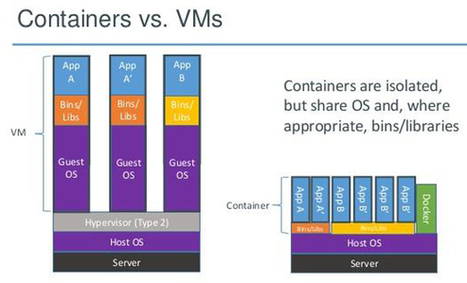
Conteneurs et machines virtuelles permettent de séparer un workload du matériel sous-jacent, mais les deux approches présentent des différences importantes qu'il convient de connaître.
|
|
Scooped by
Mickael Ruau
July 12, 2017 11:56 AM
|
Conteneuriser son application .NET : quel système d’exploitation hôte choisir entre Linux, Windows Server Core et Windows Nano Server ?
|
|
Rescooped by
Mickael Ruau
from Cloud Central
March 30, 2017 9:18 AM
|
How vulnerability management and threat prevention can move at the speed of continuous delivery
Via Peter Azzopardi
|
|
Scooped by
Mickael Ruau
February 2, 2017 5:01 AM
|
Dans cet environnement hétérogène, nous utilisions déjà Vagrant pour gérer plusieurs VM Linux : intégration continue, bases de données, conteneur Web. Vagrant
|
|
Scooped by
Mickael Ruau
December 6, 2016 3:07 AM
|
Almost overnight Docker has become the de facto standard developers and system administrators use for packaging, deploying, and running distributed applications. The DZone Getting Started With Docker Refcard teaches you the fundamentals of using this open-source container solution. This new Refcard will dive deeper into typical Docker workflows, building images, creating Dockerfiles, and includes helpful commands to easily automate infrastructure and contain your distributed application.
|