Your new post is loading...

|
Scooped by
Mickael Ruau
March 8, 2021 9:27 AM
|
The Satir Change Model has been a valuable tool in my scrum coaching toolbox for nearly 15 years. This eight minute video will give you a working understanding of the model and how you can apply it as a scrum coach, scrum master, or other change agent. After the video, you can dive deeper into the model by reading Steven M Smith’s article, The Satir Change Model. You might also enjoy this short video, where we combined the Satir Change Model with the leadership styles from Leadership That Gets Results. Cheers, Chris Share it!
|
|
Scooped by
Mickael Ruau
November 10, 2020 12:52 AM
|
1 – Les grands paradigmes du changement
1
Le changement est peut être un des phénomènes les plus étudié mais aussi le plus difficile à étudier comme l’ont souligné Van de Ven et Poole (1995) dans leur première typologie des recherches sur le changement. Durant une longue période, la littérature sur le changement prônait une approche dramatique du changement.
Pour ces auteurs la transformation radicale et rapide devient une condition de survie de toute organisation.
Cette littérature sur le changement est remise en cause par un courant alternatif qui introduit la notion d’émergence, dans un monde où il est difficilement envisageable de prévoir et d’anticiper l’avenir.
|
|
Scooped by
Mickael Ruau
October 30, 2020 9:51 AM
|
Le changement agile reprend de nombreux outils de la démarche instrumentale présentée dans les paragraphes précédents en donnant une place plus importante à la co-construction. Le changement agile constitue une alternative pour des projets de changement en termes de comportements, de culture et de posture des acteurs. Le changement agile est complémentaire au changement instrumental qui reste une méthodologie éprouvée pour les changements informatiques (de type outils) et pour des changements impactant des populations très importantes.
|
|
Scooped by
Mickael Ruau
October 16, 2020 5:01 AM
|
Dans votre processus de changement, combien de temps êtes-vous prêt à investir
pour en récolter les bénéfices ?
|
|
Scooped by
Mickael Ruau
September 22, 2020 10:13 AM
|
Kurt Lewin developed a change model involving three steps: unfreezing, changing, and refreezing. The model represents a very simple and practical model for understanding the change process. For Lewin, the process of change entails creating the perception that a change is needed, then moving toward the new, desired level of behaviour and, finally, solidifying that new behaviour as the norm. The model is still widely used and serves as the basis for many modern change models.
|
|
Scooped by
Mickael Ruau
September 22, 2020 10:11 AM
|
Commentators have pointed out that in reality large scale transformation rarely works; Dr John Kotter (Harvard Business School, A Force for Change) suggests that up to 70% of large scale business transformations fail and Henry Mintzberg (The rise and fall of strategic planning, 1997) argues that wholesale change can only be effectively made in measured steps. They both cite extensive practical research and case material to back up their claims.
So why do we continue to chase the promise of radical one step change despite the wealth of evidence highlighting the risks, what are the alternatives and how do we recognise the right approach to take in a given situation?
|
|
Scooped by
Mickael Ruau
September 4, 2020 9:26 AM
|
To make a change journey happen, you must generate the ownership and energy to execute the plan and change it on the fly.
|
|
Scooped by
Mickael Ruau
September 4, 2020 9:26 AM
|
Steering Committees and Project Teams can be the backbone of a change initiative, but if they aren't structured properly the project is doomed to failure.
|
|
Scooped by
Mickael Ruau
September 4, 2020 9:26 AM
|
|
|
Scooped by
Mickael Ruau
September 4, 2020 9:24 AM
|
ITIL Change Management: How Change Advisory Board (CAB) members are elected, what their mission is, and what they should NOT do.
|
|
Scooped by
Mickael Ruau
August 8, 2020 6:46 AM
|
Key Takeaways
Most of what is written about change management is not based in science; some is based in pseudoscience, some of it is just made up, some of it is based upon wishful thinking.
Change is the stuff of life, and constant (both in life and in business) - we need to consider building in that kind of robust adaptability, what Nassim Taleb calls “anti-fragility.”
Cognitive biases stalk the corridors of businesses costing billions in bad decisions.
The behavioral sciences help us change behaviors in ways traditional methods, influencing, persuading, involving, and teaching do not. And what people DO matters much more than what they believe!!!
Managers need critical thinking skills to see through the BS peddled by consultants and gurus.
|
|
Scooped by
Mickael Ruau
July 31, 2020 12:37 PM
|
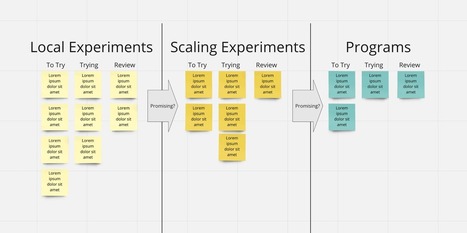
Most local experiments are best left as local practices. There's no universal rule that every team should adopt what works for one team.
|
|
Scooped by
Mickael Ruau
July 31, 2020 10:41 AM
|
Nous constatons que, dans de nombreuses entreprises, les collaborateurs ont vu passer plusieurs plans de changement dont les effets ne sont pas lisibles. Le résultat est que ces derniers ne croient plus que cela puisse fonctionner. On observe une réelle lassitude autour de ce sujet pourtant majeur dans la transformation de l’entreprise.
Le constat aujourd’hui est que 70 % des programmes de changement sont des échecs !
|
|
|
Scooped by
Mickael Ruau
February 23, 2021 7:33 AM
|
Ce sont souvent les quatre mêmes freins qui entrent en jeu et empêchent le changement.
Les projets de transformation fleurissent dans les entreprises et dans les organisations. La pandémie pourrait laisser croire que certains changements...
|
|
Scooped by
Mickael Ruau
November 7, 2020 6:07 AM
|
L'une des croyances les plus répandues dans l'entreprise est que nous pouvons forcer les personnes à faire des choses. Si c'était vrai, il n'y aurait pas besoin de démarrer un processus en 8 étapes.
Les personnes peuvent traîner des pieds de plein de manières différentes, en allant du non-productif jusqu'au sabotage pur et simple. Et la plupart du temps ce ne sera pas détecté.
Alors qu'arriverait-il si nous abandonnions l'idée que nous pouvons forcer les personnes à faire des choses ? Qu'arriverait-il si tout était facultatif ? Qu'arriverait-il si toutes les réunions, initiatives, projets et tâches étaient basés sur le volontariat ?
Certaines personnes croient que cela conduirait au chaos total. Mais si vous avez avec vous des personnes solides qui se soucient de l'entreprise, que se passerait-il si vous leur donniez totale liberté ?
Et si vous ne pouvez pas vous appuyer sur des personnes solides, alors vous avez un problème encore plus gros que n'importe laquelle de vos nouvelles initiatives. Heureusement, il existe trois étapes pour permettre un réel changement et laisser un leadership naturel émerger. C'est pour un prochain billet.
|
|
Scooped by
Mickael Ruau
October 27, 2020 1:02 AM
|
Que faire pour réussir son changement ? Que mettre en place en entreprise pour éviter le chaos de ces transformations qui nous assaillent ? La réponse ici..
|
|
Scooped by
Mickael Ruau
September 22, 2020 10:14 AM
|
Face à la complexité des organisations, de nouveaux modes de management émergent. Agiles, ils permettent aux managers d'autonomiser leurs équipes et de les responsabiliser en même temps, avance la directrice associée au Boston Consulting Group. La méthode agile casse les silos : ceux qui pensent, ceux qui font et ceux qui contrôlent ne sont plus séparés.
|
|
Scooped by
Mickael Ruau
September 22, 2020 10:13 AM
|
Big-bang approach ineffective for large organisations to scale Agile
|
|
Scooped by
Mickael Ruau
September 22, 2020 10:11 AM
|
Big bang adoption or direct changeover is the adoption type of the instant changeover, when everybody associated with the old system moves to the fully functioning new system on a given date. When a new system needs to be implemented in an organization, there are three different ways to adopt this new system: the big bang adoption, phased adoption and parallel adoption.
|
|
Scooped by
Mickael Ruau
September 4, 2020 9:26 AM
|
Roles played in change management. With links to detailed profiles of a change manager or consultant, a change agent and the leader of a change management department.
|
|
Scooped by
Mickael Ruau
September 4, 2020 9:26 AM
|
Discover the foundation for the what, why, & how of managing the people side of change with a structured approach to change management.
|
|
Scooped by
Mickael Ruau
September 4, 2020 9:26 AM
|
Change enablement, also known as change management, is at the core of ITIL® service transition. The maturity of organization depends on how well it facilitates change requests (CR) in response to end-user, technical, functional or wider business requirements. Careful change management helps reduce the risk exposure and disruption proactively when new changes are instituted within the organization, its operations and technologies.
ITIL provides an effective framework guideline to conduct change enablement and management activities. In this article, we will discuss the key roles and responsibilities involved in change management according to ITIL guidelines. Even if you don’t stringently adhere to the ITIL framework, these roles help clarify your change management processes.
|
|
Scooped by
Mickael Ruau
September 4, 2020 9:23 AM
|
Name Description Change Owner/Change Request Assigned To The person filling out the change and submitting (creating) it via the Service Now support tool. The role provides all the details regarding the change, including the business justification, implementation plan, CI details, remediation plan, etc. that are to be included in the request. RESPONSIBILITIES: Deemed the Owner
|
|
Scooped by
Mickael Ruau
August 5, 2020 6:07 AM
|
Agile change management embraces as a set of principles that can help focus efforts on the most important activities, determined by customer value and stakeholder impact and outcomes
|
|
Scooped by
Mickael Ruau
July 31, 2020 10:44 AM
|
La conduite du changement est l'ensemble des opérations effectuées au sein d'une organisation pour lui permettre de s'adapter au changement et à l'évolution de l'environnement. C'est une modification de caractères par l' apprentissage. Elle est par exemple nécessaire à mettre en œuvre lorsqu'une entreprise adopte de nouveaux outils (machines, numérique...), ou encore une nouvelle organisation.
|


 Scoop.it!