Your new post is loading...

|
Scooped by
Mickael Ruau
February 1, 2015 6:38 AM
|
Software design just like any other engineering design endeavor, requires a fair amount of effort, experience, patience and knowhow in order to be done right. Based on Akin's Laws of Spacecraft Design I present our readers with a slightly modified list of what I believe are the basic "Laws of Software design" especially when you are dealing with customer oriented, "tailored" software product solutions. As this is considered a "basic" list, let me clarify that you are more than welcome to contrib
|
|
Scooped by
Mickael Ruau
February 1, 2015 6:28 AM
|
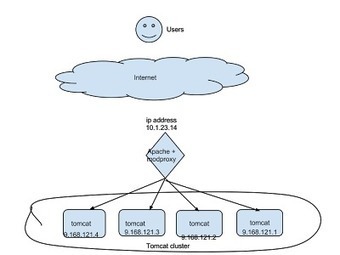
Redundancy and failover are techniques used to achieve high availability. Redundancy is achieved by having multiple copies of your server. Instead of 1 apache web server, you have two. One is the active server. The active server is monitered and if for some reason it fails, you failover to the 2nd server which becomes active. Another approach is to use a cluster of active servers as is done in a tomcat clusters. All servers are active. A load balancer distributes load among the members of the cluster. If one or two member of the cluster go down, no users are affects because other servers continue processing. Of course, the load balancer can become a point of failure and needs redundancy and failover.
|
|
Scooped by
Mickael Ruau
January 12, 2015 3:54 AM
|
Designing, implementing, and maintaining APIs for the Web is more than a challenge; for many companies, it is an imperative. This series takes the reader on a journey from determining the business case for APIs to a design methodology, meeting implementation challenges, and taking the long view on maintaining public APIs on the Web over time. Along the way there are interviews with influential individuals and even a suggested reading list on APIs and related topics.
This InfoQ article is part of the series “Web APIs From Start to Finish”.
|
|
Scooped by
Mickael Ruau
January 5, 2015 4:44 AM
|
L'utilisation de la taille pour la définition des microservices est une métrique inadaptée et inutile pour déterminer si un service possède les bonnes responsabilités, dit Jeppe Cramon dans une série de billets de blog qui clarifient sa vision sur les microservices et les problématiques de couplage qu'il trouve dans la communication synchrone bidirectionnelle.
|
|
Scooped by
Mickael Ruau
December 26, 2014 3:40 AM
|
La problématique des rôles périphériques aux équipes Scrum est une problématique que l'ensemble des organisations se doivent de comprendre et de gérer. Dans les dernières années on a beaucoup parlé du rôle du chargé de projet mais assez peu de celui de l'architecte qui, comme le chargé de projet, détient une position de fort leadership, mais se demande comment maintenant utiliser ce leadership dans un contexte d'agilité et d'auto-organisation des équipes.
Au cours de cette présentation, Jean-René, Frédérick et Mathieu présentent les principaux impacts de l'agilité sur le rôle de l'architecte et offriront des pistes de solutions quant à la façon de conduire la phase d'architecture et d'interagir pour les architectes avec les équipes.
|
|
Scooped by
Mickael Ruau
December 19, 2014 3:22 AM
|
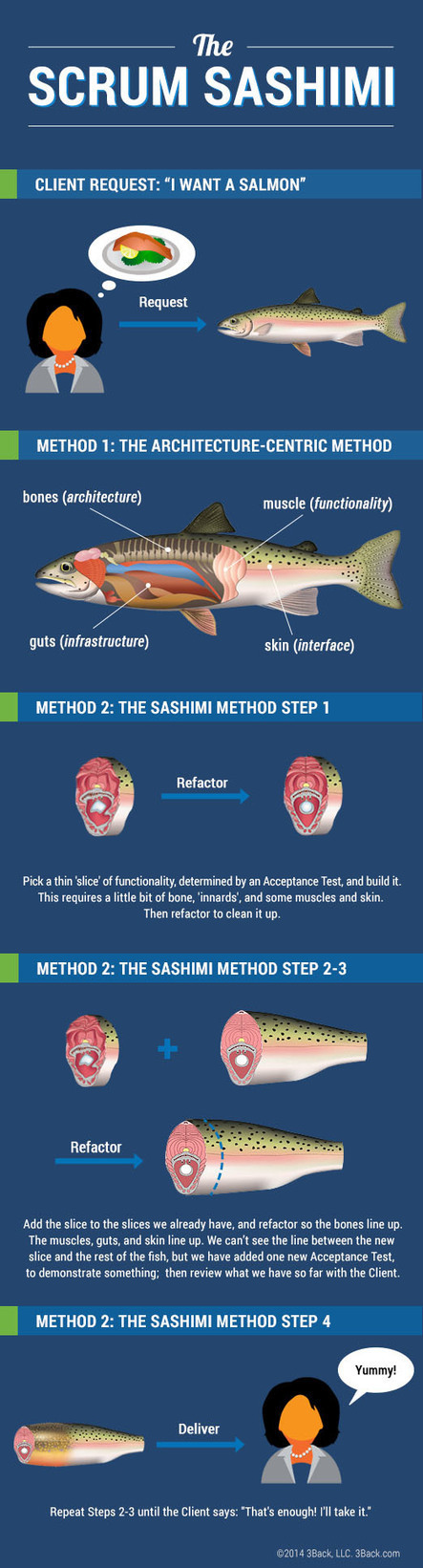
In this blog I will discuss one part of the puzzle, the Sashimi Method of incremental development, which has been around a long time. I first heard of it in the early 1990s, in the context of RUP (the Rational Unified Process), a high-ceremony agile process that focused its development on Use Cases. It was introduced to me again, in the late 1990s, as a way to understand XP (eXtreme Programming). And again, in the early 2000s, by Ken Schwaber, as the preferred way to develop software within a Scrum Team. And it’s baked into the current Software Craftsmanship movement, as part of developing Clean Code…
|
|
Scooped by
Mickael Ruau
December 15, 2014 4:12 AM
|
Au fil des années, il a été dit beaucoup de choses sur REST et ses avantages perçus sur les autres approches, avec l'idempotence souvent considéré comme étant un concept compris par tous, mais qui n'a généralement pas été traité de manière exhaustive. Cependant, une récente publication sur la liste de diffusion Service Oriented Architecture a généré beaucoup de discussion autour d'un concept que beaucoup semblaient assumer assez simple.
|
|
Scooped by
Mickael Ruau
December 4, 2014 8:53 AM
|
Les systèmes logiciels sont sillonnés par les limites (Boundaries), le code de part et d’autre de ces limites est bien différent. Des exemples de limites sont par exemple la limite entre le module definissant les objets du domaine et le module du mecanisme de livraison, ou encore la limite entre les vues et les modèles dans un module MVC.
Pour chacun de ces modules, un coté est abstrait et un coté est concret. Par exemple, le mécanisme de livraison est un coté concret, et le module des objets d’affaires quand à lui, est abstrait.
Nous avons vu aussi dans le dernier article sur l’architecture, que tout le code source pointe vers l’extérieur depuis le côté concret vers le côté abstrait.
|
|
Scooped by
Mickael Ruau
December 4, 2014 8:49 AM
|
Qu’est ce que les termes MVC, Base de données, Langage de Programmation, Framework, Editeur, SOA, Service Layer, REST etc. disent pour vous? est ce que ces termes la définissent l’architecture? Non! Ces termes représentent des Outils. De la même façon que sur le plan de construction d’une maison, vous ne voyez pas la pelle et le marque du béton qui va être utilisée, vous ne devez pas voir dans l’architecture d’un logiciel les termes ci dessous.
L’architecture d’un système est une affaire d’Utilisation. Elle doit exposer clairement l’intention du système, et non les outils avec lesquels ce dernier va être construit.
Imaginez l’architecture d’une librairie ou d’un centre culturel, vous regardez le plan et vous voyez des salles de lecture ou les lecteurs peuvent calmement lire et faire leur recherche, vous voyez des petits espaces éclairées avec des fauteuils pour prendre une petite pause, et des chambres pleines d’étagères de livres. Que voyez vous dans l’architecture d’une librairie? Vous voyez Une librairie!
|
|
Scooped by
Mickael Ruau
November 24, 2014 5:31 PM
|
Les projets multisites sont de plus en plus nombreux, les entreprises et institutions souhaitent rationaliser les coûts et optent en priorité pour un socle technique modulable et évolutif capable de motoriser rapidement et simplement de nouveaux sites à moindre coût. Partage de contenu multisites, atelier de déclinaison de charte graphique, reprise des contenus existants...
|
|
Scooped by
Mickael Ruau
November 13, 2014 5:13 AM
|
Use events for interactions between small business components to bring simplicity to a system, Russ Miles recently suggested talking about Coding Simple Event-Driven Components for Agile Software.
This talk is a follow-up on his talk a month earlier, Events bring Simplicity to a System's Architecture, where Russ laid the foundation for his ideas about simplicity; an architecture where small components collaborate with each other by exchanging events.
|
|
Scooped by
Mickael Ruau
November 12, 2014 3:06 AM
|
We have all been there, the moment when someone asks you to make a change in the software, a change that you know you can’t do, at least not without a lot of effort, Russ Miles started his presentation at a recent meeting with the London Spring user group.
Russ calls this “the inconvenient truth of the killer change”; when you realise that the different assumptions about how the system or software will evolve was wrong and that you have to answer with some bad news.
Helping with this problem, Russ shares some techniques he uses when developing Java and Spring applications that helps him experience this moment less often. What he wants from a system is adaptability. The real world changes and we want to adapt to this, but the software we build is often less adaptable than we are as developers.
|
|
Scooped by
Mickael Ruau
November 7, 2014 5:04 AM
|
Domain-Driven Design (DDD) together with Onion Architecture is a combination that Wade Waldron believes has increased his code quality dramatically since he started using it a few years back. Using DDD was a kick-off but together with Onion architecture he found his code to be more readable and understandable, and far easier to maintain.
|
|
|
Scooped by
Mickael Ruau
February 1, 2015 6:30 AM
|
I have always strived to keep as much stuff as possible in the application itself. NoSQL store? Embedded, please. Message queue? Again. URL rewrites – your web framework does that. Application server configurations? None, if possible, you can do them per-application. Modifications of the application server startup script? No, thanks. Caching? It’s in-memory anyway, why would you need a separate process. Every external configuration needed goes to a single file that resides outside the application, and Ops (or devs, or devops) can change that configuration. No more hidden stones to find in /usr/appconf, apache or whatever. Consolidate as much as possible in the piece that you are familiar and experienced with – the code.
|
|
Scooped by
Mickael Ruau
January 27, 2015 2:55 AM
|
RESTful design increases API performance, reduces development effort, and minimizes operational support burden. By conforming web applications, web services, and web APIs with proven RESTful constraints, teams can create systems as scalable, pervasive, and prolific as The Web itself. Because REST requires a new development mindset, many API implementations are not truly based on REST constraints and principles, and do not exhibit expected scalability, evolvability, and interoperability. By following a few best practices and selecting RESTful tooling, teams can easily design, evolve, and connect RESTful APIs.
|
|
Scooped by
Mickael Ruau
January 9, 2015 2:56 AM
|
Recently Roy took some time while traveling between standards meetings to answer a series of questions on a topic that often starts debates; Versioning on the Web. He also talked about why hypermedia is a requirement in his REST style, the process of designing network software that can adapt over time, and the challenge of thinking at the scale of decades.
|
|
Scooped by
Mickael Ruau
January 2, 2015 4:41 AM
|
Leslie Lamport est l’auteur d’articles parmi les plus cités dans le domaine de l’informatique. Il a remporté un Turing Award en 2013 pour ses travaux séminaux sur les systèmes concurrents et distribués. Cet article est le résumé d’un entretien que Leslie a accordé à Software Engineering Radio au cours duquel il a évoqué ses premiers travaux sur les systèmes distribués et rappelé l’importance du "Precise Thinking" dans le cadre de la programmation.
|
|
Scooped by
Mickael Ruau
December 23, 2014 3:39 AM
|
Le premier fondement de l’agilité sont les personnes. En agilité, nous entendons parler beaucoup de « l’équipe » en tant qu’unité, ceci peut donner l’impression que l’individu n’est pas concernée. Je pense que c’est tout à fait le contraire.
L’agilité reconnaît l’authenticité de chaque individu au lieu de considérer que c’est une « ressource ».
La valeur la plus importante de chaque individu est dans ses interactions et sa collaboration. Pour cette raison, les équipes agiles sont formées de différents « rôles » (développeurs, designers, testeurs, etc.) qui proviennent de diverses unités fonctionnelles.
|
|
Scooped by
Mickael Ruau
December 18, 2014 3:11 AM
|
Les liens hypermédia suppriment la partie inhérente qui restait dans le client :
Les liens montrent comment les ressources sont liées les unes aux autres
Les liens montrent comment interagir avec la ressource dans le contexte et les actions possibles
Les liens activent dynamiquement l'ajout et la suppression de commande selon le contexte
|
|
Scooped by
Mickael Ruau
December 15, 2014 3:05 AM
|
Beaucoup de concepteurs de Web APIs présentent leurs APIs comme étant RESTful. Pourtant celles-ci ont souvent peu à voir avec REST. Que doit-il être fait pour que l’API d’un Web service soit réellement RESTful ?
|
|
Scooped by
Mickael Ruau
December 4, 2014 8:49 AM
|
Qu’est ce que les termes MVC, Base de données, Langage de Programmation, Framework, Editeur, SOA, Service Layer, REST etc. disent pour vous? est ce que ces termes la définissent l’architecture? Non! Ces termes représentent des Outils. De la même façon que sur le plan de construction d’une maison, vous ne voyez pas la pelle et le marque du béton qui va être utilisée, vous ne devez pas voir dans l’architecture d’un logiciel les termes ci dessous.
L’architecture d’un système est une affaire d’Utilisation. Elle doit exposer clairement l’intention du système, et non les outils avec lesquels ce dernier va être construit.
Imaginez l’architecture d’une librairie ou d’un centre culturel, vous regardez le plan et vous voyez des salles de lecture ou les lecteurs peuvent calmement lire et faire leur recherche, vous voyez des petits espaces éclairées avec des fauteuils pour prendre une petite pause, et des chambres pleines d’étagères de livres. Que voyez vous dans l’architecture d’une librairie? Vous voyez Une librairie!
|
|
Scooped by
Mickael Ruau
November 26, 2014 4:36 AM
|
As open source becomes more and more popular, we see organizations rolling out many sites across their organization. As they try to manage them, many of them turn to "multisite" networks.
In short, a "multisite" allows you to run many sites from a single codebase. The idea is that you can update the codebase once and automatically apply those changes to all your site. In theory, it's a great idea. In practice, it often causes more problems than it solves.
In this blog post, I'll explain why you should think very carefully before setting up a multisite network. No matter what software you use, there are often better alternatives.
|
|
Scooped by
Mickael Ruau
November 17, 2014 2:24 AM
|
So what does the architecture of your application scream? When you look at the top level directory structure, and the source files in the highest level package; do they scream: Health Care System, or Accounting System, or Inventory Management System? Or do they scream: Rails, or Spring/Hibernate, or ASP?
|
|
Scooped by
Mickael Ruau
November 13, 2014 3:13 AM
|
Using events for interactions between small business components can bring simplicity to a system's architecture, Russ Miles explained last week when talking about Architectural Simplicity through Events.
Simplicity really matters, Barbara Liskov said in a keynote at QCon London 2013, and Russ Miles, a Principal Consultant, strongly agrees. His experience is that teams often are slowed down by the increasing size and complexity of the code they write, and he believes that architecturally led simplicity is the best way to help teams keep their momentum and speed up.
|
|
Scooped by
Mickael Ruau
November 7, 2014 5:12 AM
|
Architecture is about intent, we have made it about frameworks and details, Robert C. Martin, "Uncle Bob", stated earlier at this year’s DDD Exchange Day in London.
Robert refers to an architecture model described in the book Growing Object-Oriented Software Guided by Tests, (similar to the Hexagonal architecture), which describes an architecture with three zones with dependencies going only one way, from the volatile parts towards the more stable parts:
(...)
Robert notes that this model fails to describe what he regards as a key aspect; architecture is about intent, what the application does. He thinks we focus too much on details and frameworks and have made them the centre of our systems.
|