Devops for Growth
120.8K views | +11 today
Devops for Growth
For Product Owners/Product Managers and Scrum Teams: Growth Hacking, Devops, Agile, Lean for IT, Lean Startup, customer centric, software quality...
Curated by Mickael Ruau
Your new post is loading...

Popular Tags

Current selected tag: 'customer development'. Clear
Scooped by Mickael Ruau
August 9, 2019 3:18 AM
Scoop.it!

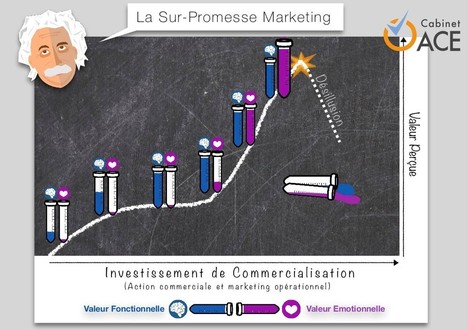
LE MARKETING DES SERVICES, LA SERVUCTION ET LES PROMESSES INTENABLES

LE MARKETING DES SERVICES, LA SERVUCTION ET LES PROMESSES INTENABLES | Devops for Growth | Scoop.it

Sur le seul sujet de la promesse, trois étapes :

Définir une promesse identifiante. Elle doit permettre de connaître immédiatement ce que vous proposez.
Compléter avec un élément différenciant. C’est lui qui vous fera sortir du lot de la concurrence.
S’assurer que ces deux promesses sont compatibles et tenables. Ce sont les caractéristiques intrinsèques de votre produit ou service qui rendent cette promesse tenable, et non la promesse qui donnera des caractéristiques extraordinaires au produit ou au service. Le fonctionnel doit primer sur l’émotionnel, sous peine de désillusion.

No comment yet.
Scooped by Mickael Ruau
July 26, 2019 9:49 AM
Scoop.it!

CUSTOMER DEVELOPMENT |

CUSTOMER DEVELOPMENT | | Devops for Growth | Scoop.it
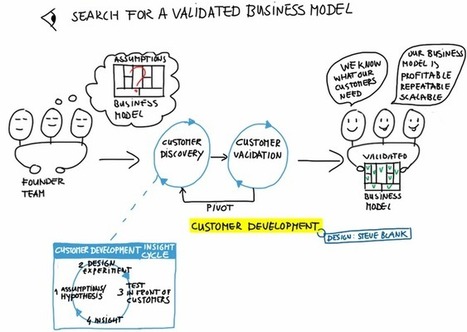
Customer Development is a continuous process that helps you develop a product and business model based on customer feedback. Customer Development gives you a clear understanding of what your users and customers want, need and will pay for. Pivot:  A substantive change to one or more components of your business model. Customer Discovery: Turning your…
No comment yet.
Scooped by Mickael Ruau
July 19, 2019 4:15 AM
Scoop.it!

Innovation Funnel for R&D Projects and Ideas - Ahmad Bilal

o Internal Technology or Products Roadmap: This is the internal technology or product roadmap of the organisation. In which areas organisation wants to develop its future competitive technologies…
Mickael Ruau's insight:

Innovation Funnel for R&D Projects Concepts Development:

 
Figure: Innovation Funnel for R&D Projects concept development
No comment yet.
Scooped by Mickael Ruau
July 12, 2019 4:18 AM
Scoop.it!

AARRR (Startup Metrics) - StartitUp

AARRR (Startup Metrics) - StartitUp | Devops for Growth | Scoop.it

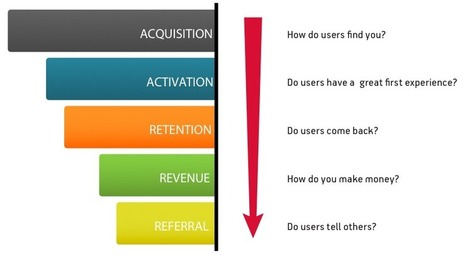
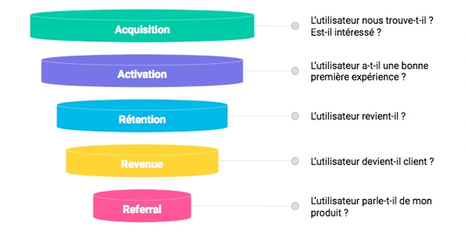
This is the AARRR (Must Read!) startup metrics model developed by Dave Mcclure. These 5 metrics represent all of the behaviors of our customers. 

We want to break down these 5 metrics on your product and look at them separately, then analyze and monitor them so that we can optimize them. A successful startup is one where they are able to optimize every single one of these 5 metrics.

It's important to understand about AARRR, because only when you understand all the metrics, you will understand where exactly is wrong with your startup, so you don't guess and make the wrong assumptions. When you understand AARRR, you can become a startup doctor, because you will know exactly what or which part is wrong, and then fix it.

Mickael Ruau's insight:

See Dave Mcclure's AARRR to learn more: http://www.slideshare.net/dmc500hats/startup-metrics-for-pirates-long-version

A great read to learn about Lean Analytics: http://www.kaushik.net/avinash/lean-analytics-cycle-metrics-hypothesis-experiment-act/

Great Tools to build engagement/gamification:

  1. Bunchball – gamification for user engagement and loyalty
  2. Hoopla – motivate employees, increase sales productivity
  3. Badgeville – gamification platform
  4. Gigya – social plugins, gamification
No comment yet.
Scooped by Mickael Ruau
July 6, 2019 5:22 AM
Scoop.it!

The Lean Startup Circle Wiki / BusinessModelCanvas

The Lean Startup Circle Wiki / BusinessModelCanvas | Devops for Growth | Scoop.it

USER EXPERIENCE 

  • Business Model Canvas for User Experience by Tristan Kromer

http://grasshopperherder.com/business-model-canvas-for-user-experience/  


START-UPS

  • Reinventing How We Do Start-Ups by Alexander Osterwalder

http://www.businessmodelalchemist.com/2010/11/re-inventing-how-we-do-start-ups.html 


  • LeanLaunchLab: Online Tools for Focused, Nimble Startups by Ted Greenwald

http://www.forbes.com/sites/tedgreenwald/2012/02/23/leanlaunchlab-online-tools-for-nimble-startups/ 


  • Reinventing the Board Meeting (Part 2 of 2): Virtual Valley Ventures by Steve Blank

http://steveblank.com/2011/06/02/reinventing-the-board-meeting-%E2%80%93-part-2-of-2-virtual-valley-ventures/ 


  • Why Board Meetings Suck - Part 1 of 2 by Steve Blank 

http://steveblank.com/2011/06/01/why-board-meetings-suck-%e2%80%93-part-1-of-2/ 

Mickael Ruau's insight:

CUSTOMER DEVELOPMENT

  • Customer Development and the Business Model Canvas: How they Fit by Alex Osterwalder

http://www.businessmodelalchemist.com/2010/08/combining-business-model-prototyping-customer-development-and-social-entrepreneurship.html 


  • Customer Development and the Business Model Canvas: Social Entrepreneurship Case Study by Alex Osterwalder

http://www.businessmodelalchemist.com/2011/01/methods-for-the-business-model-generation-how-bmgen-and-custdev-fit-perfectly.html 


  • Entrepreneurship as a Science: The Business Model/Customer Development Stack by Steve Blank 

http://steveblank.com/2010/10/25/entrepreneurship-as-a-science-%e2%80%93-the-business-modelcustomer-development-stack/ 


  • Turn Your Blog into a Business Model and Customer Development Tool by Tor Grønsund

http://torgronsund.com/2012/06/06/businessmodelpress/

No comment yet.
Scooped by Mickael Ruau
July 5, 2019 7:34 AM
Scoop.it!

Web Entrepreneurship Example Customer Development Model

Web Entrepreneurship Example Customer Development Model | Devops for Growth | Scoop.it

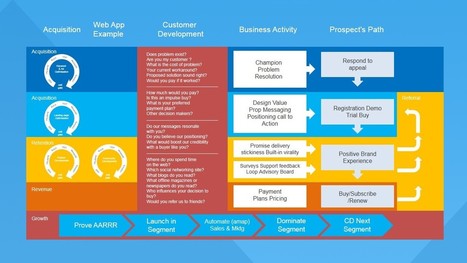
This slide presents the customer development process applied to an example of a web app startup.It unifies the models for startup development of Dave McClure, customer development process of Steve Blank, and the Lean Startup of Eric Ries.
The slide can be adapted to the particular startup to be analyzed, ideal for new entrepreneurs willing to follow a successful approach.

No comment yet.
Scooped by Mickael Ruau
July 3, 2019 3:27 AM
Scoop.it!

Communicate Business Value to Your Stakeholders

Communicate Business Value to Your Stakeholders | Devops for Growth | Scoop.it
Often project leaders—even Agile project leaders—talk about their projects in terms of features. Yes, and what do features really mean for stakeholders?
Features are what your system or process can do. Benefits are why people care. And benefits equal business value. Learn why and how to communicate benefits rather than features—and what it will mean for you, your team and your organization.
Mickael Ruau's insight:

Here are their “Six Elements of Stickiness” to make messages memorable:

  1. Simple – what’s the most important thing to remember?
  2. Unexpected – how can we grab the stakeholder’s attention?
  3. Concrete – what is the context that makes the benefit relevant?
  4. Credible – why should stakeholders believe this?
  5. Care – what’s in it for me the stakeholder?
  6. Act – what should I do now?
No comment yet.
Scooped by Mickael Ruau
June 28, 2019 10:00 AM
Scoop.it!

The Customer Discovery Handbook

The Customer Discovery Handbook | Devops for Growth | Scoop.it
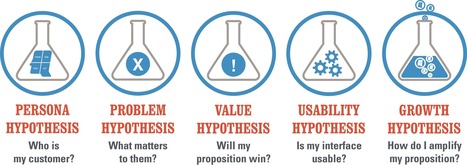
This is a practioner's guide to conducting design research on personas, needfinding, value, and usability.
No comment yet.
Scooped by Mickael Ruau
June 22, 2019 4:24 AM
Scoop.it!

How Uber, Airbnb, and Etsy Attracted Their First 1,000 Customers - HBS Working Knowledge - Harvard Business School

How Uber, Airbnb, and Etsy Attracted Their First 1,000 Customers - HBS Working Knowledge - Harvard Business School | Devops for Growth | Scoop.it
Thales Teixeira studies three of the most successful “platform” startups to understand the chicken-and-egg challenge of how companies can attract their first customers.
No comment yet.
Scooped by Mickael Ruau
June 8, 2019 7:57 AM
Scoop.it!

Design thinking vs. Customer Development - Steve Blank

Comparison between Design Thinking and Customer Development, made by Steve Blank
No comment yet.
Scooped by Mickael Ruau
May 24, 2019 4:11 AM
Scoop.it!

Marketing des Services et Servuction – Approche par le Relationnel - 3/4

Marketing des Services et Servuction – Approche par le Relationnel - 3/4 | Devops for Growth | Scoop.it
Dans le premier billet de cette série, nous avons présenté sous forme d’un PREZI notre vision du Marketing des Services et de la Servuction.

Nous avions également introduit notre modèle du POSSIBLE Mix-Marketing© qui permet de traiter de manière plus spécifique les activités de services.

Et nous avions présenté une première stratégie de mise en oeuvre de la Servuction : l’Approche par la Maîtrise.

Aujourd’hui, nous vous présentons (de nouveau sous forme de billet-vidéo interactif) une deuxième stratégie : l’Approche par le Relationnel.
Mickael Ruau's insight:

Rappel : la Servuction met en relation trois entités :

  • le Client, bénéficiaire du service réalisé par le Prestataire, mais aussi contributeur à la réalisation de ce service,
  • le Prestataire, principal réalisateur du service, qui doit prendre en compte les contributions et les blocages du client ; il est responsable de la réalisation du Service,
  • le Service, qui est la réponse aux désirs du Client.

Cela permet de verbaliser trois types de liens dans la production d’un service :

  • le lien entre le Prestataire et le Service qu’il produit : il témoigne de l’Expertise (ou de sa Maîtrise), souvent technique,
  • le lien entre le Prestataire et le Client : il témoigne de la qualité relationnelle entre ces deux acteurs,
  • le lien entre le Client et le Service : il témoigne de l’implication du Client dans la production du service, voire même de son appropriation totale.

Notre postulat, c’est qu’il n’est pas possible pour le Prestataire d’équilibrer ces trois liens : l’un des trois sera privilégié par le couple {prestataire + client} au détriment de l’une des trois entités.

No comment yet.
Scooped by Mickael Ruau
May 11, 2019 5:51 AM
Scoop.it!

Customer Interview Script Generator

Customer Interview Script Generator | Devops for Growth | Scoop.it
[Updated] July 18, 2018Here’s an example:     Use this template… As a starting point. Add & edit questions as necessary. As a place to store the notes from your interviews. To share with your teammates so you’re all asking the same questions. Let’s Create your Script Fill out each of the fields below then …
No comment yet.
Scooped by Mickael Ruau
April 20, 2019 5:45 AM
Scoop.it!

Lessons Learned: The one line split-test, or how to A/B all the time


Split-testing is a core lean startup discipline, and it's one of those rare topics that comes up just as often in a technical context as in a business-oriented one when I'm talking to startups. In this post I hope to talk about how to do it well, in terms appropriate for both audiences.
No comment yet.
Scooped by Mickael Ruau
August 2, 2019 4:17 AM
Scoop.it!

Comment utiliser le framework AARRR ?

Comment utiliser le framework AARRR ? | Devops for Growth | Scoop.it
Le framework AARRR vous permet de mesurer et d’optimiser chaque phase de votre entonnoir client en vous basant sur une métrique à la fois. Comment utiliser le framework AARRR ? Ce framework est connu pour mesurer l’efficacité de votre entonnoir client. Sur les 1 000 personnes qui visitent votre site Web, combien deviennent des clients …
No comment yet.
Scooped by Mickael Ruau
July 20, 2019 4:15 AM
Scoop.it!

Play the Customer Development Game

Agile teams are great at building what you want - but how do you know what your customers need? This game-based workshop shows you how to discover the right pr…
No comment yet.
Scooped by Mickael Ruau
July 12, 2019 11:14 AM
Scoop.it!

The difference between a soft launch and a hard launch – Cahoots Blog

In business, the terms ‘soft launch’ and ‘hard launch’ refer to two different techniques for introducing a new product or service to the market. A soft launch is less aggressive, as the name indicates, where as a hard launch is louder with the goal of generating buzz.

A soft launch is a technique that introduces a product into the market quietly without drawing too much attention to it. This is a more gradual technique which is particularly good for startups releasing a beta version, minimum viable product, or are otherwise lacking features they intend to add. A soft launch refers to releasing a product/service to a closed audience as well as a public launch accompanied by little to no marketing.

A hard launch is great for creating excitement and getting your product or service into the hands of a large number of people. A hard launch builds anticipation through things such as countdowns, previews, etc. Hard launches often require a marketing budget.

There is no little to no talk of a ‘medium launch’ as this half-way approach tend to fail to achieve the goals of soft and hard launches rather than obtaining the best of both worlds.

Mickael Ruau's insight:

Soft launches are particularly good for:

  • Small teams and first-time entrepreneurs
  • Testing the viability of a product
  • Refining features with a small audience
  • Gaining valuable feedback
  • Focusing on product development
  • Determine price points
  • A/B testing different features
  • Helps you determine how much of a marketing investment you actually need to put into future marketing.


When to do a hard launch?

A hard launch is best reserved for those who meet the following criteria:

  • When you’re sure you can deliver on time and to a large audience.
  • Your server is reliable.
  • You’ve gotten rid of all the bugs and other problems
  • You’re a big company with a bold new product/feature
  • You have a marketing budget and a good idea of where and where not to spend it
  • You have successfully been able to build anticipation in your target market.

A soft launch is often followed by a hard launch, as a properly executed soft launch prepares a product and team for a hard launch.  A soft launch is more consistent with the concept of a lean development and has become a popular approach for release, particularly among technology startups.

No comment yet.
Scooped by Mickael Ruau
July 12, 2019 4:14 AM
Scoop.it!

6 Ways for Product Managers to Collect Customer Feedback - Usersnap

6 Ways for Product Managers to Collect Customer Feedback - Usersnap | Devops for Growth | Scoop.it
No feedback or too much feedback? That's the challenge of customer feedback! With the following 6 ways, you can collect customer feedback more effectively!
No comment yet.
Scooped by Mickael Ruau
July 5, 2019 9:48 AM
Scoop.it!

A Entrepreneur’s Guide to Customer Development (2/2): The 8 Steps to Customer Discovery

Document all hypothesis by writing them down, Storing them in your brain allows you to rationalize subconsciously. Your intention is to Learn. From the ecosystem map, you should specify your CPS…
No comment yet.
Scooped by Mickael Ruau
July 5, 2019 3:16 AM
Scoop.it!

Marketing des Services et Servuction – Approche par la Maîtrise - 2/4

Marketing des Services et Servuction – Approche par la Maîtrise - 2/4 | Devops for Growth | Scoop.it

L’Approche par la Maîtrise : un positionnement objectif

Cette stratégie met donc l’accent sur le duo Prestataire-Service. Le Client s’efface alors.

Cette stratégie appelle un positionnement objectif de l’offre de services : sa valeur technique doit être objectivement incontestable.

Si nous donnons quelques conseils de POSSIBLE Mix-Marketing© associé :

Prix : privilégier le haut de gamme ; une offre low-cost ne sera pas crédible
Offre de Valeur : valeur ajoutée forte perceptible par le Client (souvent révélée par un manque cruel de compétences chez le Client)
Servuction : le Client apportera sa contribution de façon matérielle et intellectuelle (pas de contribution psychologique)
Standardisation : l’offre sera plutôt personnalisée, construite sur une démarche d’analyse de la valeur (la standardisation peut être contre-productive)
Image : tonalité de communication centrée sur l’expertise, la technique, les résultats (objectifs) et la performance
Back & Front Office : le front-office devra être très compétent, le back-office permettra de compléter l’expertise
Logistique : seront privilégiés des missions en mode projet, sans grande récurrence ; le Prestataire pilote la réalisation
Explications : un technico-commercial crédible (donc avec du savoir-faire !) sera bien perçu ; un bon relationnel ne nuit pas

Mickael Ruau's insight:

La Servuction met en relation trois entités :

  • le Client, bénéficiaire du service réalisé par le Prestataire, mais aussi contributeur à la réalisation de ce service,
  • le Prestataire, principal réalisateur du service, qui doit prendre en compte les contributions et les blocages du client ; il est responsable de la réalisation du Service,
  • le Service, qui est la réponse aux désirs du Client.

Cela permet de verbaliser trois types de liens dans la production d’un service :

  • le lien entre le Prestataire et le Service qu’il produit : il témoigne de l’Expertise (ou de sa Maîtrise), souvent technique,
  • le lien entre le Prestataire et le Client : il témoigne de la qualité relationnelle entre ces deux acteurs,
  • le lien entre le Client et le Service : il témoigne de l’implication du Client dans la production du service, voire même de son appropriation totale.

Notre postulat, c’est qu’il n’est pas possible pour le Prestataire d’équilibrer ces trois liens : l’un des trois sera privilégié par le couple {prestataire + client} au détriment de l’une des trois entités.

No comment yet.
Scooped by Mickael Ruau
June 29, 2019 5:23 AM
Scoop.it!

Nail the Customer Development Manifesto to the Wall

Nail the Customer Development Manifesto to the Wall | Devops for Growth | Scoop.it

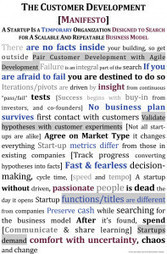
When Bob Dorf and I wrote the Startup Owners Manual we listed a series of Customer Development principles. I thought they might be worth enumerating here

Mickael Ruau's insight:
  1. There Are No Facts Inside Your Building, So Get Outside
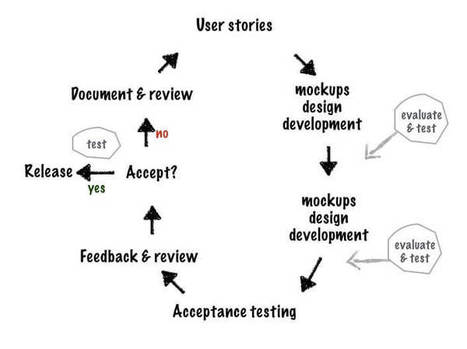
  2. Pair Customer Development with Agile Development
  3. Failure is an Integral Part of the Search for the Business Model
  4. If You’re Afraid to Fail You’re Destined to Do So
  5. Iterations and Pivots are Driven by Insight
  6. Validate Your Hypotheses with Experiments
  7. Success Begins with Buy-In from Investors and Co-Founders
  8. No Business Plan Survives First Contact with Customers
  9. Not All Startups Are Alike
  10. Startup Metrics are Different from Existing Companies
  11. Agree on Market Type – It Changes Everything
  12. Fast, Fearless Decision-Making, Cycle Time, Speed and Tempo
  13. If it’s not About Passion, You’re Dead the Day You Opened your Doors
  14. Startup Titles and Functions Are Very Different from a Company’s
  15. Preserve Cash While Searching. After It’s Found, Spend
  16. Communicate and Share Learning
  17. Startups Demand Comfort with Chaos and Uncertainty
No comment yet.
Scooped by Mickael Ruau
June 24, 2019 3:51 AM
Scoop.it!

Example project – Customer Development: Co-founders wanted (part 5) | Ywan van Loon

Example project – Customer Development: Co-founders wanted (part 5) | Ywan van Loon | Devops for Growth | Scoop.it

This article is part of a series of articles, as an example how to use Customer Development in practice. If you didn’t read the introduction, please read it first.

Now we start with to State your business model Hypotheses as the first part of Customer Discovery. We use the checklists to fill. The checklists are all based on Customer Development from Steve Blank. In this part we describe checklists number 9, 10, 11 and 12. In part 3 checklists number 3, 4 and 5 are described and in part 4 the checklists number 4 6, 7 and 8

No comment yet.
Scooped by Mickael Ruau
June 15, 2019 7:58 AM
Scoop.it!

How To Build a Web Startup – Lean LaunchPad Edition

How To Build a Web Startup – Lean LaunchPad Edition | Devops for Growth | Scoop.it

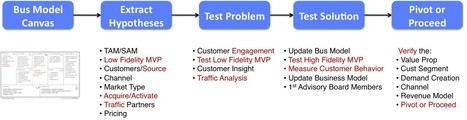
Here’s the step-by-step process we suggest our students use in our Lean LaunchPad classes.

  1. Set up the logistics to manage your team
  2. Craft company hypotheses
  3. Write a value proposition statement that other people understand
  4. Set up the Website Logistics
  5. Build a “low-fidelity” web site
  6. Get customers to the site
  7. Add the backend code to make the site work
  8. Test the “problem” with customer data
  9. Test the “solution” by building the “high-fidelity” website
  10. Ask for money

(Use the Startup Tools Page as the resource for tool choices)

No comment yet.
Scooped by Mickael Ruau
June 8, 2019 5:17 AM
Scoop.it!

The Lean Startup Circle Wiki / Customer Interview Templates and Resources

The Lean Startup Circle Wiki / Customer Interview Templates and Resources | Devops for Growth | Scoop.it
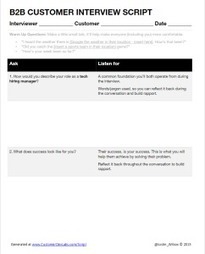
Interview Questions

1) Ask about the situation wherein they might discover the problem you're attempting to solve. 

E.g. If you're trying to solve the problem of foot pain, I'd ask "Do  you like hiking?" instead of saying "Do you have foot pain?"

2) Can you describe the problem to me in your own words? 

NOTE: If you were sly when asking the first question, they already did  this without you having to ask them. Directly asking this also only works, if you didn't already force the issue by asking them if they have the problem. Otherwise they'll just parrot what you asked them. This will also give you the keywords to put on your homepage and in your ads. 

3) How are you solving the problem currently? What are your workarounds? 

E.g.: "I stuff cotton in my shoes to eliminate my heel pain." 

This tells you your real competitors. Not just corporate ones, but workarounds.

Source


For Existing Customers
  • What can we do to improve our offering?
  • What surprised you as you started to work with us? [can be positive or negative]
  • Knowing what you know now, what would you have done differently in evaluating or adopting our offering?
  • What alternatives did you consider before choosing our offering?
  • We are really committed to improving, where should we target our efforts? 
  • Are there things we should improve for other customers, problems that you avoided but others may experience?
  • If you have been previously rejected by a potential customer (by phone or in person), what signals should you heed before trying again?  How do overcome that established fear of rejection? Should you wait for them to approach you?


Mickael Ruau's insight:
Customer Development Tips and Templates


  • Tips for B2B Customer Development Interviews by Sean Murphy

http://www.skmurphy.com/blog/2011/10/19/tips-for-b2b-customer-development-interviews/


  • 3 Great Steps to Customer Development (Google Spreadsheet) by Ray Wu

http://blog.raywu.co/post/42414946417/3-steps-to-great-customer-development 


  • The Achilles Heel of Customer Development by Ash Maurya 

https://blog.leanstack.com/the-achilles-heel-of-customer-development-57d50203c717


  • Tips for Customer Development Interviews: Templates and Pressure Points (LSC Forum) by Jaime Pabon

https://groups.google.com/forum/?fromgroups#!topic/lean-startup-circle/gOUqI_uqidk  

Customer Development Interview Template by Jaime Pabon 
http://bit.ly/cusdev_interview_template 


  • Completely Useless Online Surveys by Trevor Owens

http://leanstartupmachine.com/2011/07/the-flaws-of-online-surveys/


  • How To Actually Do Customer Development (and not waste your time) by Rob Fitzpatrick

http://leanca.mp/2012/09/how-to-actually-do-customer-development-and-not-waste-your-time-by-robfitz/ 


  • Bad Customer Development Questions and How to Avoid My Mistakes by Kevin Dewalt 

http://kevindewalt.com/2013/01/21/bad-customer-development-questions-and-how-to-avoid-my-mistakes/


  • How to Do (And What To Expect From ) Early-Stage Customer Development & Sales (20 Minute Video) by Rob Fitzpatrick

http://vimeo.com/40192415


  • 12 Random Customer Development Tips by Tristan Kromer

http://grasshopperherder.com/1-customer-development-tips/ 


  • P241 of Startup Owner's Manual


  How to find people to interview


Analyzing Interview Results


No comment yet.
Scooped by Mickael Ruau
May 18, 2019 5:28 AM
Scoop.it!

How The Lean Startup Team Practices Customer Development

How The Lean Startup Team Practices Customer Development | Devops for Growth | Scoop.it
Customer development is one of the cornerstones of Lean Startup. It teaches that instead of assuming your beliefs about your business to be true, you should apply an engineering, or scientific method, in orde
No comment yet.
Scooped by Mickael Ruau
May 4, 2019 4:41 AM
Scoop.it!

Lessons Learned: Using AdWords to assess demand for your new online service, step-by-step

Lessons Learned: Using AdWords to assess demand for your new online service, step-by-step | Devops for Growth | Scoop.it

Google Analytics ベンチマークIf you want to build an online service, and you don't test it with a fake AdWords campaign ahead of time, you're crazy. That's the conclusion I've come to after watching tons of online products fail for a complete lack of customers. So I thought I would walk you through exactly how to run a "fake landing page" test using cheap tools that require no technical skills whatsoever.
No comment yet.