Your new post is loading...

|
Scooped by
Mickael Ruau
January 14, 2022 4:48 AM
|
Que vous soyez sous Linux ou Windows, il est parfaitement possible de faire tourner macOS grâce à Docker. Comment ? Et bien grâce à ce projet de la boite de sécu Sick Codes qui vous fournit tout... Les images Docker pour Monterey, Big Sur, Catalina...etc ainsi que les lignes de commande qui vont bien pour…
|
|
Scooped by
Mickael Ruau
October 7, 2021 5:11 AM
|
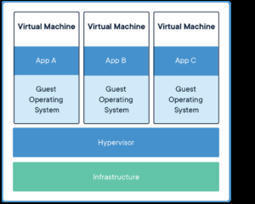
Bonjour, Depuis quelques années maintenant, nous avons vu arriver dans le milieu de l’informatique, le phénomène de “containerisation” ! C’est quoi au juste ! Et qu’est ce qui change par rapport à la virtualisation ? On va dire que c’est un peu, comparativement, des concepts d’architecture qui se différencient comme peuvent l’être le Paas et le Iaas. Toute la question est qu’est ce qui est inclut dans chaque couche ! Principes Une VM englobe un OS, ses librairies (DLL windows, rpm/pkg linux), avec son schéma d’architecture stockage et les applications installées et embarquées.
|
|
Scooped by
Mickael Ruau
September 21, 2021 10:34 AM
|
How to install PostgreSQL using Docker, along with some basic Docker management operations as well as some examples.
|
|
Scooped by
Mickael Ruau
October 12, 2020 4:18 AM
|
Serie of sketchnotes about Docker. Explaining in a visual way Docker principles. Tagged with docker, devops, beginners, cloud.
|
|
Scooped by
Mickael Ruau
July 23, 2020 12:50 PM
|
In the modern era, software is commonly delivered as a service: called web apps, or software-as-a-service. The twelve-factor app is a methodology for building software-as-a-service apps that:
Use declarative formats for setup automation, to minimize time and cost for new developers joining the project;
Have a clean contract with the underlying operating system, offering maximum portability between execution environments;
Are suitable for deployment on modern cloud platforms, obviating the need for servers and systems administration;
Minimize divergence between development and production, enabling continuous deployment for maximum agility;
And can scale up without significant changes to tooling, architecture, or development practices.
The twelve-factor methodology can be applied to apps written in any programming language, and which use any combination of backing services (database, queue, memory cache, etc).
|
|
Scooped by
Mickael Ruau
July 20, 2020 10:42 AM
|
Inutile de se demander s’il vaut mieux choisir Kubernetes ou Docker, car cette question n’a pas lieu d’être. Les deux programmes sont utilisés conjointement. Dans le cas de Kubernetes, la composition et l’exécution du conteneur sont également assurées par Docker (ou une autre plateforme de conteneurs comme rkt). Kubernetes accède à ces conteneurs et assure la gestion ou l’automatisation des processus. Kubernetes n’est pas en mesure d’assurer seul la création des conteneurs.
Kubernetes entre davantage en concurrence avec Docker Swarm, un outil de gestion proposé par le fabricant de Docker. À l’instar de Kubernetes, cet outil travaille également avec des clusters et offre des fonctionnalités similaires.
Conseil
Vous pourrez en apprendre davantage sur les différences et les possibilités d’association entre les deux systèmes dans notre comparatif de Docker et Kubernetes.
|
|
Scooped by
Mickael Ruau
June 11, 2020 4:33 AM
|
This Refcard will lay out the basics of the container security challenge, give you hands-on experience with basic security options, and also spell out some more advanced workflows. We split container security into three sections covering what to do at each step of your container security lifecycle.
|
|
Scooped by
Mickael Ruau
April 19, 2020 8:39 AM
|
Reproducable and identical development environment for all host operating systems with zero configuration requirements. Docker LAMP development stack with valid https support The Devilbox is a modern and highly customisable dockerized PHP stack supporting full LAMP and MEAN and running on all major platforms. The main goal is to easily switch and combine any version required for local development.
It supports an unlimited number of projects for which vhosts, SSL certificates and DNS records are created automatically. Email catch-all and popular development tools will be at your service as well. Configuration is not necessary, as everything is already pre-setup.
|
|
Scooped by
Mickael Ruau
January 24, 2020 4:21 AM
|
If you want your Docker images to be small and you still want fast builds, multi-stage images are the way to go. And yet, you might find that multi-stage builds are actually quite slow in practice, in particular when running in your build pipeline. If that’s happening, a bit of digging is likely to show that even though you copied your standard build script, somehow the first stage of the Dockerfile gets rebuilt every single time. Unless you’re very careful, Docker’s build cache often won’t work for multi-stage builds—and that means your build is slow. What’s going on? In this article you will learn: Why multi-stage builds don’t work with the standard build process you’re used to for single-stage images. How to solve the problem and get fast builds. Note: Outside the specific topic under discussion, the Dockerfiles in this article are not examples of best practices, since the added complexity would obscure the main point of the article. Want a best-practices Dockerfile and build system? Check out my Production-Ready Python Containers product.
|
|
Scooped by
Mickael Ruau
December 14, 2019 4:15 AM
|
Dans cet article, nous allons voir comment utiliser la technologie Docker pour faciliter nos développements de prototypes frugaux.
|
|
Scooped by
Mickael Ruau
November 20, 2019 5:40 AM
|
There are many good things about Docker. It packs, ships, and runs applications as a lightweight, portable, and self-sufficient containerization tool. Docker is great for businesses of all sizes.
|
|
Scooped by
Mickael Ruau
November 4, 2019 8:15 AM
|
Cet article se veut compréhensible par les profanes. Ce qu’est un programme informatique En première approche, nous pouvons définir un programme (...)
|
|
Scooped by
Mickael Ruau
October 1, 2019 9:28 AM
|
With the popularization of containerized applications and microservices, server automation now plays an essential role in systems administration. It is also a way to establish standard procedures for new servers and reduce human error. This guide explains how to use Ansible to automate the steps contained in our guide on How To Install and Use Docker on Ubuntu 18.04. Docker is an application that simplifies the process of managing containers, resource-isolated processes that behave in a similar way to virtual machines, but are more portable, more resource-friendly, and depend more heavily on the host operating system. While you can complete this setup manually, using a configuration management tool like Ansible to automate the process will save you time and establish standard procedures that can be repeated through tens to hundreds of nodes. Ansible offers a simple architecture that doesn’t require special software to be installed on nodes, and it provides a robust set of features and built-in modules which facilitate writing automation scripts.
|
|
|
Scooped by
Mickael Ruau
October 14, 2021 7:22 AM
|
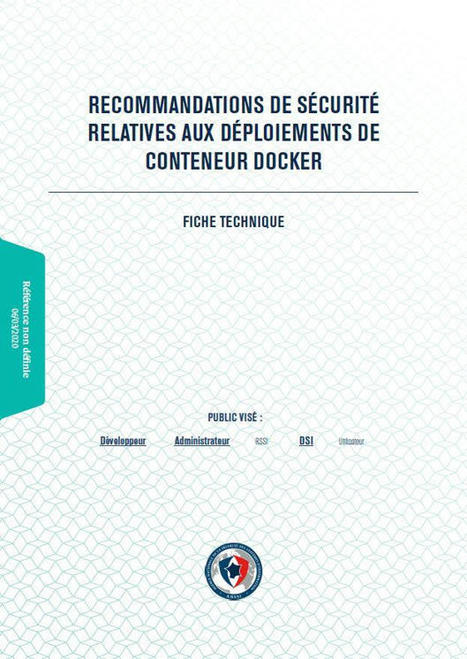
Ce document a pour objectif de présenter les bonnes pratiques de sécurité relatives au déploiement et à l’exécution de conteneur Docker. De ce fait, le Docker daemon et la gestion des images Docker sont hors périmètre de l’étude.
|
|
Scooped by
Mickael Ruau
September 21, 2021 10:35 AM
|
Following a series of blogs about matching Docker and open source databases, in this article, we look at installing MongoDB with Docker.
|
|
Scooped by
Mickael Ruau
July 14, 2021 1:54 AM
|
Software architecture diagrams can be a very useful communication tool, but many teams have scaled back on the creation of diagrams, and when diagrams are created, they are often confusing and unclear. The C4 model consists of a hierarchical set of software architecture diagrams for context, containers, components, and code.
|
|
Scooped by
Mickael Ruau
August 7, 2020 5:46 AM
|
Personnellement je travaille à de la refonte d’applications Java au quotidien et un point sur lequel Go se démarque particulièrement c’est sa consommation mémoire et son packaging vers des images docker. Les binaires Go sont petits et autoporteurs (pas besoin de bibliothèque tierce pour leur exécution), les API REST créées en Go sont parfaites pour le cloud et les besoins de scalabilité. Go est aussi très performant et se prête très bien au développement de services frontaux devant accueillir un trafic utilisateur conséquent.
"Les API REST créées en Go sont parfaites
pour le cloud
et les besoins de scalabilité"
|
|
Scooped by
Mickael Ruau
July 20, 2020 11:12 AM
|
Dans ce cross-over entre Quoi d'Neuf Docker et Zenika TV, nous allons vous parler des “patterns de déploiement” Nous aborderons donc les différentes approches permettant de déployer vos applications en production, depuis les plus traditionnelles jusqu’aux plus modernes pratiquées par les géants du Web… le tout dans un format “court et ludique” � Des techniques…
|
|
Scooped by
Mickael Ruau
June 22, 2020 4:23 AM
|
Ce cours complet pour débutants sur la technologie Docker vous expliquera pas à pas les différentes notions de Docker.
|
|
Scooped by
Mickael Ruau
June 11, 2020 4:32 AM
|
Docker has rapidly evolved into a production-ready infrastructure platform, promising flexible and scalable delivery of software to end users. This Refcard looks into the challenges that containers (or black boxes) present in DevOps, explores architectural models for monitoring containers, and investigates pros and cons of Docker monitoring and troubleshooting options. It also covers a complex, real-world example with Sysdig Cloud to understand what to monitor and how.
|
|
Scooped by
Mickael Ruau
April 19, 2020 8:23 AM
|
Get an introduction to Lando; why it exists, what it's good for and how it differs from Docker Compose and other local development and DevOps tools.
|
|
Scooped by
Mickael Ruau
January 20, 2020 4:18 AM
|
Multi-stage Dockerfile builds can help shift information left and standardize commands in an elegant way.
|
|
Scooped by
Mickael Ruau
December 9, 2019 1:15 PM
|
Cette fois, nous allons apprendre à dockeriser un script, et en monitorer le fonctionnement, grâce à un squelette d'image Docker.
|
|
Scooped by
Mickael Ruau
November 18, 2019 5:28 AM
|
At QCon SF, Yevgeniy Brikman presented "Automated Testing for Terraform, Docker, Packer, Kubernetes, and More". Key takeaways from the talk included the recommendation to use an appropriate mix of all testing techniques discussed, such as static analysis, unit tests, integration tests, and end-to-end tests.
|
|
Scooped by
Mickael Ruau
October 3, 2019 9:31 AM
|
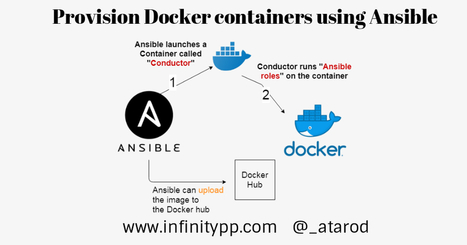
Find out to provision Docker containers using Ansible. Ansible Container is a Python library that lets you provision Docker containers and upload it to Docker Hub
|