Steve Omohundro interviewed at the Royal Botanical Gardens in Melbourne Australia. He speaks about artificial intelligence and compassionate technology - app...
|
|
Decision Intelligence News
Decision Intelligence (DI) is the discipline concerned with how organizations and individuals design, support, and improve decision making at scale. It connects actions to outcomes in context by integrating human judgment, data, models, text, and AI into coherent decision systems. Decision Intelligence News curates developments across DI and related fields, including AI, machine learning, governance, enterprise architecture, orchestration, measurement, and decision modeling. Learn more at www.opendi.org and www.learn-di.com. Curated by Decision Intelligence |
Your new post is loading...
|
|
Scooped by
Decision Intelligence
February 20, 2014 8:54 PM
|
Steve Omohundro interviewed at the Royal Botanical Gardens in Melbourne Australia. He speaks about artificial intelligence and compassionate technology - app...
|
|
Scooped by
Decision Intelligence
February 19, 2014 2:41 AM
|
This is a beautiful video showing the unintuitive *positive* consequences that we can understand through a cause-and-effect whole-systems model of an ecosystem. The substantial cascading ripple effects of the re-introduction of wolves to Yellowstone is quite unexpected and wonderful.
I wonder if there were feedback effects here, too, where the improvements to the river and other wildlife, in turn, helped the wolves.
|
|
Scooped by
Decision Intelligence
February 18, 2014 12:09 AM
|
One of the most important benefits of big data analysis is when it corrects long-held beliefs: heuristics that we believe to be true, but the data says "not so much".
When we apply analytics to HR, this is often the case, as described in this article. For instance, are workers who change jobs a lot likely to also leave quickly? Many believe "yes", but the data doesn't support this pattern.
Another common myth: an outgoing personality is a good indicator of a good sales person. Turns out that the most important characteristic for sales success is "a kind of emotional courage, a persistence to keep going even after initially being told no."
In Big Data HR, we see these and other conclusions about "soft" factors leading to hard-dollar opportunities for substantial cost savings and revenue growth.
|
|
Scooped by
Decision Intelligence
February 16, 2014 8:04 PM
|
Thinking, Fast and Slow was a global bestseller, and had a profound impact on psychology and economics, as these tributes from other leading figures show
What a lovely tribute to Daniel Kahneman from some of the great thinkers of our time: Steve Pinker, Richard Thaler, Nassim Taleb, and more.
Kahneman's work is also deeply important to Decision Intelligence, because we'll never automate / systematize the thousands of decisions we make every day, so they're subject to cognitive bias. Understanding those biases, deeply, is therefore important.
In addition, arguably the "slow" part of thinking (System 2) is what decision intelligence is trying to do more rigorously for many use cases, because these use cases are being handled today suboptimally, by the "fast" part (System 1).
Kahneman is the master of this space. I highly recommend Thinking, Fast, and Slow: http://amzn.to/1bbdQs7 .
|
|
Scooped by
Decision Intelligence
February 16, 2014 12:15 AM
|
It seems that complex projects often go off the rails. I've seen multi-hundred-million dollar construction, data center, telecom transformation projects become years late, and hugely over budget. This article digs into why, based on interviews with a few veterans. Worth a read, if only to understand what complexity feels like from the trenches, and how Decision Intelligence might help.
|
|
Scooped by
Decision Intelligence
February 15, 2014 4:18 PM
|
The One Thing You Can Do To Help You Make Better, More Rational Decisions
Mindfulness meditation -- which is awareness of the present moment -- can help you to make a rational decision in the face of this sunk-cost bias.
Great decision making comes from two sources: (1) better tools/methods, and (2) better thinking through the thousands of decisions we make every day without benefit of computer / process support. No matter how good we get at (1), we should not lose track of the importance of (2). Recent research shows that we're very subject to cognitive bias, which is in part what's driving a lot of focus on "evidence-based" and other tool/data-based approaches. But (2) will always exist, so we should also seek to reduce cognitive bias here. This article says how.
|
|
Scooped by
Decision Intelligence
February 15, 2014 3:33 PM
|
Systems models may offer realistic solutions for development, a workshop hears. But what about the building blocks?
More "Systevism". I intend to buy this book, right now.
"The last thing I expected to hear at this week’s workshop in London, United Kingdom, on complexity science was that this is an approach that can lead to realistic solutions to development challenges from the bottom up. But it is one of the messages that came through from freelance science writer Philip Ball, as well as Ben Ramalingam, author of the widely acclaimed book Aid on the Edge of Chaos, which draws on complexity research to argue for its role in rethinking development aid."
|
|
Scooped by
Decision Intelligence
February 14, 2014 1:01 PM
|
Business management magazine, blogs, case studies, articles, books, and webinars from Harvard Business Review, addressing today's topics and challenges in business management.
Once we cross from data to the mind that uses it, things get interesting. From the article:
"I think chaos is a perception. People say that there’s too much information, and I would say that there’s no more information now than there was before. The difference is that people believe they have to know it—that the more information they have, the better the product is going to be and the more money the company is going to make. I don’t think it depends as much on the amount of information someone has as on the way it’s taken in. And that needs to be mindfully."
|
|
Scooped by
Decision Intelligence
February 14, 2014 3:46 AM
|
We face unprecedented levels of complexity, with increasing likelihood of unintended consequences, winner-take-all dynamics, and virtuous and vicious cycles. At the same time there's a big push to be more "fact-based", more objective, to use more data. However, data has a completely new role in navigating complex situations. This webinar is a tour guide to this new reality.
Probably the most important webinar I've done to date.
|
|
Rescooped by
Decision Intelligence
from Peter Milsom's Interesting Media Articles
February 13, 2014 3:11 AM
|
"The economy has been stronger than we thought. That's a good thing, obviously." Bank of England governor Mark Carney's defensive tone as he fielded pointed questions at a press conference today cast some doubt on whether the dilemma he faces could be called "good." As Carney reassured markets that an interest rate rise is not...
|
|
Scooped by
Decision Intelligence
February 13, 2014 2:56 AM
|
A guest post by Ryan Rivera who suffered from panic attacks for seven years. Although it is a premise that is quite obvious, stress has been proven to have far-reaching impact in the decision making process.
"Studies show that cognitive stress, such as distractions, affects rational decision making. People experiencing stress are likely to choose the positive side of choices given to them."
Read more: http://www.weighteddecision.com/how-does-stress-affect-the-decision-making-process/#ixzz2tBdNqata
|
|
Scooped by
Decision Intelligence
February 11, 2014 11:37 PM
|
Historic moment.
|
|
Scooped by
Decision Intelligence
February 11, 2014 9:14 PM
|
Commentary from D-Wave Chief Scientist, Eric Ladizinsky
Amazing story, including some antifragiilty of quantum computing content: 08:15: "You're going to have these systems of interest coupled with these uncontrolled fluctuating environments... It'll work anyway, and in fact it might work a little bit better with a little noise...we now have a programmable piece of quantum matter...and that's a treasure, in terms of making progress."
|
|
Scooped by
Decision Intelligence
February 11, 2014 9:10 PM
|
Quantum computing uses strange subatomic behavior to exponentially speed up processing. It could be a revolution, or it could be wishful thinking
Watch out, D-Wave: things are going to get even more interesting starting on Monday!
|
|
Rescooped by
Decision Intelligence
from BIG data, Data Mining, Predictive Modeling, Visualization
February 11, 2014 4:19 PM
|
Data Science for Business: What you need to know about data mining and data-analytic thinking eBook: Foster Provost, Tom Fawcett: Amazon.es: Tienda Kindle (#Amazon #Spain Data Science for Business: What you need to know about data mining and...
I haven't read this yet, but it's by the smartest guys in the business. Worth a look!
|
|
Scooped by
Decision Intelligence
February 11, 2014 3:54 PM
|
Thursday, February 13, 2014
11AM EST, 8AM PST, 4PM GMT, 5PM CET
Decisions cannot live by data alone.
In fact, the deluge of data is creating an increasing amount of difficulty in making good business decisions. Complexity abounds. Surviving the buzzword storm is hard enough; couple that with industry pressure to have a "big data initiative," or an "analytics initiative" or the popular sub-text of "store everything, and we'll figure out how to use it later," and it's (forgive the trite quote, but it is so relevant) hard to see the forest for the trees.
In this thirty-minute webinar, Dr. Lorien Pratt will share six survival tips that will help you and your organization put data in its place. Using these tips will help you become more agile, more responsive, and more aware of what is really going on.
You won't want to miss this.
After registering, you will receive a confirmation email containing information about joining the webinar.
I hope you can join me and Margaret for our next webinar.
|
|
Scooped by
Decision Intelligence
February 9, 2014 4:04 PM
|
“In order to survive, all systems must evolve by providing greater and greater access to the currents that flow through them.”
If you watch only one TED talk this month, this should be it. Excerpts:
"Companies develop a forecast, a prediction, and make sure that all of the right resources are in the right place at the right time to meet that demand. That's a push institution....
How have companies done, since 1965 to today? It turns out that [since then], return on assets has basically collapsed, it's declined by 80%. I'm struck...by the image... of the red queen... running faster and faster just to stay in the same place. ..but [she] had it pretty good...we're running faster and faster and falling further behind.
...
So the question is, why have [companies] failed so badly? There are... two shifts...one factor has to do with the notion of moving from stocks to flows. In the…21st century we had a [good formula]...you create proprietary knowledge stocks, something that nobody else knows… then, as efficiently as possible, extra value from those knowledge stocks from the marketplace.
...
But [today] what you know at any one time diminishes in value at an accelerating rate. So if all you do is to hold on to your knowledge stocks, you're playing a losing game. The only way to succeed in that kind of environment is to find ways to participate more effectively in a diverse and larger range of knowledge flows. Most of our companies were not built around a knowledge flow model, they were built around a knowledge stock model.
|
|
Scooped by
Decision Intelligence
February 8, 2014 9:43 PM
|
Predictive Intelligence is the last piece of the puzzle to deal with a future that does not look like the past; look over the horizon to understand how decis...
This was a fantastic webinar; thanks to the attendees on four continents for your interest! Here's the recording for those who weren't able to join us.
|
|
Suggested by
Website Scraping
February 6, 2014 12:52 AM
|
ITSYS Solutions offers Monitor Competitor Prices, Track Competitor Prices, Competitor Price Monitoring, Competitor Price Tracking, Competitor Tracking, Track Competitors, Product Catalog Monitoring service.
Looks like a great source of external data for decision models.
|
|
Scooped by
Decision Intelligence
February 6, 2014 12:48 AM
|
IBM has launched a 10-year, $100 million project to use technology to improve the quality of life in Africa. The initiative has been named Project Lucy, in honor of the oldest human ancestor found ...
Factivism upticks.
|
|
Scooped by
Decision Intelligence
February 6, 2014 12:44 AM
|
Predictive Analytics World is the business-focused event for predictive analytics professionals, managers and commercial practitioners.
I might be there. Will you?
|
|
Scooped by
Decision Intelligence
February 6, 2014 12:40 AM
|
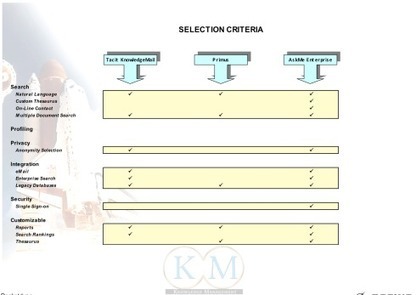
As I study the value of Quantellia's World Modeler decision modeling software, I realize it provides (among many things) a trade study capability I find analogous to the relationship between AutoCAD and its hand-drawn blueprints...
From the article: "With World Modeler, we would have been able to model so much more than just these paltry selection criteria. We could have included in our decision the aggregate likely impact of things we assumed would happen, thereby surfacing possible misconceptions that some had. We could have included connections to IT, HR, and Communications, thereby giving us a clearer picture of the likely impact on the enterprise of implementing the system."
|
|
Scooped by
Decision Intelligence
February 5, 2014 11:25 PM
|
Social decision making insights coming from brain neuroscience research
A nice summary of recent brain research and its relevance to decision making from the smart folks at Decision Innovation.
Collective organizational decisions are also social decisions …
|
|
Scooped by
Decision Intelligence
February 5, 2014 9:11 PM
|
O'Reilly Strata Conference delivers the nuts-and-bolts foundation for building a data-driven business—the latest on the skills, tools, and technologies you need to make data work. Strata is for developers, data scientists, data analysts, and other data professionals.
Looks like a great show, next week.
|
|
Scooped by
Decision Intelligence
February 4, 2014 5:37 PM
|
Compared to non-insurance players, the insurance industry has been slow to reap the real benefits of analytics investments
There's a ton of untapped value in looking forward with analytics instead of only backwards:
"Almost half of insurers (44%) are using analytics retrospectively to understand the past. Only 23% use data insights to predict what will happen, and thus enable themselves to react to customers in real time and to make better decisions"
(boldface mine)

Underneath Decision intelligence are a lot of cutting-edge technologies: big data, machine learning, deep learning, quantum computing, and more, which are also part of a re-emergence of AI. But what are the greater implications of this increasingly powerful technology? I lost track of Steve Omohundro a few years back and was delighted to make his re-acquaintance through this video, which covers "compassionate intelligence" (including the work of Marshall Rosenberg, who is one of the great ones imho), balancing multiple outcomes, avoiding unintended consequences, animal intelligence, and more. A real treat, and worth a watch.